Battle in the Mist: Dwarves vs Orcs in Middle-earth

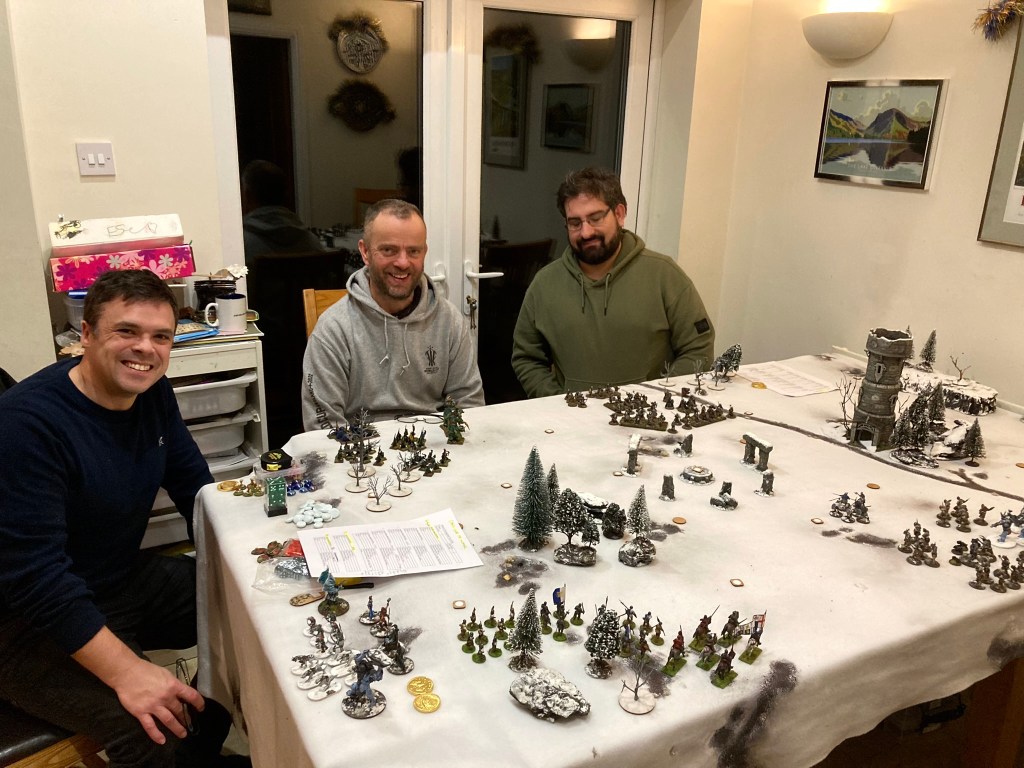
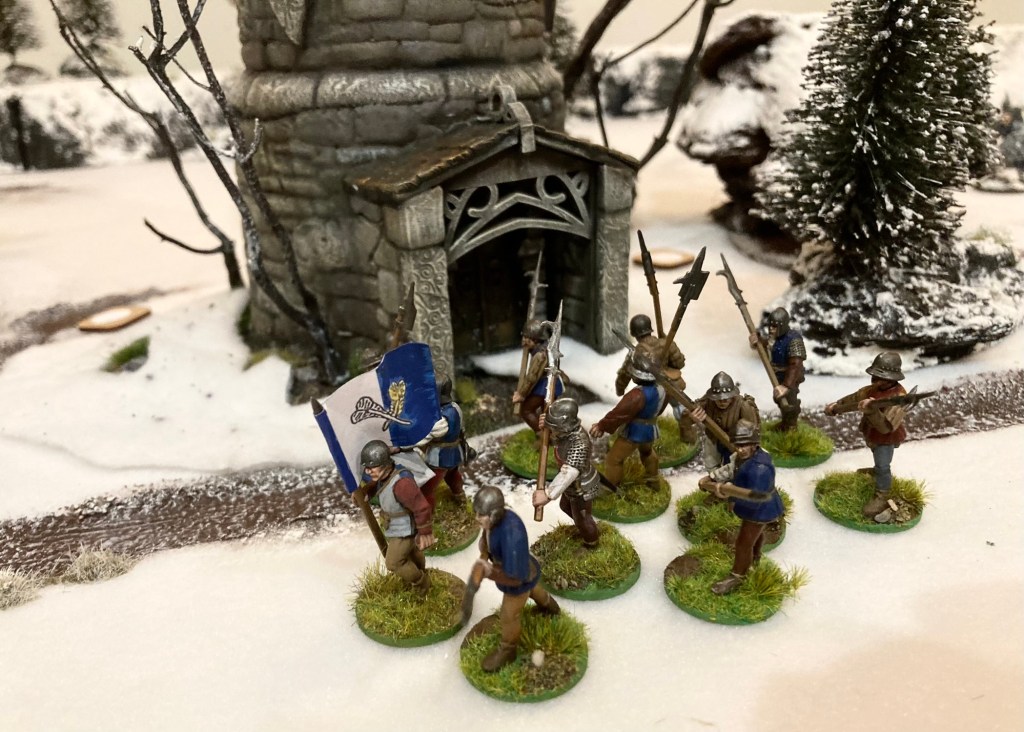
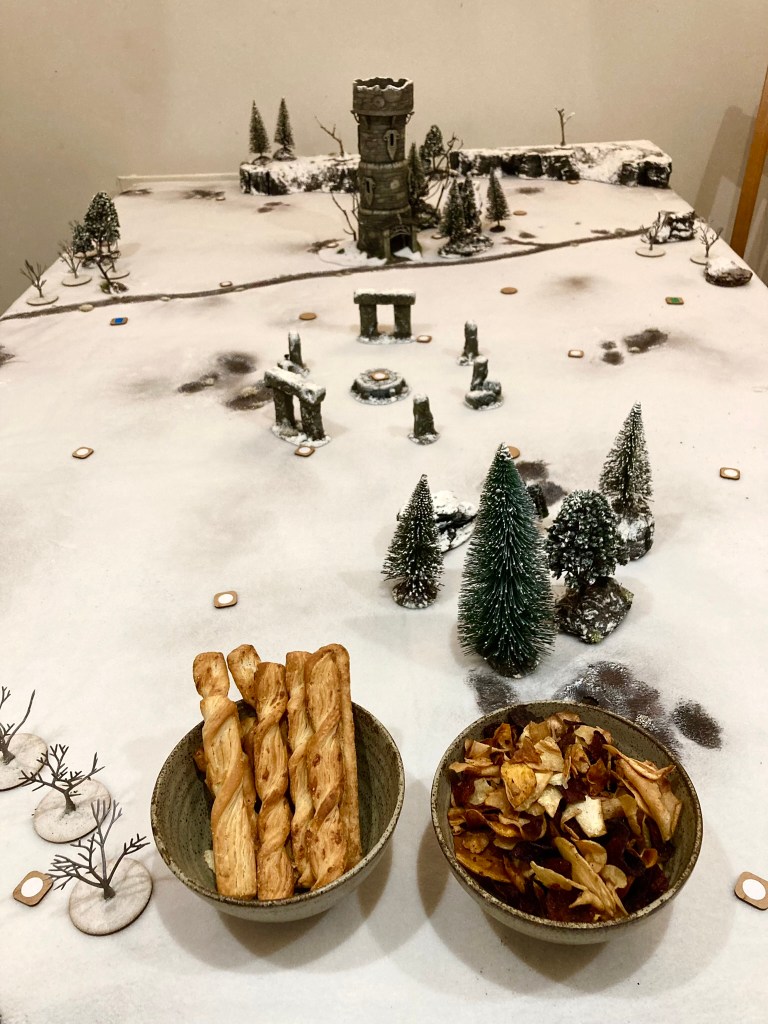
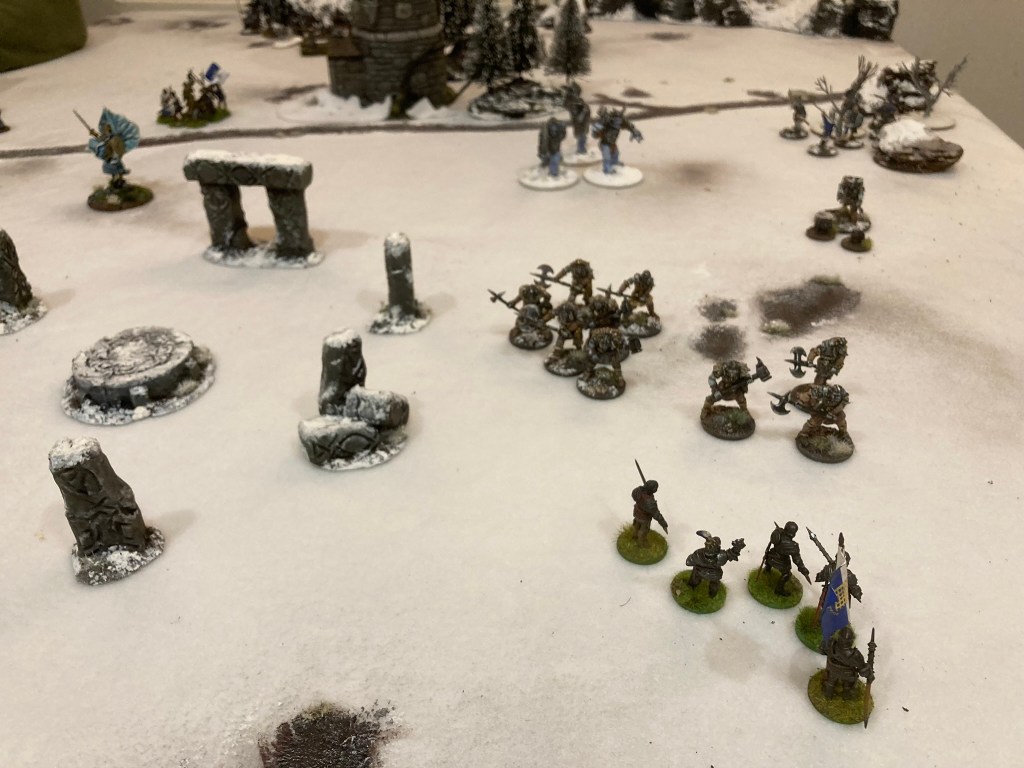
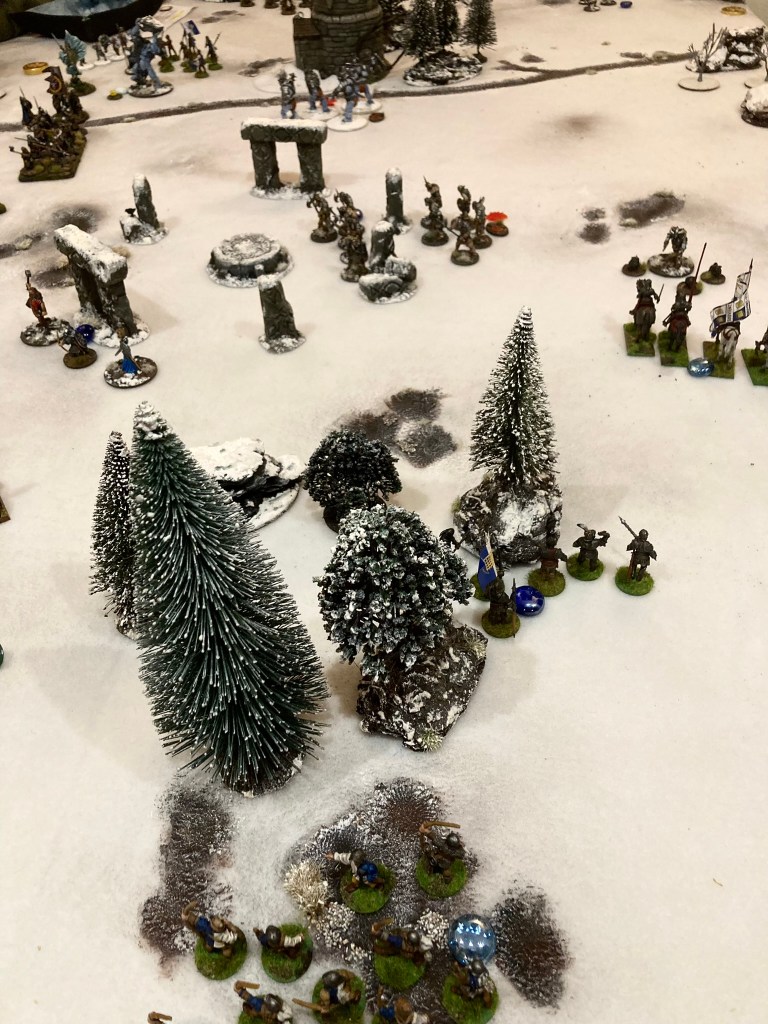
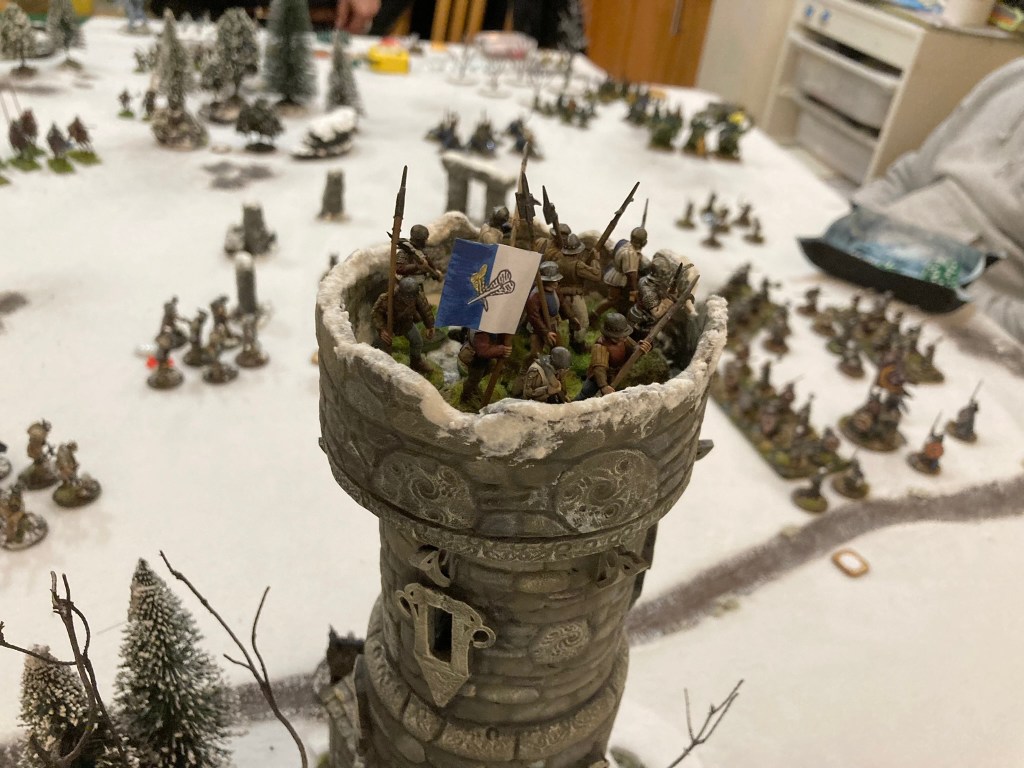
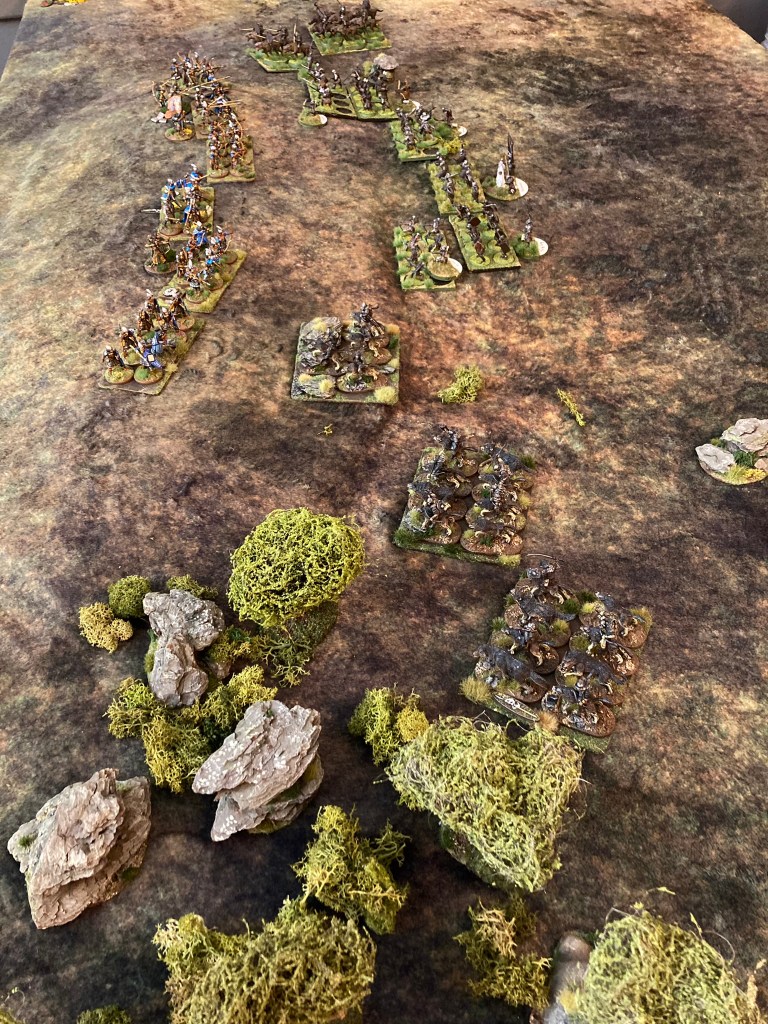
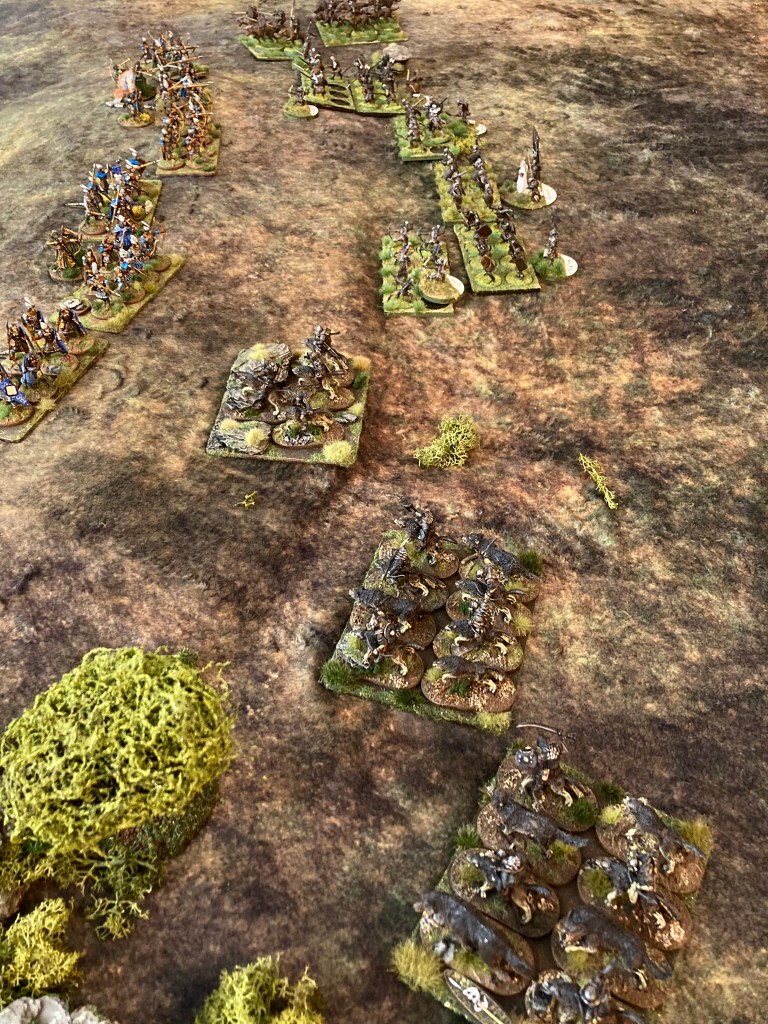
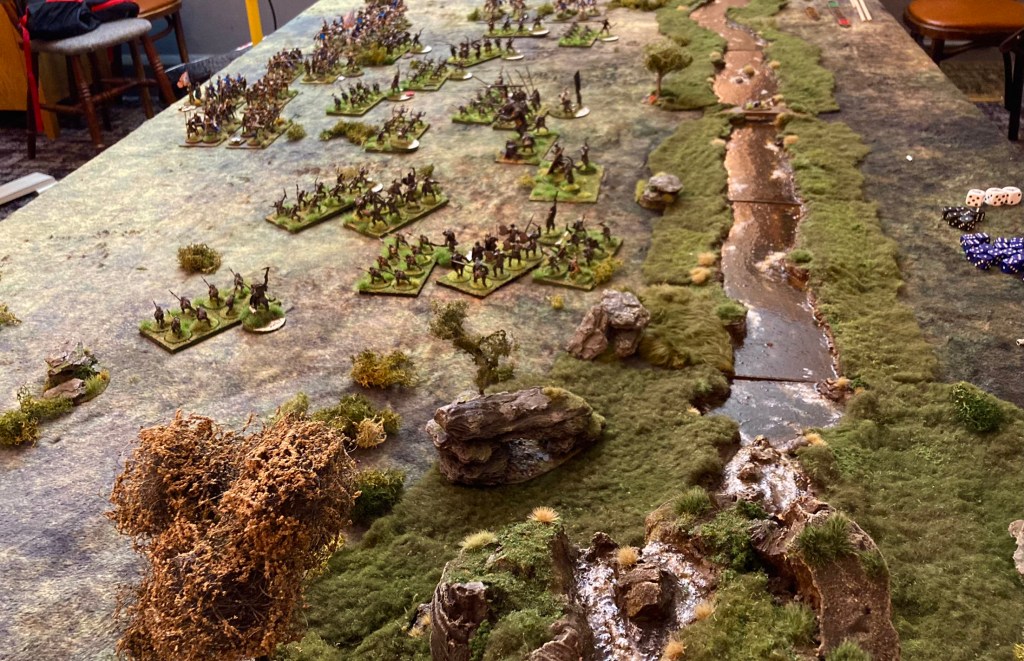
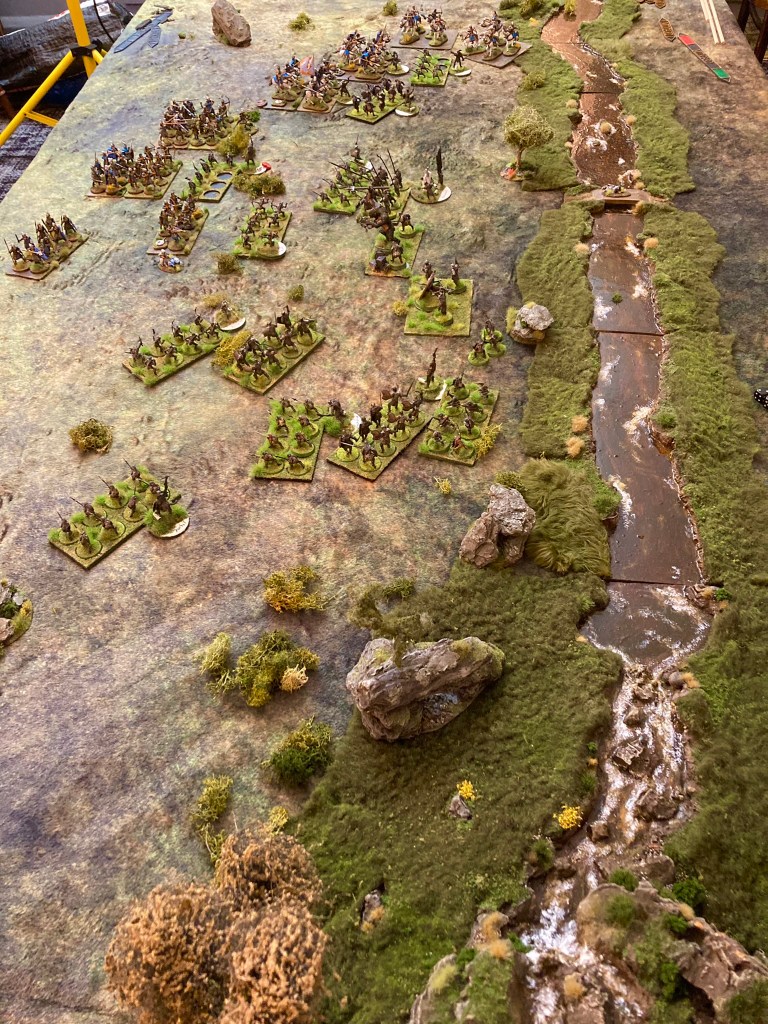
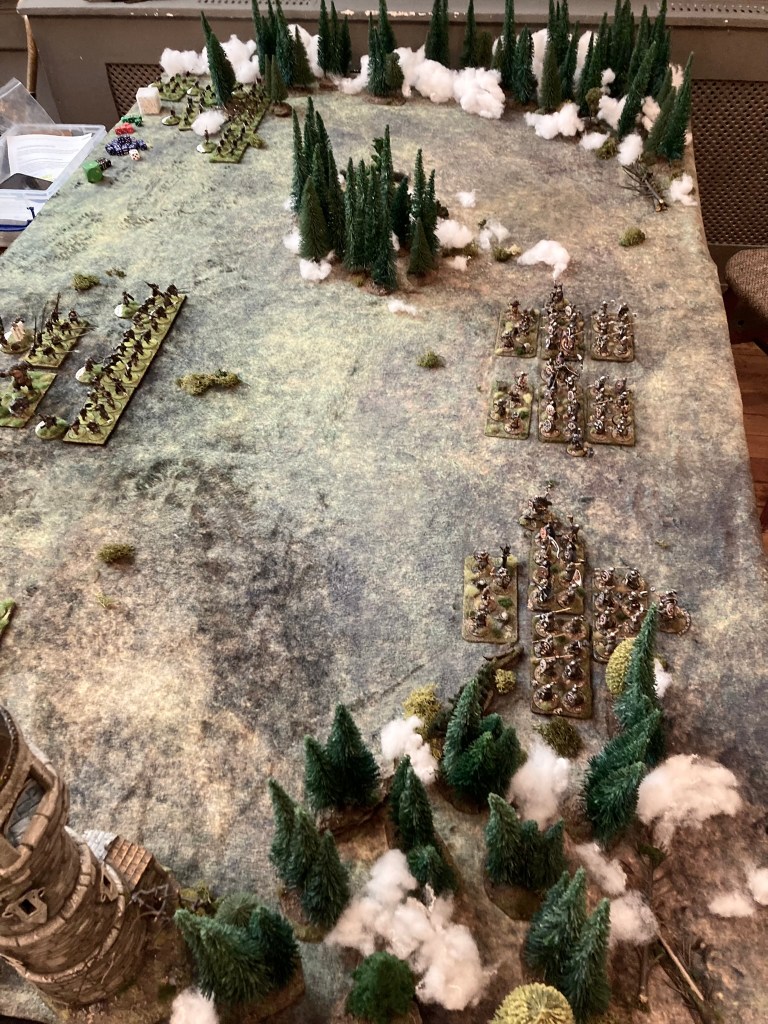
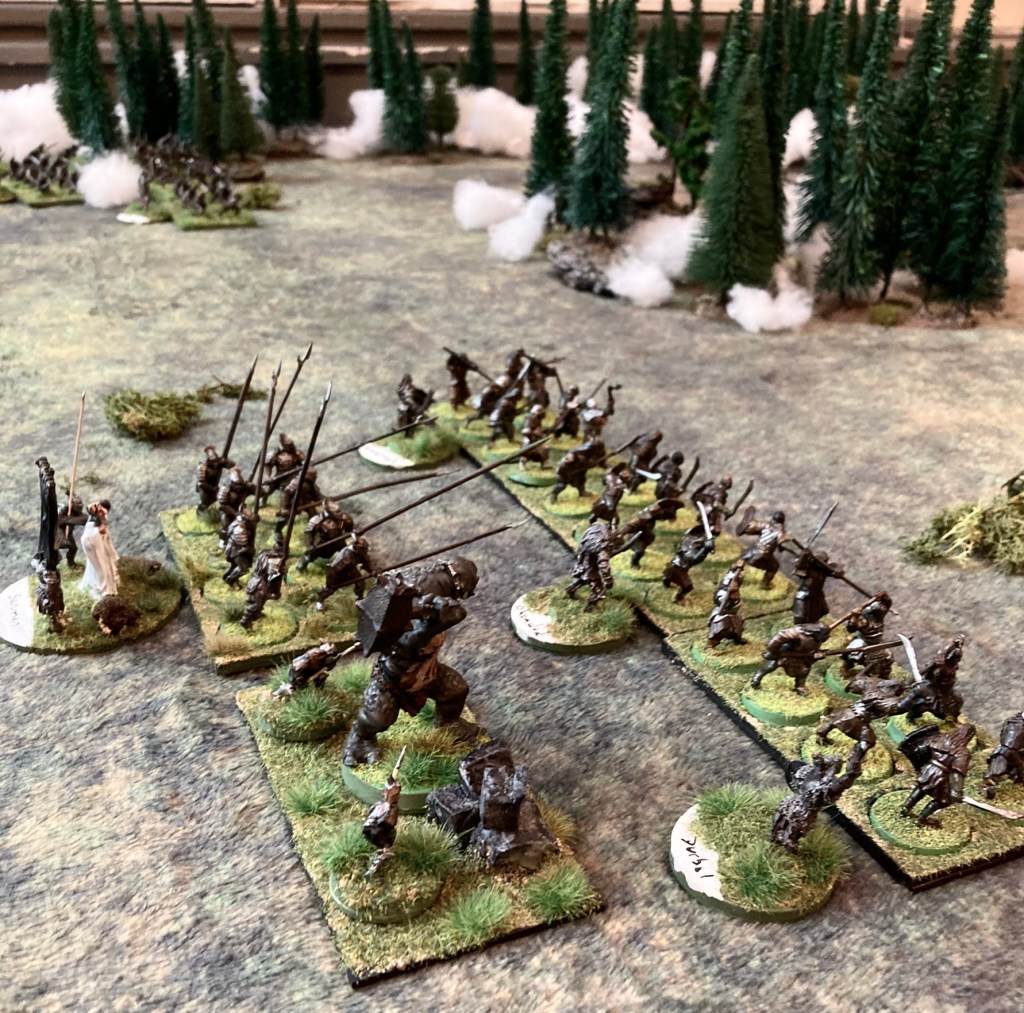
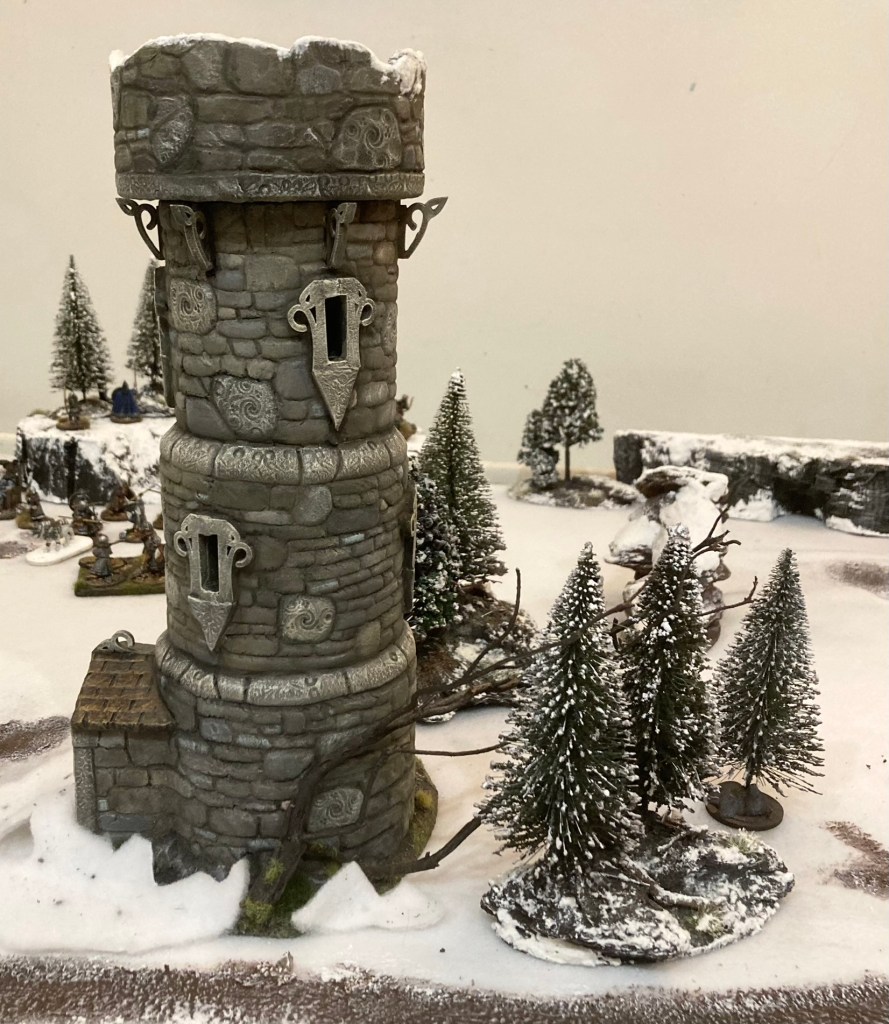
The battle gets underway: scratch built watch tower, Cigar Box mat, lots of conifers and even more fluff serving as mist.

I’ve not gamed Middle-earth for a few months, so it was nice to be able to get a game in with Pete at the club last night. Pete has been reorganising his substantial collection of GW minis into armies for my Midgard Heroic Battles rules (which are due for publication by Reisswitz Press in the future – no date yet but watch this space for updates).

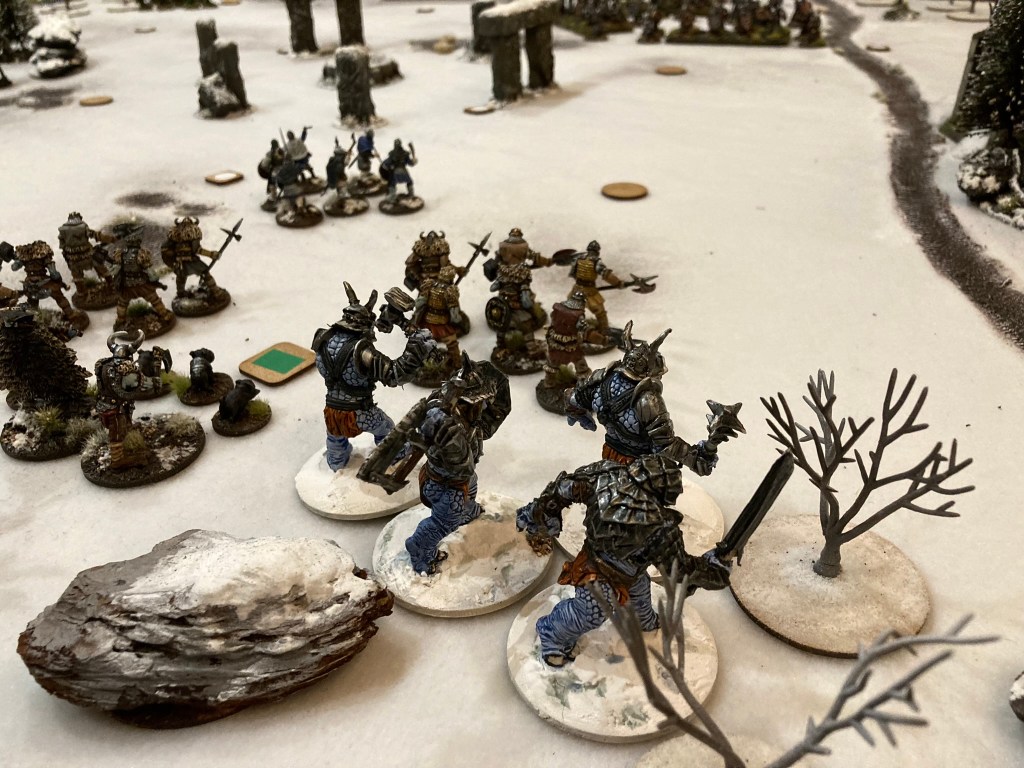
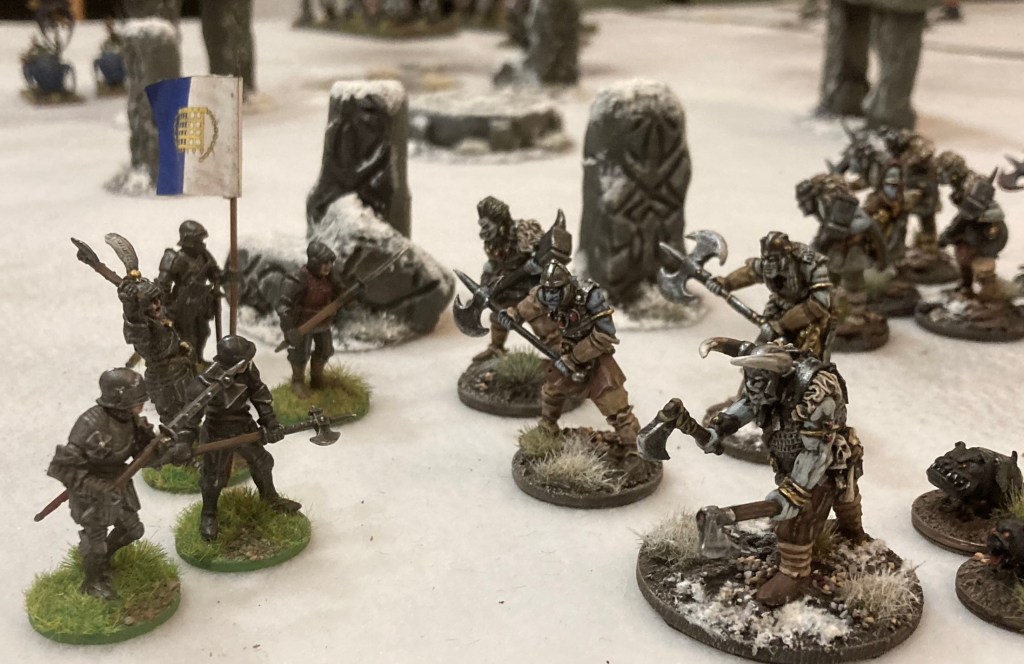
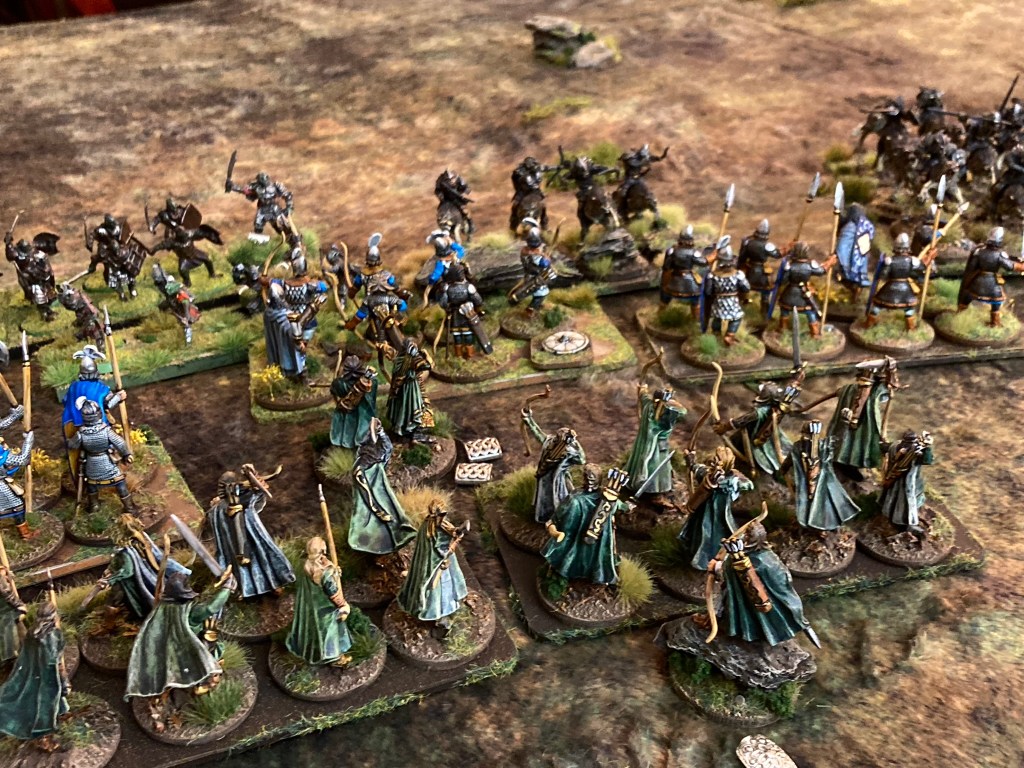
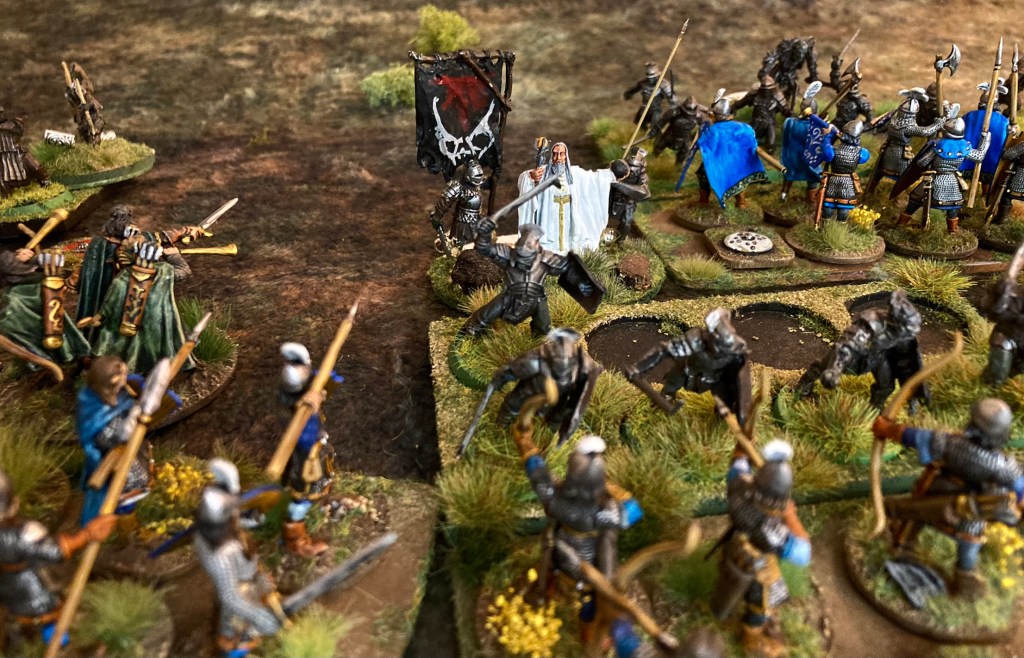
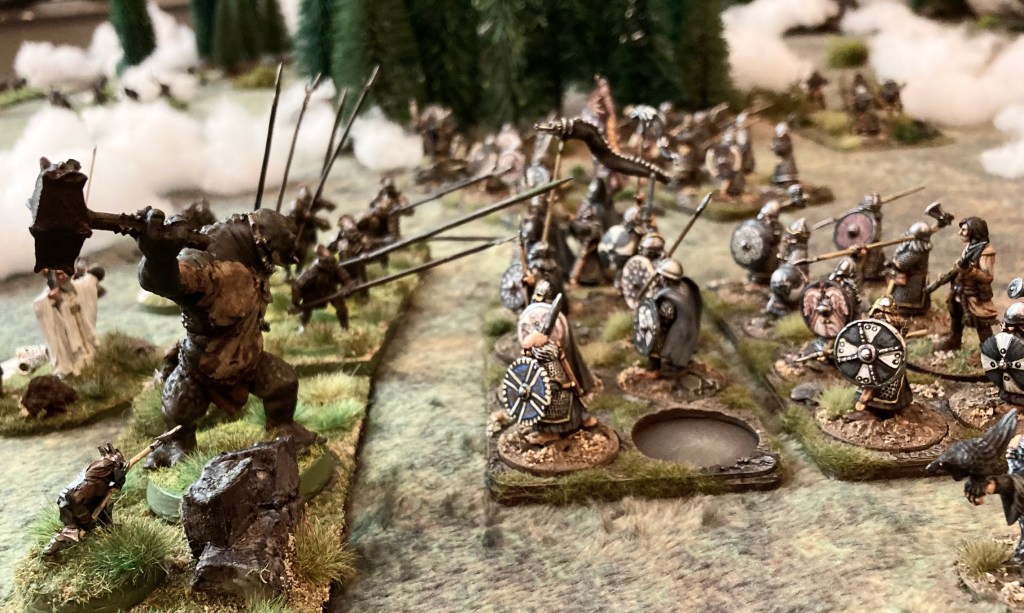
Orcs sight the Dwarves, weapons drawn!

On a whim, I decided to bring my much-loved Dwarf army. Their Orc opponents were kitted out as an army of Isengard from the Third Age, so our clash would not be strictly canonical, but quite suitable for a game of toy soldiers with a nod to Tolkien.

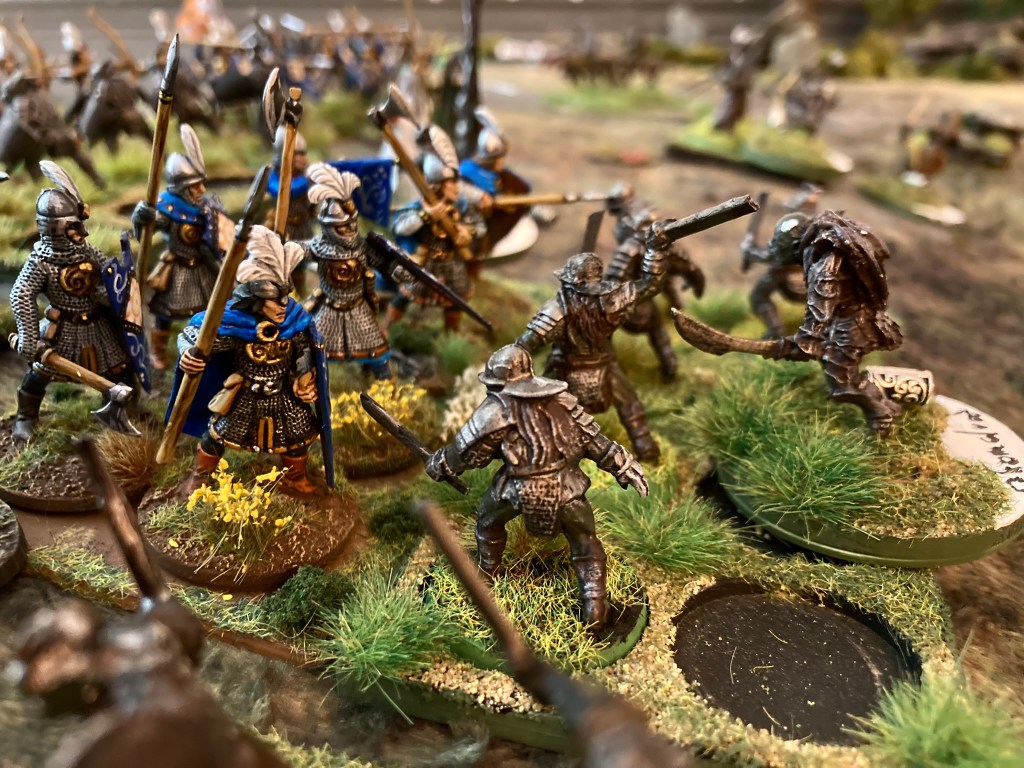
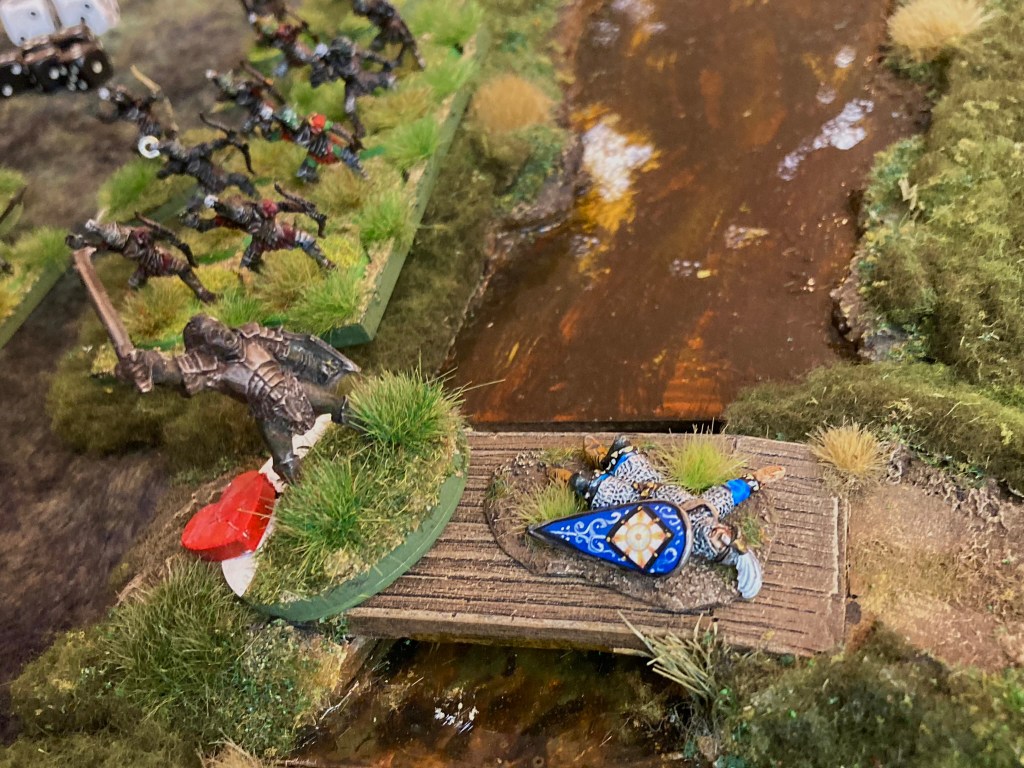
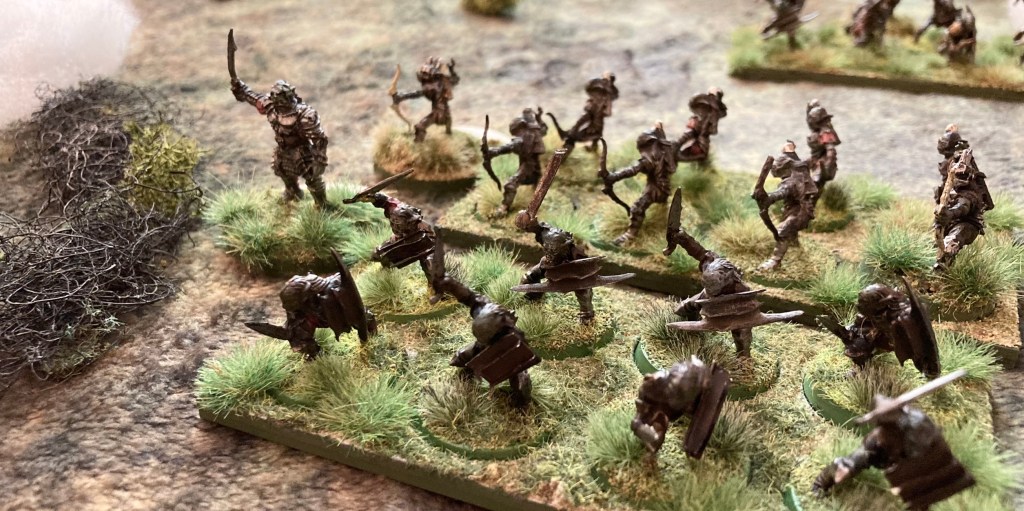
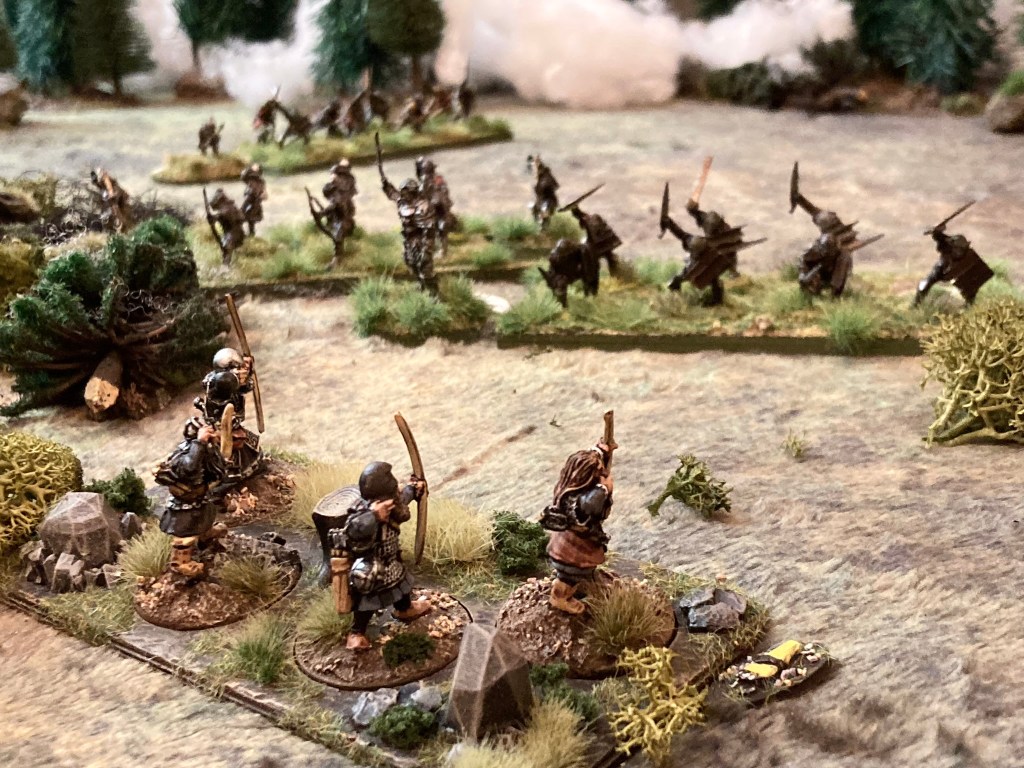
A lone Orc captain gets taken down in the mist: GW Moria Goblin against Vendel and Conqueror Models Dwarves

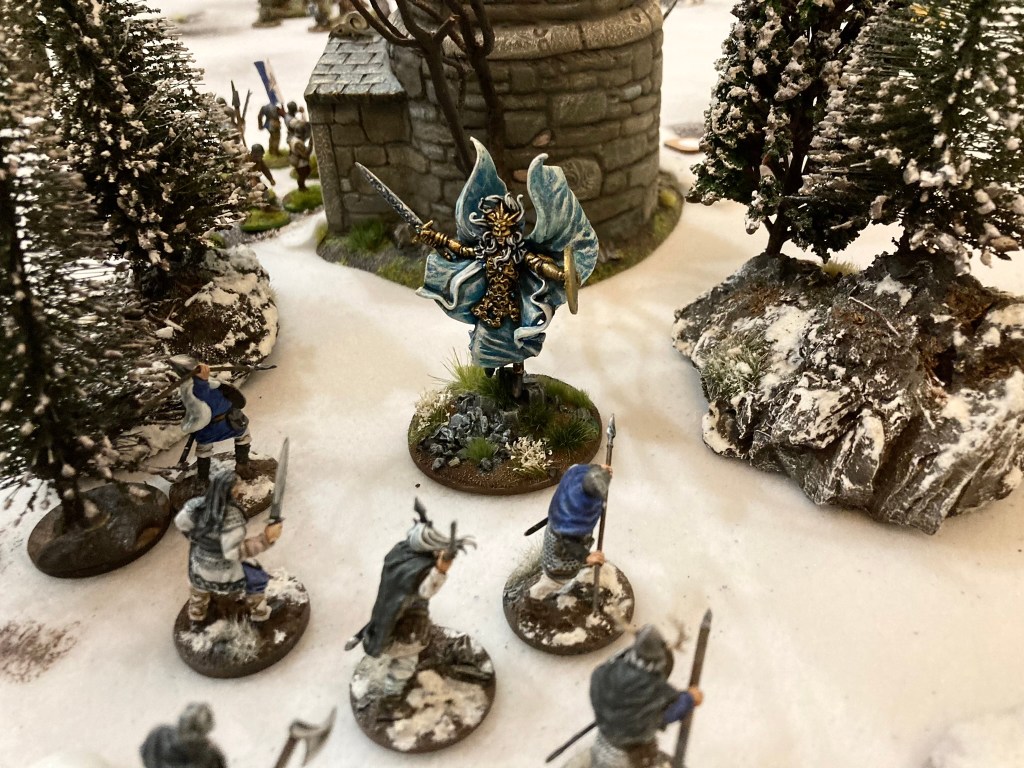
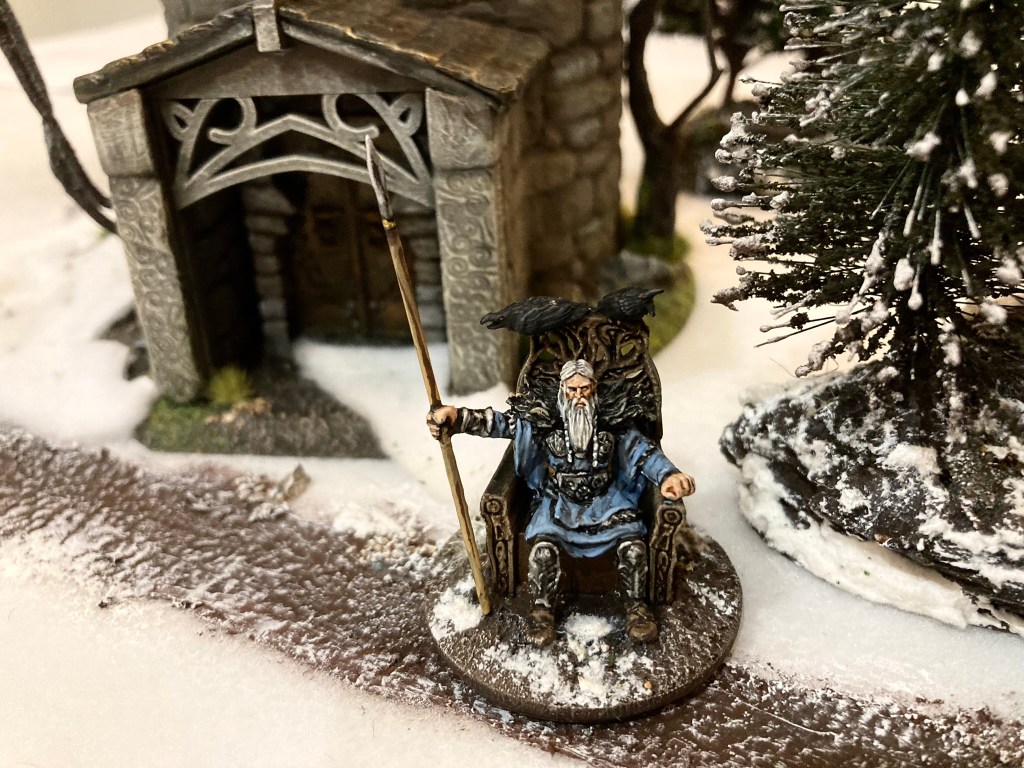
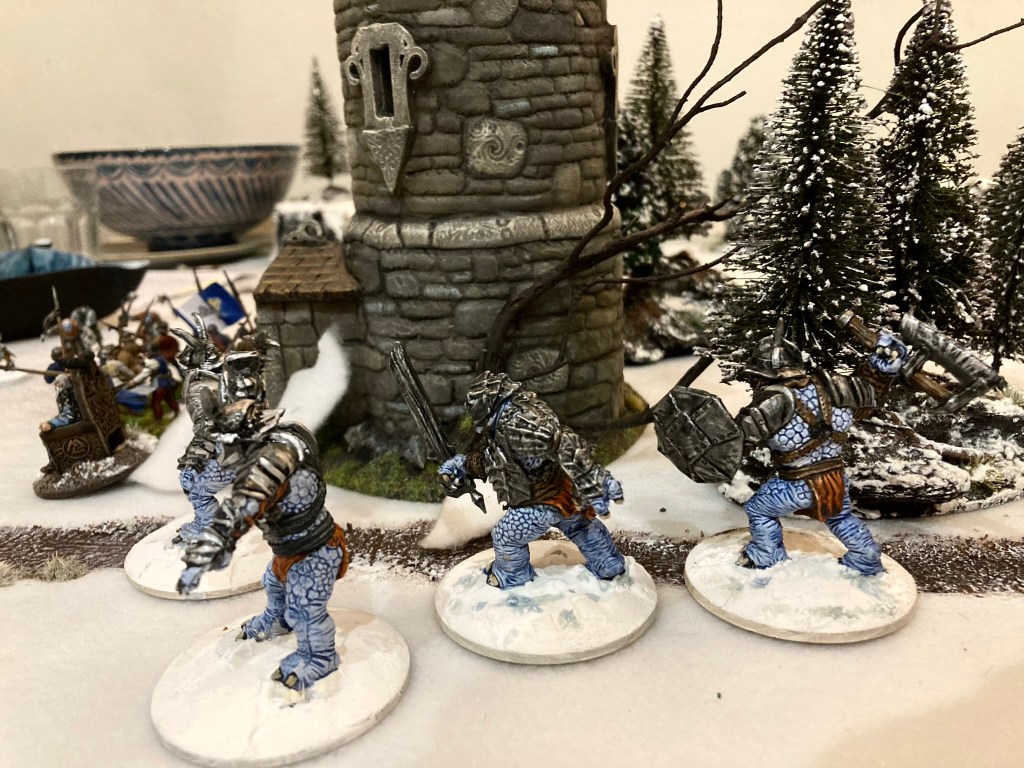
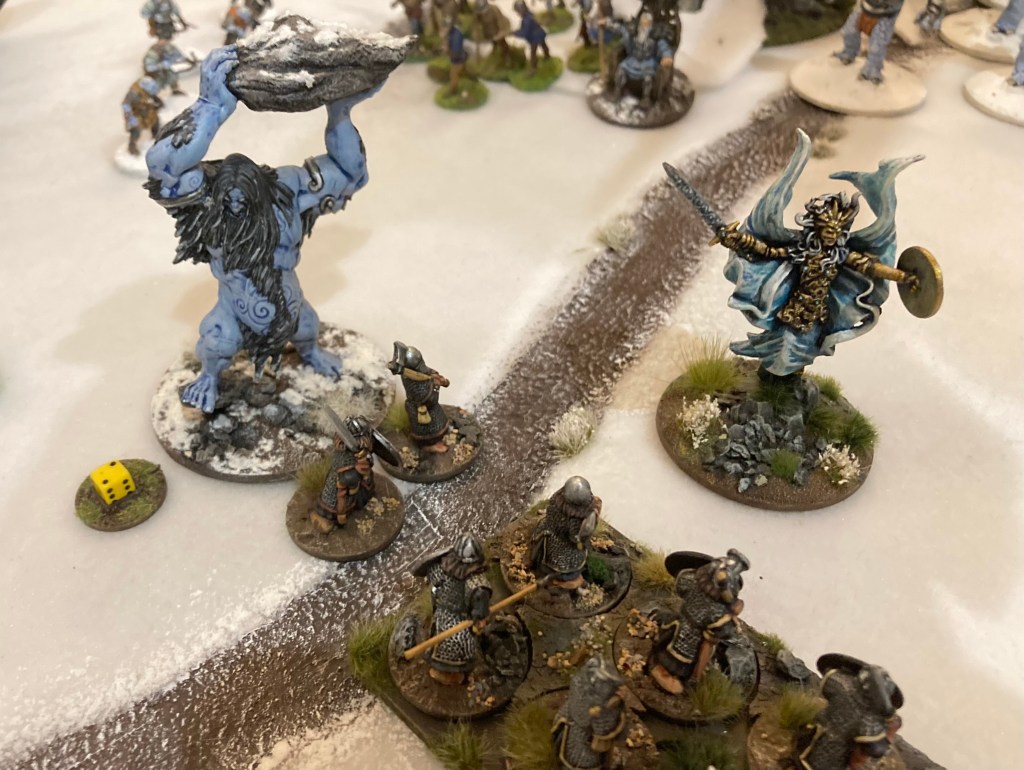
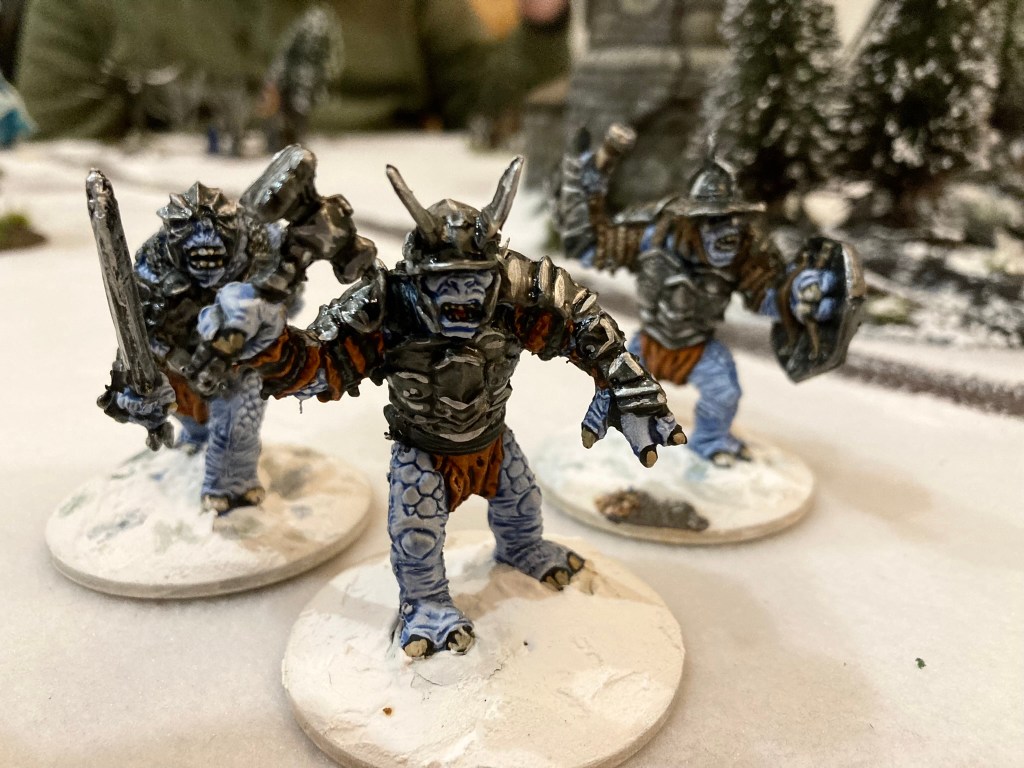
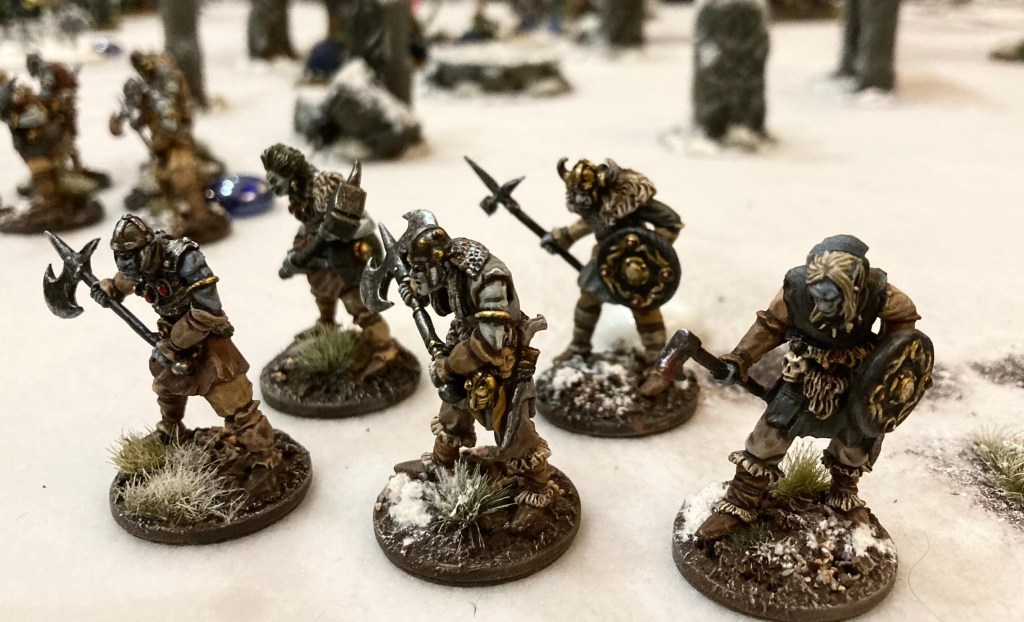
The two armies clocked in around 400 points each in Midgard; this gave the Dwarves ten units of high quality troops plus 5 Heroes, whereas the Orcish horde had roughly double this, with many poor-quality warriors and archers backed up by Uruk-Hai, Warg riders, a couple of Trolls and Saruman himself (alongside a slew of disposable Orc captains). This was definitely a quality vs quantity game, although the higher quality Isengard units – Uruk-Hai and Trolls in particular – played a critical role in the battle that was to follow.

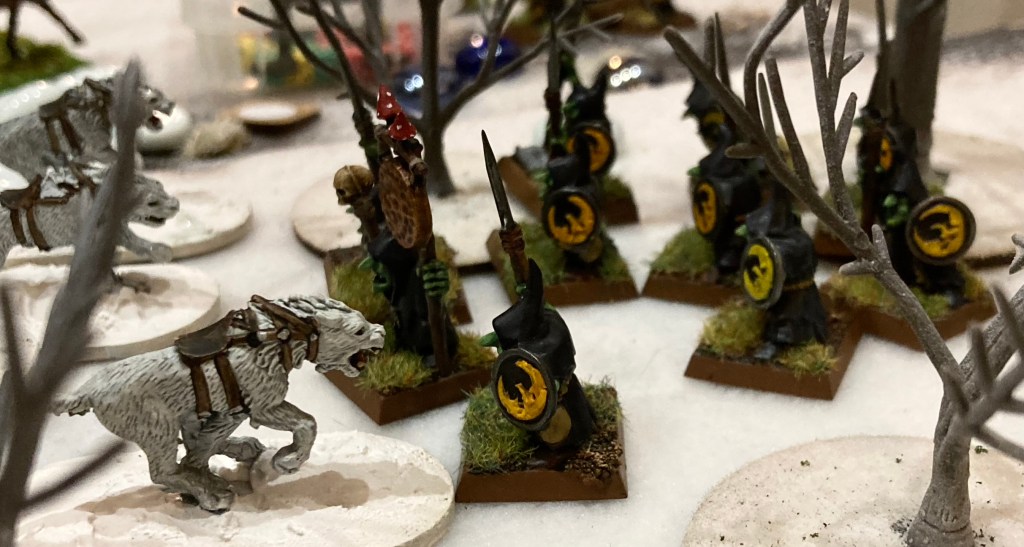
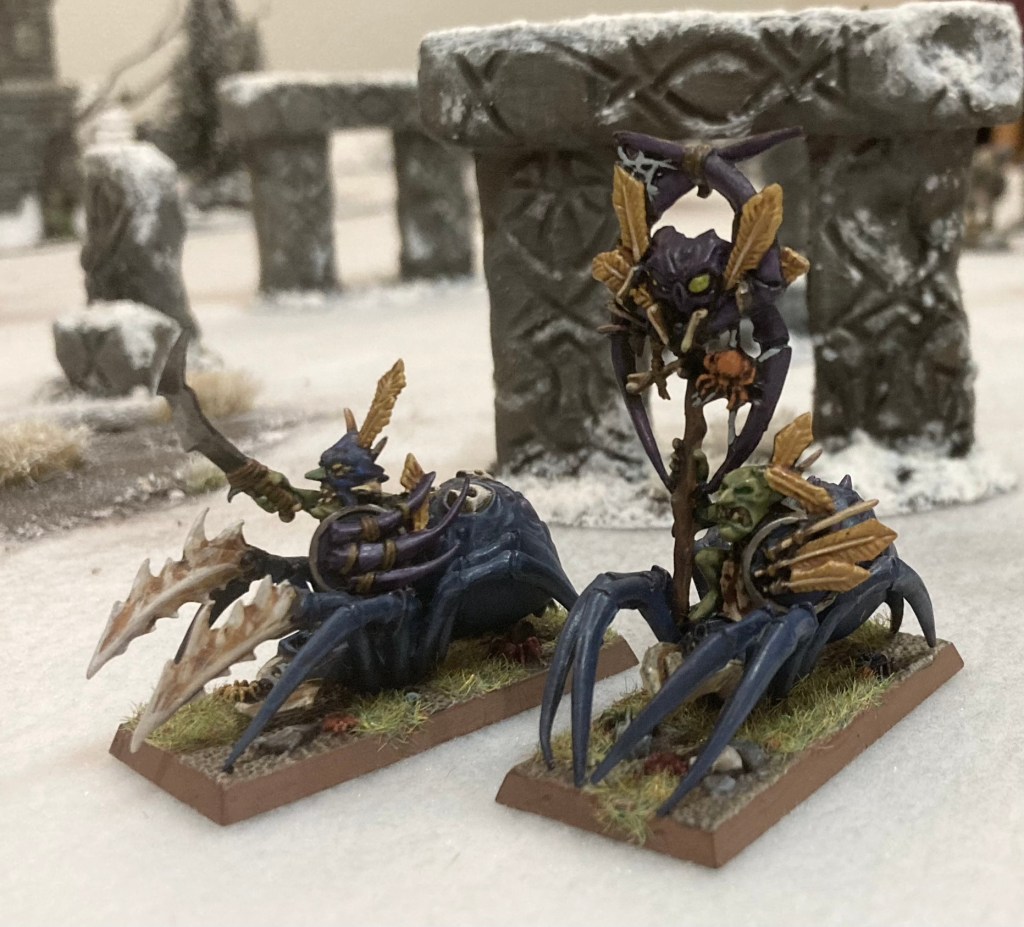
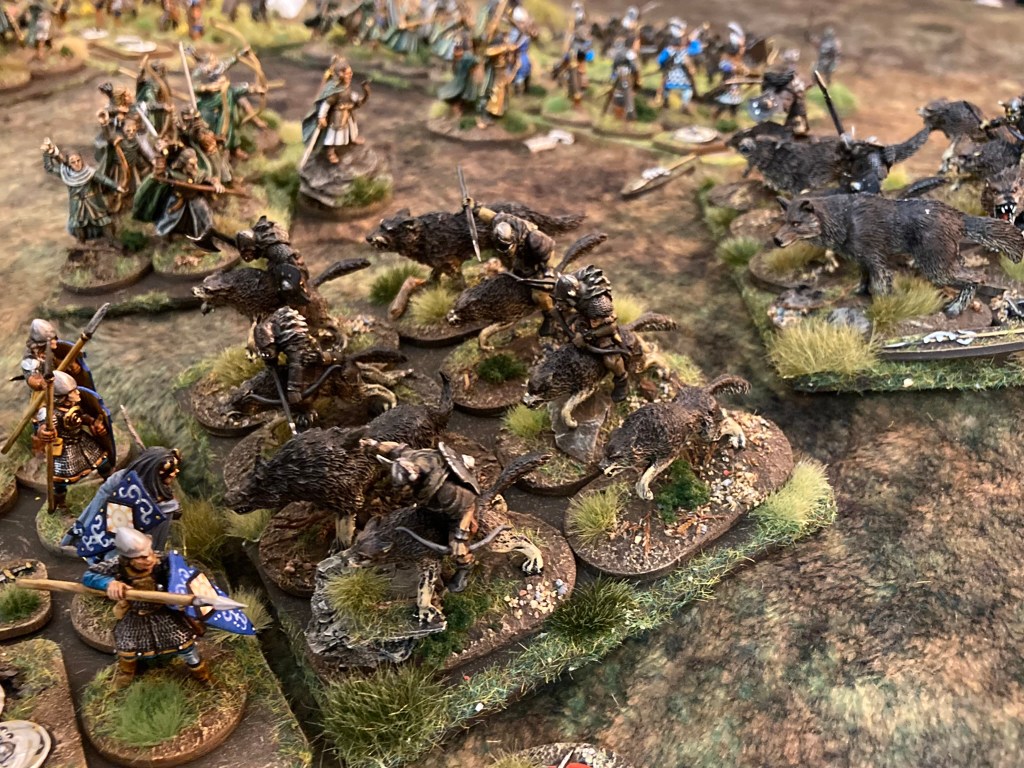
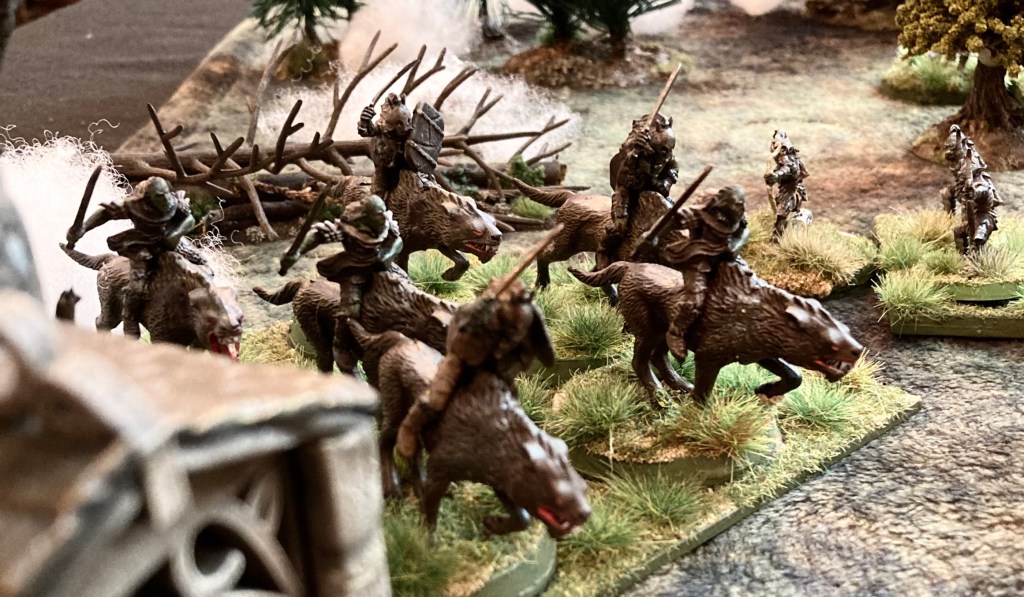
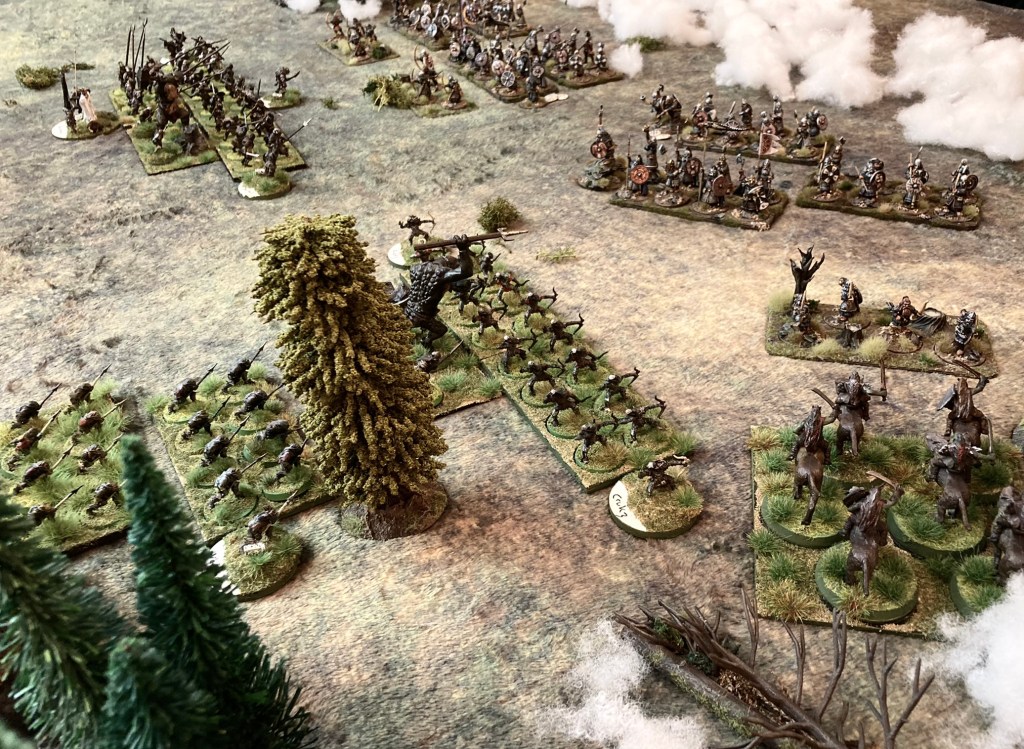
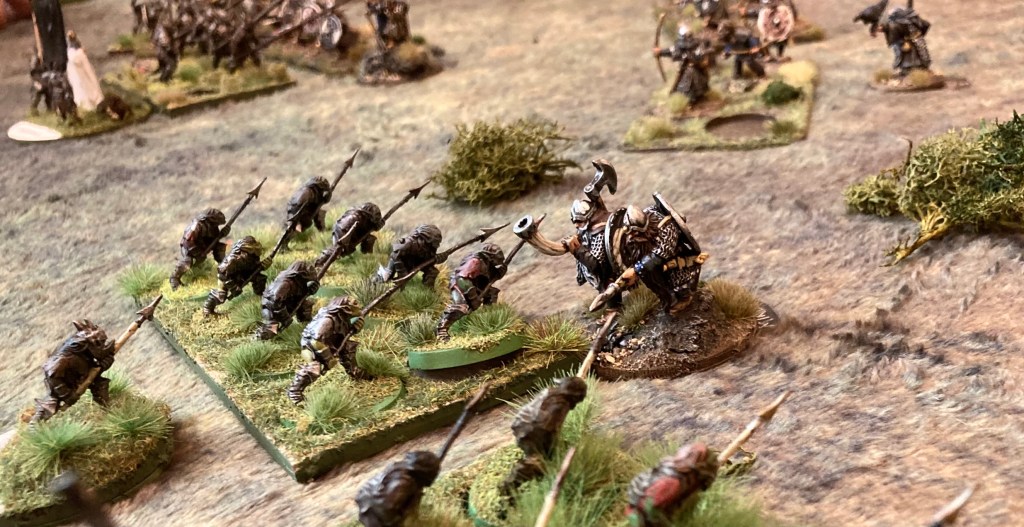
Orc Warg riders burst out of the woods next to the watch tower (all GW minis)

I was testing out a new scenario called ‘Encounter in the Mist’ that actually had its origins as a Wars of the Roses Battle of Barnet game that we played last year (you can read Tom WD’s account of it on his blog here). The key principle was the same: creating confusion! We deployed the armies in three ‘battles’, then diced for each one to see what had happened to it in the fog.

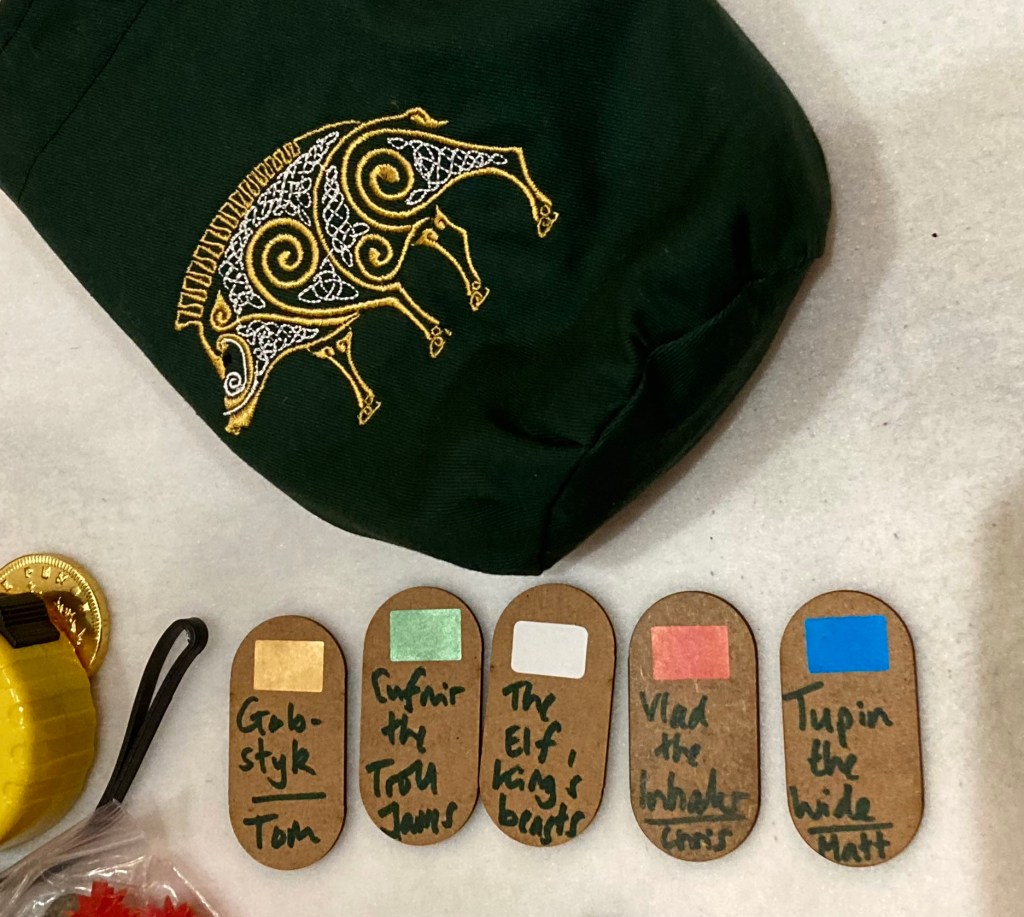
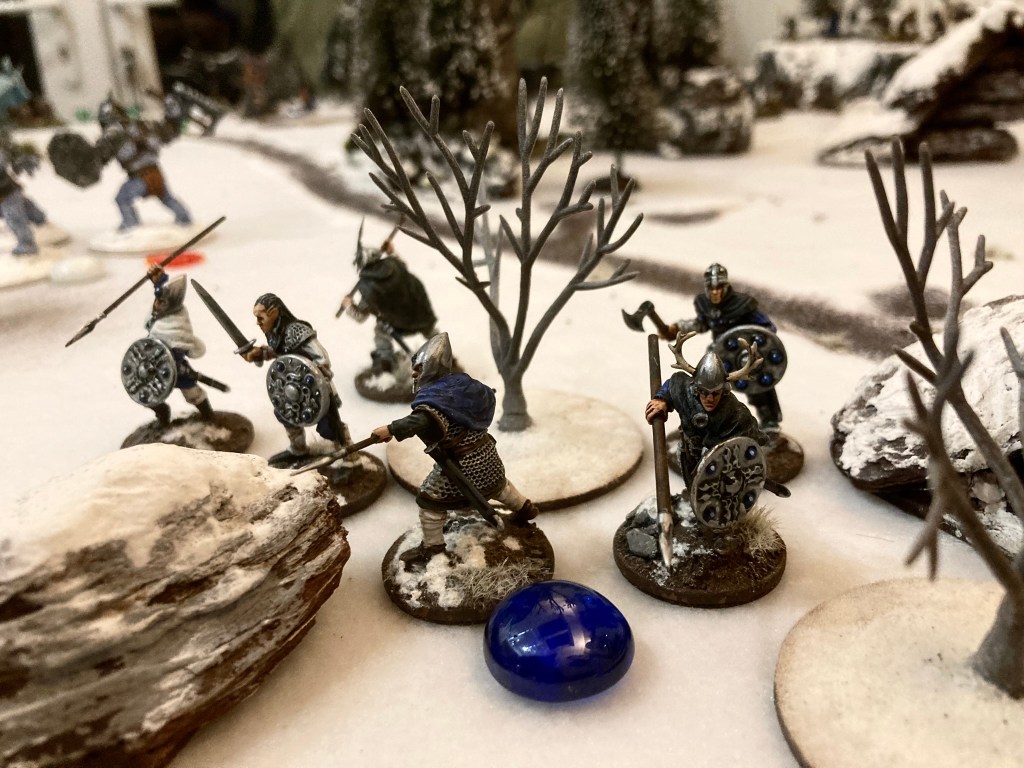
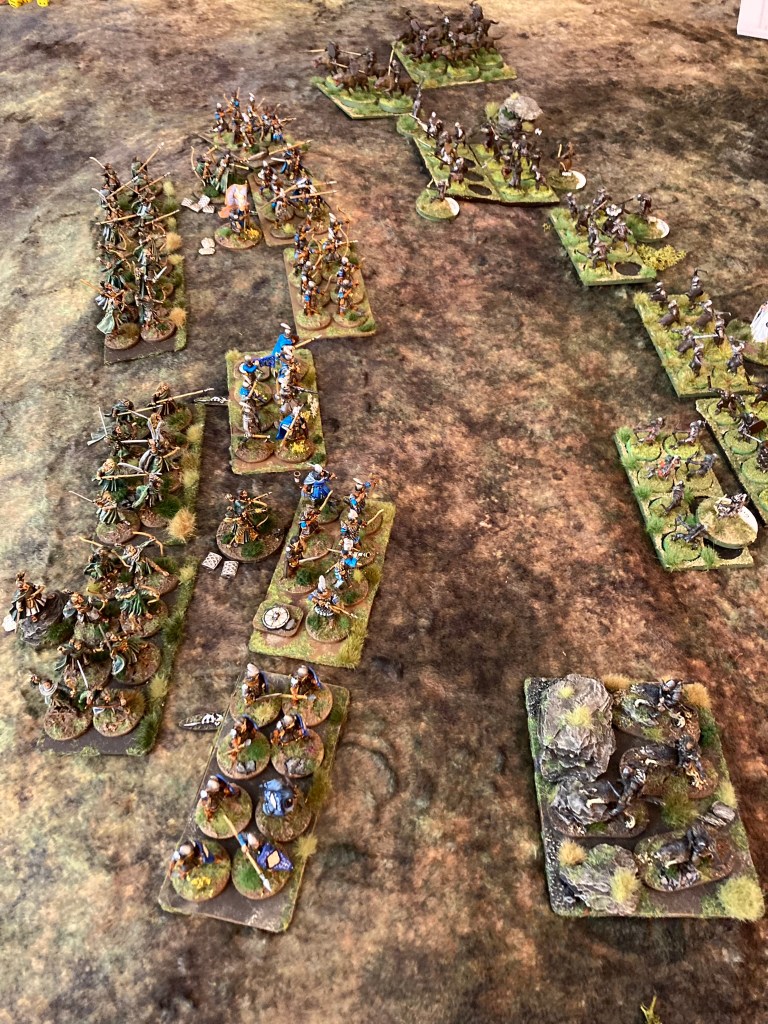
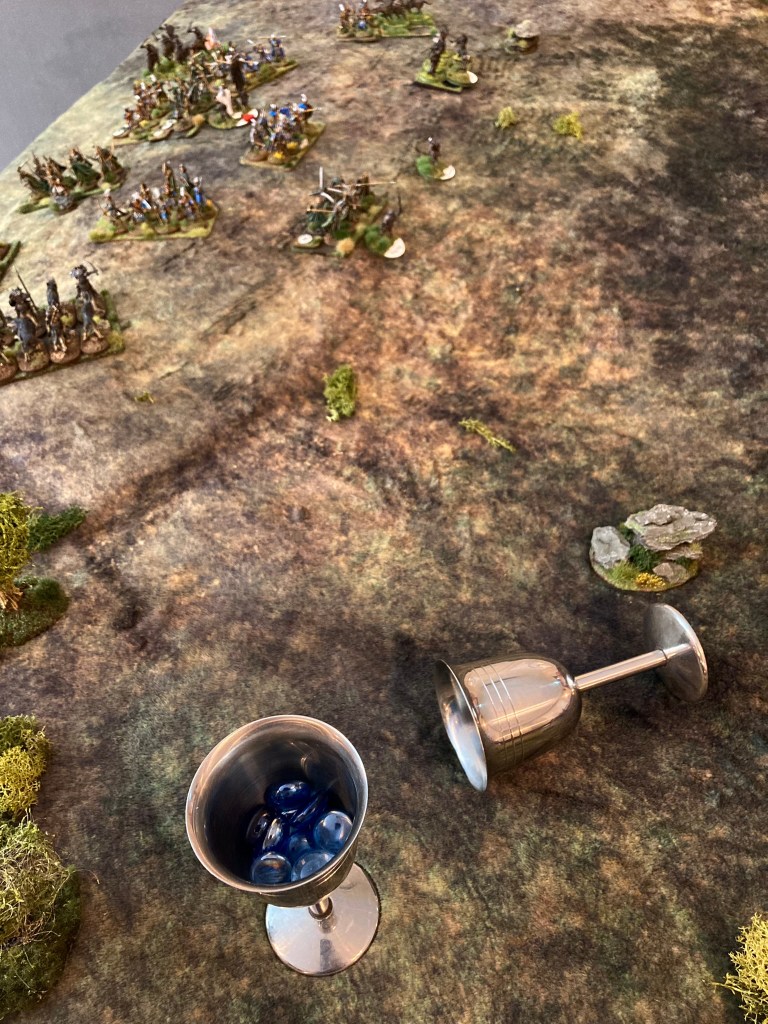
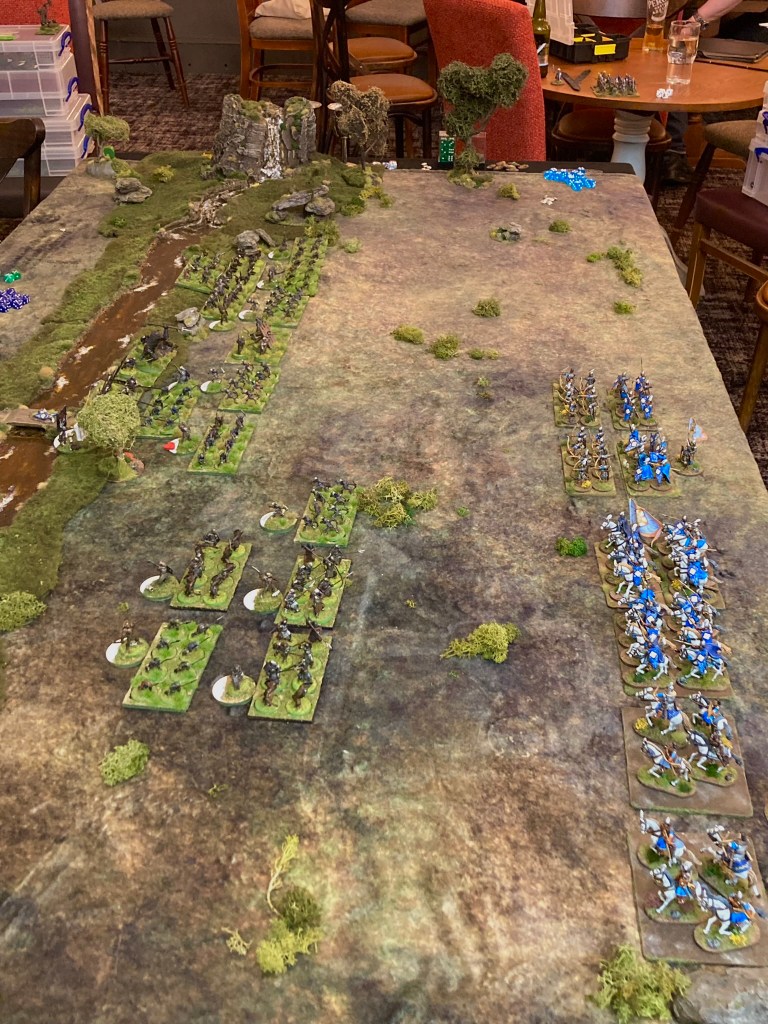
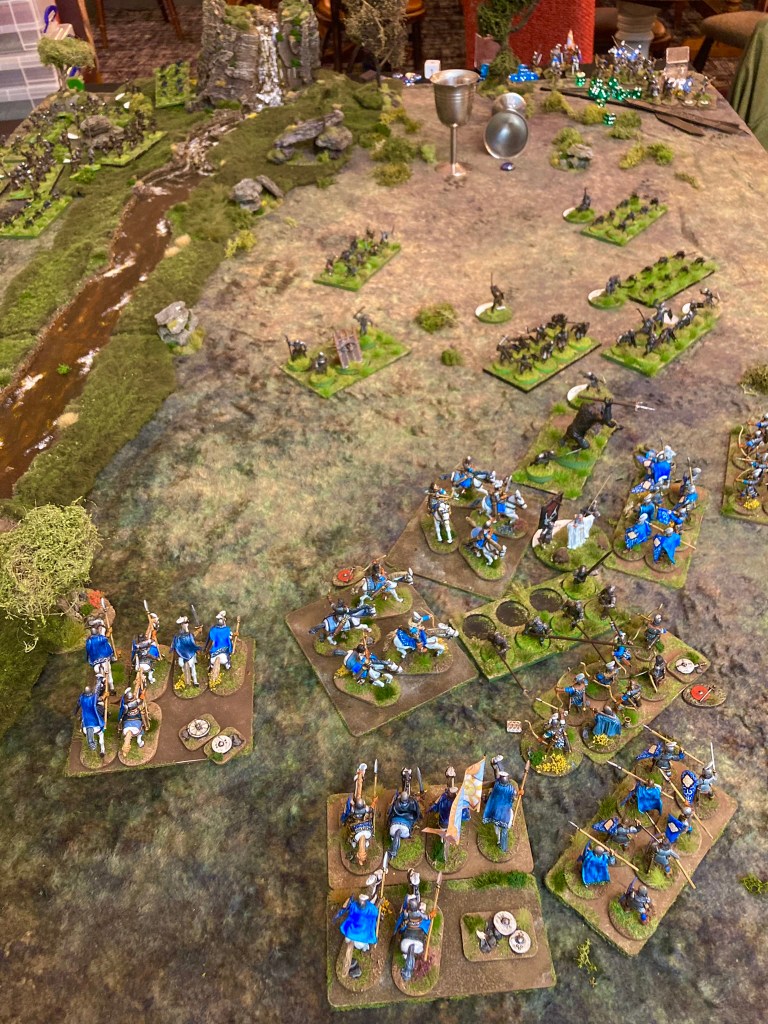
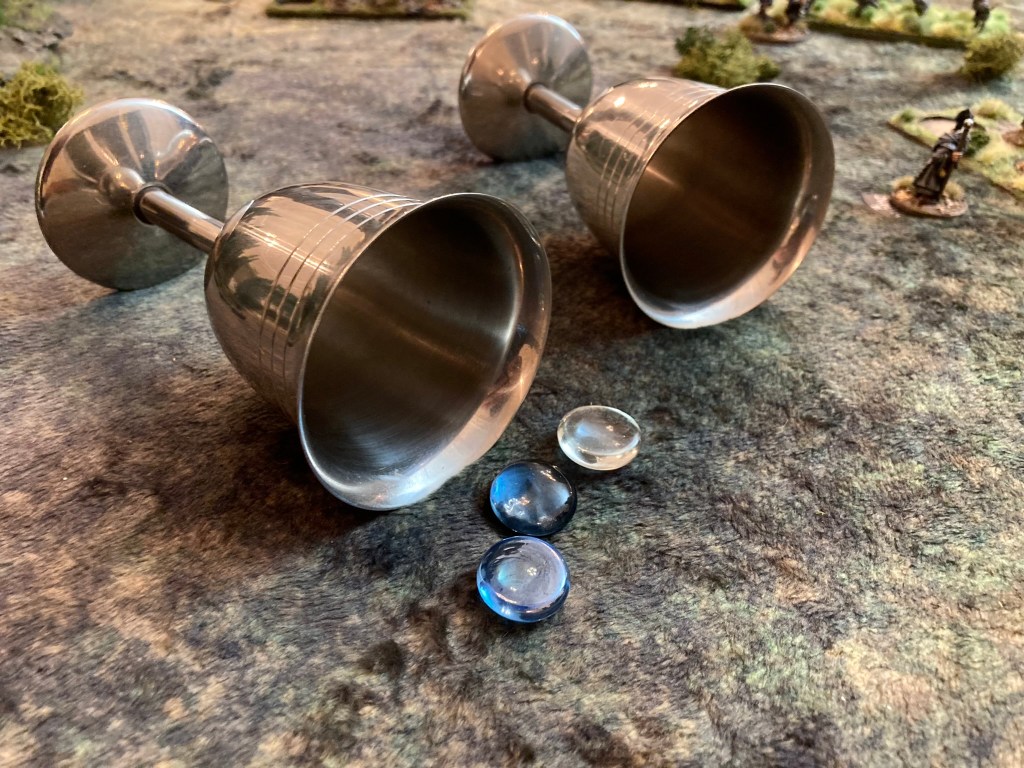
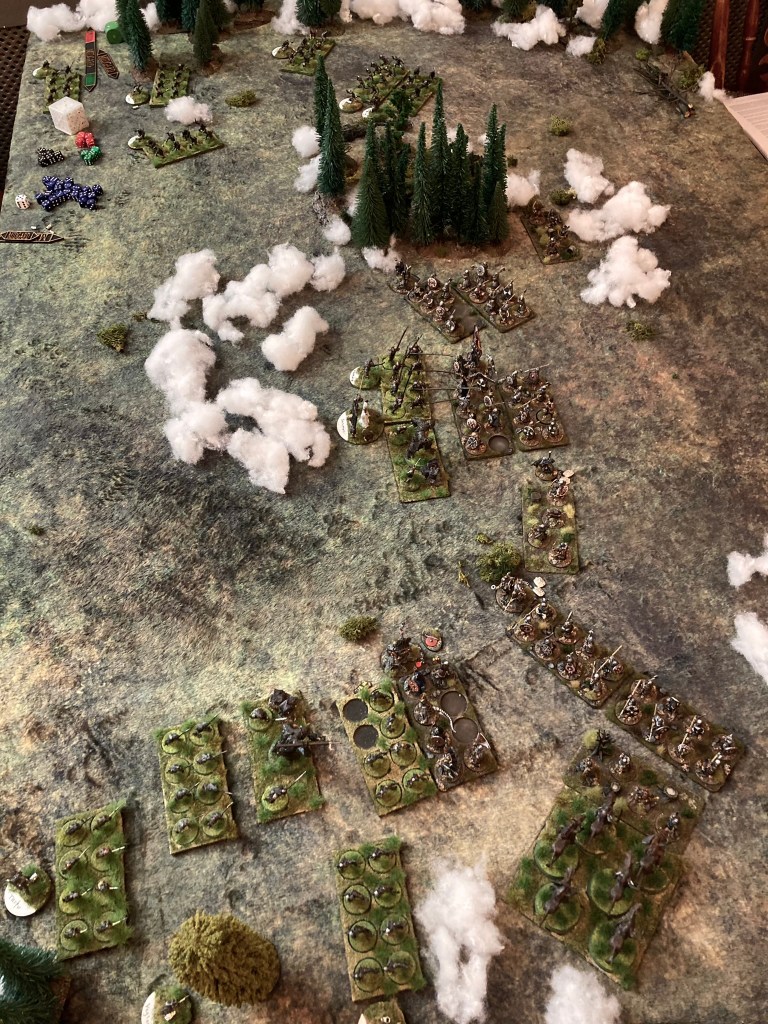
The table after deployment – you can see how the Orcish battles have become separated (left), but the Dwarven host (admittedly smaller) is all together on the right. The goblets keep track of the two forces’ Reputation – tokens are gained and lost in battle until one cup runs empty.

I was very fortunate in that only one of the Dwarven battles deviated slightly from my planned deployment, but the Orcish left and right battles got completely lost and veered off to the far right and left of the battlefield. Better still, both groups had units in the woods, which would create further command and control problems as the game started. The Dwarves were, so far, in the pound seats and looking forward to a fast advance to crush Saruman and the Orc centre before the wings recovered. Well, that was the plan!

Terrain-wise, we used a Cigar Box mat (mine is a long pile version that is sadly no longer available) with a variety of coniferous trees that I found on eBay and rebased serving as the mountain woods. The mist is just soft toy stuffing (bought in a bag from a craft store – NOT extracted from mercilessly-hunted teddy bears!) For a bit of extra set dressing, I used a scratchbuilt watch tower from my collection as well.

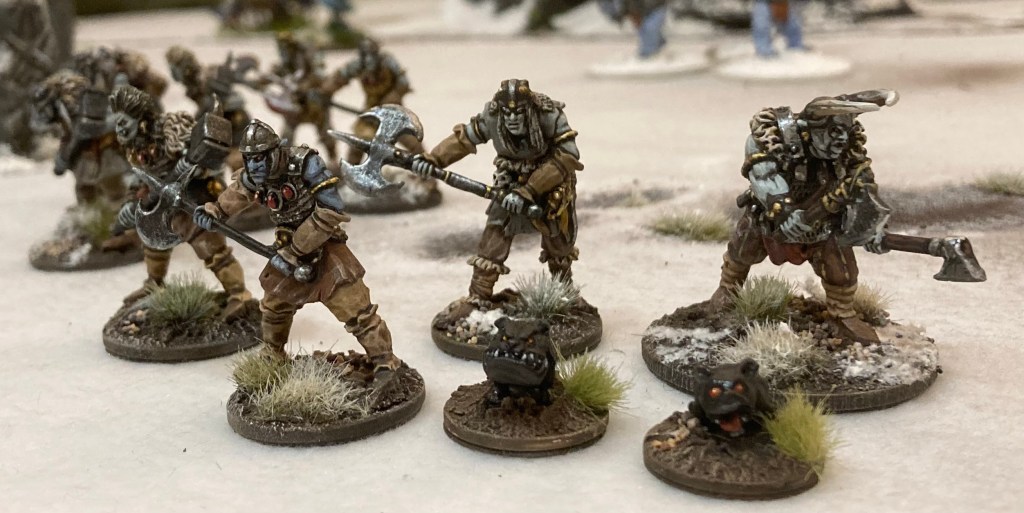
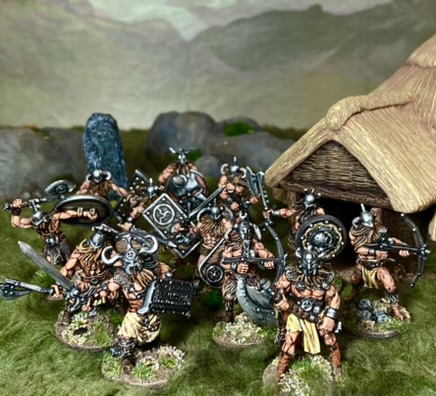
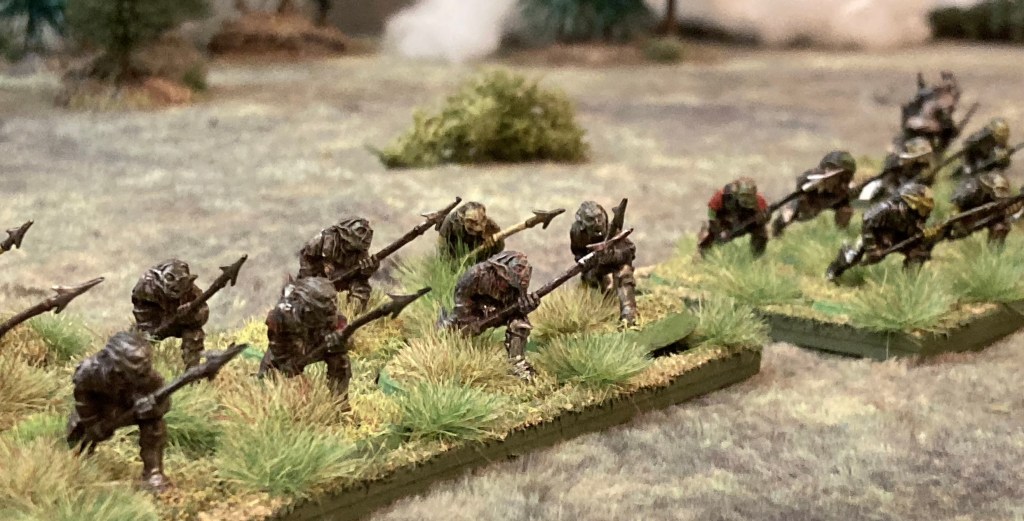
Massed Moria Orcs: oldies but goodies
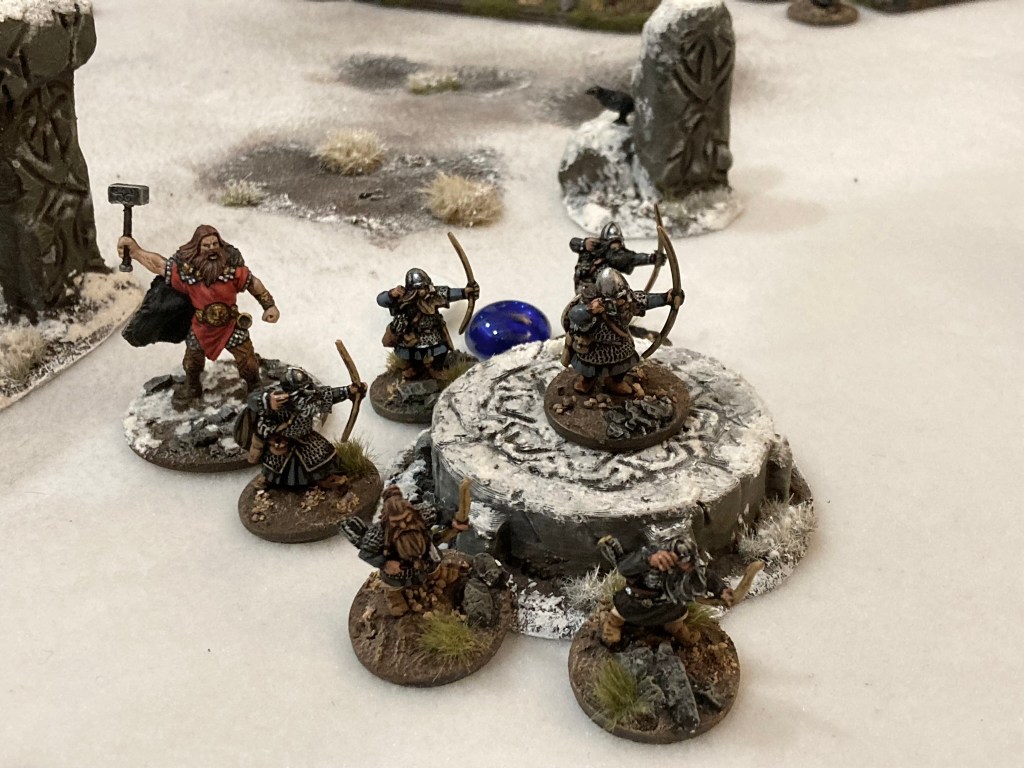
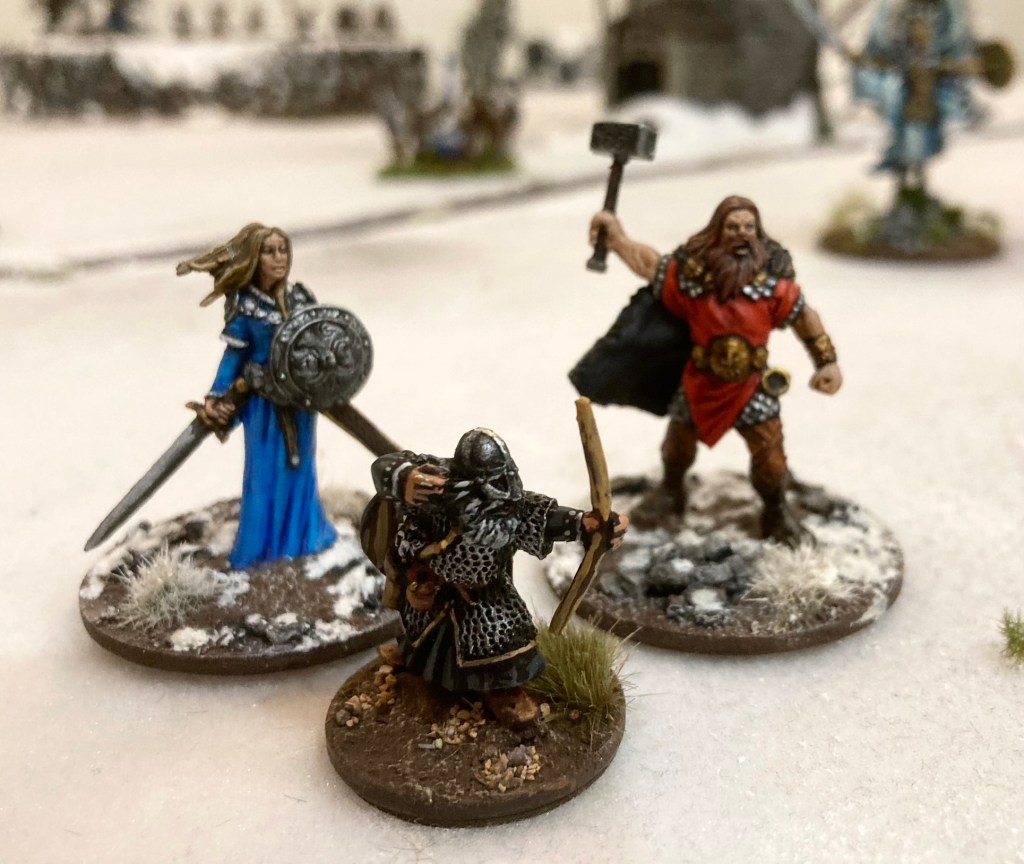
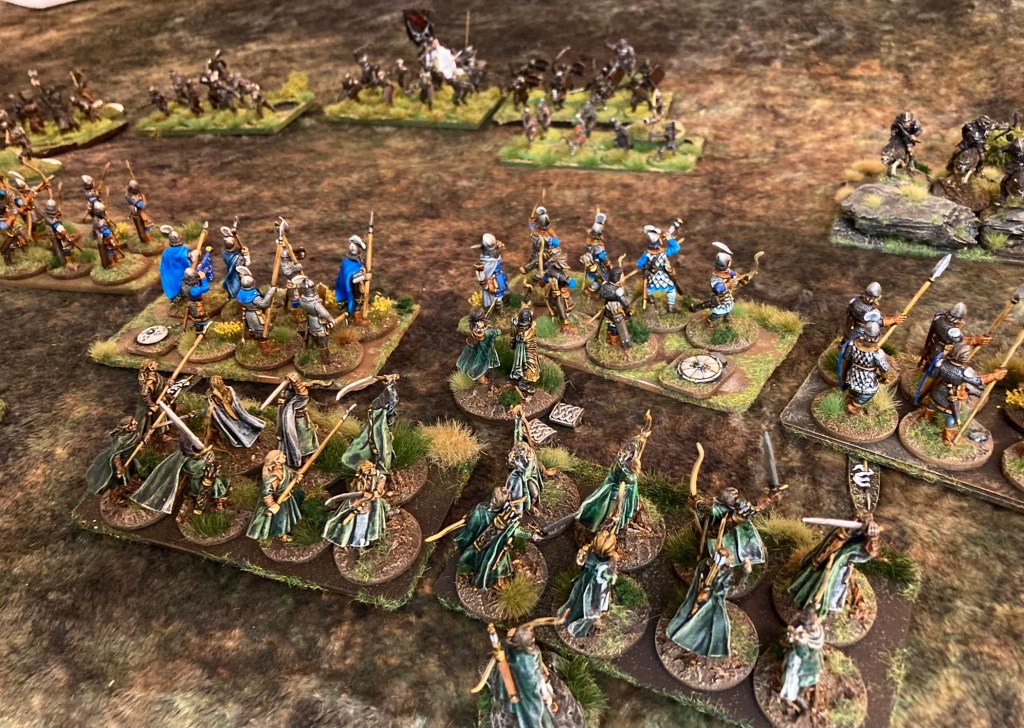
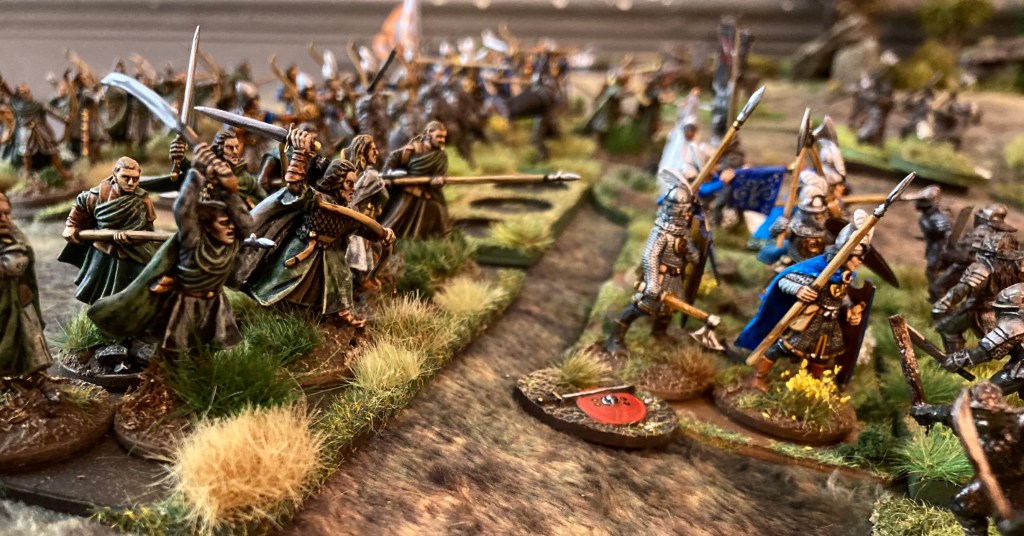
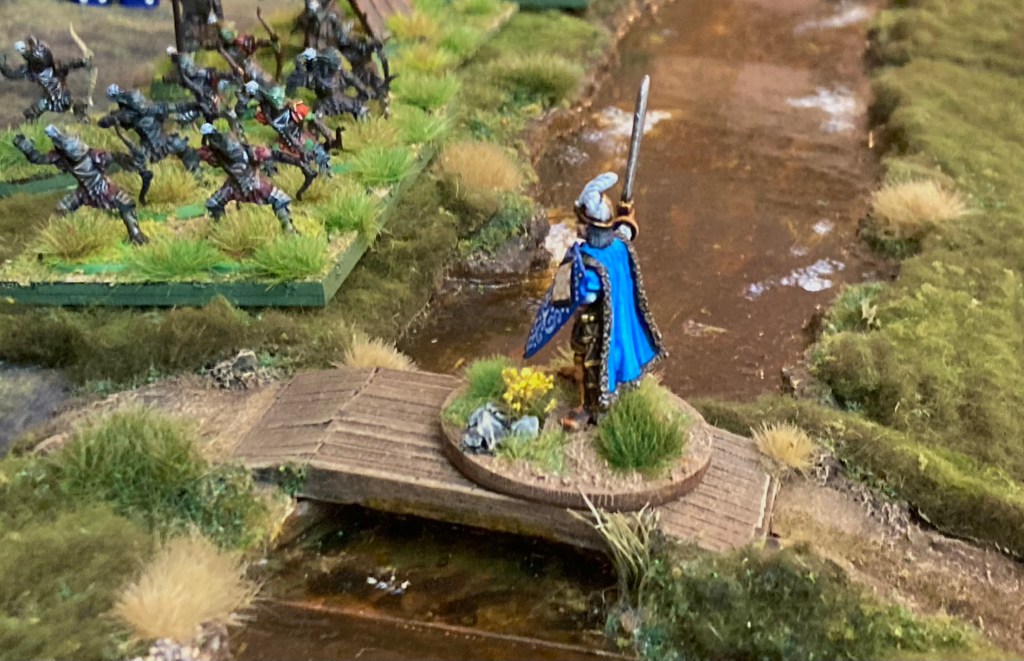
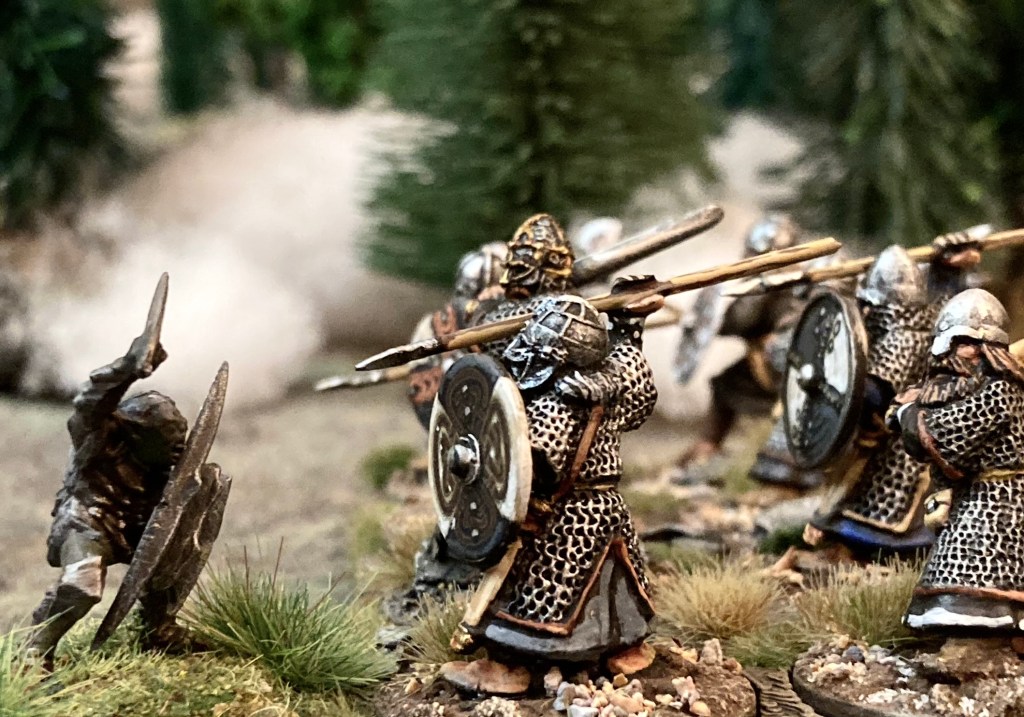
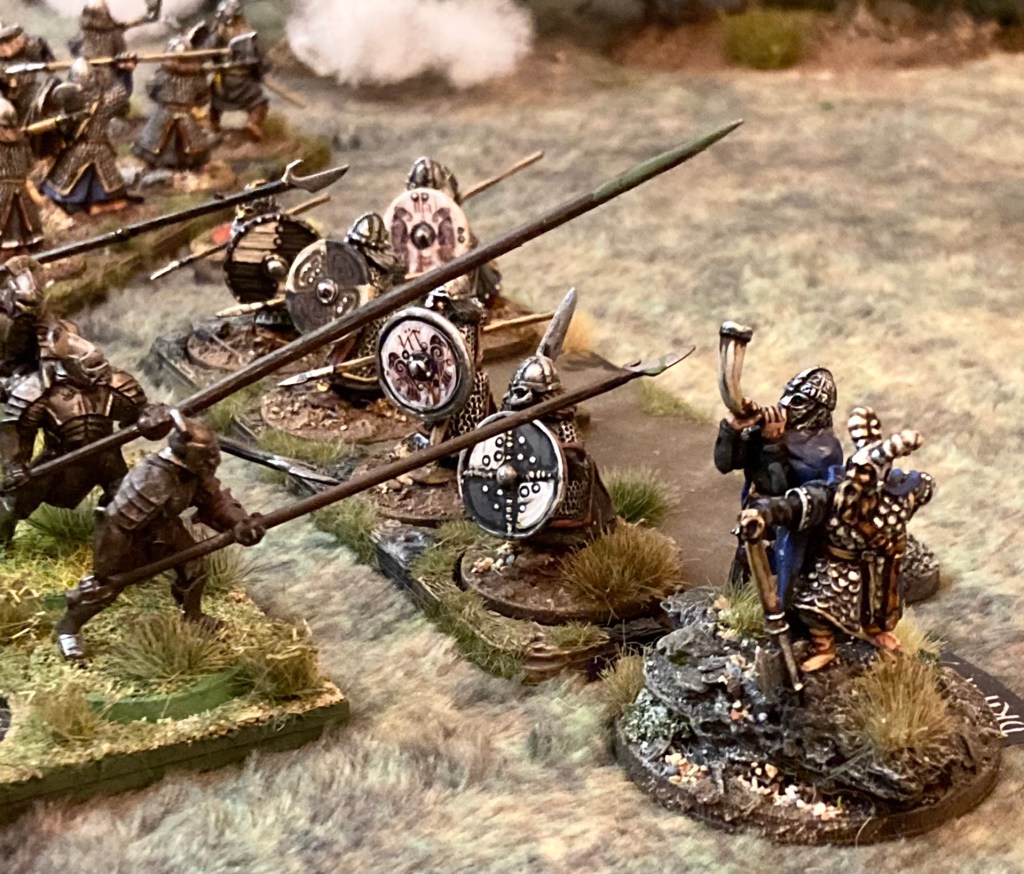
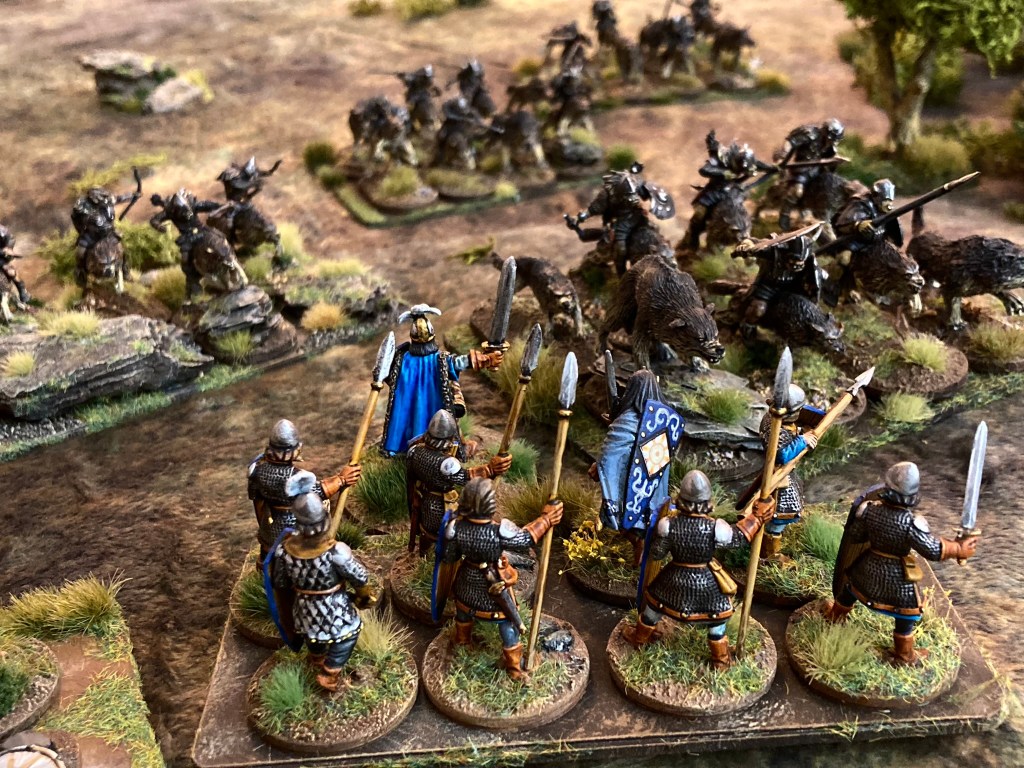
Dwarves fighting off the Uruk-Hai: mostly Conqueror and Vendel minis, but Dwarf Lord Drifir (right) is an old Mithril mini.

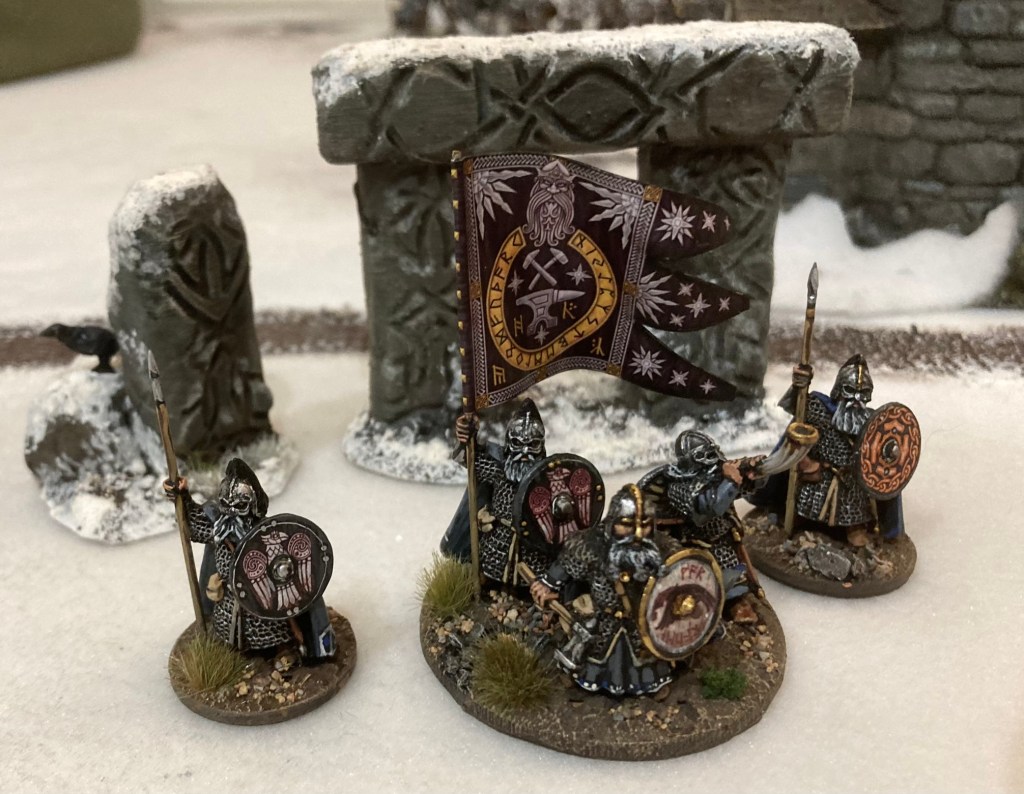
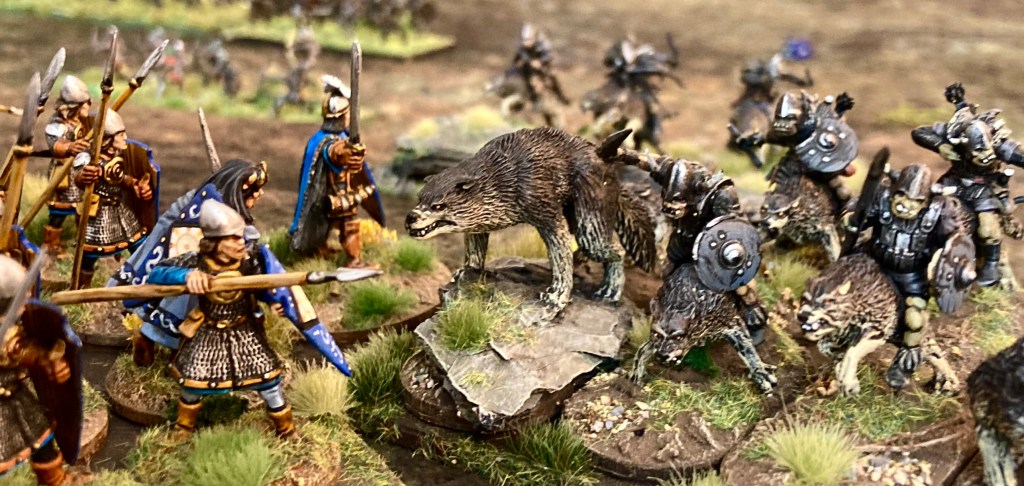
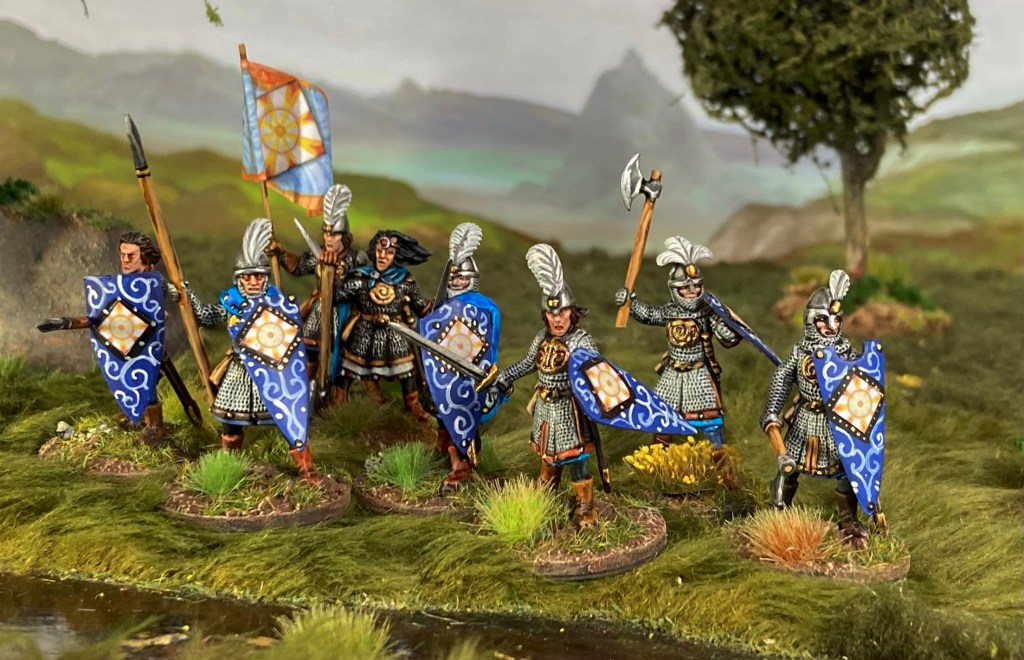
Pete’s Orc army is entirely GW, with a mix of metals and plastics dating back to the early 2000s. My Dwarf army is mostly composed of Vendel Miniatures (now available from Thistle & Rose in the USA) and UK-based Conqueror Models, all sculpted by the talented Colin Patten who is now working on Ragnarok Miniatures. There are a number of other minis in my Dwarf army, which you can read about here if you want to see more. Right, that’s the endorsements out of the way, now: to battle!

Part 1 of the plan went pretty well: the well-disciplined Dwarves moved up without too much trouble, whereas the Orc captains in the woods suffered merry hell trying to get their hordes moving! (It was quite fun watching Pete cursing away). Midgard uses a very simple command test, but it becomes more complex if you have reluctant troops, especially if they’re in rough terrain. Oh yes, and the mist made it harder to pass the command test too. Laugh? The Dwarves were certainly having a chuckle in their beards.

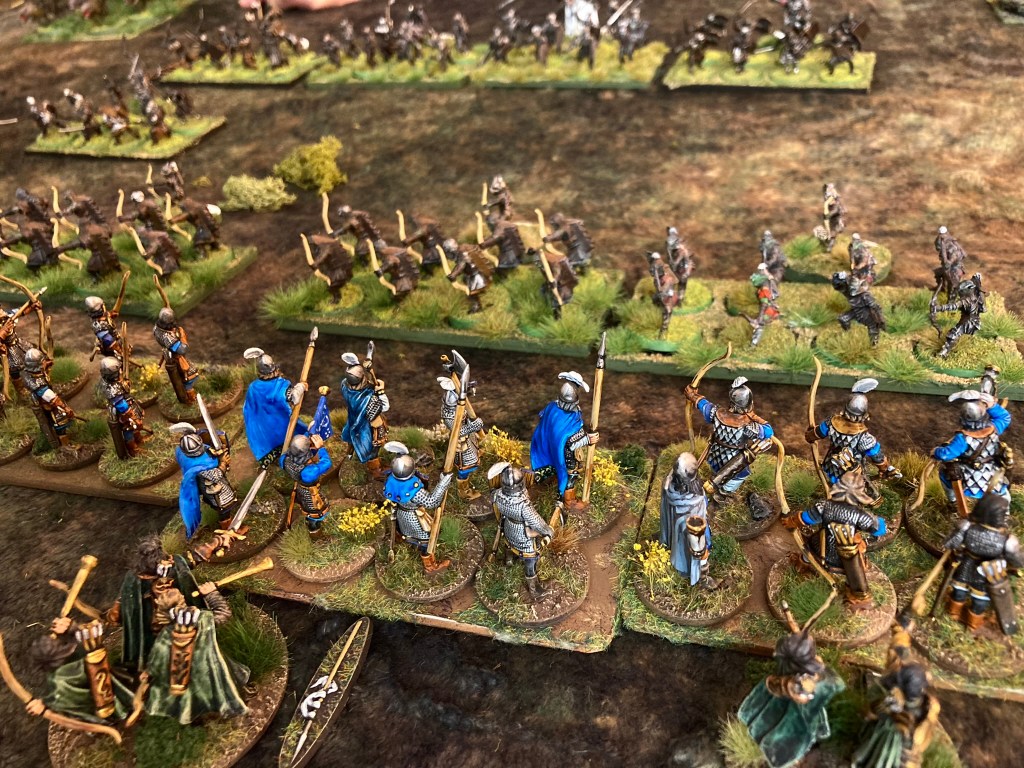
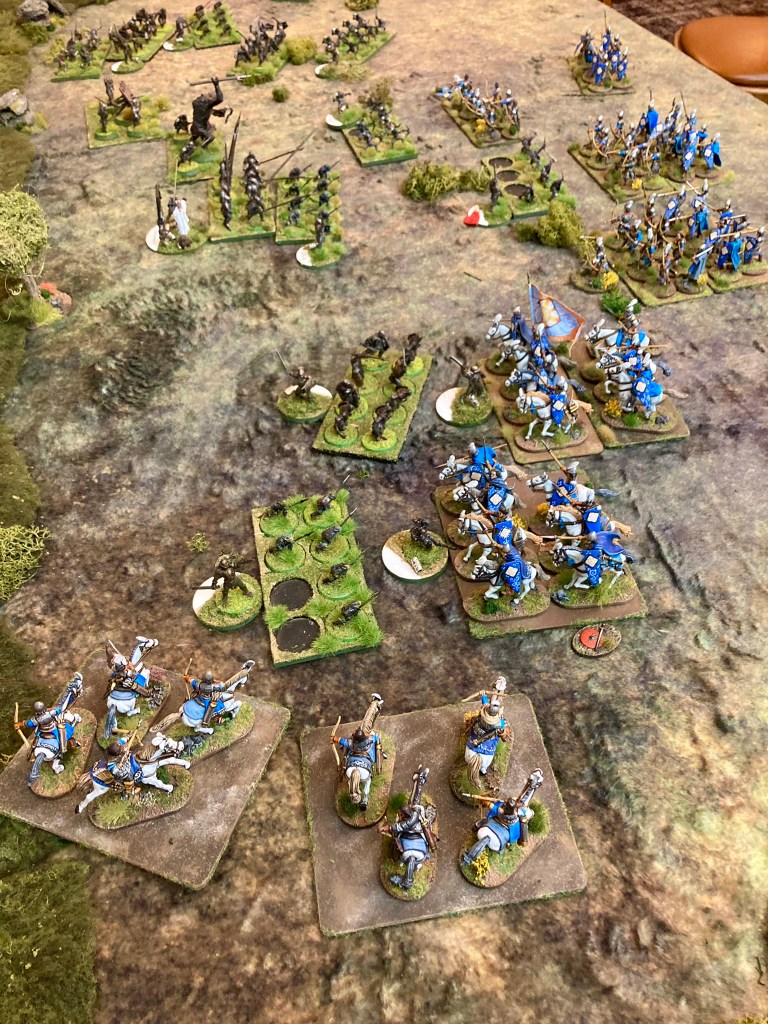
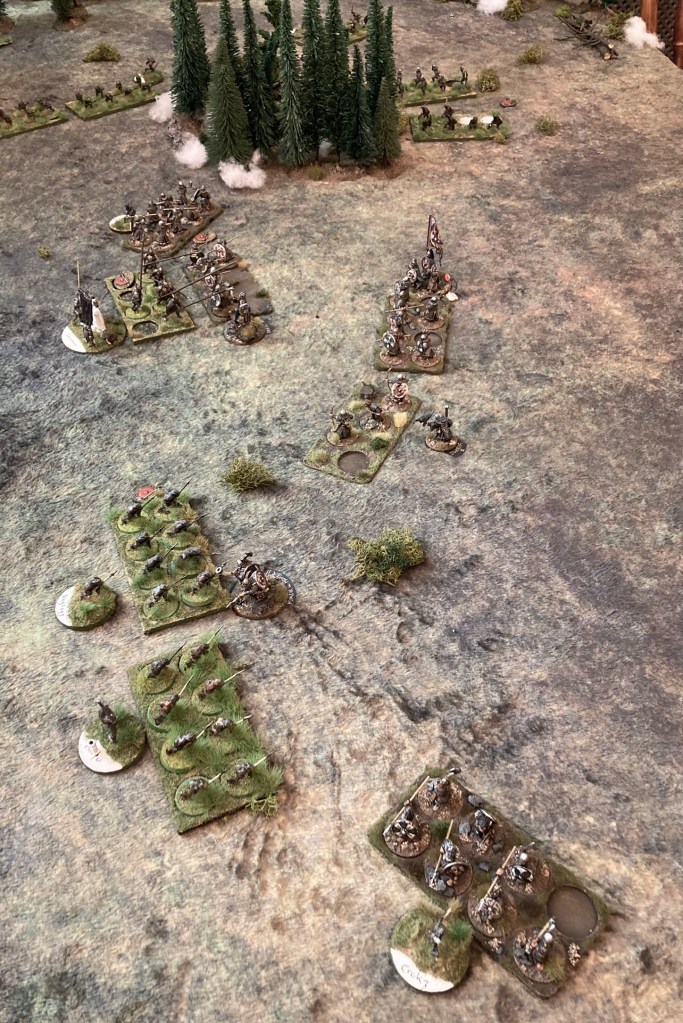
The Dwarf plan starts well with a coordinated advance on Saruman’s centre (top). Orcs in the woods (bottom) are having a few command and control issues thanks to the mist.

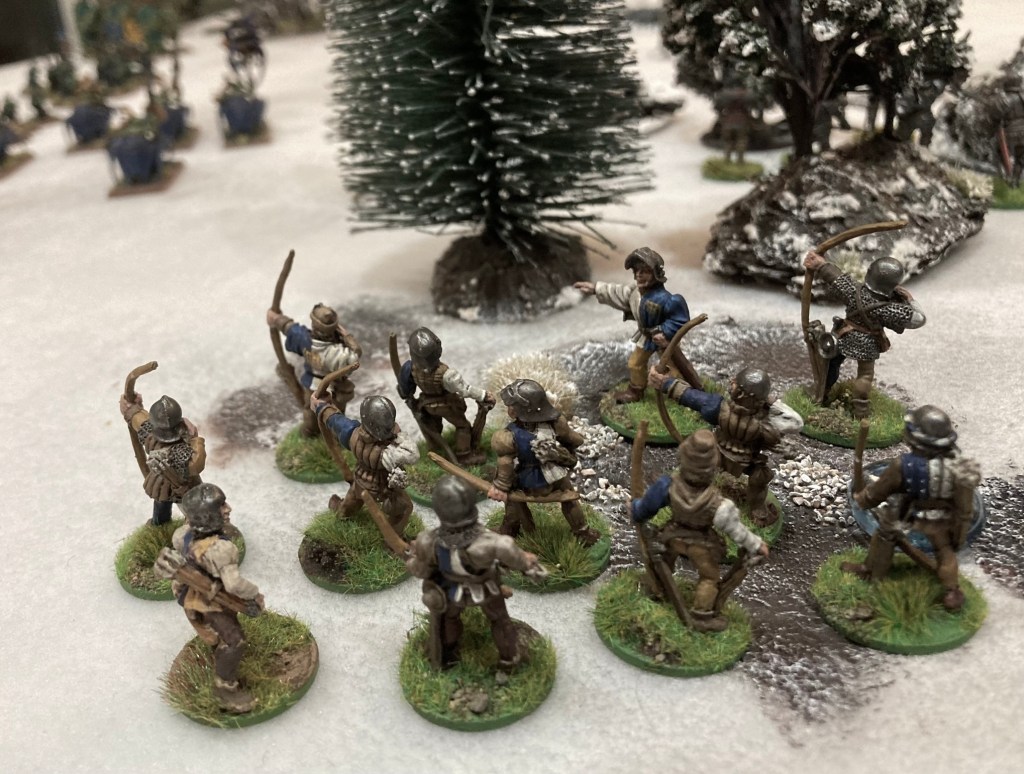
However, the mist worked against the Dwarves as well, reducing visibility to just a single Spear Throw (the unit of game measurement). This meant that the archers had to hang back, and let the Orcs get the first charge in. I can’t blame the mist for the terrible dice the Dwarves rolled in the first round of combat, but suddenly they found themselves being driven back by a horde of Orcs.

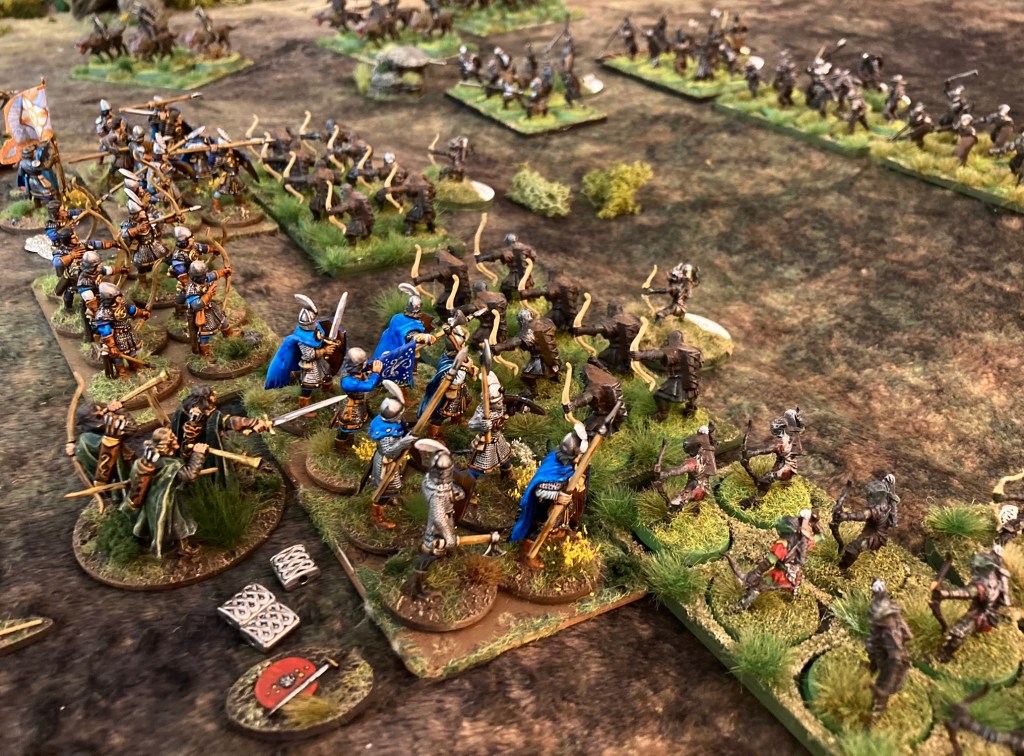
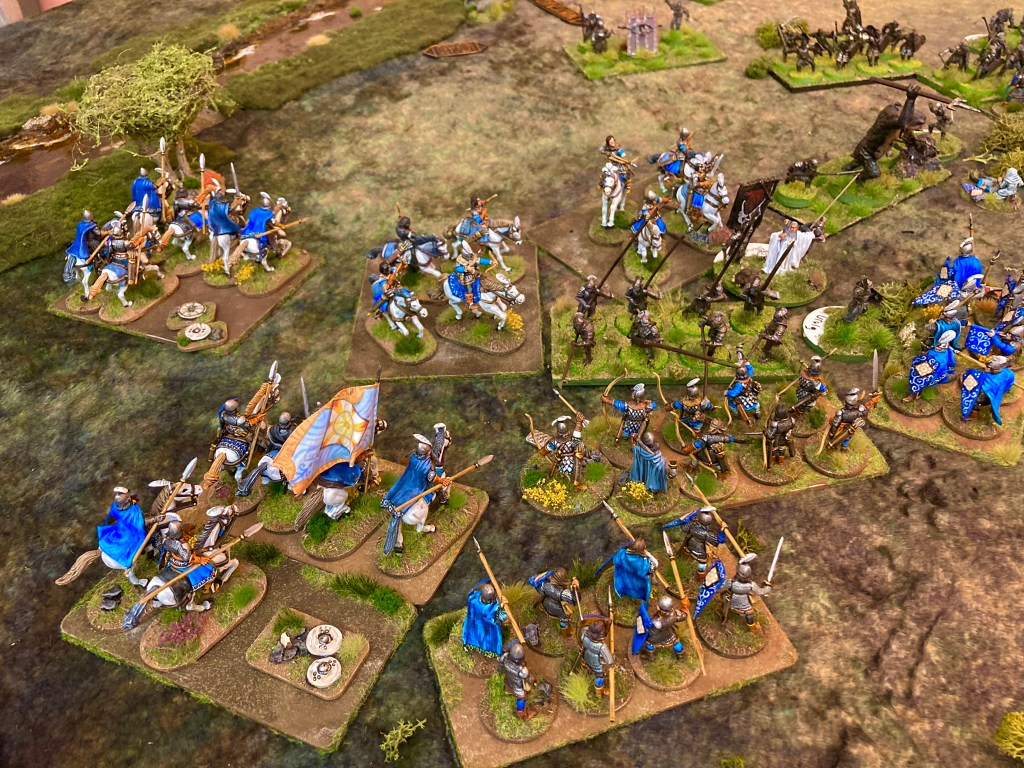
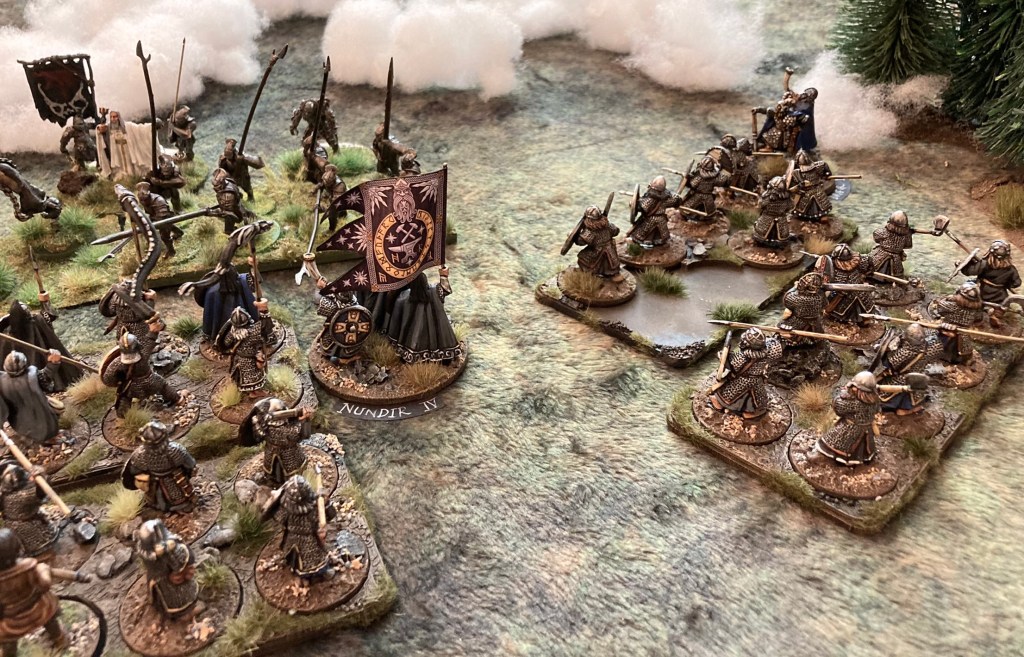
The Dwarf centre goes in, with Lords Nundir and Drifir smiting the enemy. However, note the Uruk Hai and Troll lurking behind the first wave of Orcs!

Fortunately, quality started to tell, and the Dwarves fought back, crushing the first rank of Orcs. However, cunning Saruman had created a second line of Trolls and Uruks, who then piled into the combat-weary long beards.

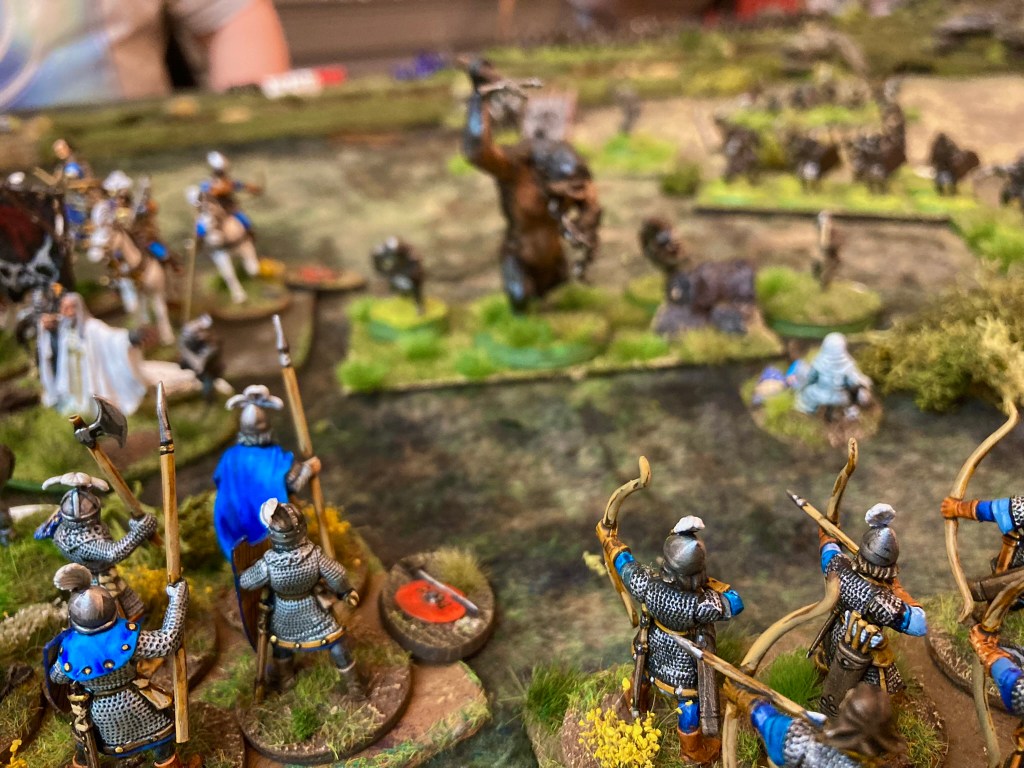
Drifir slays an Orc captain in single combat, but suffers a wound in the process.

Weapons clashed up and down the line; Dwarf Lord Drifir took down a goblin captain with a single blow of his hammer; and the Orcs on the flanks started to draw in, finally responding to the whips of their masters.

Turn 4 saw the mist beginning to clear (on a random dice roll) and it looked like the Dwarves might prevail, but three of their Heroes were now wounded. Noin, mighty Dwarf champion, fell fighting a huge troll.

‘I fought the Troll, and the Troll won’. (Noin bites off more than he can chew).

The other Troll was weakened by a curse from the Dwarven Elder before before decked by a combination of warriors and archers in an impressive pincer movement (the Troll then fell on top of the archers, who were fortunately saved from a certain crushing by a cry from Nundir, their lord).

A wounded Lord Nundir and his hearthguard finally bring one of the Trolls down.
Fierce combat between Dwarven scouts and Wargs; to my surprise. the Dwarves won!

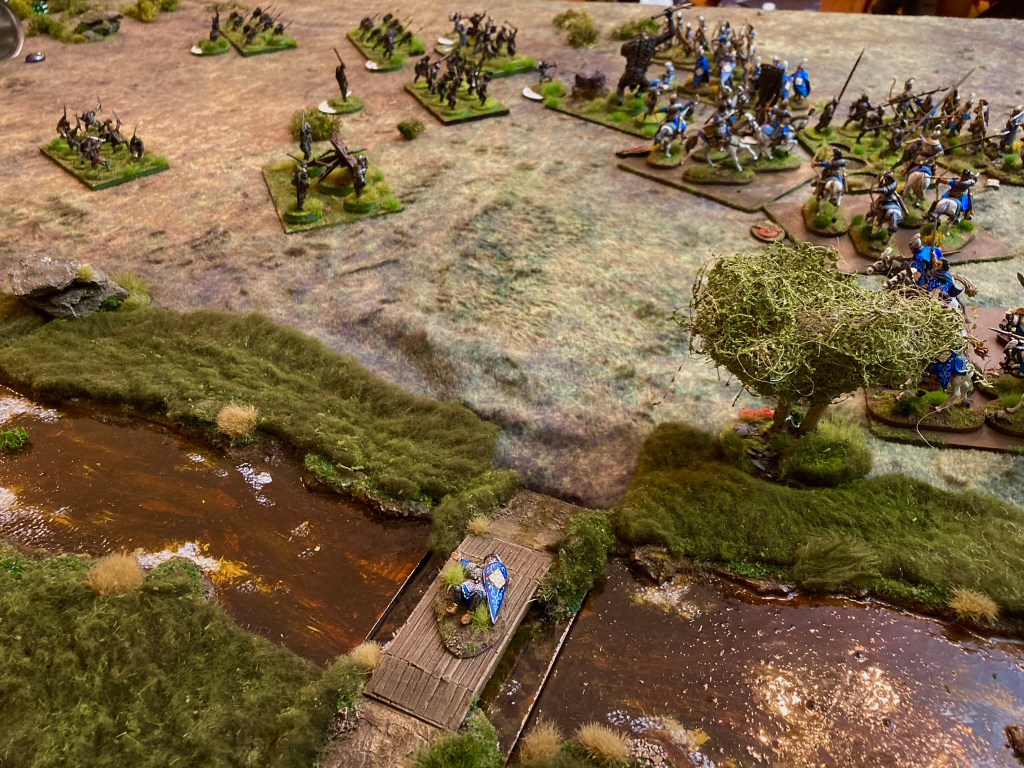
However, it was too little, too late. With the mist clearing, the Orcs on the right flank had finally escaped from the woods and were bearing down on the Dwarf archers who had been sent to head them off, massacring them in a vicious round of combat.

On the right flank, the Dwarf scouts are closed down and destroyed by the recovering Orcs.

Dwarf lords Nundir and Drifir, both wounded, were still locked in combat with Saruman’s Uruks in the centre, but had failed to land a blow on the white wizard.

Saruman holds out, unscathed despite being with his Uruks!

The loss of another unit of warriors on the left reduced the Dwarves’ reputation too far, and they broke and fled, leaving a heavily mauled force of Orcs in command of the battlefield.

The end: Saruman’s goblet (right) has no Reputation left, but the Dwarves (left) are on -3!

This was an exceptionally fun game which swung both ways before the Dwarves finally threw in the towel – it could have easily gone either way. We’ll definitely play the scenario again. Cheers Pete!

Battle’s end: although the Orcs have been mauled, both Dwarf Lords are wounded and their losses are too great.
/

Brig’s Peak: a WW2 game in East Africa

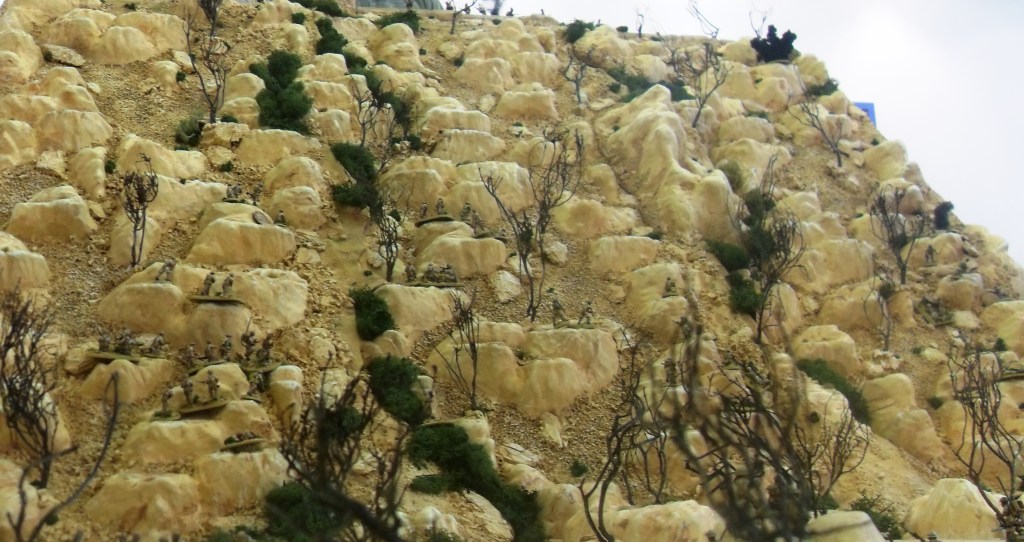
The Keren Battlefield (actual pic, not my terrain, I hasten to add!)

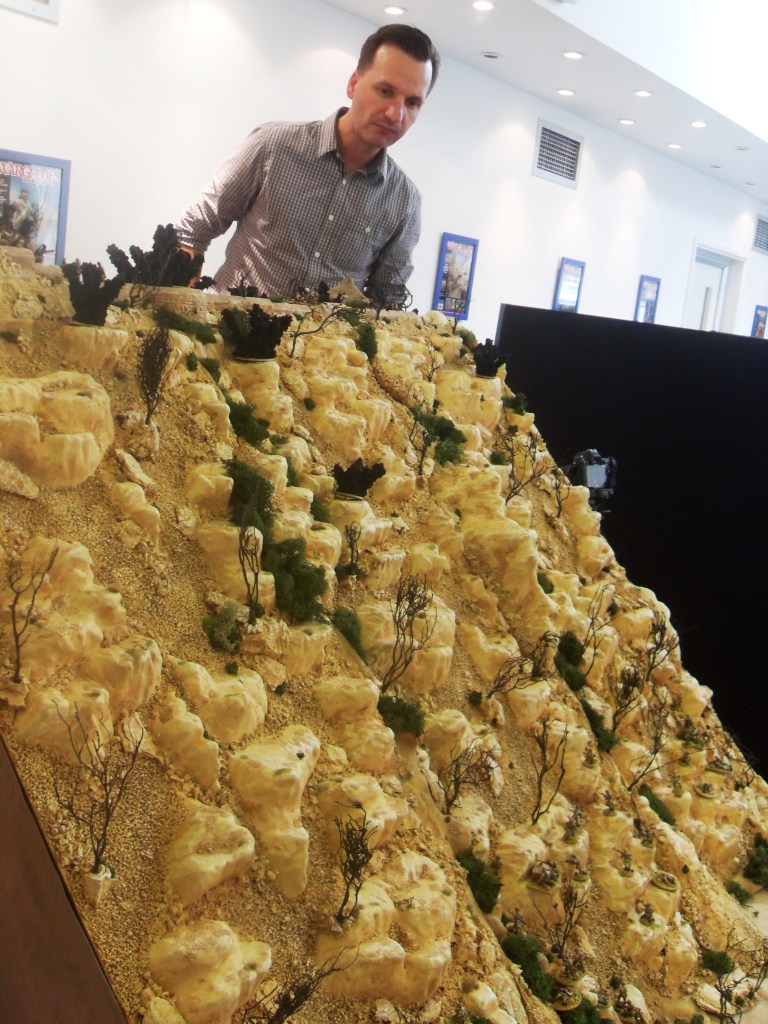
Having had the lurgy and not having much new to show, I thought I’d pull out a battle report from what feels like the dim and distant past, but turns out to be only 2013. In this period, I was exploring WW2 in the East Africa theatre – an amazing period of history that deserves way more attention than it gets. I got fixated on the 1941 Battle of Keren and the multiple actions that took place in this gruelling contest between the British Empire and Italian East Africa. This resulted in the rather impetuous decision to build part of a mountain and tour it round various shows in Scrivs’ Mini (you can see more our Keren adventures on Mogsymakes and on Scrivsland).

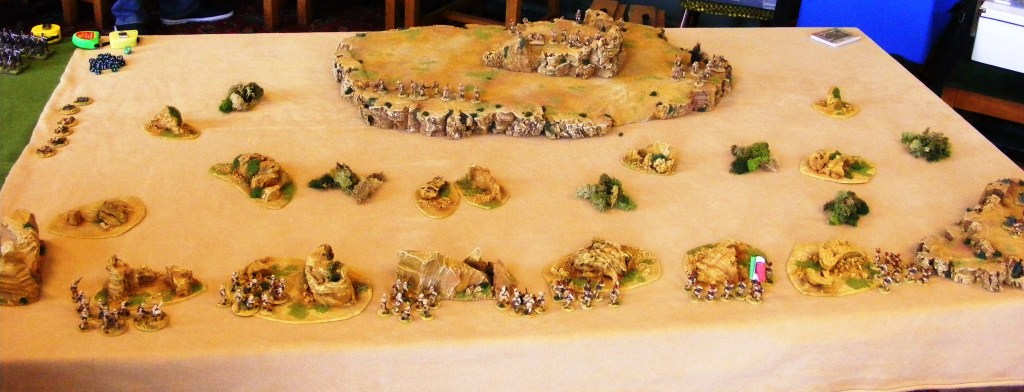
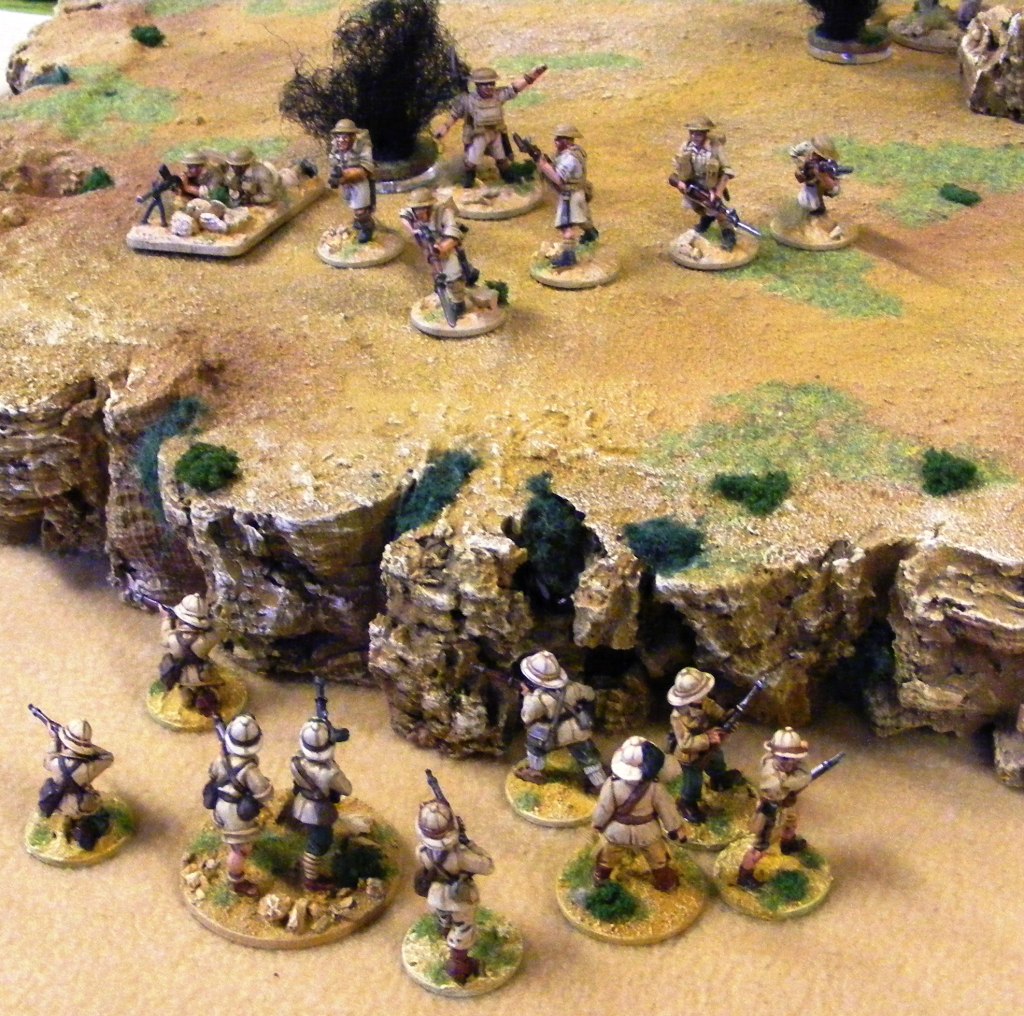
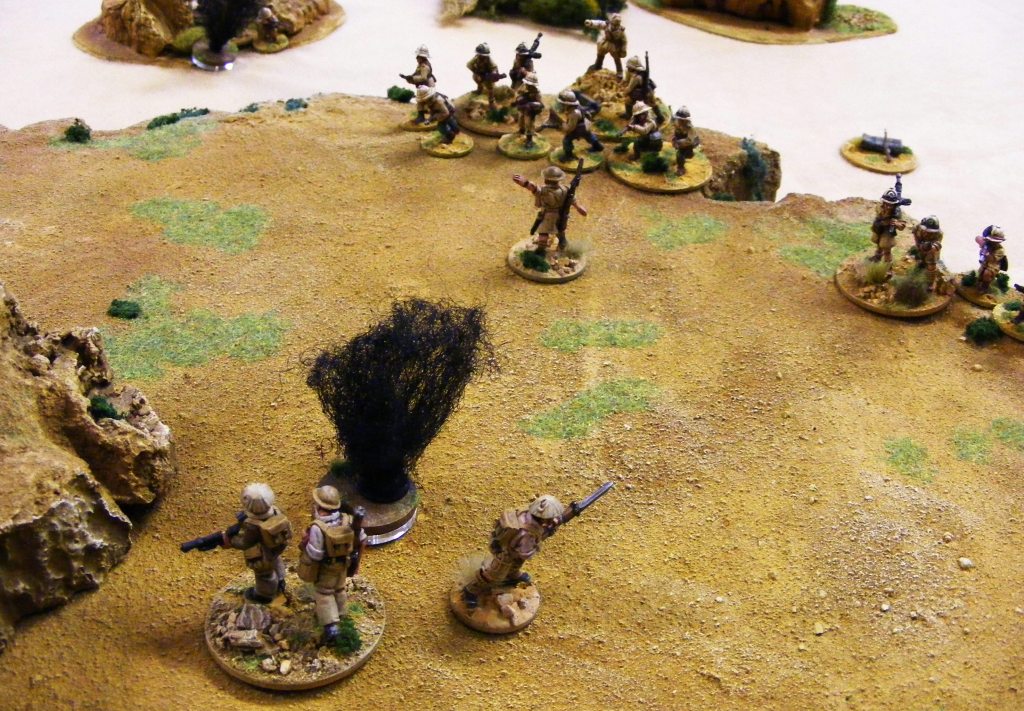
Brig’s Peak (centre top) with Brits occupying, Italians about to assault.

Anyway, at this stage, the mountain had not yet been built, but Scrivs and I were busy testing out scenarios for the campaign in our weekly gaming sessions. I’ve got a feeling that Andy Mac also played in this one due to the presence of RSM ‘Basher’ MacTaggart on the roster, but couldn’t swear to it!

Brig’s Peak on the battle map (centre). The contours don’t do the Keren battlefield justice – have a look on Google Earth if you want to get an idea of the challenging terrain!

We were playing Two Fat Lardies’ I Ain’t Been Shot Mum.  Last time out we’d tried a Cameron Ridge scenario using both IABSM and then Bolt Action; this time we played out a game based on the battles for Brig’s Peak, the highest peak at Keren – so called because ‘that’s the one the Brigadier wants.’  Brig’s Peak was viciously fought over and changed hands a couple of times, but the British never managed to hold onto and it remained under Italian control until the surrender in March 1941. 

IABSM is one my favourite Lardy games, and we’d stripped it down for this game so that 1 card = 1 section (not 1 card = 1 platoon as in the core rules). This gave us a smaller but very fast-moving game.

The British started with 4 infantry sections, a sniper and a 2” mortar on Brig’s Peak itself – their mission was to hold off the Italians until the end of the game.  They were led by RSM ‘Basher’ Mactaggart (a Level 3 Big Man) and Lance-Corporal Jones, and also had a Forward Observer who could call up the fire of a pair of 3” mortars in support.  All troops were rated as Elite, although each section had to take a dice roll before the game to see if it had already suffered any casualties; I got off very lightly, only taking a few points of Shock.

The Italians had 6 infantry sections, a Fiat-Revelli MMG, and additional support from a pair of mountain guns.  They were led by 3 Big Men (levels 1, 2 and 3).  All were rated as Veteran.

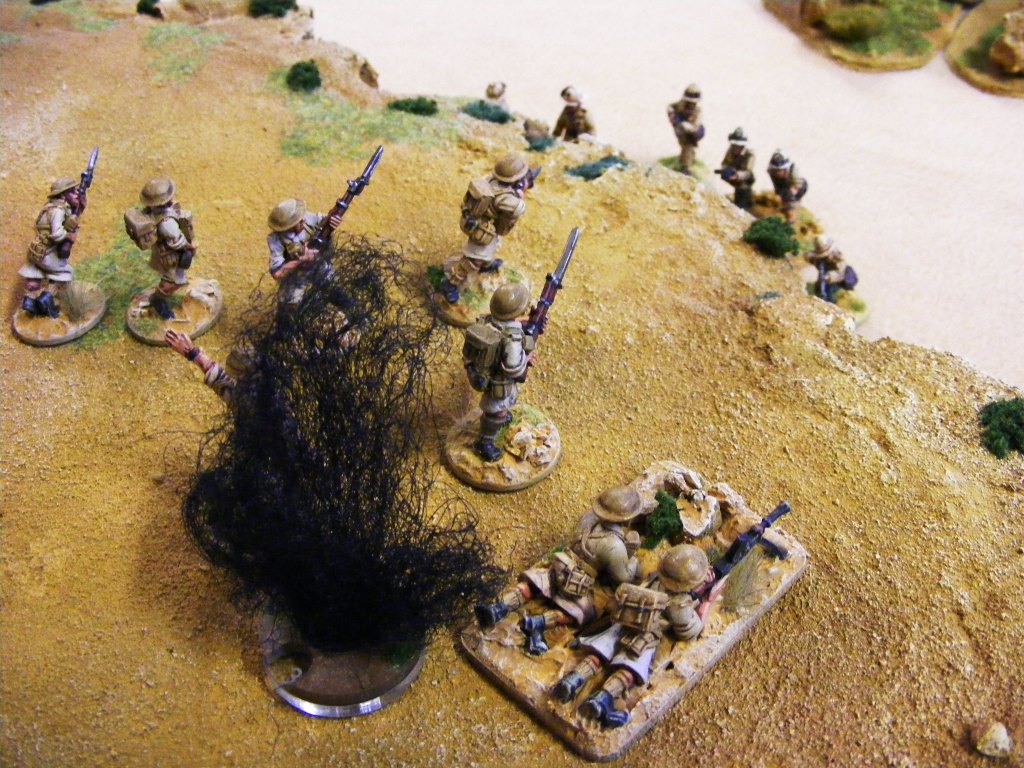
Askari LMG and Italian MMG teams line up the Brits in their sights.

Playing IABSM in 28mm, we simply used 1 card for each section (so the Allied Platoon 1 card meant Allied Section 1 instead), and just doubled all the distances.  We also decided to deploy all units on table at the start of the game, rather than using blinds – this gave us a slightly faster playing time (2 and half hours), which was what we needed on a weekday evening with work the next day! 

We also added in some extra cards: Allied Ammo Shortage; Allies & Axis Rally; Allied & Axis Heroic Leaders (there were many brave feats during the battle on both sides); and two blank cards to represent the treacherous rocky slopes which characterised the Keren battlefield (if one of  these was drawn, the next section/ Big Man would be unable to move that turn.)  Terrain-wise, we used a sand cloth with some rocky terrain pieces on top (not quite a vertiginous as the real terrain, but fine for a wargame!)  The small peak in the centre was Brig’s Peak itself.

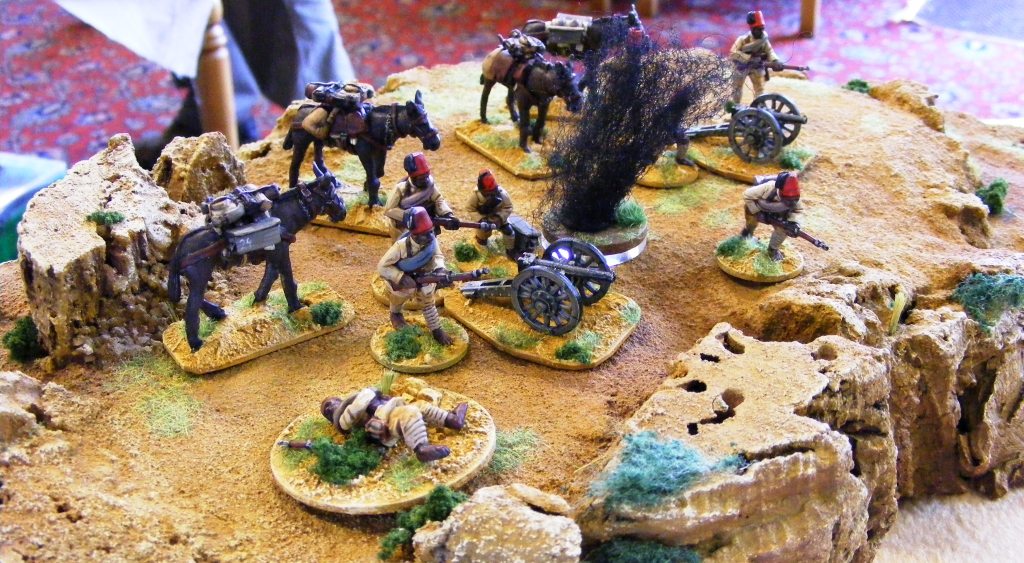
Italian mountain guns, crewed by Askaris, coming under fire from the Brits.

The battle started with a hail of fire from the Italian mountain guns deployed on the Italian right – despite the cover of Brig’s Peak, the British units took a number of hits.  Not for the first time, lucky dice rolling on my part meant that casualties were minimal, and my British sniper got the gunners’ heads down with a number of Shock points caused by his sharpshooting. 

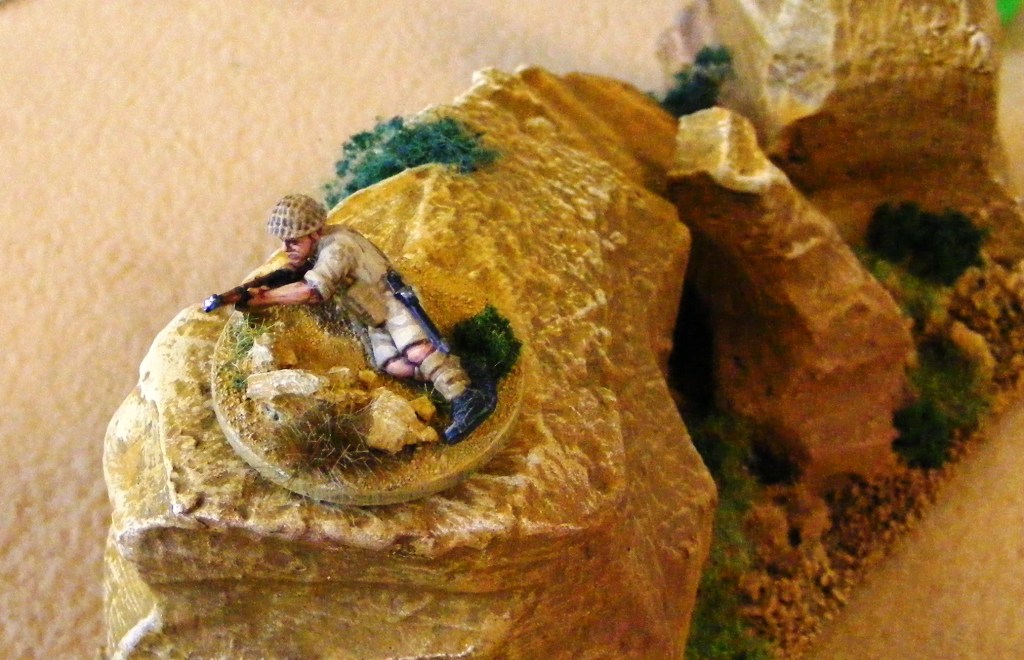
British sniper – great at inflicting Shock in IABSM!

The firefight continued across the battlefield and, as the turns rolled on, the Italian numbers began to tell.  My section deployed on the left was in good shape and was being well-supported by the 2” mortar team at the rear of the peak and the two Big Men; however, the Italian MMG chewed up the sections holding the front of Brig’s Peak, and the Italian Tenente ordered an advance on the Italian left and centre.  RSM Mactaggart was about to rush back to rally his men, when he tripped over a rock and was forced to stay put!  Fortunately, the British FO had managed to call up the 3” mortars and caught an Italian unit with the first salvo, causing no damage but pinning the section. 

With a few lucky cards and two Big Men leading the attack, the Italians rapidly approached the peak and drove off the defending units, now down to their last few men and heavily shocked. 

At this point the Italian Heroic Leader card came up, so we allowed the Tenente an extra turn to assault the peak – the three Italian sections heroically scaled the peak and drove off the defenders with grenades.  At this point I certainly thought it was game over, but the next card happened to be Allied Heroic Leader! 

Italians scale Brig’s Peak!

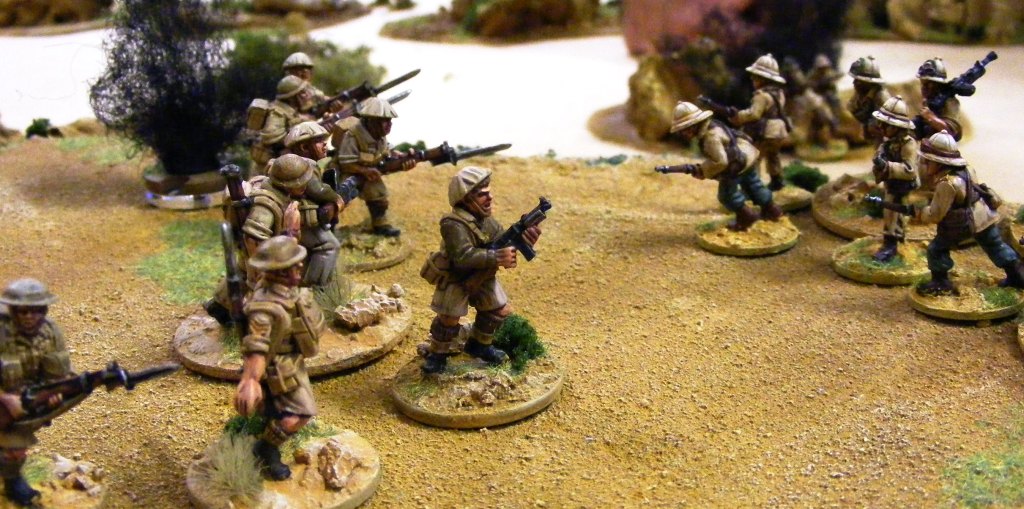
This allowed RSM Mactaggart to lead his final remaining rifle section in a final, desperate charge to drive the Italians off the peak.  With around 10 dice vs the Italians’ 14 or so, I thought it was unlikely to succeed, so I was amazed to roll 6 kills against 2.  The Italians lost by 4, and fled down the slopes, closely followed by a hail of Mills bombs and falling rocks.

RSM MacTaggart drives off the Italians!

With that, it was all over.  The British had a close victory, although were in no state to hold the peak and would have been forced to withdraw had we played a few more turns.  Lots of fun and a great chance to use a mixture of Italians, Brits and Askari models. 

Here’s a couple of snaps of where the project was a year later, in 2014 – by then I’d built the mountain, and this was the game we were taking round the shows:

Here’s Wargames Illustrated editor Dan for scale!
This was the end point of this project – part of the Battle of Keren played on a 24″ high ‘mountain’!

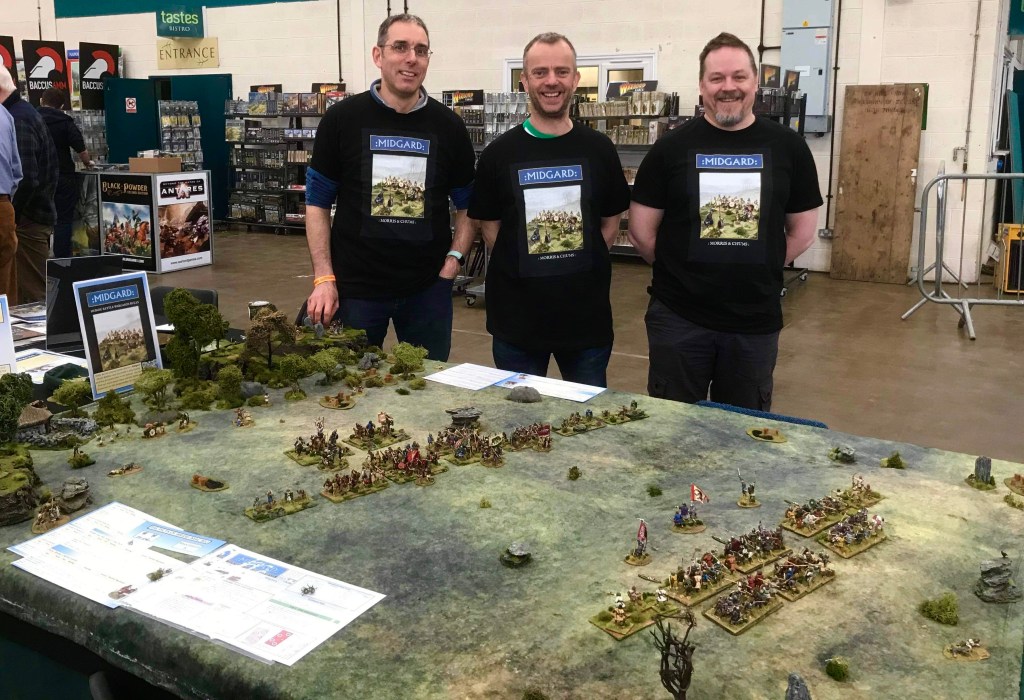
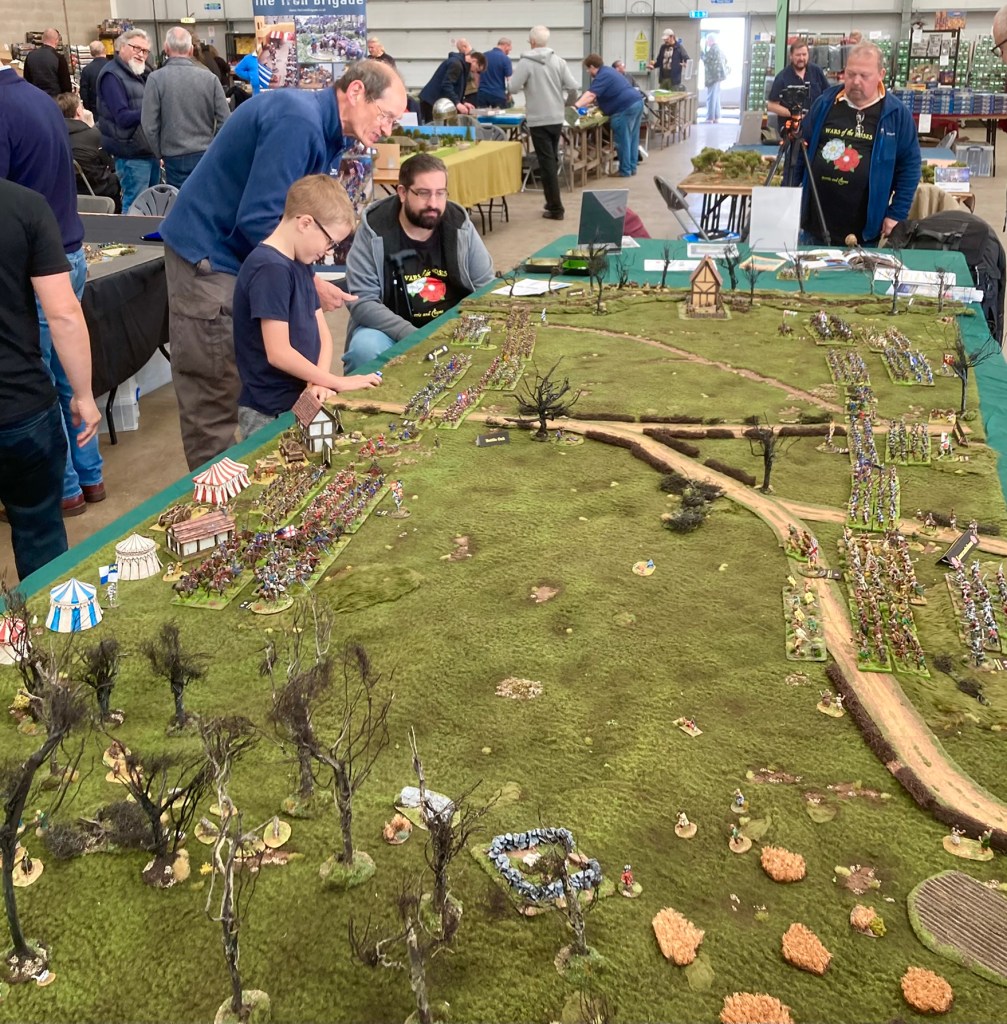
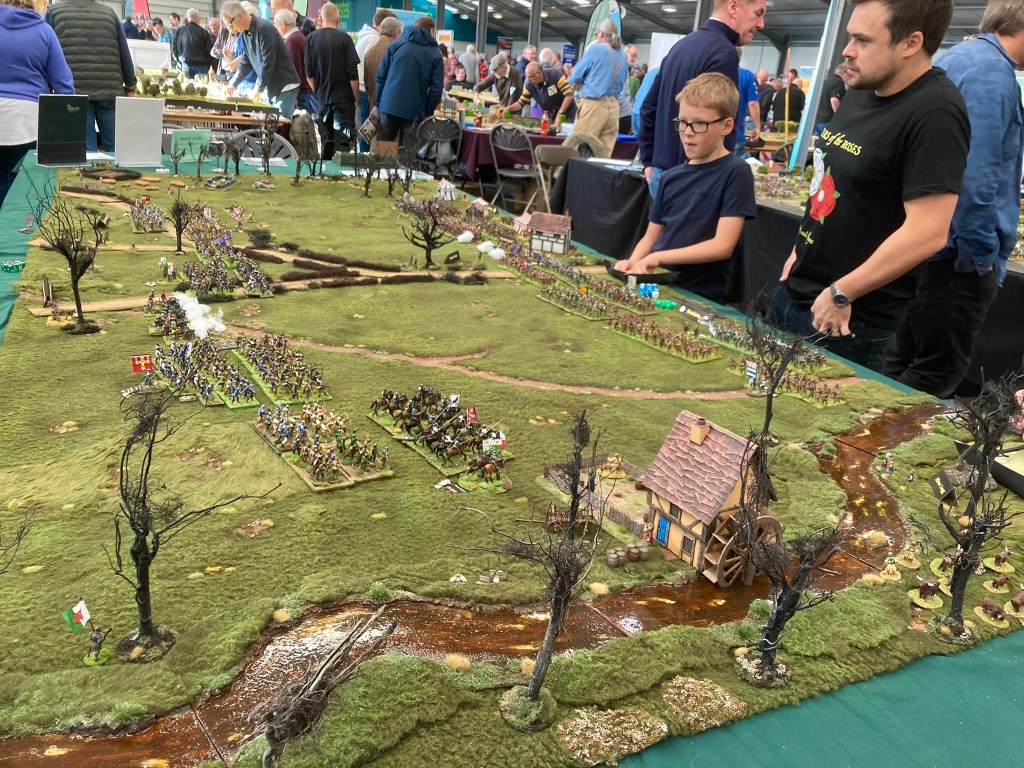
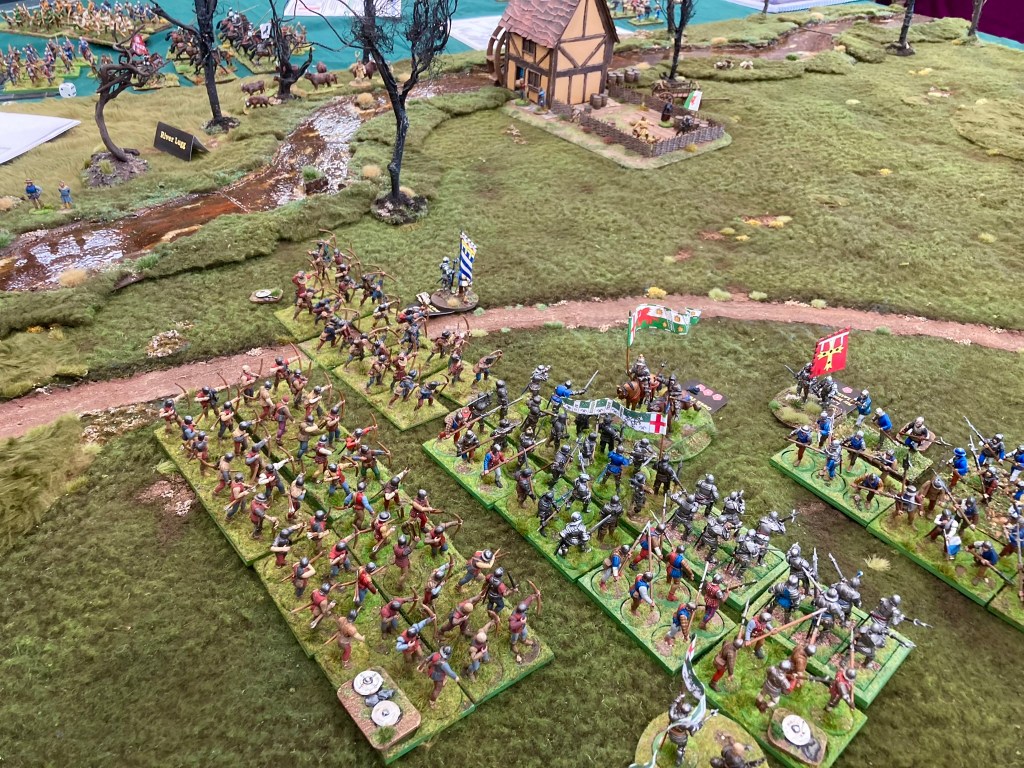
The Battle of Mortimer’s Cross at The Other Partizan 2022

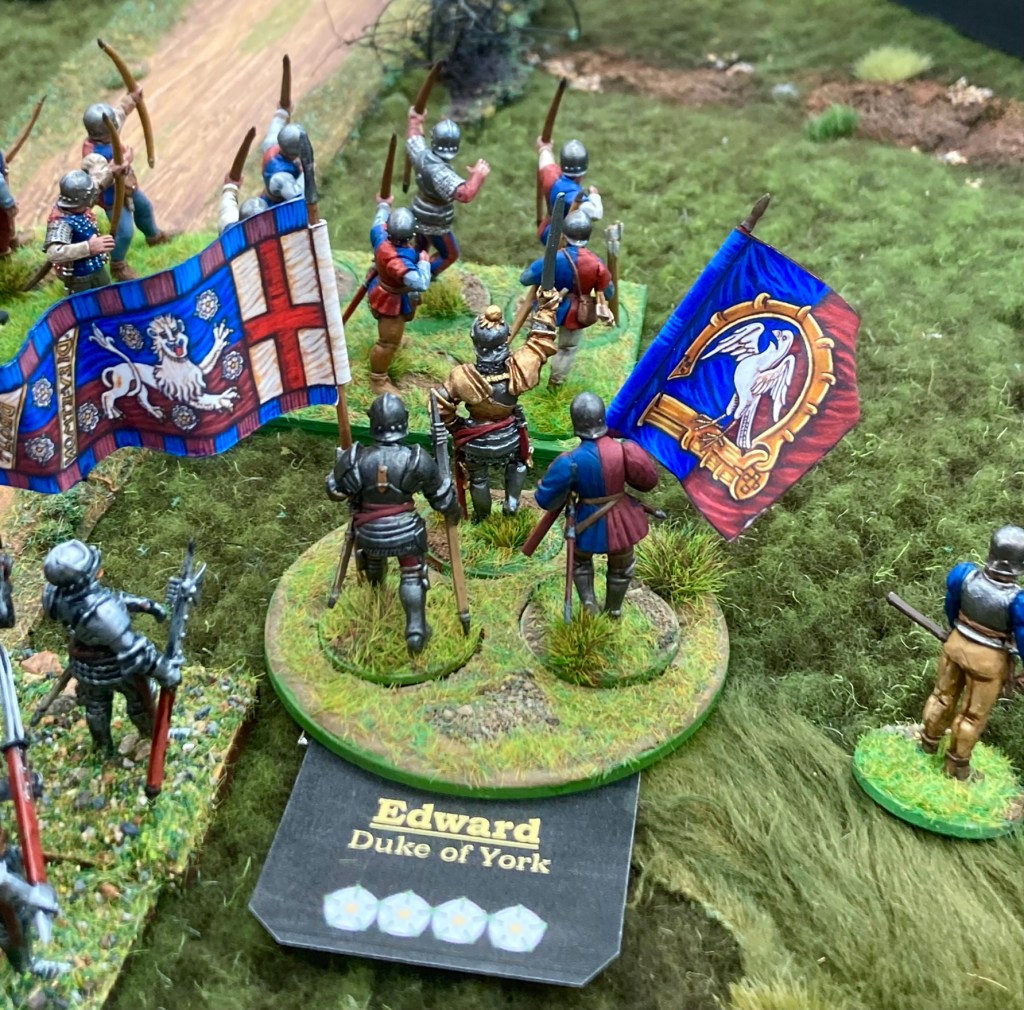
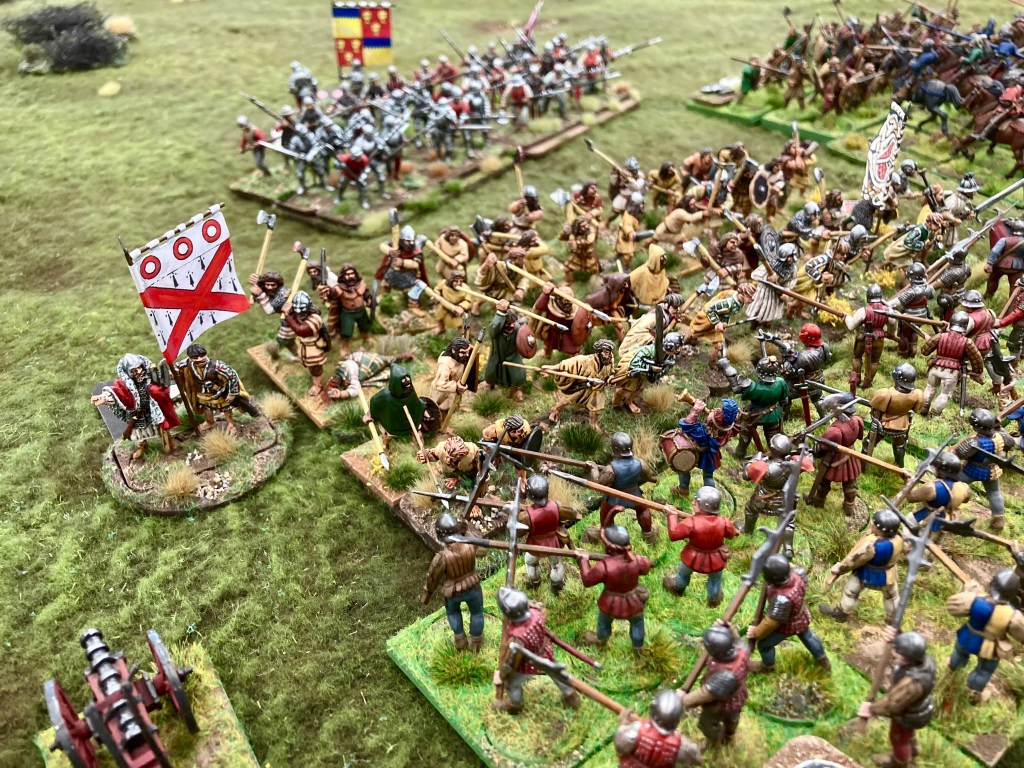
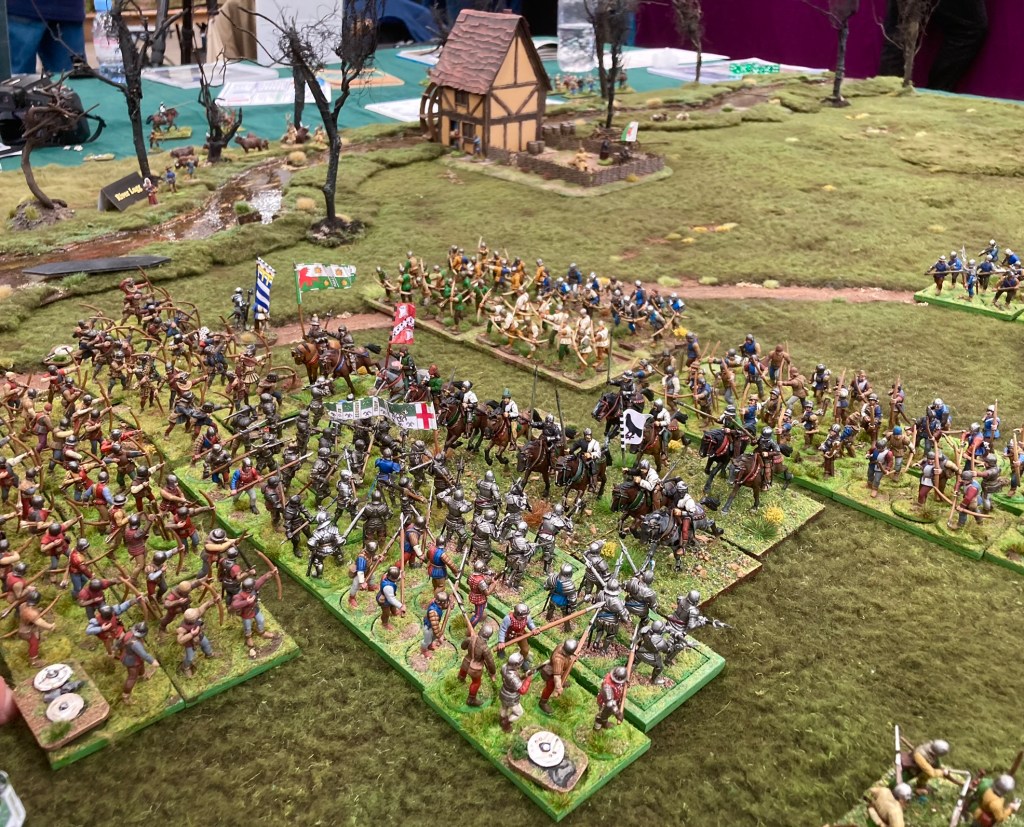
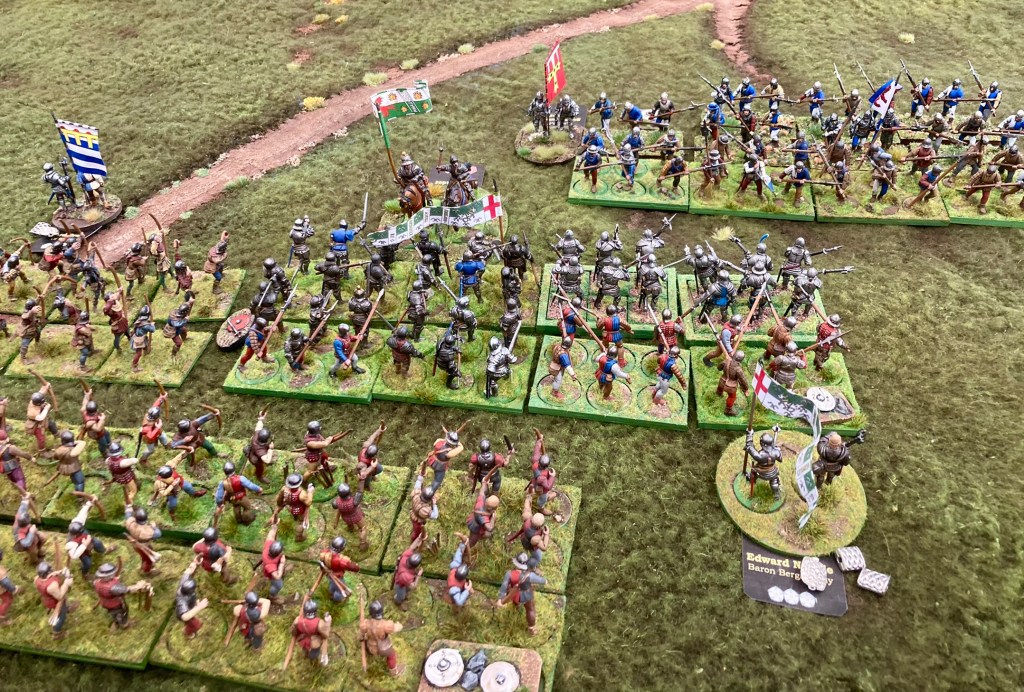
‘Edward of York, he’s our man, if he can’t do it, no one can!’ Eddie gets the top Hero rating in Midgard, Level 4 Legendary Hero (shown by the 4 roses). Perry Minis by Chris.

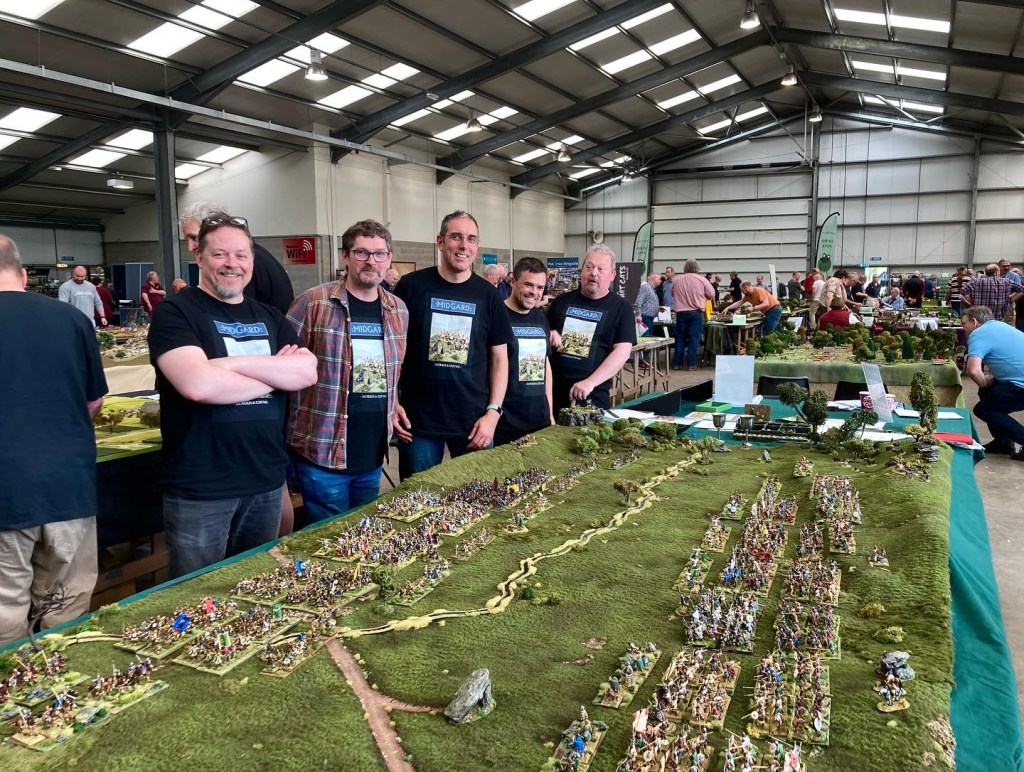
Tom in our group has long had a fascination with the Battle of Mortimer’s Cross and we’ve all dabbled in Wars of the Roses over the years (collecting the armies twice in my case!), but when Chris (Winston Ap Rees for you social media fans) joined our merry band, this was the catalyst for our latest Partizan game.

Mortimer’s Cross is an interesting battle for a number of reasons; like Stoke Field, it featured a contingent of Irish, the Tudors fought there, and it also saw the emergence of the military legend that would become Edward IV and his famous symbol ‘the Sunne in Splendour’ (later immortalised as the title of Sharon Penman’s excellent novelisation of the Wars of the Roses).

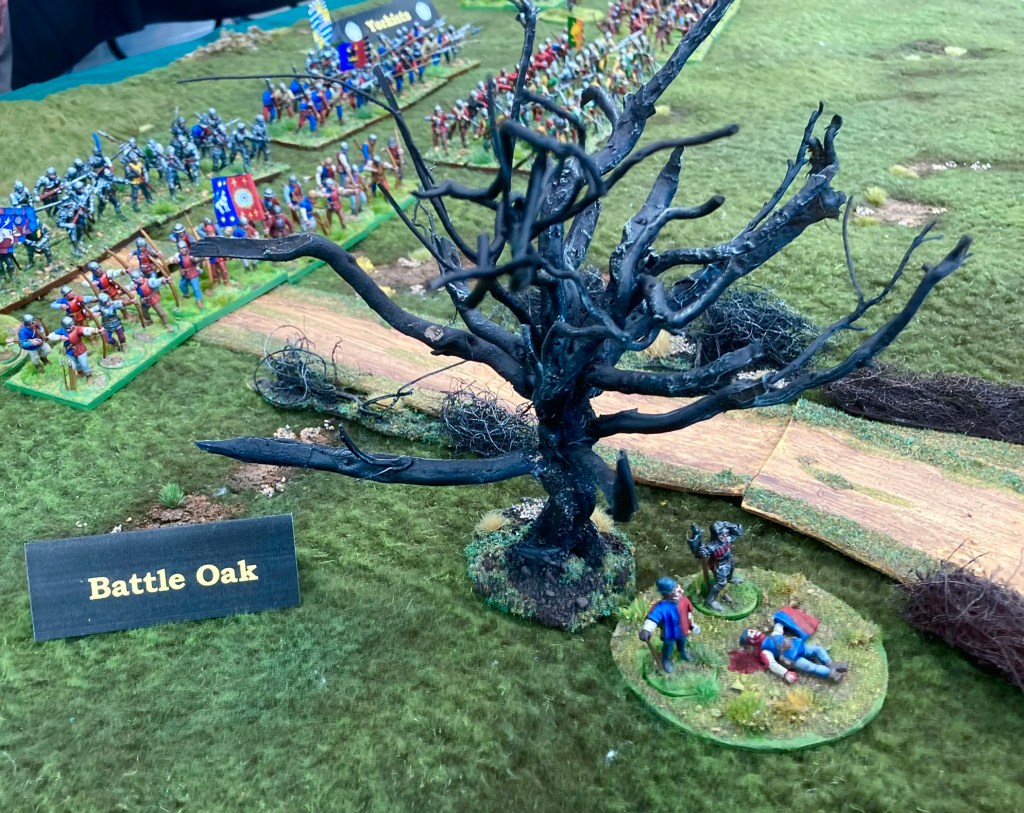
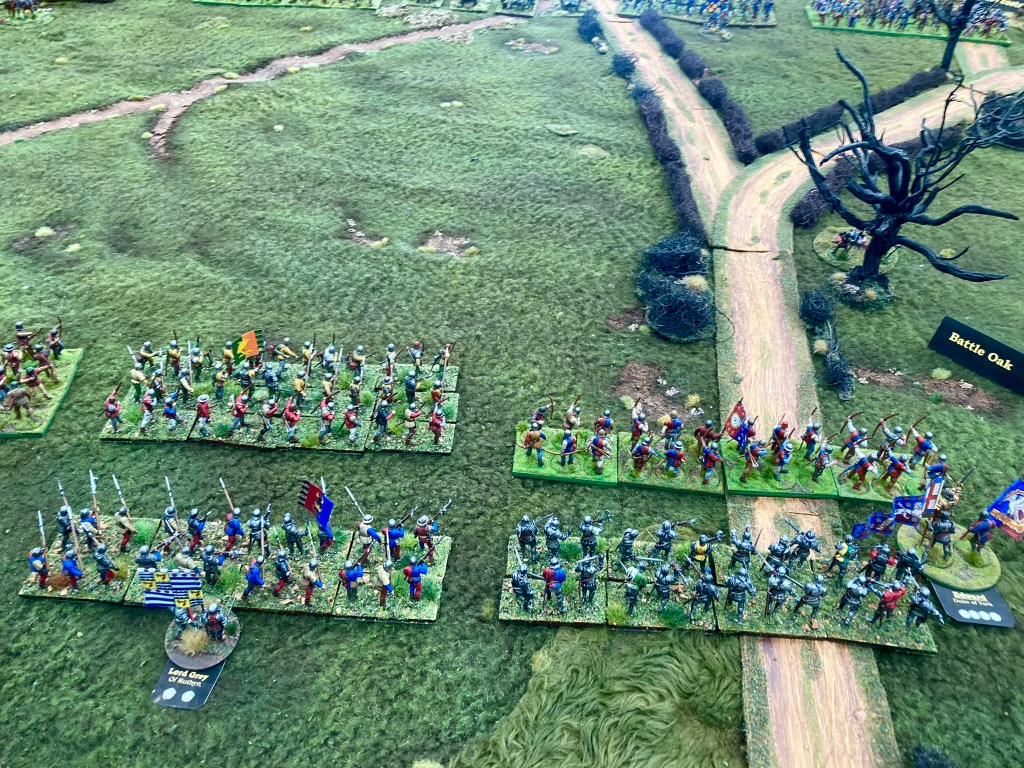
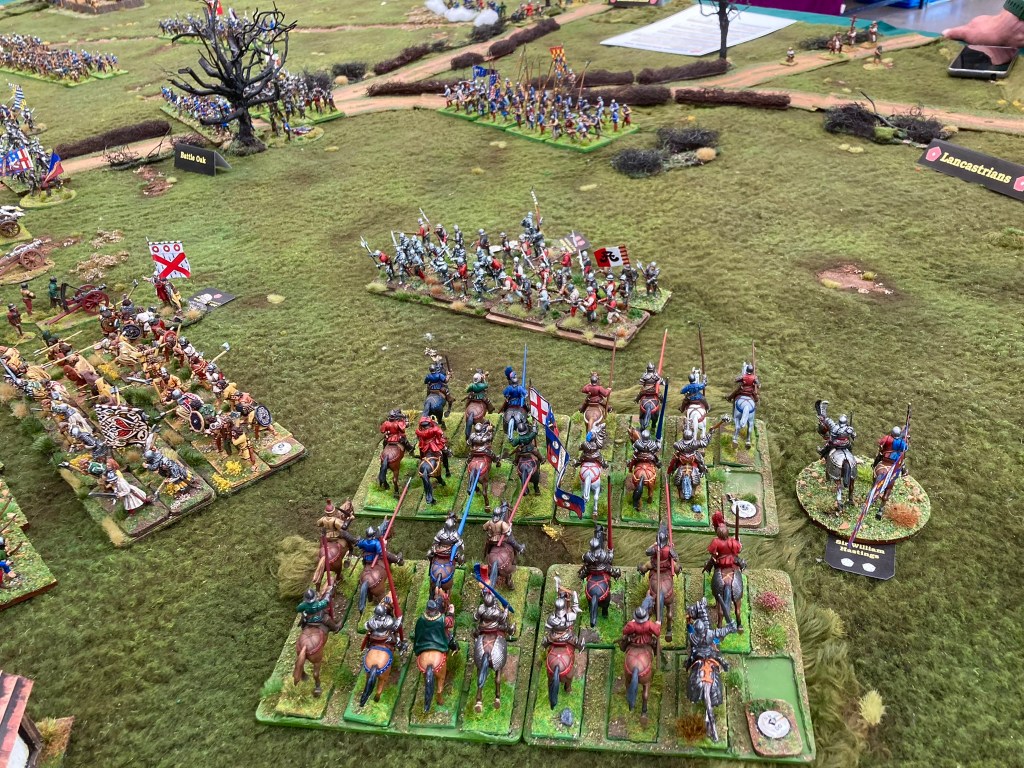
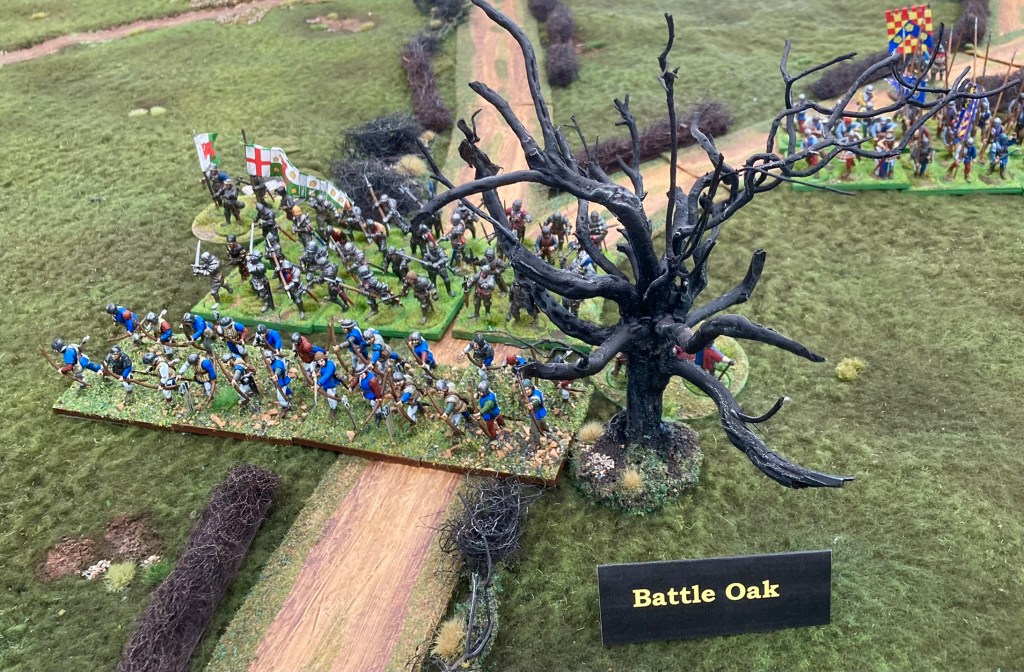
Battle Oak and the unfortunate herald killed beneath it – a folk tale unearthed by Tom WD and recreated in miniature by Chris.

One of the most famous tales of the battle is that, as the sun was rising through the cold morning mist on February 2nd 1461 (or 3rd – the exact day of the battle is disputed), it created the atmospheric phenomenon known as a parhelion – the appearance of a triple sun. Although the Yorkists were frightened by this, Edward (Earl of March and Duke of York, soon to be King) is said to have interpreted the vision as a sign of God’s favour. We were able to replicate this in our game by giving Edward the ‘Omens’ trait that allowed him a (randomised) chance of raising (or lowering) morale before the game. Fortuitously, Fraser (playing Edward) rolled a 5, giving the Yorkists extra tokens in their goblet of reputation, and the rest, as they say, is history.

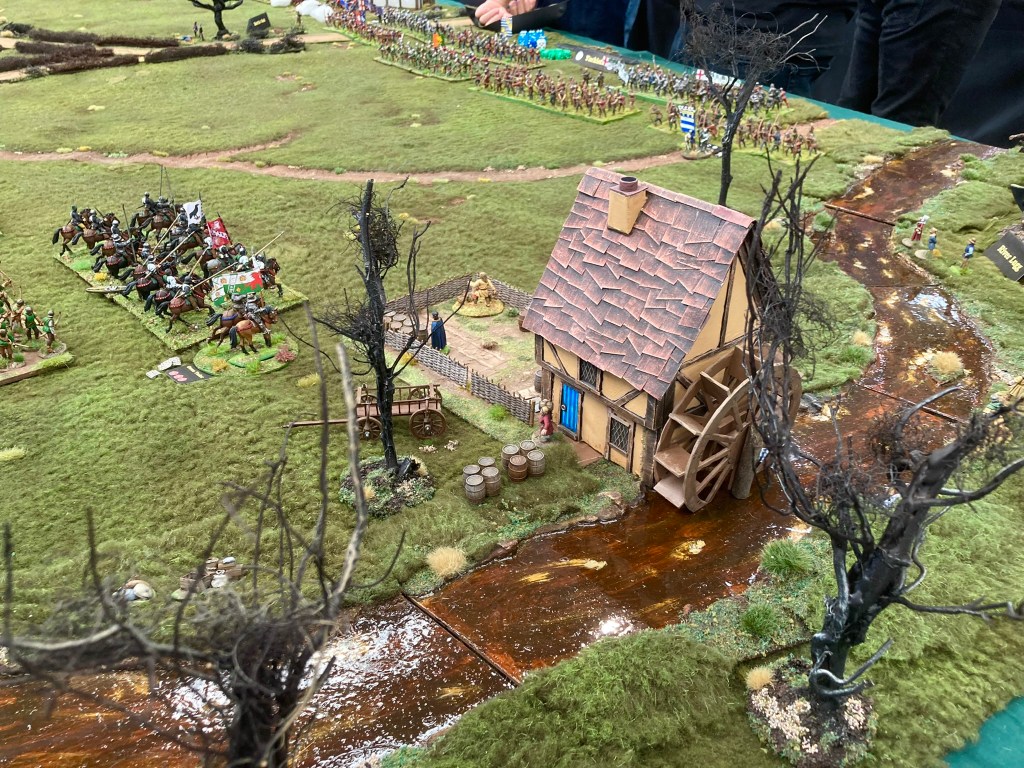
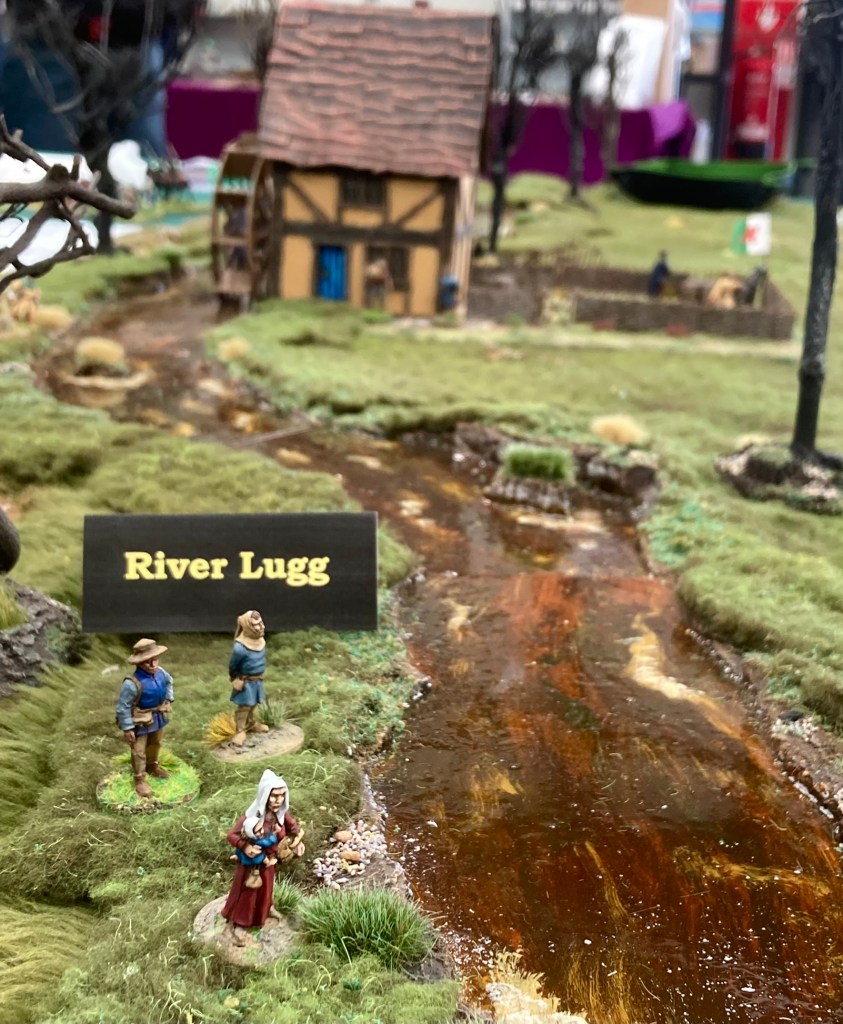
The mill on the Lugg – fine work by Chris.

We considered the very enjoyable Never Mind The Billhooks for rules, but my own Midgard won out because it was specifically designed for fighting large battles. We stripped out the more heroic elements by banning single combats and cutting back on some of the more mystical traits, leaving the basic game engine that, I’m pleased to report, worked very well indeed.

By combining our various collections, we were able to put around 900 28 figures on the table. Units were composed of around 36-48 infantry or 16 cavalry, depending on the various basing systems in use. Midgard usually works with a standard unit frontage of 12 cm, but for this game we doubled that to 24 cm, giving us the appearance of a big battle but without too many units to keep track of. The army lists were sorted out by Chris, juggling our collections into a possible order of battle for the two forces. We followed tradition by appointing Jasper Tudor, Owen Tudor and Edward as the main commanders, but fitted in various other models from our collections as likely sub-commanders and leaders.

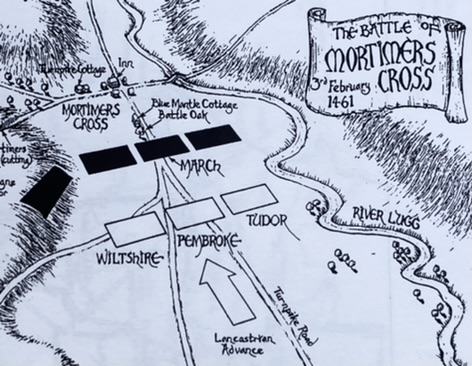
This is the wonderful map by Derek Stone from the Lance and Longbow society’s Battle of Towton booklet by Pat McGill. We followed this traditional deployment for the battle (apart from the flank attack shown on the high ground)

After a number of discussions about the different options (the alignment of the armies has two popular variants), we plumped for the traditional one with the north-south alignment shown above. During the show, I had fascinating conversations with a member of the Battlefields Society who favoured the other alignment (east-west) but who also confirmed the finding of three stone cannon balls on the suggested battle site. Whether these are related to the battle requires further investigation, but as we’d already deployed a few cannon, that was enough for us!

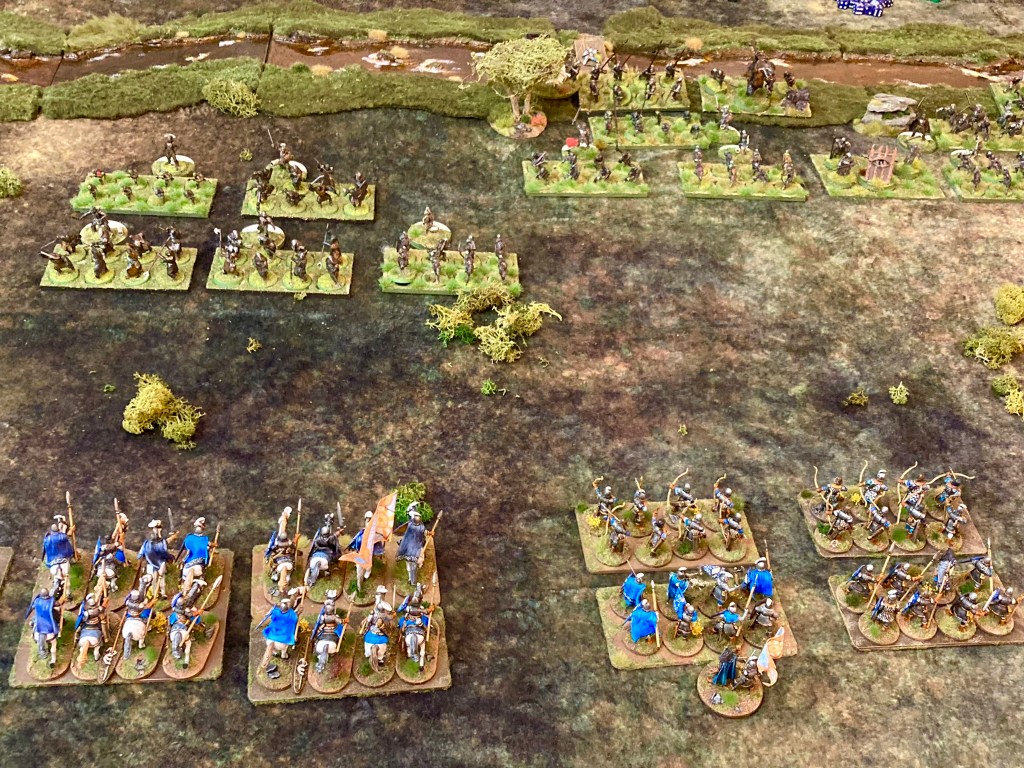
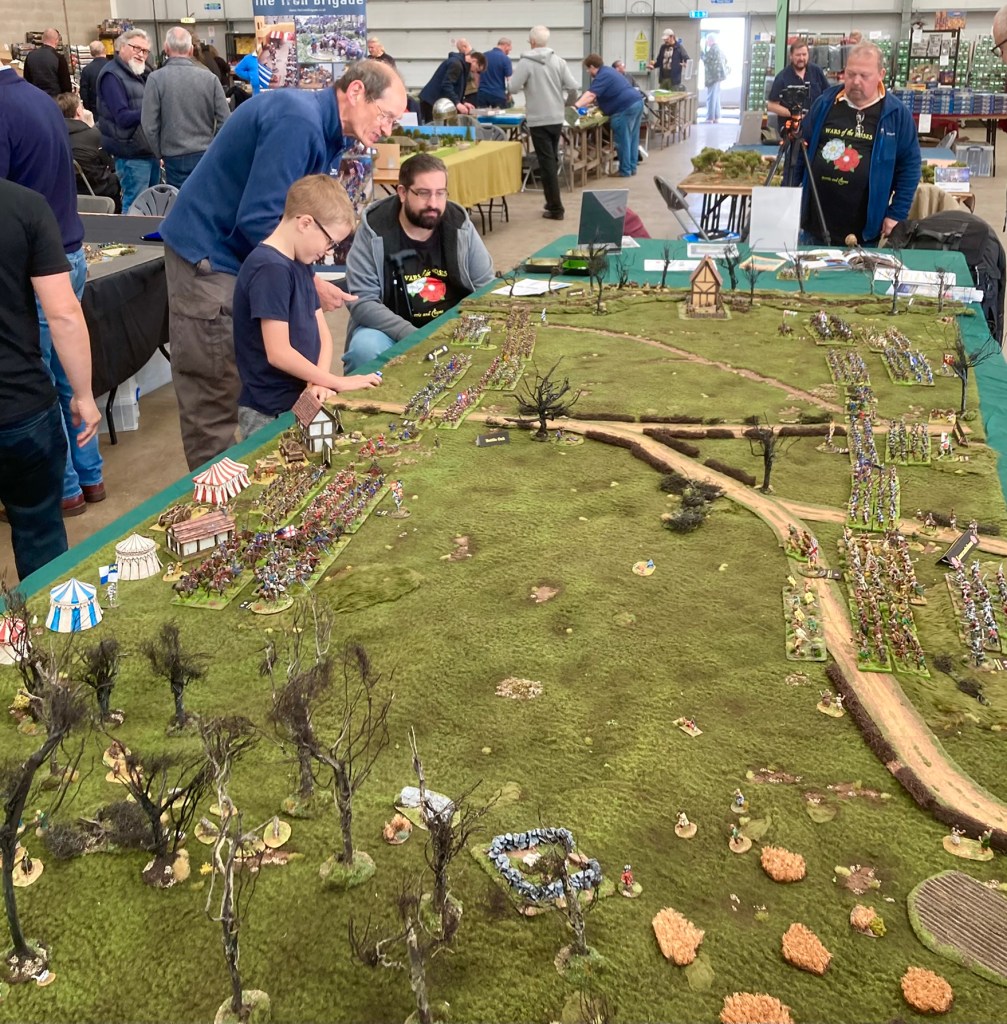
The ever genial Dr Nick pays us a visit. Yorkists are on the left (north) just in front of the village of Mortimer’s Cross; Lancastrians are on the right (south) with the River Lugg at the back of the table.

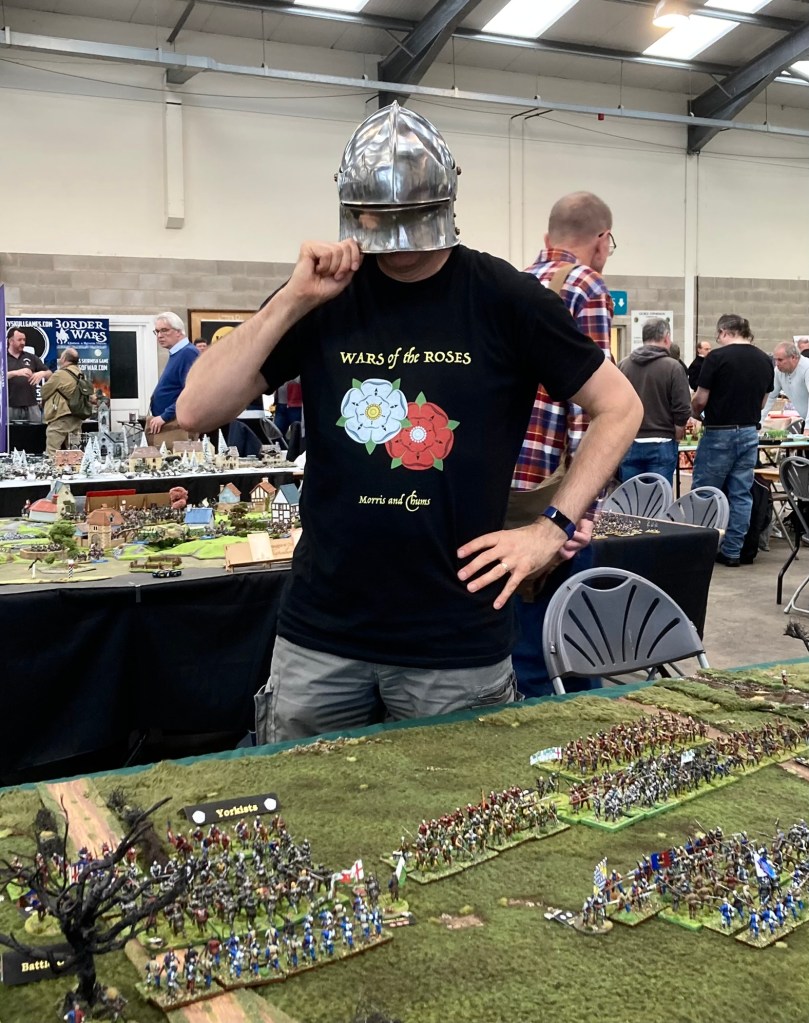
Minutes later, Barry Slemmings (author of Bills, Bows and Bloodshed and the Wikipedia page on the battle) arrived to congratulate us on choosing the correct alignment! We had a lively natter and he also lent me his splendid sallet for a quick comedy photo. Barry was followed up by a self-proclaimed descendant of Richard III, reminding me what a broad and fascinating church gaming is!

[Insert caption here]

Anyway, after this flurry of debate, we got stuck in to the battle proper. I’m not going to give a full blow-by-blow account, but will rather dwell on some highlights as I work through the pics. Martin posted a rather nice video of the game (plus some general highlights of the show) so do have a look at that if you get time!

Lancastrians close in on the Yorkists (top)
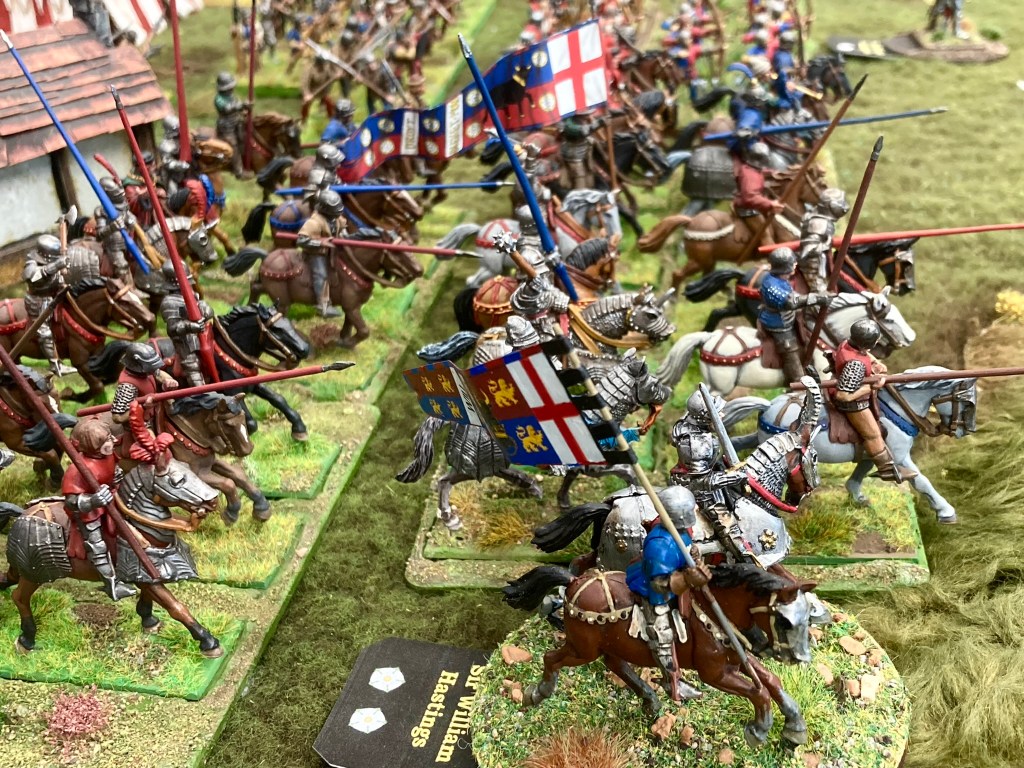
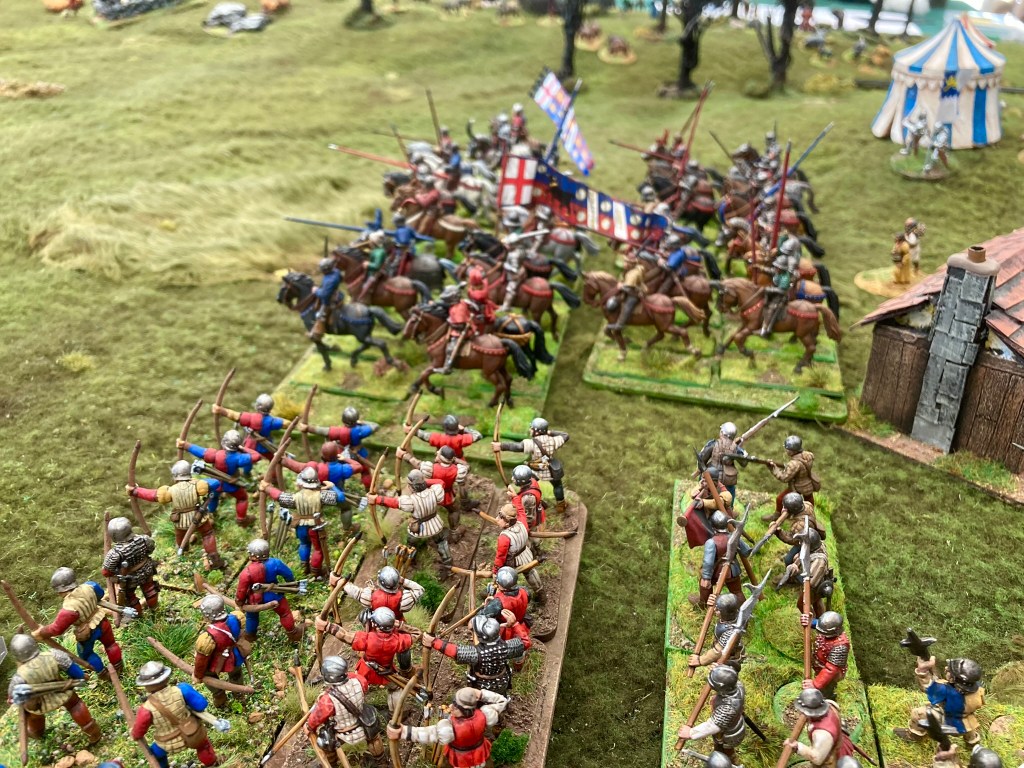
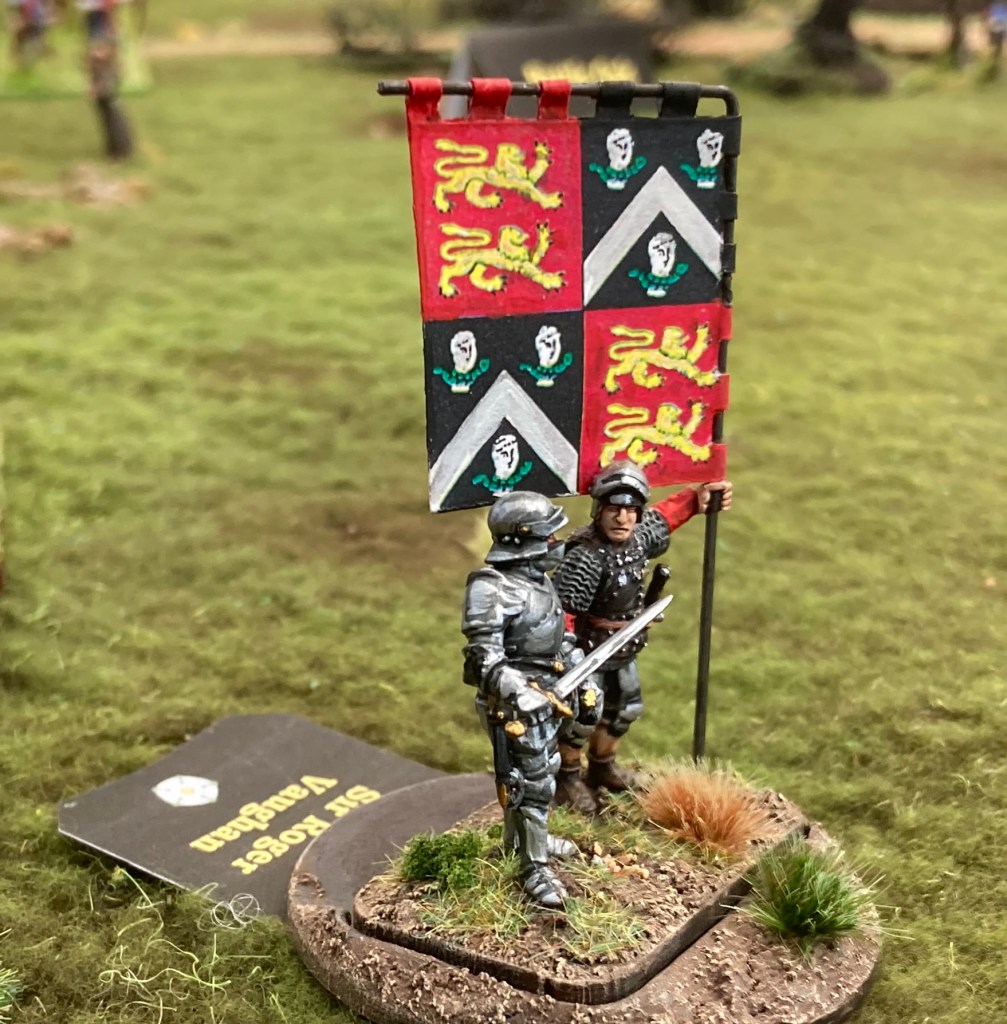
Sir Roger Vaughan and Sir William Hastings (mounted) prepare to defend Mortimer’s Cross.
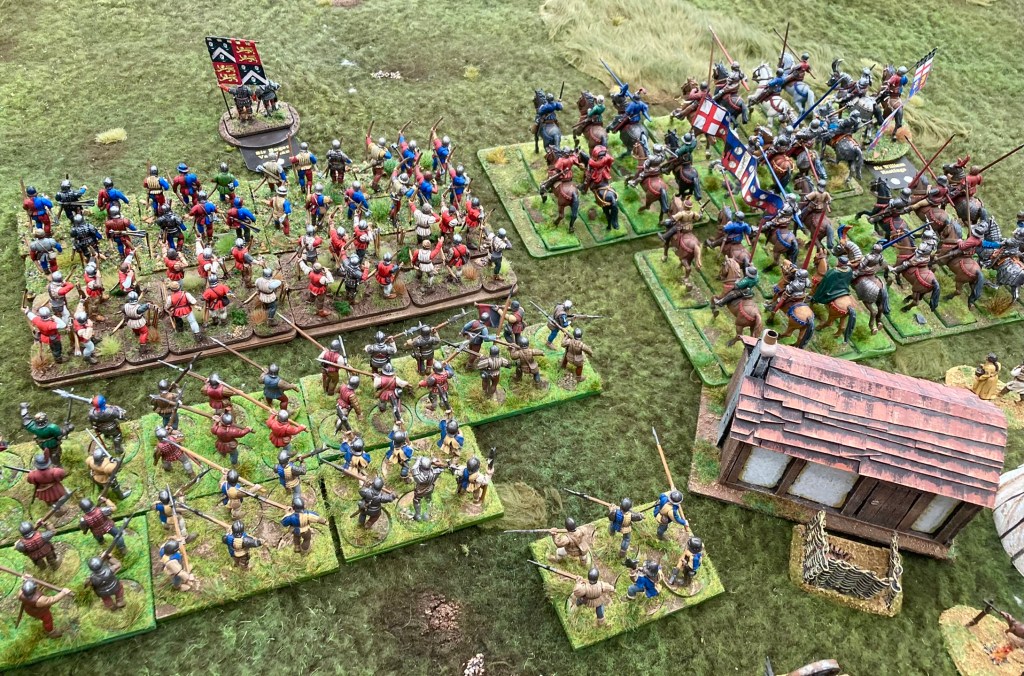
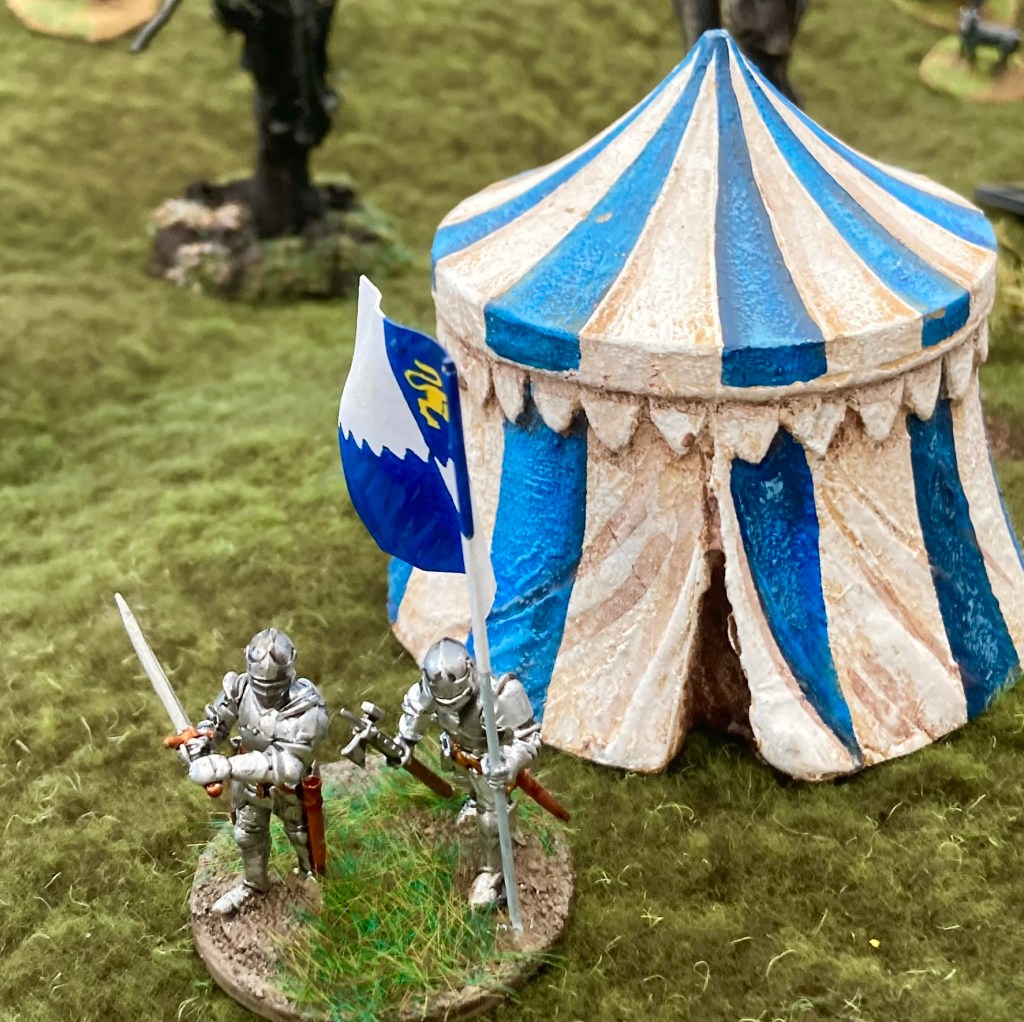
Sir Richard Croft of Croft’s Castle gets ready to smite the Lancastrians (Perry Minis by Tom WD, tent from Magister Militum painted by me for an El Cid game in the distant past)
A York! A York! Sir William Hastings commands the right.
Baron (A)Bergavenny commands the Yorkist left.
Lord Grey of Wilton supports Baron Bergavenny in the Yorkist ranks.
Sir Roger Vaughan, Yorkist sub commander
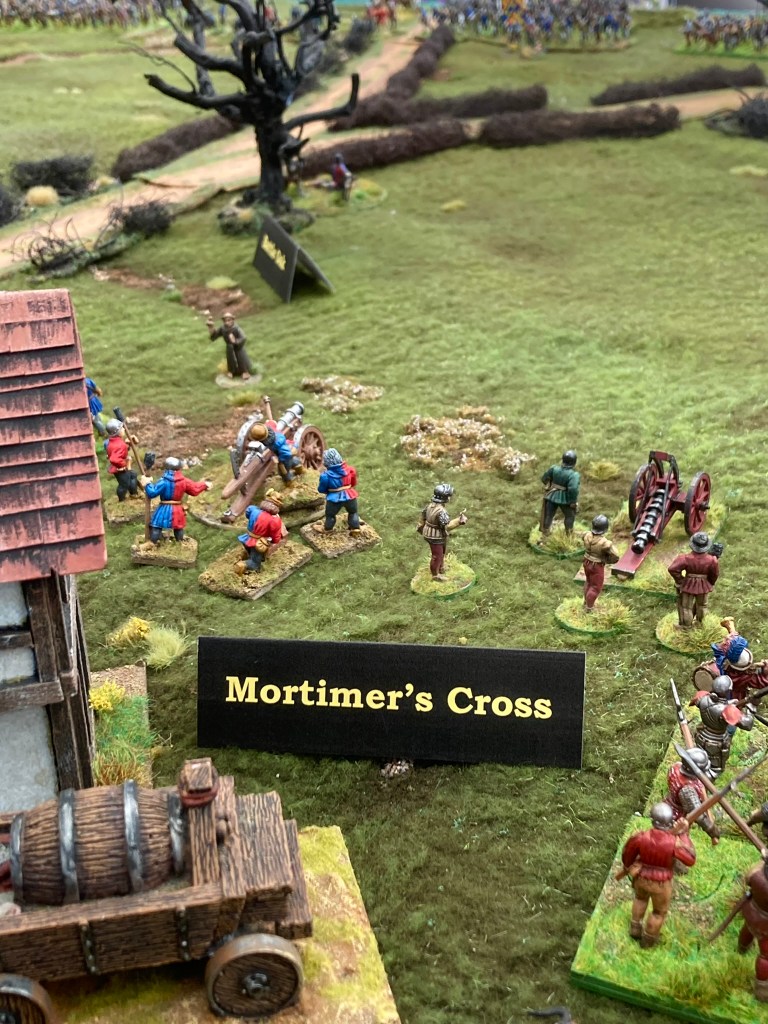
Defend the beer, men! Tom WD’s excellent hedges line the road in the background, providing a feeling of winter.
Lord Grey of Ruthyn
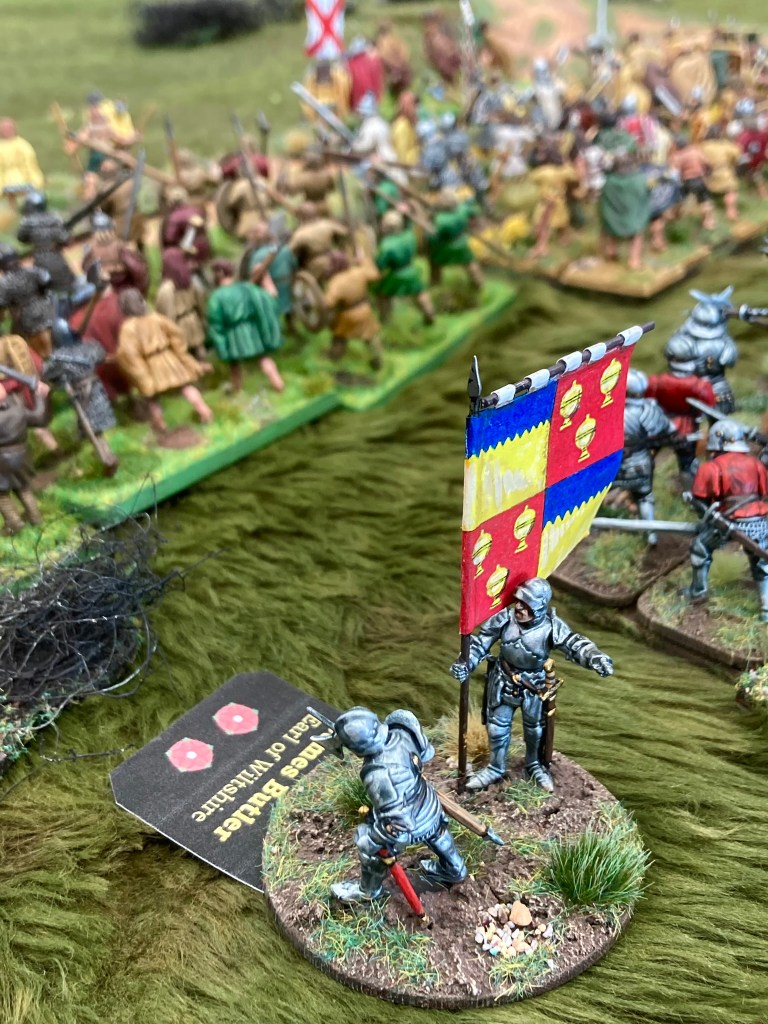
Our special tribute to the Earl of Wiltshire (who had a reputation for leaving the battlefield, er, prematurely). His standard bearer is reminding him of his duty!
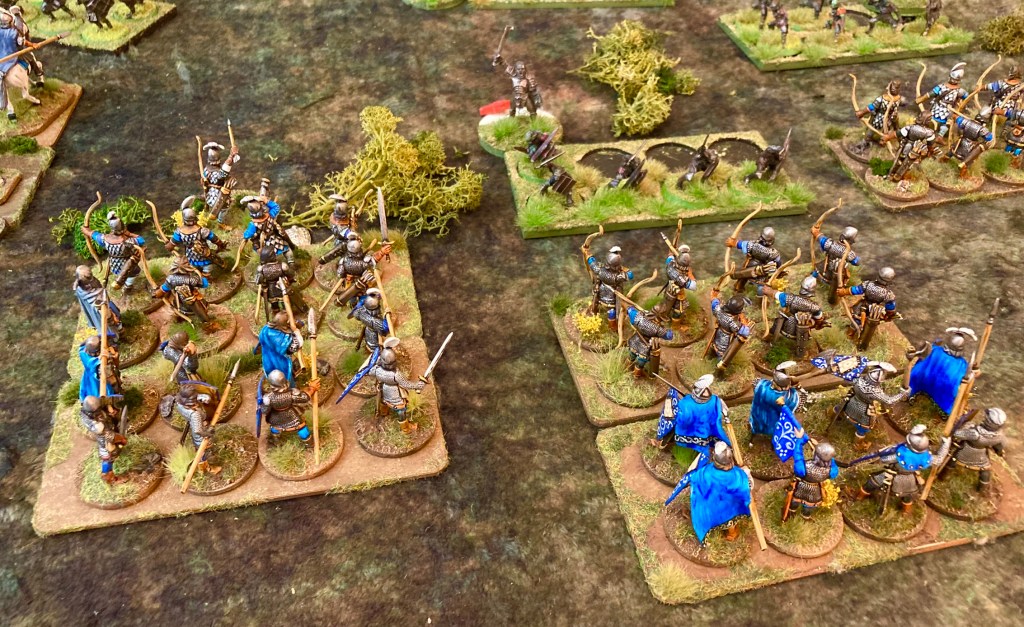
Irish surge forwards – Perry, Crusader and Gripping Beast minis painted by Chris and myself. If you like the Irish, there’s a load more pics here.
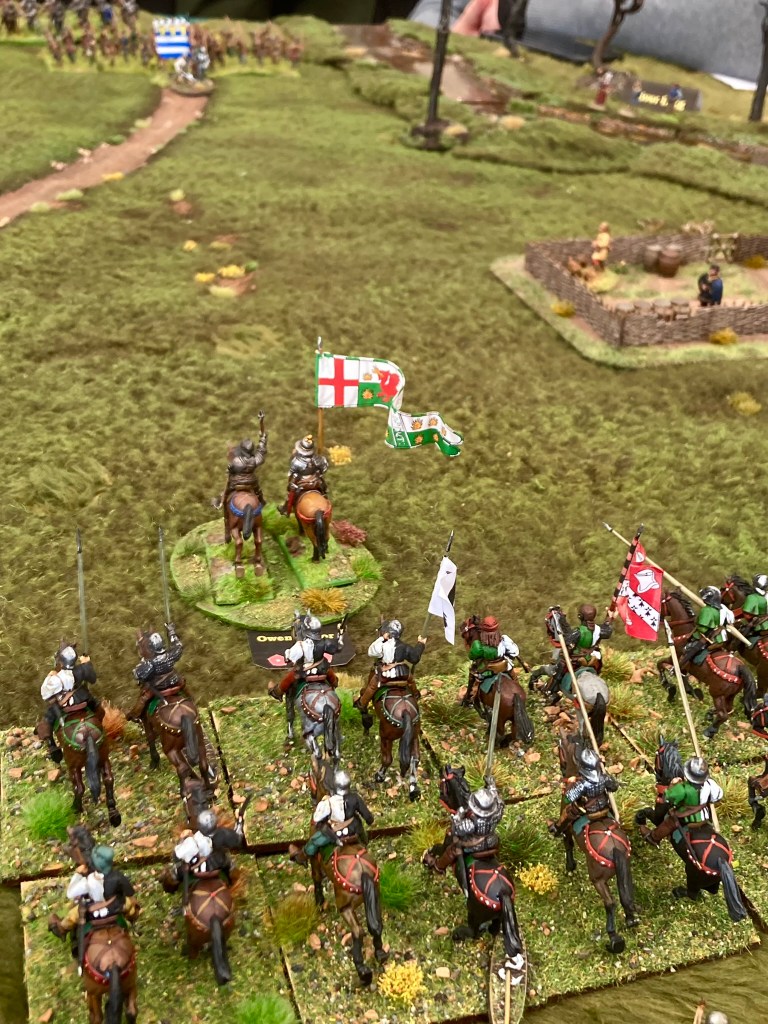
Ride to glory! Owen Tudor and a fine cavalry unit painted by Martin.
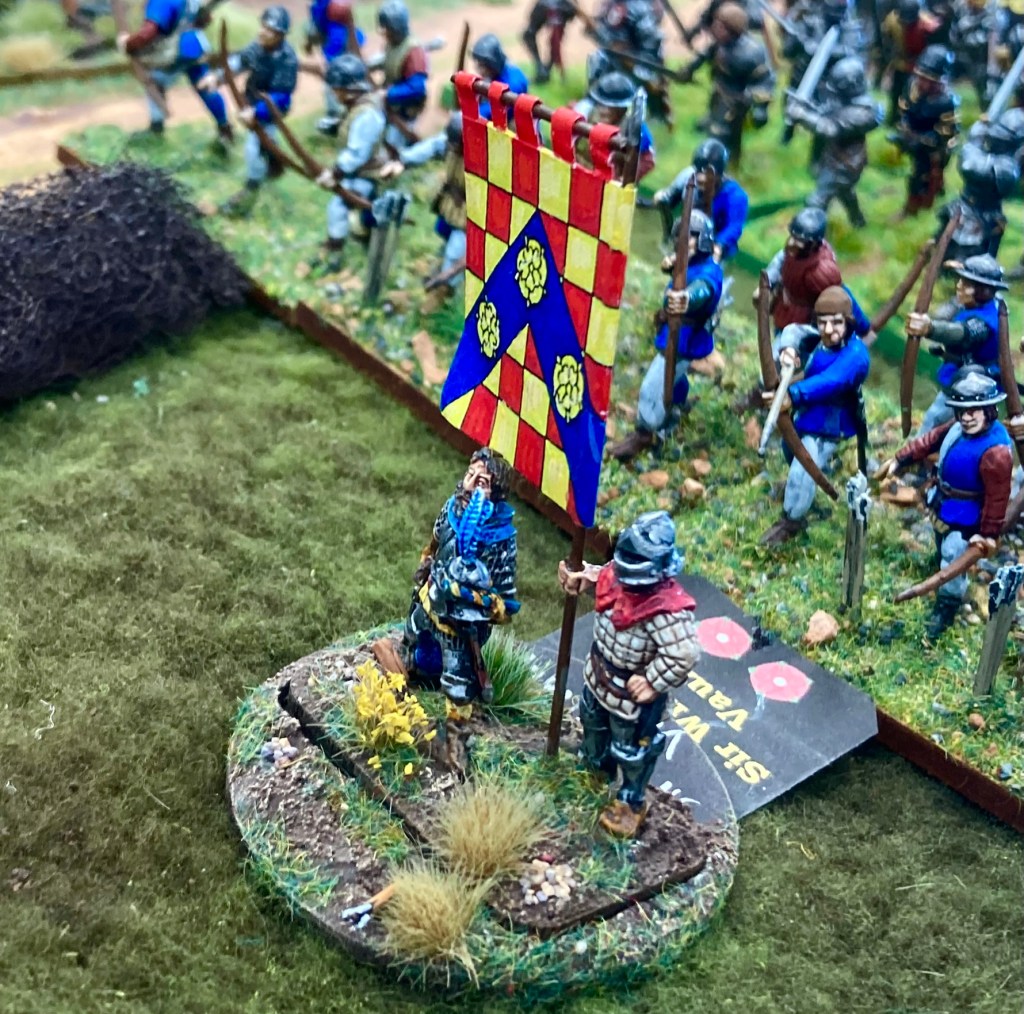
Sir William Vaux commands the mercenaries for Lancaster.
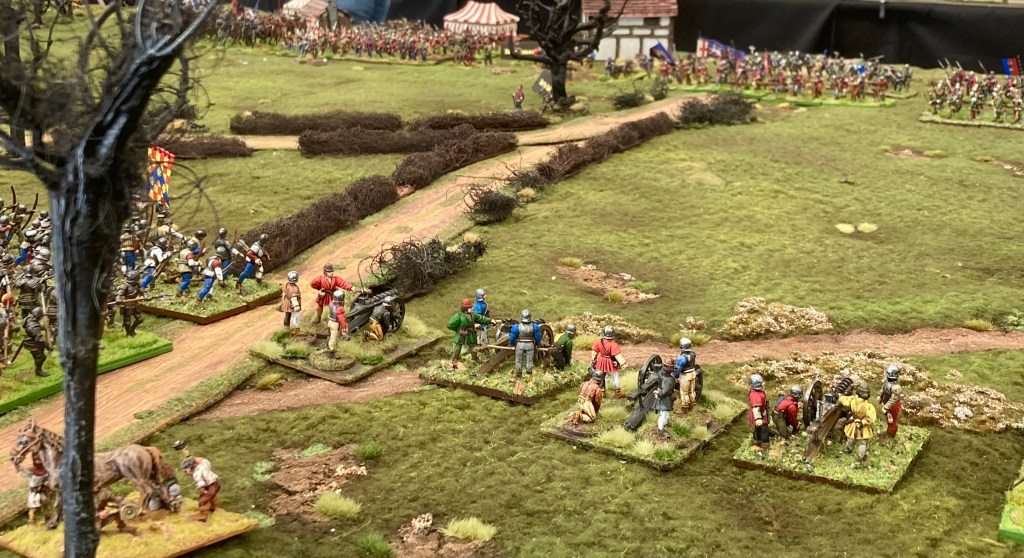
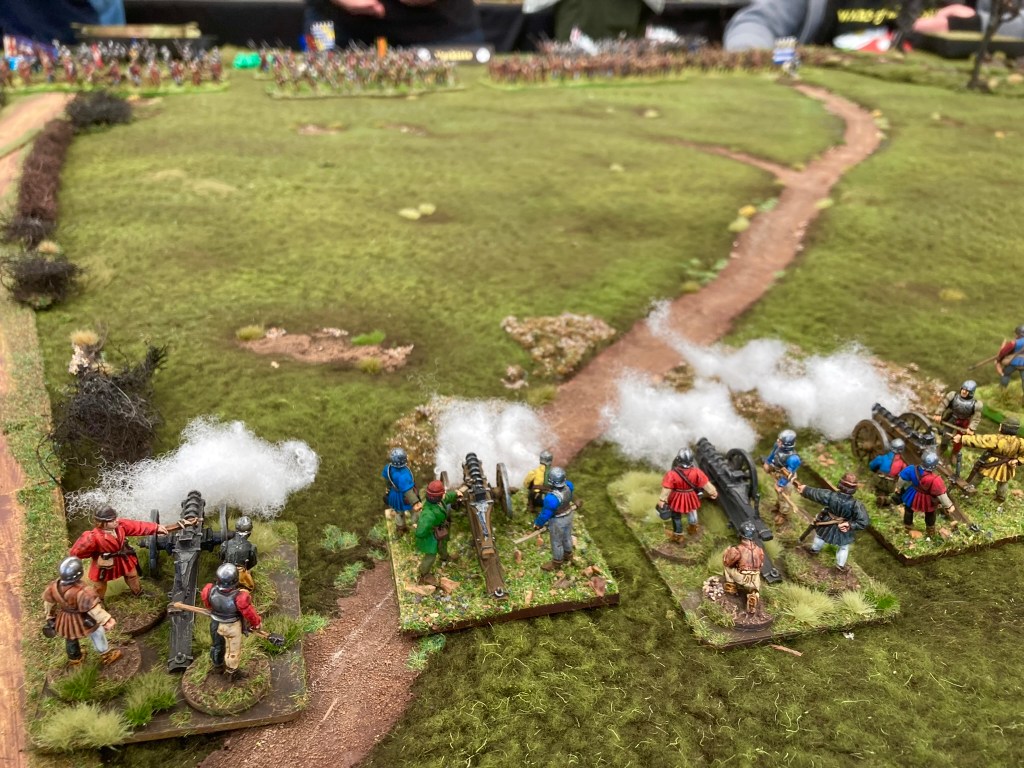
The Lancastrian gonnes open up
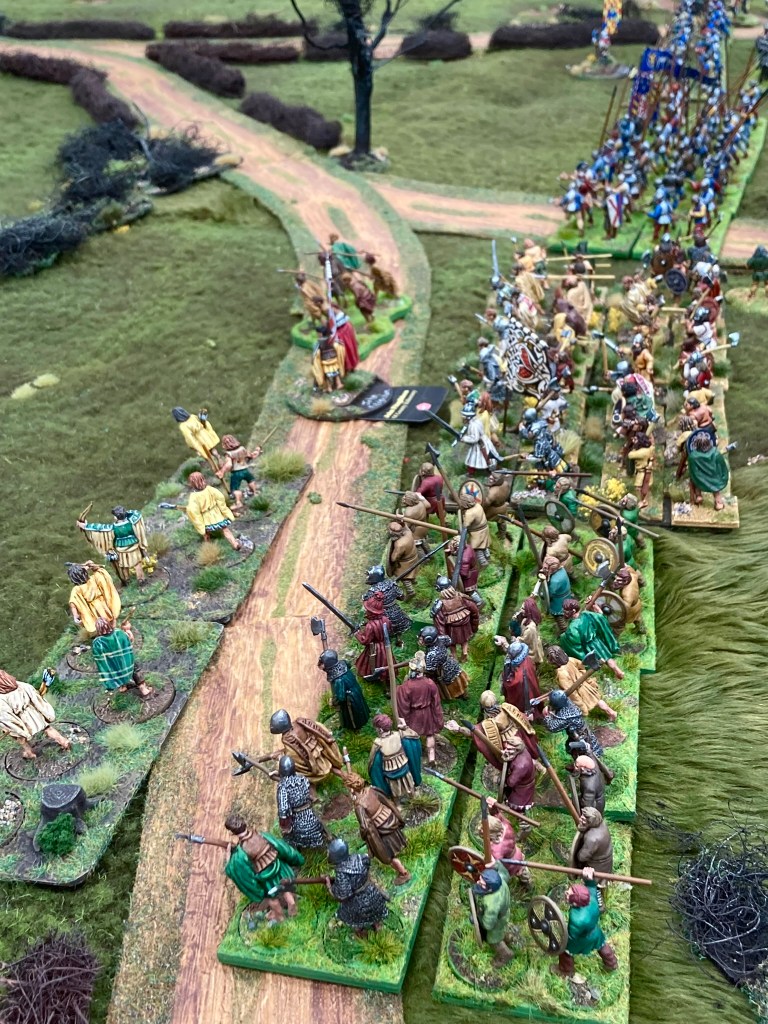
Battle is joined! Owen Tudor rides ahead of his command on the Lancastrian right while the Yorkists stand firm.
John Fitzgibbon of County Kilkenny leads the Irish home into a fearsome charge against the Yorkist billmen.
With the routing of one Irish unit, Hastings is ready to turn his attention to the Earl of Wiltshire’s retinue.
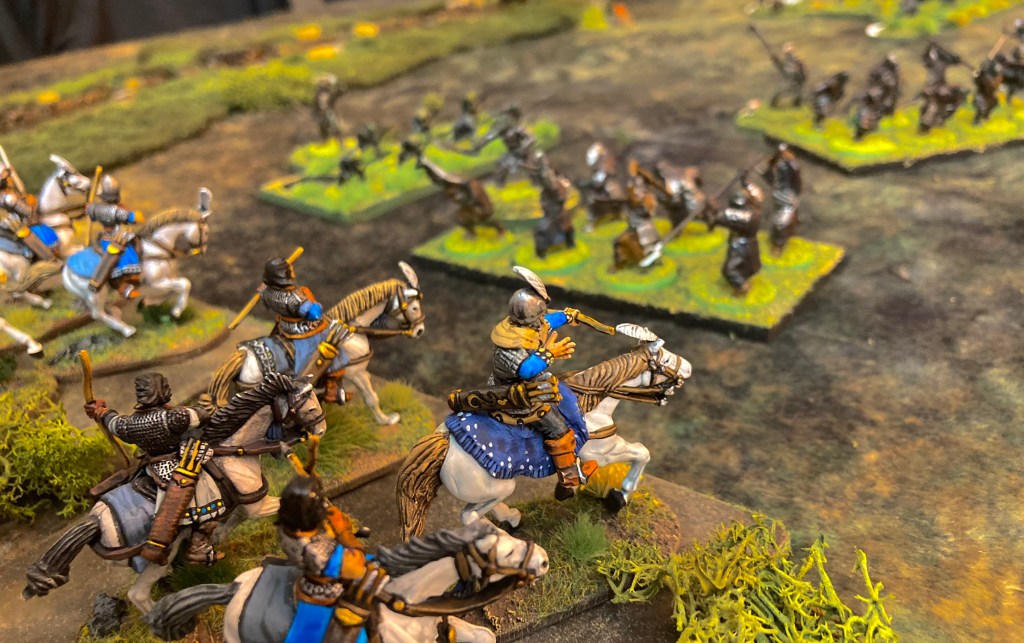
Owen Tudor’s cavalry charge causes casualties, but the archers drop back behind the men at arms who drive back the horsemen.
Jasper Tudor brings up the Lancastrian centre
Baron Bergavenny’s men defeat Owen Tudor’s knights.
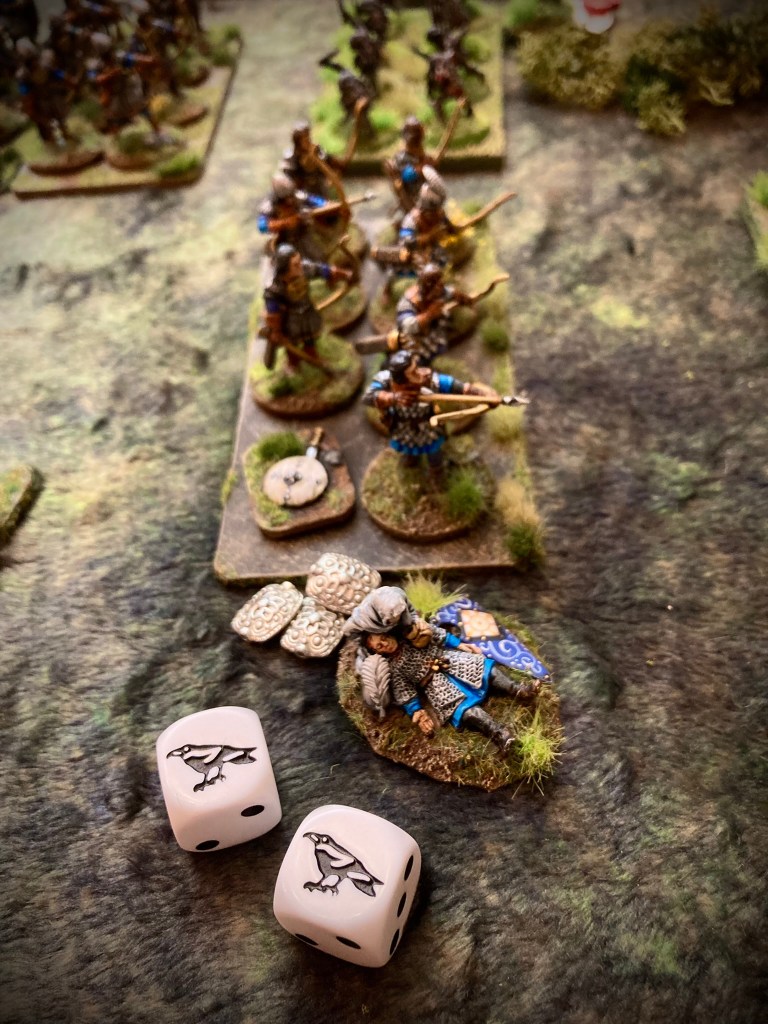
Owen Tudor is knocked off his horse and captured!
Peasants gather on the safe side of the Lugg. I made the river about 30 years ago, but it had a new coat of varnish and spruced-up banks for the show.
The luckless mercenaries get shot up by the Yorkist gonnes. (I know that the figures are Burgundians, but they’re too nice not to use) – lovely painting by Chris again.
The climactic combat under the Battle Oak! Edward is wounded by Jasper Tudor’s men, but the Lancastrian reputation is crushed by the defeat of Owen Tudor by the river and the force is defeated.

It was, as ever, a fun but exhausting day out. Fortunately, with a great team of chums on board, we shared the load and enjoyed the game. The spectacle of two substantial medieval armies meant that the game had plenty of visual punch despite the understated winter terrain, and it was nice to one of several WOTR games. It’s always a pleasure meeting up with old friends and making new ones, something that Partizan always does well. After helping to pack up 900 figures, I’m now considering a small skirmish for Partizan 2023! Or not.
Billhooks Bash 3 and Medieval Irish

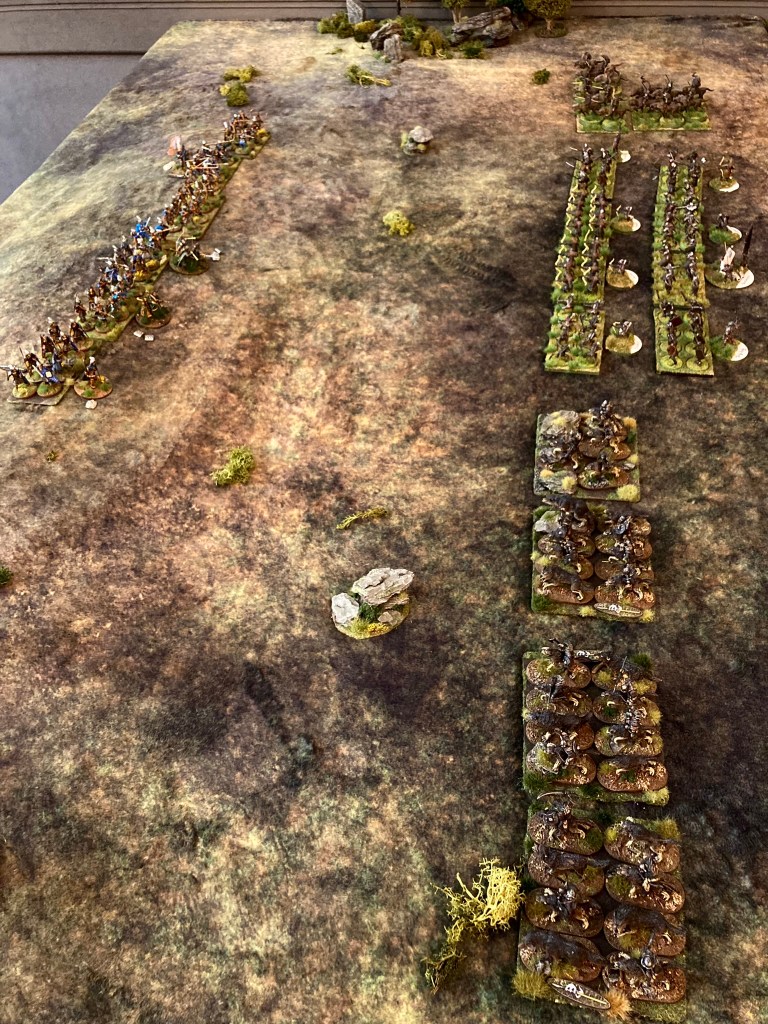
Perry Miniatures’ Irish burst forth from the mist. Background by Jon Hodgson Maps

It’s been a while since the last post due to a combination of doing too much and just too much going on, resulting in the thrill of finishing some figures at the eleventh hour just before an event! Not done that for a while, though I was having flashbacks to the time I tried to rebase my entire Pictish army just before Salute 2005 (pulled it off but best not repeated).

Lancastrian Sir Nicholas Latimer of Buckland Newton (one of the minor commanders at Mortimer’s Cross) bags the poshest tent. Perry Miniatures plastics, with a banner by Freezywater Flags and tent from Magister Militum

I’ve been meaning to play Andy Callan’s Never Mind The Billhooks ever since it came out, but failed to do so, spending most of my medieval gaming time as an opportunity to develop my Midgard rules instead.

An in-game shot from Billhooks Bash 3 as Pete Harris’s scourers harrass my billmen

However, the opportunity finally came along, with Pete Harris organising the Billhooks BASH 3 event at Boards and Swords hobbies just a few miles away from me. With noted scoundrels like Mike Peters, Steve Wood and Lord Callan himself attending, it would have been remiss for me to stay home.

Irish Kern – Perry Miniatures with a couple of Crusader models added

This also gave me the push to get some more WOTR troops completed – for Partizan on October 9th this year, my group are planning a large refight of the 1461 Battle of Mortimer’s Cross., which featured a contingent of Irish. Some Perry Miniatures swiftly arrived in the post and were fettled into shape, lining up alongside some other Irish warriors who had snuck in from my Dark Ages armies.

The Perry Twins are probably the greatest mini sculptors in the world, but cleaning up the metal castings is always a chore 😦
Halfords White Primer plus some acrylic black on the armour and metalwork

Wheeling out the inspiration: McBride! Metalwork is moving along with some silver drybrushing, plus skin base layer using GW Contrast Guilliaman Flesh
Various shades of yellow (ish) enacted with GW Contrast Paints: L-R Nazdreg Yellow, thinned Nazdreg Yellow, Aggaros Dunes, Skeleton Horde

The fun bit, painting the decorative panels! By this point, the clothes have also had a single acrylic highlight

Basing under way
Huzzah! The glue on those bases has about ten hours to dry!

Suffice to say that the army only just got finished in time, but at least the PVA was dry by Saturday morning. Fellow first-time Billhooker Jan’s force was likewise barely dry but it looked splendid!

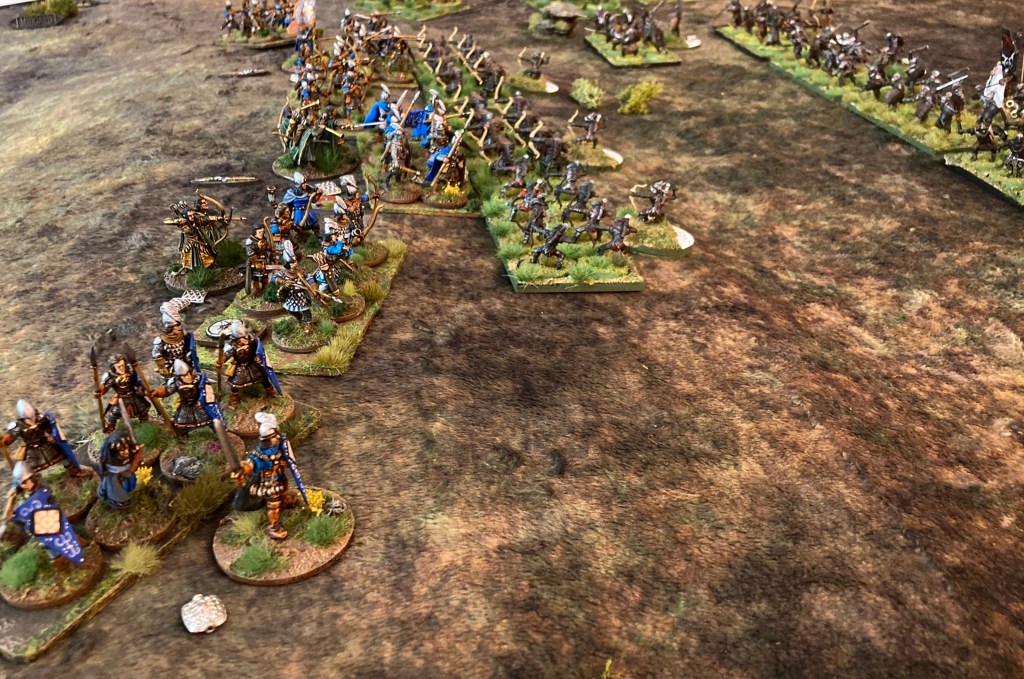
Despite being a dyed-in-the-wool Yorkist ever since my first visit to Bosworth battlefield aged around 7 or 8, I’d been persuaded to join the Lancastrian faction. I must confess that I struggled to recognise the red rose on the cards when it was my turn in the game! My force looked something like this:

LEADERS

Sir William Vaux of Richard’s Castle

Sir Nicholas Latimer of Buckland Newton

John Fitzgibbon of County Kilkenny

Sir William Vaux of Richard’s Castle – Old Glory figures with a Freezywater banner

ENGLISH

1 Men At Arms @ 24
3 Bowmen @ 36

1 Billmen @ 12

John Fitzgibbon of County Kilkenny and some of his followers
IRISH

1 Gallowglasses @ 18 (as MAA but armour save = 4, 5, 6)

2 Bonnachts (Levy Billmen) @ 18

2 Kerns @ 6

Game 1: Pete Harris runs me through the basics of the game

So, I rolled up to Boards and Swords, a very neat shop/ gaming centre on an industrial estate on the edge of Derby which is home to the local Billhookers (and many other gamers). Despite getting distracted by various bags of flock and the superbly indulgent Rolo cookies on sale, we managed to get the games under way at a decent hour.

Game 1: Sir Nicholas Latimer gets stuck in (and fails a record number of saving throws)

My first scrap had been arranged against Veteran Pete Harris so that he could teach me the rules and a great game it was too (until the dice betrayed me and my force fled). I will confess that I had already read the rules a couple of times, and watched the videos by Wargames Illustrated, but there’s nothing like actually playing the game!

Just before the pizzas arrived for lunch, it was time for the painting competition and everyone lined up their forces. There were many that caught my eye:

Steve Wood’s rather excellent force and bloody ditch, as seen in the pages of WI
Mark Taylor’s neat Lancastrians – fab paint job
Dave Gretton’s striking blue-and-yellow themed army
Mike Peters’ superb army with crazy handpainted flags and soil scraped from the field of Tewksbury (or possibly Mike’s back garden)

Somehow, my force narrowly beat Mike Peters in the painting comp – to be honest, nothing really stands up against Mike’s work (we need to get Dave Andrews or Simon Chick to drop by sometime), so I was flattered to get the public vote. Anyway, cheers!

Winning – on colour, if not tactical ability or dice rolling! My finished army lined up at Boards and Swords

With that, it was on with the games, and I now got to play Lord Callan himself. Andy is always a pleasure to game with and we had a most enjoyable scrap which, somehow, I won (a ferocious Irish charge was involved).

Game two vs Lord Callan and the yeomen of Bingham. Send in the coo!
Game 2: Lord Callan sends in his prickers who are seen off by a very annoyed Sir Nicholas Latimer
Irish bonnachts get stuck in with their axes, led by the heroic John Fitzgibbon

Game 3 was against the gentlemanly Jan who had themed his force around local family the Howards and driven all the way from Surrey. I confess I took only one picture as we were so absorbed in the game, which started badly and then went properly bad for me. Great fun!

Game 3: another light cavalry charge in the flank!

I thoroughly enjoyed my first games of Billhooks: it’s very much as it is sold – fast-playing, period-themed fun that doesn’t take itself too seriously. Top moments for me were the manouvre phase at the start of the game, where units advance until someone starts shooting (very evocative of a medieval battle), and the interplay between combined formations of archers and billmen. The cards are also highly entertaining. Every force I played against featured a unit of light horse that were able to scuttle round the back and harass my troops with relative impunity, so I reckon I’ll need to lay in some kind of counter-measure next time (caltrops, hidden ditch or sugar lumps). Overall, a great game played in excellent company. Thanks!

Billhooks Deluxe: we saw the banner and talked to the author, Manuscript looks awesome (I was very pleased to see a whole section on Ireland) and the modelling/painting section by Captain Blood is mint, but it’s not out yet. Keep an eye on Wargames Illustrated for updates.

If you’re interested in Billhooks, I suggest that you seek out the very active group on Facebook.

Last few shots are of the Irish taken in an impromptu (and poorly lit) session when I got home!

Old Norse

Foundry Norse warband, one careful owner, full service history! Background from Jon Hodgson Maps.

In the dim and distant past, I had my first encounter with Viking minis courtesy of the Citadel Norse range. The Perry Twins sculpted a characterful bunch of Scandinavians that tied in with the early Norse lists which were circulating around Warhammer Fantasy Battles (1st and 2nd edition, I think) and fired up my imagination for some Viking gaming. Once Citadel had become part of GW and historical minis were dropped, these guys found their way over into the Foundry stable, where they are still available today.

Ulfhednar. L-R Gripping Beast, Essex, Foundry, GB. The GB models are certainly showing their age, being some of Colin Patten’s earliest sculpts.

The exact provenance of these minis in my collection is hazy, as I bought some when they were released, and then added to them with various Foundry and second hand purchases (while rebasing them, I found that some had slottas and others integral bases, so it was obviously a mixed bag). When Warhammer Ancient Battles was released in 1998, I bulked out the Viking force to make a full WAB army with Gripping Beast and Essex Miniatures. My painting at the time was pretty basic with a black undercoat, single layers on most areas, limited highlighting and some interesting colour choices – I’m not sure why I thought that purple Rus trousers worn with a green-trimmed tunic was a good idea, but there you go!

Foundry Vikings. Old school Perry work: big heads and weapons.

In between WAB games, they also saw action in various Viking skirmishes, but have been sat in a box not doing much for the last decade. However, playing an increased amount of Norse myth games (OGAM and Midgard) got me wondering if I should get them back on the table. I also toyed with the idea of starting again with Victrix plastics, but the nostalgia won out and I decided to start reconditioning these old campaigners.

First, I removed them from their old bases and patched up any chipped areas. Skin areas had a quick wash of brown and a highlight. I painted over the worst excesses of my youthful colour choices and repainted selected areas (especially shields) to try to get back to a more limited palette. The chieftain and his raven standard bearer were finally paired on a single heroic base, as should always have been the case! (Warhammer always required singly-based minis, but there’s nothing that beats a cool leader vignette in my book).

Having touched up the metalwork, I gave them all dark bases that I hope won’t look out of place in a rocky/ snowy Norse setting. They’re not my finest work, but I hope that they will measure up to my current output a little better than they used to. It’s been fun getting them back into action – just another 70 or so to go!

Azande! 19th Century African Warriors

Inspired by the writings of Chris Peers and his rather wonderful Death in the Dark Continent rules, I spent some months back in 2013 putting together an Azande force. These lovely 28mm models are all by Mark Copplestone, sculpted between his time at Foundry and Copplestone Miniatures.

These fierce warriors won several battles against the reviled Belgian Force Publique in the 1800s and adopted firearms alongside their traditional throwing spears and fearsome throwing knives. If you want to know more of the background, I can highly recommend that you get hold of a copy of Chris Peers’ The African Wars. Foundry’s Azande page also has a potted history and painting guide.
I wanted to create more than just an army to get the flavour of the Azande; fortunately, the tribe was well-recorded in photographs and drawings in the late 1800s, including this fascinating image of an Azande village. This was my jumping-off point for creating some scenic pieces to fill out my own gaming set up.

The huts were so unique that I decided to scratch build my own. They started life as small cardboard tubes with broom bristles glued around the outside for texture. Some were on stilts, which I achieved by cutting up wooden skewers and drilling them through the hut and into the base.

The main part of each hut was the roof, for which I roughly carved a piece of blue foam. The thatch was then added in layers of Milliput, into which I pressed a rough pattern. The insane pointy tops were made from yet more Milliput formed over a cocktail stick pressed into the top of the roof.

VLUU L200 / Samsung L200

Unfortunately these are the only WIP photos that I took at the time, but hopefully you get the idea!

VLUU L200 / Samsung L200

Spray painting was the fastest way to finish these. I gave all the models an overall coat of brown (Army Painter Leather Brown) followed by masking up the hut walls and spraying the roofs with a yellow-brown (Army Painter Desert Yellow).


VLUU L200 / Samsung L200

When all this was dry and the fumes had cleared, I painted the huts with various black/brown washes and dry-brushed highlights.

This hut got some painted decoration around the door as well.
Hut with shield!

I painted around 80 figures for the army, so I experimented with time-saving techniques. The bulk of the warriors were sprayed with Army Painter Leather Brown and then subjected to a coat of black/brown oil paint which was wiped off to leave the basic skin colour. This was really effective (even if it took five days to dry!) A few of the personality figures were instead black-undercoated and the painted traditionally using the Foundry Dusky Flesh triad.

Musketmen with skin tones using an oil paint wipe-off technique

Clothing and detail was then picked out in acrylic paints, before I got over-involved in painting the shields, at which point I was glad I’d saved all that time with the oil paints! I’ve always loved painting shields and had a brilliant time picking out the patterns on these based on various surviving examples I’d seen in books and museums.

Shields, I love ’em
Musket-armed king and bodyguards (the skin on these is Foundry Dusky Flesh triad)
Grim but necessary – Disorder markers for playing DITDC. There’s no specific Azande casualties in the Foundry range so I just added Azande shields.

The centrepiece of the village is the ‘tree of skulls’, adorned with shields and grisly battle trophies. This was created from a single Woodland Scenics tree armature with skulls from the old Wargames Factory (now Warlord Games) plastic skeletons and some spare Foundry Azande shields.

VLUU L200 / Samsung L200

Although DITDC uses 60mm ‘elements’, I wanted to be able to split up the figures for skirmish gaming as well, so I bought a load of 60mm movement trays from the ever-wonderful Warbases and added 5mm neodynium magnets. The figures were all based on UK 1p pieces – the most recent kind are magnetic and therefore perfect for this kind of thing.

Trojan War: King Memnon of Ethiopia

Following on from my post about doing some Amazons and Ethiopians for the Trojan War a few weeks back, I was inspired to get a mini for King Memnon of Ethiopia, who features in the later sections of the Iliad.

Memnon and his warriors, photographed on a rocky hillside that I built a few years back. Background by Jon Hodgson Maps

In Rosemary Sutcliff’s Black Ships Before Troy, one of John Howe’s watercolours has a go at recreating Memnon and his troops. I say ‘recreating’ but ‘imagining’ is probably a better term for this kind of mythological illustration.  Anyway, I thought I’d attempt something similar in 28mm. 

Illustration by John Howe from Black Ships Before Troy

After some hunting around through the usual suspects online (Foundry, Eureka, Redoubt, Lucid Eye) I settled on using a Northstar Kadesh chariot with a converted Sea Peoples leader as Memnon. The colour scheme was to reflect the green and gold that I’d used to tie Memnon’s followers together last time out, expanded with a little red and black.  Howes’s illustration draws upon the modern Ethiopian flag colours for inspiration, which although obviously anachronistic, has a clear African vibe to it. One reason I picked the Northstar chariot was that the horses had elaborate plumes and caparisons which would allow for some bright colours and patterns! 

Northstar chariot original (pic from Northstar website)
Sea Peoples Champion (pic from Northstar website)

Memnon himself started life as a Sea Peoples officer; the figure was suitably heroic (pointing and waving a sword, wearing scale armour) but I wanted to swap his headgear for something more esoteric.  His Ethiopian warriors are conversions of Perry Beja models with some Greek-style crested helmets so I wanted something similar but suitably ostentatious for the big boss.  

Memnon’s warriors – all converted plastics. Bodies and bare heads are from Perry Miniatures’ Beja, apart from second left who has a Warlord Games Greek Hoplite body. Helmeted heads are Victrix Iberians with crests added. Shields are from Oathmark Skeletons and Wargames Atlantic Skeletons.
More of the same – these guys have weapons and shields taken from Oathmark skeletons and revenants.

Cue hunting through all my bits boxes!  Victrix had some nice crests but these were beaten into second place by Wargames Atlantic skeletons, which feature a single transverse crest of heroic dimensions.  

After some chopping and gluing, I managed to transpose the rather OTT crest onto Memnon’s royal head and blended it in with some inexpert green stuffing.  A fur cape was added from a Victrix Roman and I now had the hero I was after. 

The charioteer was a simpler affair, being no more than a Perry Beja body and arms with a Victrix Iberian head and crest. The hands had the weapons cut off and were then drilled out to accept reins that I would add after painting. 

The Northstar chariot is made from MDF and grey board (originally produced for them by 4Ground and now by Sarissa) and it’s a clever little piece of work that wasn’t too hard to fit Memnon and his charioteer into. 

Component parts from Northstar – you can see the level of detail on the MDF chariot.

 I primed it separately from the other models with a coat of Halfords camouflage dark brown spray.  This didn’t take long to dry brush up with various shades of brown before painting the housing to match the cowhide shields of the Ethiopians.  Ok, then I got slightly carried away and decided to add a pattern, but hey, it looks the part. 

Memnon and his charioteer both had a white undercoat before being painted using the same colours as my previous Ethiopians.  His fur cloak had a few spots added to suggest a leopard or similarly ferocious big cat. 

The horses – also primed white- received a base coat of GW Contrast Apothecary White with various patches of grey and pink added for variety.  Patterns were picked out in acrylics using a number 1 brush before blocking in the areas around them in black.  Tassels and plumes were treated the same as the Ethiopian helmet plumes – GW Contrast Warp Lightning and Dark Angels Green in various mixes. 

With all the base layers finished, I gave the minis two coats of matt varnish and then did the bronze. After that, it was time to assemble the pieces. 

In a scene reminiscent of Ben Hur, our heroic charioteer struggles to get it together with the reins and chariot…
Success! Just the last bits of basing to go..

After some suitably sandy basing and a few grass tufts and rocks, Memnon and his warriors were ready to go.

I really enjoyed doing these minis and will be using them in my Greek myth games very soon – either in Midgard or, quite possibly, as a good basis for a warband in Of Gods And Mortals (OGAM).

Near, Far Away: Part 4 – More 15/18mm Saxons

Saxon war leaders

Dan Mersey of Wiglaf Miniatures kindly sent me a pre-release sample of the latest 18mm Wiglaf Miniatures Saxons a month ago, which I promptly cleaned up, undercoated, base coated…and then abandoned for several weeks as I got distracted by work and other things. Fortunately, I found some focus this week and got them finished off and based up.

This chap (front right) is my favourite of this release – a wonderfully animated little warrior with a superb Vendel helm.

As you probably already know, the second Wiglaf release is another pack of character models and a couple of packs of Vendel-style Saxons showing the Swedish influence that may have been present in the East Saxon kingdoms of the 7th and 8th centuries. These have some subtle differences to the original release: slightly larger shields ornamented with metal strips and plaques – similar to the Sutton Hoo shield ; tunics with a distinctive ‘crossover’ neck; and helmets based on the various Vendel-period designs with mail ventails and large cheek plates.

15mm Forged in Battle ‘Saxon raiders’. All the backgrounds are – as ever – printable downloads from Jon Hodgson Maps.

I thought it’d be fun to paint the Wiglaf Minis side-by-side with some Forged in Battle 15mm of a very similar style. While not described as ‘Vendel’, the FiB pack of ‘Saxon Raiders’ contains a number of 7th-8th century armoured Saxon warriors, including a version of the Sutton Hoo king, some Vendel helms and (fun but not quite sure of the provenance of this) a couple of guys wearing a wolf skin head dress.

Forged in Battle (left), Wiglaf (right)

Despite Wiglaf being described as 18mm and the Forged in Battle as 15mm, both are very compatible, with the Wiglafs being marginally broader and more animated.

Characters in the latest Wiglaf release include Edwin and Oswald of Northumbria, plus a praying monk, a banner bearer and horn blower and a number of leaders aimed at the South-East: Æthelbert of Kent, Sexred of Essex and Caedwalla of Wessex. These are all lovely sculpts that I’ve struggled to do justice to, especially after seeing Steve Dean’s work, but they’ve all painted up nicely. As usual with Mark Copplestone’s 15/18mm work, they are all good enough to be 28mms!

Wiglaf character miniatures

An interesting feature of the new leader pack is that it also contains some ‘banner pole toppers’ to add a bit of fun to the standard bearers (a cross, boar and deer – the latter not pictured). While quite fiddly to drill out, they absolutely look the part once finished.

Oswald of Northumbria showing off his Christian credentials. The banner is hand painted, based on one that I saw a few weeks back at a re-enactment event.

The paint job was, once again, a white undercoat with GW Contrast colours followed by some selected highlights. I cut a few more corners this time, but spent longer on the metallics to make sure I had the shine on the armour and weapons that I like. If you want to see the painting method in more detail, have a look at my previous post here.

Forged in Battle 15mm Saxons

Unit bases were 40 x 80mm to play Age of Penda, with a micro dice holder at the back right to record damage. The heroes were based on 20mm rounds in order to fit into the gaps I left in the unit bases.

Forged in Battle Saxon unit with a couple of Wiglaf command models (centre back)

I’ll doubtless be doing some more of these in the near future, but right now my eyes need a break so it’s time for some 28mms!

The full muster!

Greek Midgard 3: Basileus in the Underworld

Basiileus’ hoplites face off against the shades of Hades

In testing my Midgard rules, we’ve been slowly playing our way through a Greek myth mini-campaign based on the adventures of Greek prince Basileus and his hardened crew of hoplites – you can read more here in previous instalment Basil and the Horn of the Minotaur. The whole thing is loosely based on Jason and the Argonauts with more than a dose of Harryhausen and nothing too serious involved.

This weekend’s game was prompted by the outpouring of excellent and well-priced 28mm plastic undead mini kits over the last couple of years. Tom, Martin and myself have all succumbed to a greater or lesser extent, thus we had enough skeletons and shades to put together an army of Hades. Tom had recently added Hades, Cerebus and Orpheus to his collection as well, and thus a simple scenario was born…

Legions of the Dead – nearest unit is Wargames Atlantic skeletons with some Victrix Greek parts

Greek hero Basileus has been set three highly dangerous (and probably fatal) tasks by the King of Athens in return for the hand of his daughter.  Fortunately, Basileus can call on a large band of followers – the Argianauts.  Having successfully escaped from Crete with the Minotaur’s horn during his first task last year, Basil has also recently liberated Apollo’s chalice from the Isle of Delos. 

Now Basil tackles his most dangerous task – emulating Heracles in bringing Cerberus out of the Underworld.  Fortunately, he has acquired the services of the famed Orpheus to charm the three-headed hound, but Hades is on the warpath to stop him.  Who will prevail?

The scenario would be fought as a straight battle but with Orpheus in control of the enchanted Cerberus – the mission for the denizens of Hades was to get him back at all costs! Which was pretty much what happened.

Battle in the Underworld – Greeks on the left, army of Hades on the right

The forces deployed looked roughly like this:

FOLLOWERS OF BASILEUS

Basileus, Greek Hero and Army Commander

Deianeira, Priestess of Athena

Orpheus, Bard

Parthenios of the Winged Sandals, Greek Hero

Haplus the Steersman, Hero

Eryx the Marksman, Archer

10 x Hoplites

3 x Archers

Eryx the Archer and his men. Eryx couldn’t hit anything for toffee for the first few turns but his followers did the job!

FOLLOWERS OF HADES

Hades, King of the Underworld (arriving later in the game after being invoked by his followers)

High Priest of Hades

Priest of Hades

3 x Skeleton/ Shade Warleaders & Champions

5 x Skeleton Archers

9 x Skeleton Warriors

2 x Shade Warriors (summoned during game)

1 x Wurms of the Underworld (summoned during game)

The Legions of the Dead deploy for battle – mostly Oathmark skeletons in these pics, painted by Martin. There are some Alternative Armies Celtic undead at the back.
Terrain: a piece of painted dark grey polar fleece fabric that Tom created for Frostgrave games, with various drop-on pieces of terrain. Big pillars are pieces of wood with wooden moulding from the DIY store, based on slottabases.
This skull has been living on the shelves in Tom’s gaming room for some years but I’ve never seen it used in a game (obviously playing the wrong stuff). If you can’t use this in Hades, where can you use it?
Mucking around with camera settings – we quickly discovered that the ‘Dramatic Cool’ filter sucked out some of the colour, perfect for the Underworld. Tom, you’ll notice, has also made the correct colour choice of shirt for the day 🙂

The battle opened cautiously, with both sides advancing into bow range. The left flank on each side was slightly overlapping, as you can see, and that became the focus of the action.

Eryx and his men exchange arrows with the skeletons on the flank

Hades’ forces were praying for the arrival of their God, who took his time and didn’t turn up until Turn 3! Once on the table, he moved down the line and summoned the ‘Wurms of the Underworld’ to support the undead on the exposed right flank.

Hades finally turns up but is deep in contemplation! SHQ Miniature painted by Tom.
Orpheus advances his men, keeping a close eye on Cerberus. Footsore (Orpheus) and Reaper (Cerberus) Miniatures respectively, again both painted by Tom.

With Hades flexing his godly muscles, the Greeks decided to act. Parthenios of the Winged Sandals drew his legendary blade and was sent to challenge the King of the Dead to single combat. The Priestess of Athena had used her ‘I Foretell Mighty Deeds’ trait to give Parthenios extra, er, Mighty Deeds in the turn that followed, and Parthenios decided to blow the lot in the first round of combat. The gamble paid off! Hades disappeared in a puff of blue smoke, not to return – a huge blow to the Army of the Dead (but cheers all around from the Greeks).

Parthenios of the Winged Sandals takes out the Ruler of the Dead in a daring single combat

The Greek line was now advancing across the field against the skeleton archers. Casualties were inflicted on both forces, but the Priests of Hades were replacing their losses as quickly as they occurred. Clearly the hoplites would have to get stuck in to break some bones!

Deianeira casts a wall of mist to protect the advancing hoplites from Hades’ archers.

It was crunch time, literally, and the hoplites crumbled their way through a couple of units of skeletons with a clear view to rolling up the flank. The Priests of Hades summoned some shades to bolster the line and the Wurms of the Underworld were sent forward to do their deadly work.

Yet more shades are summoned by the High Priest of Hades
Crunch time for Hades’ bony buddies

Seeing the threat, Parthenios of the Winged Sandals and Eryx the Archer attempted a pincer attack on these thirty-foot long monstrosities – I say ‘attempted’ as it all went wrong. The Wurms turned on Parthenios and swallowed him whole in the following round of combat. Ah well, it was heroic!

Farewell, Parthenios of the Winged Sandals. The Wurms of the Underworld are 3d prints from Martin’s collection.

The High Priest of Hades now decided to commit everything to the battle and there was a huge melee in the centre of the field. Orpheus and Basileus found themselves engaged by different units of skeletons.

With Basileus’ unit pinned on one side, one of the skeleton warleaders led a charge against Orpheus and his men. Clearly inspired by the flaming skeleton and his dreadful steed, the skeletons won the combat decisively. Not only that, but Orpheus was slain (rolling a double one on his Risk to Heroes dice). Cerberus was free!

Orpheus falls in combat with the skeletons

Unleashed, Cerberus reverted to being Hades’ big, brutal watch dog (a Legendary Hero in the game) and proceeded to rip chunks off the hoplites encroaching upon his territory.

Hades’s forces caused chaos on the Greek right flank, winning several combats and causing the hoplites to fall back in fear. The goblet of Reputation for the undead briefly ran empty – but was refilled by successful charges and spell-casting from the Priests of Hades. With Cerberus back in his role as the watchdog of Hades, it was time for Basileus and his surviving warriors to beat a hasty retreat, albeit with a glorious tale to tell on their return.

What unpleasant task will the King of Athens dream up for Basileus next?

Return to Verdun: Bello Ludi WW1

After a gap of a couple of years, I got the urge to get the First World War collection out for another game. This was partially because Scrivs was back in the country with his substantial collection of minis that we’d used for our Verdun campaigns back in 2015-16, and partially because I’d liked the sound of the Bello Ludi rules after catching a post about them on Instagram. After a bit more research I decided to take a punt on the rules and bought them from Caliver Books along with a set of cards and a couple of the game-specific command dice.

Bello Ludi are a Dutch publisher that has created a core set of rules based around the command dice and cards – which are transferable across the various BL games. A large part of their business is using wargaming as a team-building activity, often for non-wargamers, so the rules are designed to be simple and easy to pick up.

I was surprised how slim the Bello Ludi WW1 rulebook was – just 24 sides of A5. It contains all the core rules with some additional rules for flamethrowers, tanks, planes and so on. There are no force or platoon organisations – I would have appreciated even just a couple of sample platoons for the Western Front as an example of where to get started. As an experienced gamer, it wasn’t too hard to put together some French and German lists of my own for our first game, but I did feel that a newer player might have been put off by this. (Stats for different nations’ artillery and vehicles are available on the BL website).

One of the big attractions of Bello Ludi was the fact that the game has been designed for multiple players a side, each controlling a ‘group’ of units, without the complexity of some rules systems. I put together a scenario loosely based on the struggles for the village of Fleury-devant-Douamont during the battle of Verdun: two French machine-gun teams were holed out on the outskirts of Fleury but the Germans were mounting an attack with three platoons supported by flamethrowers to drive them out. The French HMG teams had a pair of platoons in reserve but would be outnumbered by the Germans.

All the Germans in our collections are the lovely Great War Miniatures painted by Scrivs and myself. We both used the Scrivsland paint recipe which you can find here.
Our French come from Woodbine Designs (pictured), Brigade Games, Scarab Miniatures and Old Glory.

The standard unit in the BL rules is given as 12 miniatures, and although historical sections varied in size, I stuck with this for the basic rifle units, but created 8-figure units for the French grenadiers. Some sections had LMGs, bombers (qualifying them as ‘Assault Troops’) and VB rifle-grenades – more of which later.

One interesting feature of the BL rules is that, although 1 model = 1 soldier. the overall model count in a unit is used as a combination of casualties and morale – so a Rally order (and certain cards) will restore a soldier to a damaged unit. There is no separate ‘shock’ (as in Two Fat Lardies’ games) which provides a fast game, albeit with less granularity. One dice per figure is rolled when shooting or fighting with modifiers for close range, cover and the like, but any hit removes a model without a ‘saving throw’ or other mechanic. Again, this keeps the game cracking along.

Martin marshals the Germans attacking the French right.

We got the game underway, with the French getting the initiative for the first turn. Units activate using the special Bello Ludi commander dice – a d20 marked with a B (Blunder), and a number of 0s, 1s, 2s and 3s. The digit rolled determines the number of actions the unit can undertake, with a Blunder resulting in a roll on the blunder table (very similar to the one in Black Powder). Actions include movement, taking cover, rallying and throwing grenades, although shooting and close combat happen later on in the turn as a free action. The system is quite random in the number of activations you get, but leaders within 12″ can use their actions to activate units as well.

Bello Ludi commander dice (photo from Bello Ludi website)

The French HMGs failed to make much impression on the Germans, but the platoons of Poilus activated well and advanced up in support. As we worked our way through the shooting sequence, we found that the French VB launchers were rather more effective than we expected! Despite their shorter range, they caused havoc in the German ranks. As the French player, this was obviously welcome, but as the game went on it became clear that they were a little over-powered. (Grenades and rifle grenades use a 2″ template and the command dice to see if they hit, deviating by up to 3″ – which isn’t a great deal if you place the template right in the centre of a unit. The resulting blast then wounds each soldier under the template on a roll of 3+ – hefty stuff, and more powerful on average than an HMG or artillery piece). This felt odd – possibly exaggerated because some of the French sections had two VBs each – and we adjusted it later in the game.

Moving on, the Germans surged forwards towards the ruins of Fleury, where the French had a Hotchkiss firing from a low window. After a brief firefight where the HMG struggled to hit anything, German grenades cleared out the house. Objective 1 achieved!

A French MG team is finally bombed out by the Germans.

On the French right, the other Hotchkiss team perished after multiple rounds of German rifle and LMG fire. Working on a d6, shooting and combat hits are usually scored on a roll of 5+ with some simple modifiers, e.g.+1 shooting at 8″ or less, -1 shooting at dispersed troops, -1 shooting at troops taking cover, -1 at units in cover etc. However, a roll of 6 always hits. This left us with a slightly unusual situation where an HMG team in a sandbagged dugout would be hit on a roll of a 6, and the Germans they were shooting at (in the open but taking cover) would also be hit on a 6. Although the HMG had the longer range, once the Germans were within 24″, they were shooting on better terms than the dug-in Hotchkiss (German section with LMG shooting with 13 dice; Hotchkiss with 6). I had no problem with the HMG being taken out, but I’m not sure that a WW1 section would have fancied their chances in this situation.

Despite the village of Fleury being taken, the French had reinforced the position on their right and had the Germans pinned in front of the wood with their VB fire. Lunchtime was approaching, so we took a trip to the pub, where we enjoyed a couple of beers and some tapas while discussing the game so far.

We all agreed that we were enjoying the simplicity of the game – things were moving along at a pace with little reference to the rule book – but that we didn’t feel the balance was quite right for WW1. Inveterate tinkerers that we are, we resolved to play on after lunch with the following tweaks:

  1. Grenades and VBs would cause hits in the open on a 5+ (and only 3+ in an enclosed space).

2. Units in hard cover such as dug-in positions and trenches would ignore the first hit from each round of shooting.

3. Units hit by HMGs, flamethrowers and artillery would become Disordered if the hit dice had more 6s than 1s (a common mechanic in Two Fat Lardies’ rules).

To try these out, we played out the second phase of the battle. The Germans brought on their third platoon and both sides dragged up a 75/ 77mm gun as well as another Hotchkiss for the French.

All three amendments worked pretty well – the French in the sandbagged position were far more resilient with the extra cover bonus, the VBs felt less over-powered, and a number of units became Disordered from shooting – the flamethrowers were particularly effective.

Becoming more familiar with the rules, we also had some fun with the cards in this section of the game – effects like units shooting at half strength due to lunchtime drinking added a dash of colour. Another card that extended a unit’s range by 6″ was used by Scrivs to great effect with a German flamethrower team – clearly a crack unit with the latest equipment!

Fun with the cards! These are usable in any BL game

Despite a brave resistance, the Germans eventually rolled up the flank by the wood and cleared the French position, forcing the others to retreat.

Bello Ludi gave us a fun, fast-moving game as promised. We picked it up very quickly and I had some excellent support on the run-up to the game by messaging BL to get clarification on the rules. That said, I felt that it needed some adaptations to get the right balance for WW1, and the lack of army lists of any sort required some work before the game. I applaud the simplicity of the rules and the willingness to engage new gamers, but feel that its potential is not quite being delivered by its current incarnation. I will definitely play again with our amendments and look forward to seeing how the Bello Ludi line of games develops.