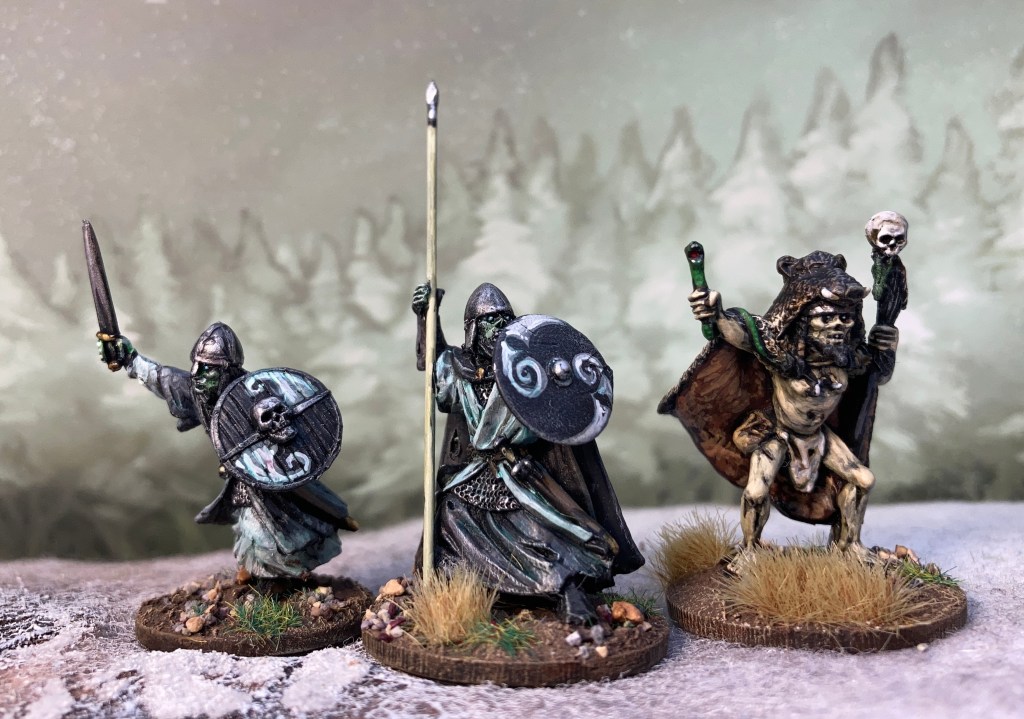
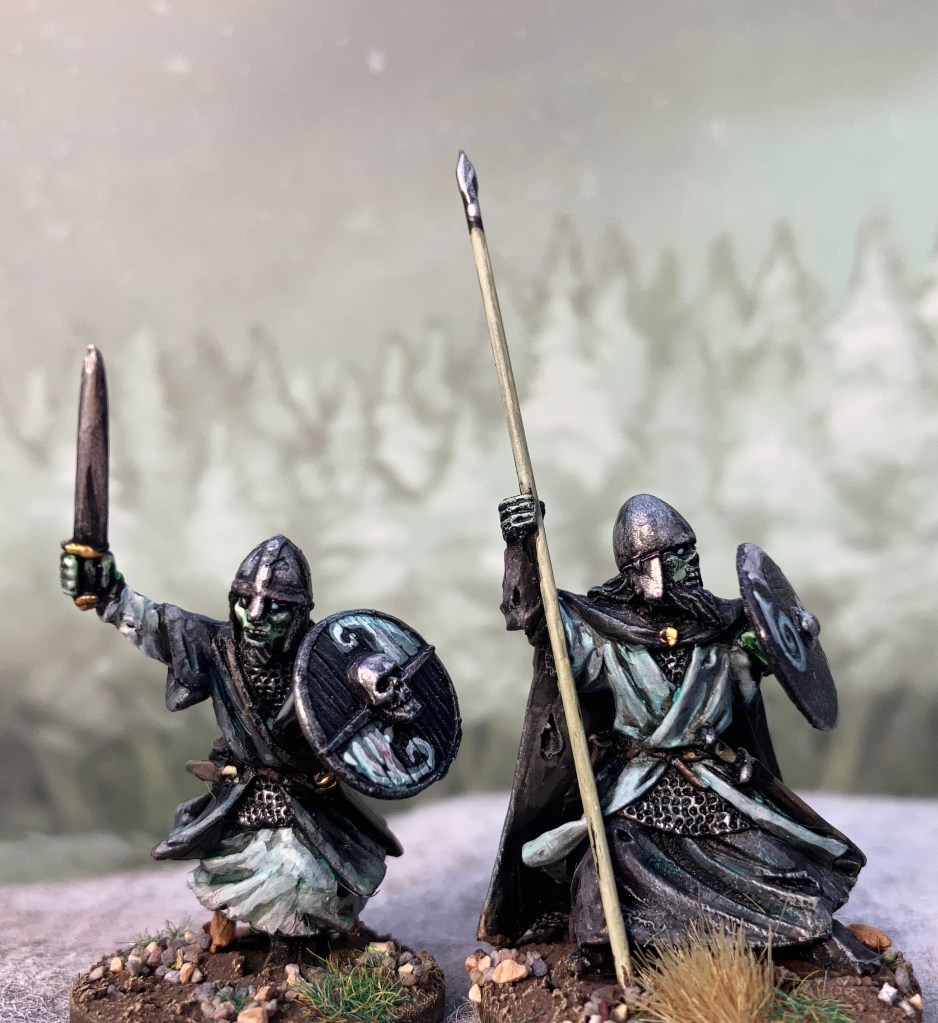
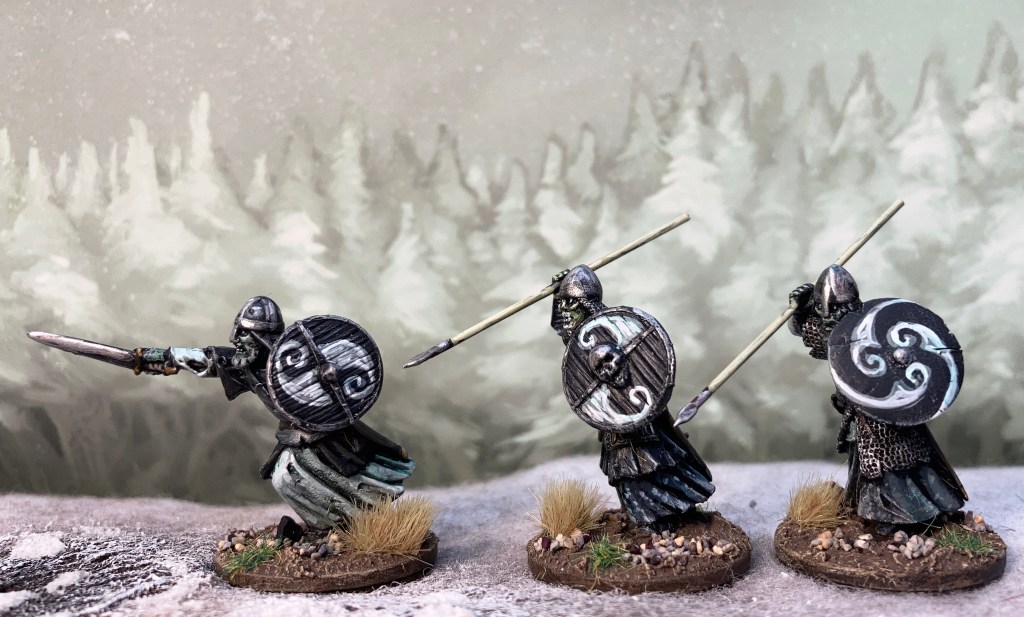
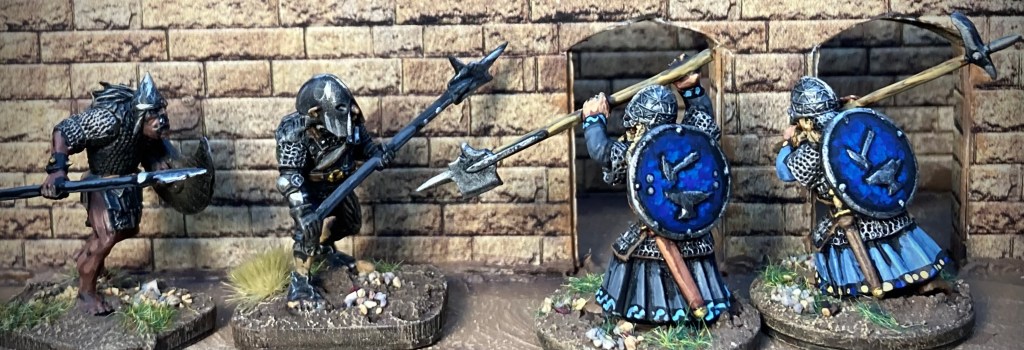
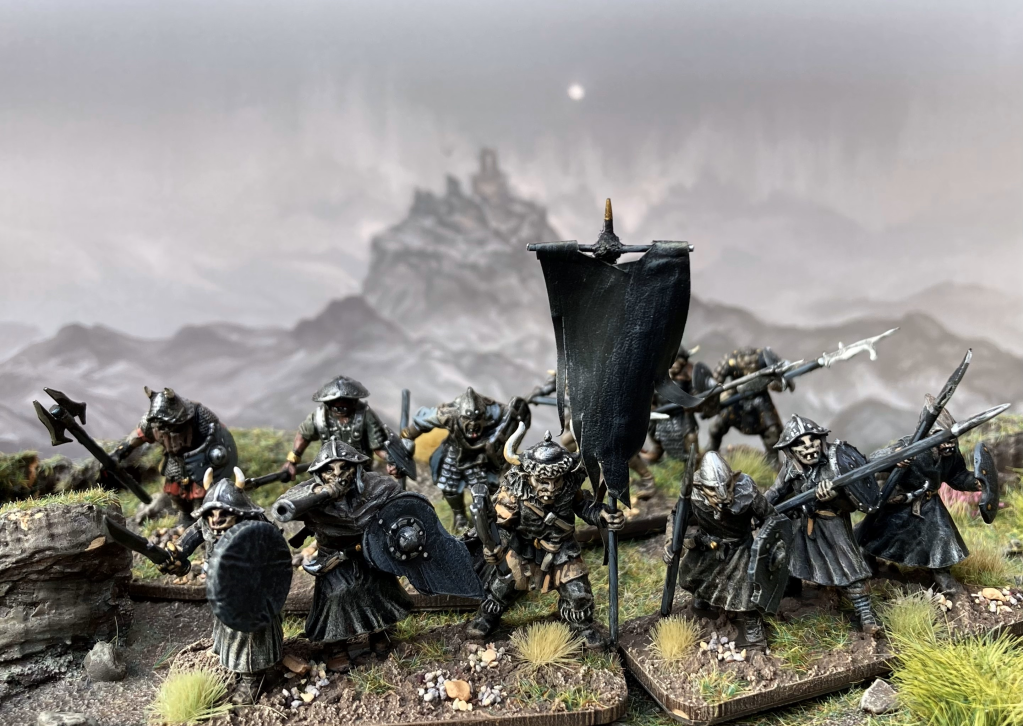
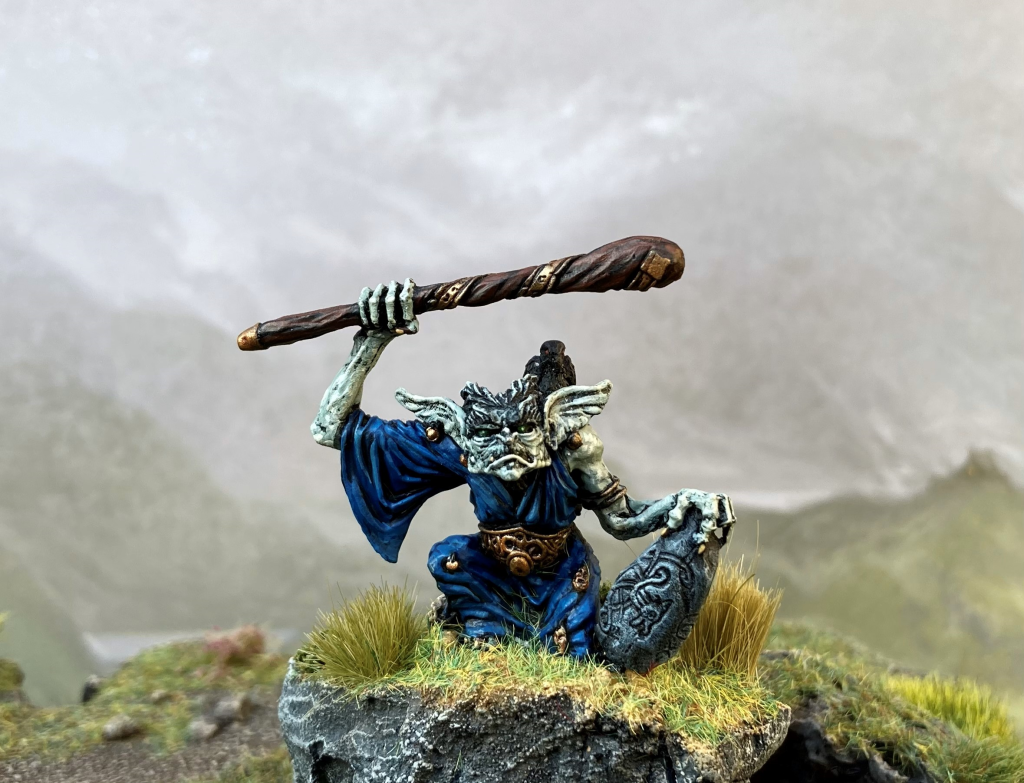
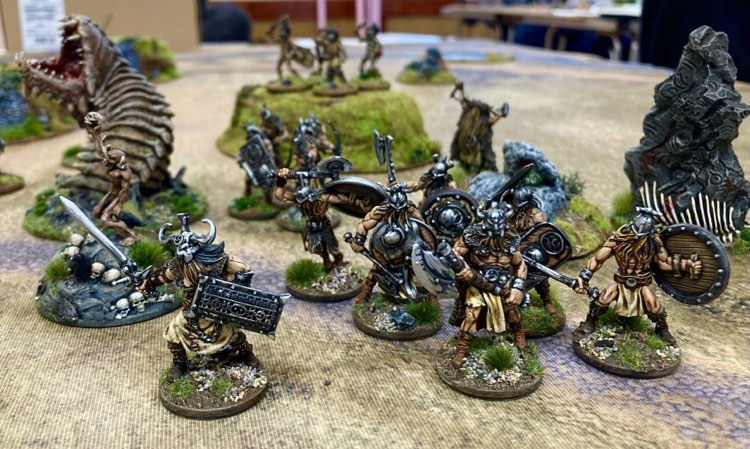
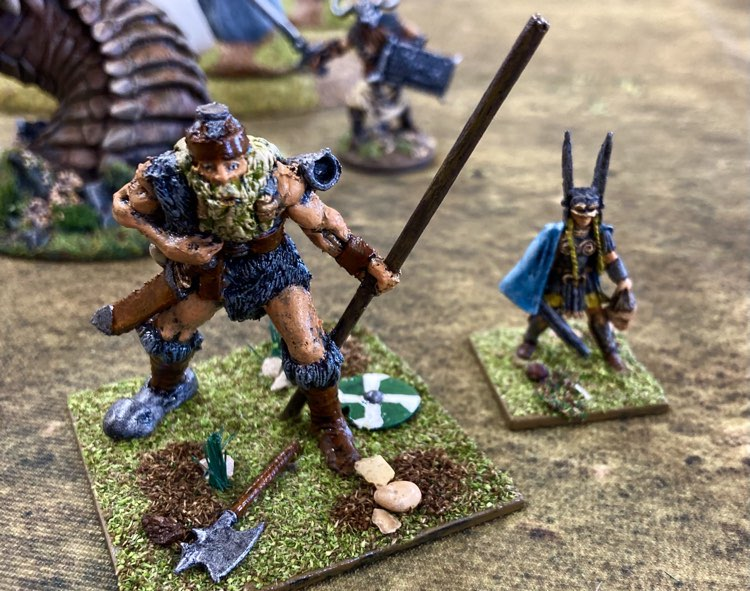
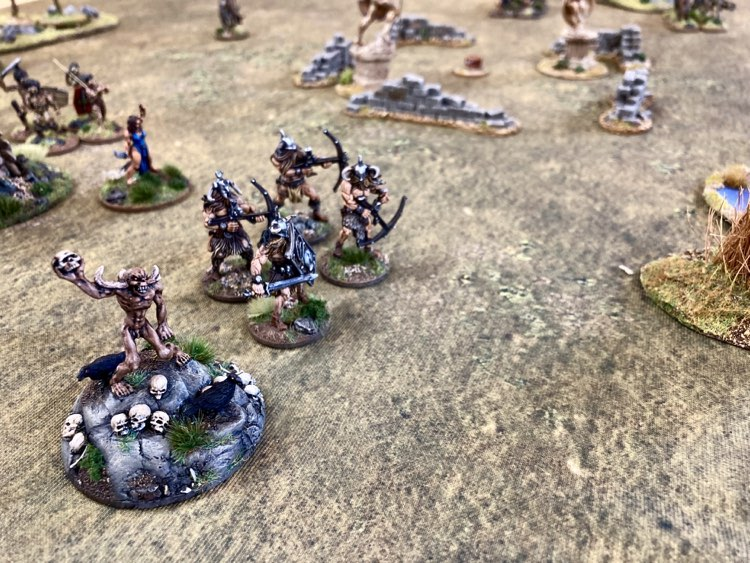
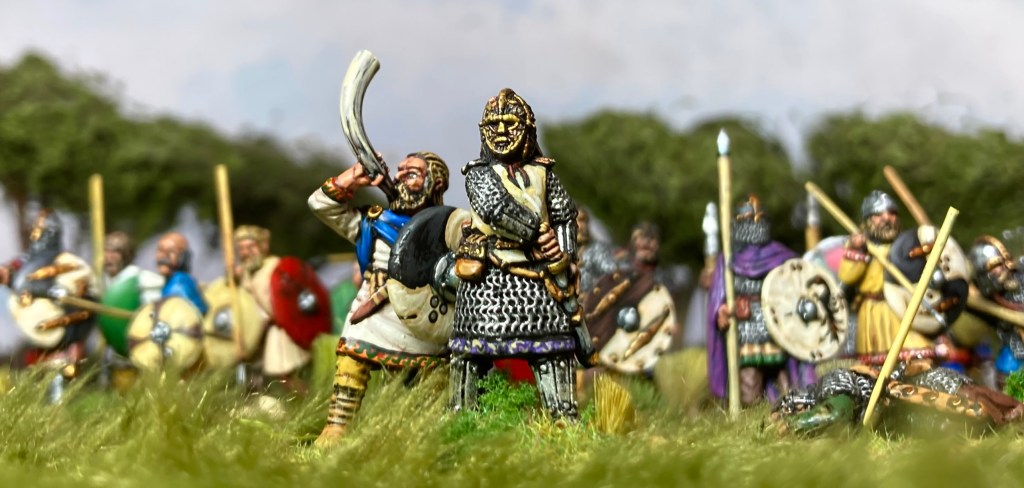
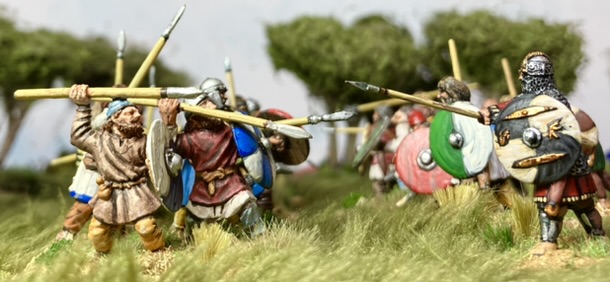
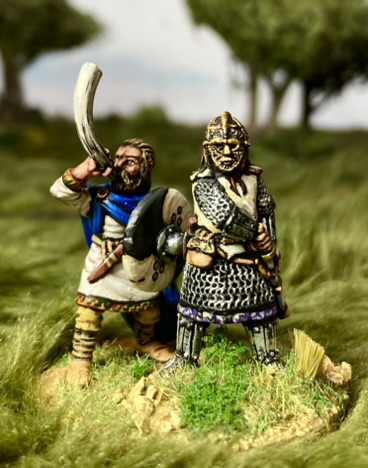
L-R: Draugr Heathguard in tattered robes, Draugr Lieutenant 2, Draugr Necromancer Warlord from Ragnarok Miniatures. Photographed in front of a Jon Hodgson Backdrop.
Seeing as it’s the festive season, it’s probably time for the pics of the Draugr from Ragnarok Miniatures. I’ve never been a massive fan of undead but the current crop of outstanding miniatures has been slowly crumbling my resolve; the rather wonderful Oathmark Revenants, alongside skeletons from Reaper, Oathmark and Wargames Atlantic have all found their way onto my painting table in recent years.
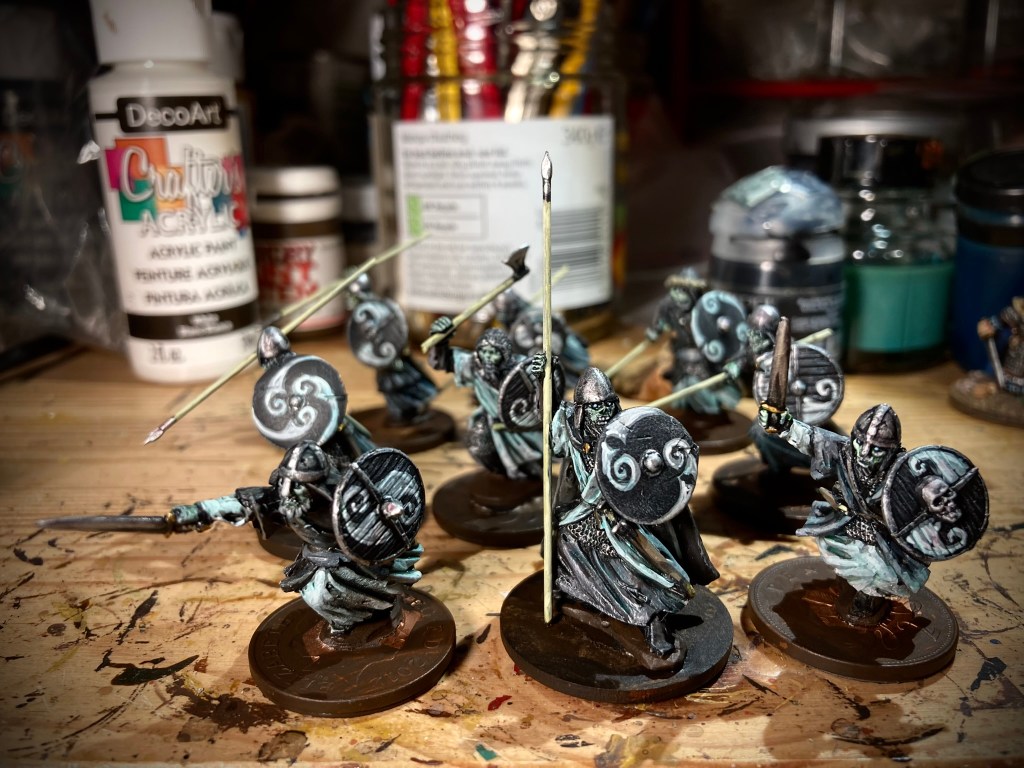
These ten minis are the Draugr Hearthguard in tattered robes, led by a Draugr Lieutenant and a Necromancer Warlord. Coincidentally, one of the sample force lists that I’ve written for Midgard Heroic Battles is an undead horde under to command of a necromancer by the name of Ulric Deathwhisperer, and I’m wondering whether this is the mini for the job.
These are chunky 28mm sculpts from Colin Patten and very compatible with most of GB’s other ranges. After painting a fair bit of plastic and resin recently, it was fun feeling the heft of a metal mini again. The castings I received were very clean and required only minimal clean up, quickly pushing their way to the front of the painting queue! Plastic bases for Saga and cast metal weapons are provided, though I used Northstar wire spears alongside the metal swords and axes.
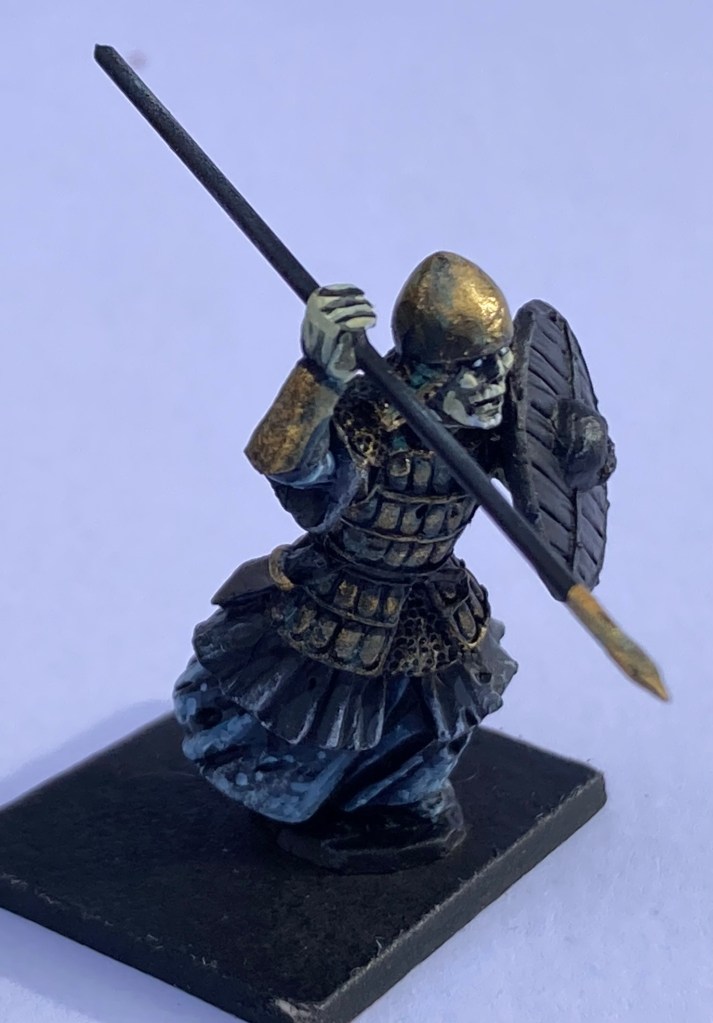
I hemmed and hawed about whether to go with GW Contrast Paints on these (requiring a white undercoat or black with white dry brushing) or traditional acrylics over black. Eventually I went with the latter, but then spent some time being slightly unsure of what I was after. Colin Patten’s painted examples are incredibly good but I wanted something with a little more colour. However, my first attempt probably had too much bronze and blue.
After taking some advice from chums on social media, I revised the bronze armour idea (which doesn’t really work as they’re meant to be Viking age) and went for a lighter skin tone.
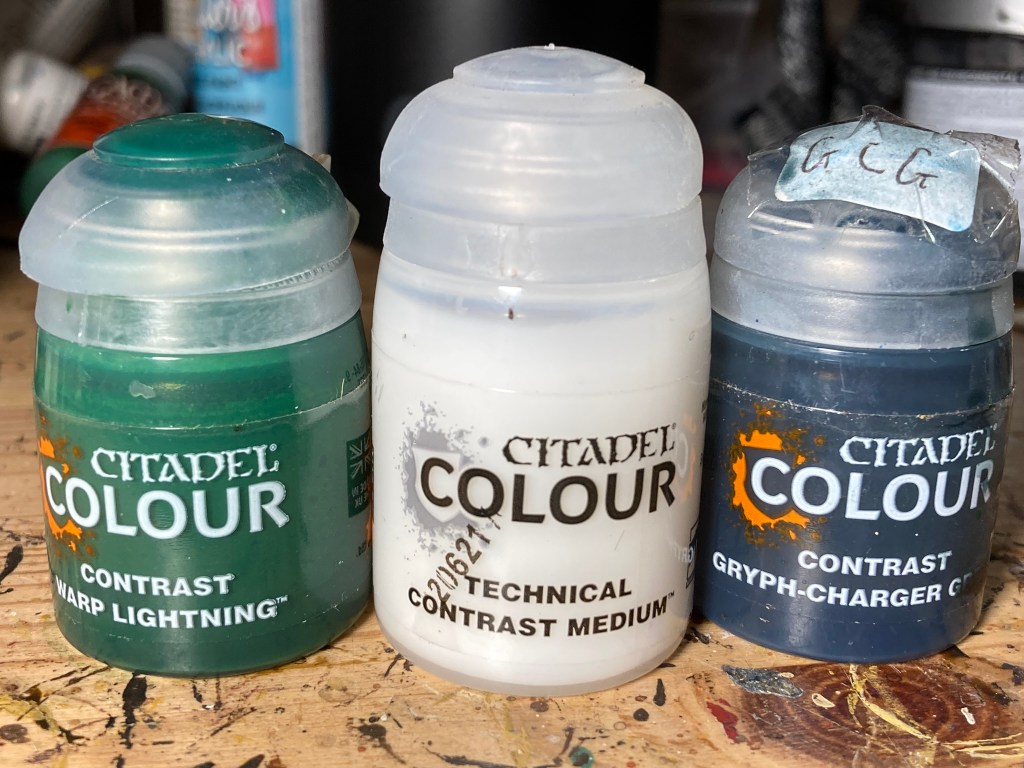
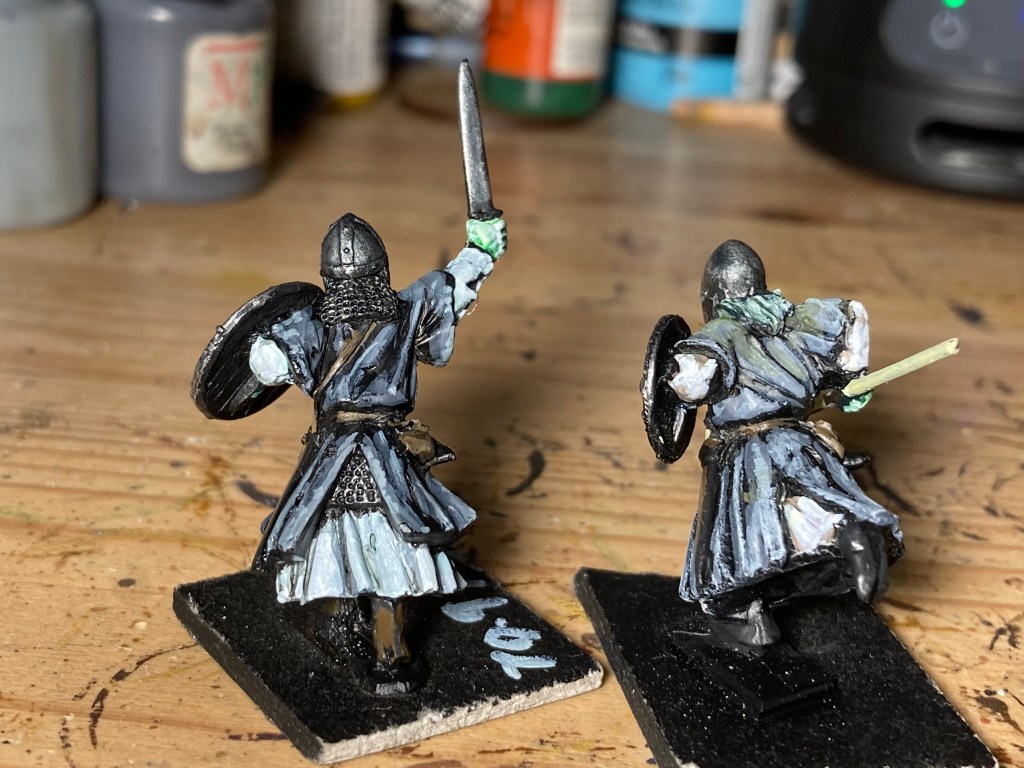
Having used a dry brush of Army Painter Gunmetal as the basic armour layer on all the models, I tidied up the undercoat and then used a base layer of white acrylic on all the skin. When dry, I used some GW Contrast Paints to pick out the skin, followed by a thinnned-down highlight of acrylic white. This gave me a stronger contrast between skin and clothing. I cut down on the blue clothing of the test mini and went with black, grey, blue-grey and off-white instead.
I found dug out some elderly bottles of ink: Oldhammer fans will recognise the venerable example on the left and I suspect the right hand one dates back to my student days. Both were still perfectly serviceable!
You can see the green tinge of the inks here, especially on the centre mini.
Some thinned-down washes of the green ink really did the trick, tying the models together and giving an unnatural tinge to proceedings. I also weathered the armour with a little brown ink to suggest rust and age.
Shields received some Celtic-inspired spirals painted in light grey and then highlighted in white. It’ll sound crazy to some of you, but I really enjoy hand painting shield designs – it’s challenging at the start of a session, but once I get into it, I find it very therapeutic.
The eye sockets were shaded in black before I dotted in the eyeball with a light blue and a final highlight of white for that ‘restless undead’ look. After a coast of matt varnish, I added a few extra highlights and then based them up in a fairly neutral scheme that should work both on grass and snow mats for gaming.
After the initial prevarication, I’m pretty pleased with these and am sorely tempted to knock up an undead horde! One for 2024 maybe? Season’s greetings to you all!
I was delighted when old chums Gripping Beast became the distributors for the Ragnarok range of Norse fantasy minis, sculpted by GB co-founder Colin Patten. I already have a number of Colin’s Dwarves from various companies, so while I didn’t really *need* any more longbeards, the Durinn’s Folk range had to be sampled!
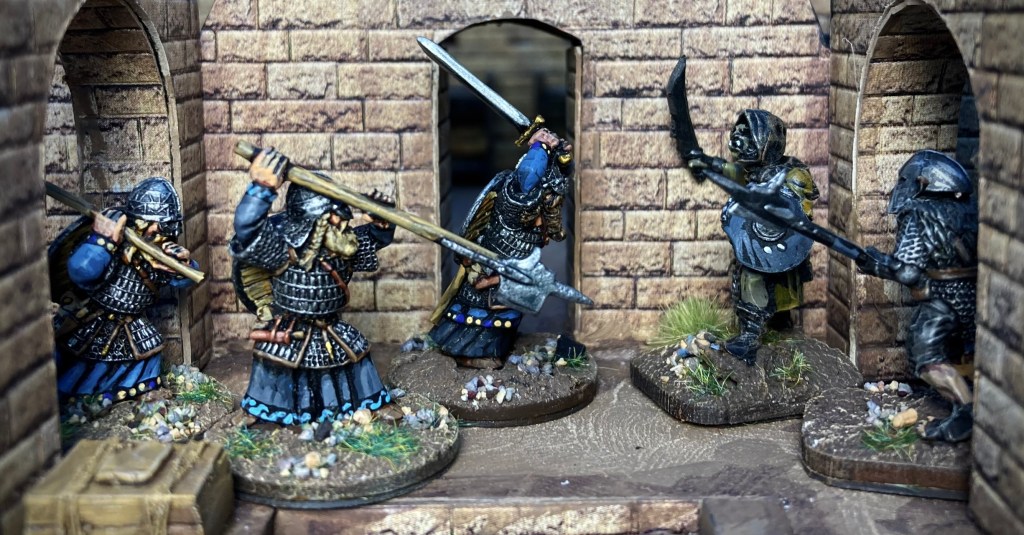
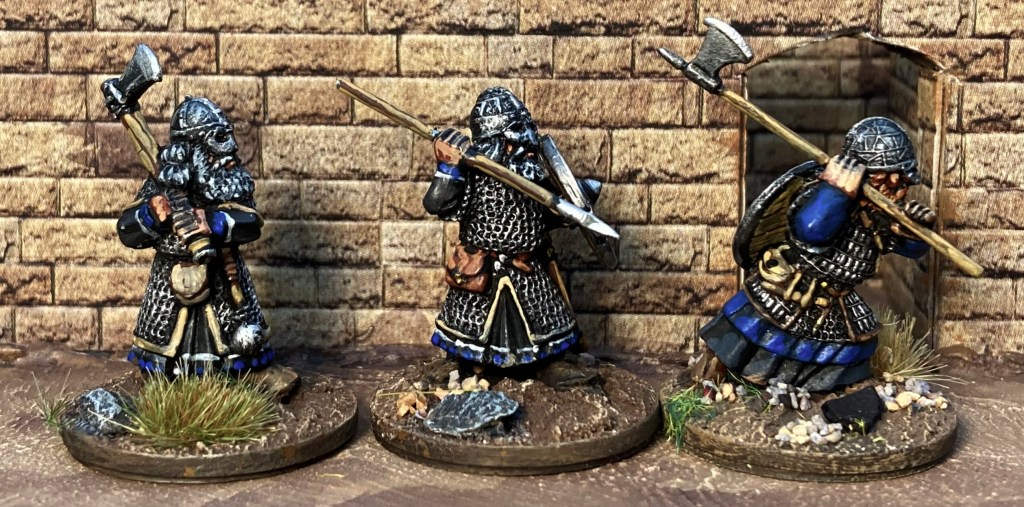
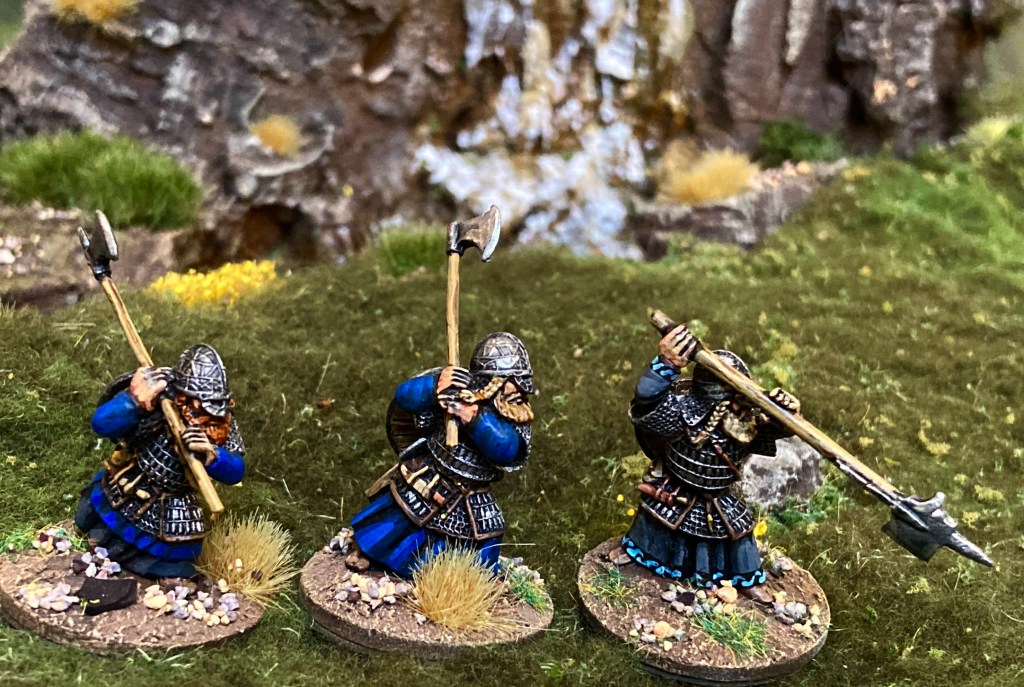
In the pictures, you can see a collector’s pack of Hearthguard Attacking With Heavy Weapons plus a Warlord. The hearthguard are supplied with separate mattocks (very Tolkien) and double-handed axes, but I couldn’t resist replacing a few of the weapons with a sword and a pair of halberds borrowed from Front Rank medieval weapons packs (also available from Gripping Beast).
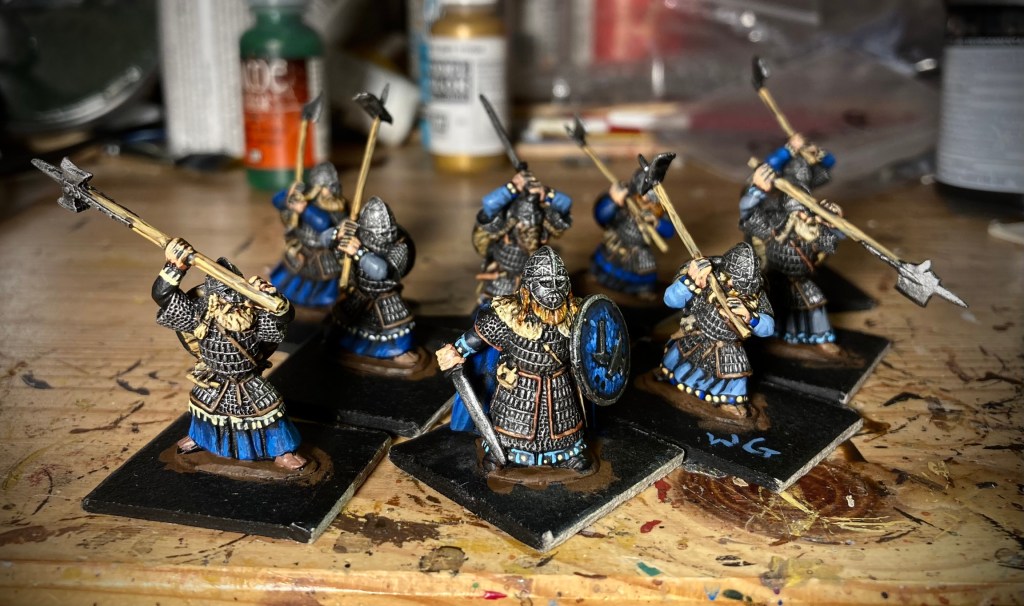
As I already have a Dwarf army painted in a blue/ grey colour scheme, I didn’t want to deviate from that. With the armour and helmets on these chaps – heavily influenced by the early medieval Vendel culture – I went for a black undercoat, drybrushed all the metalwork with silver, and then built up layers for the main colours.
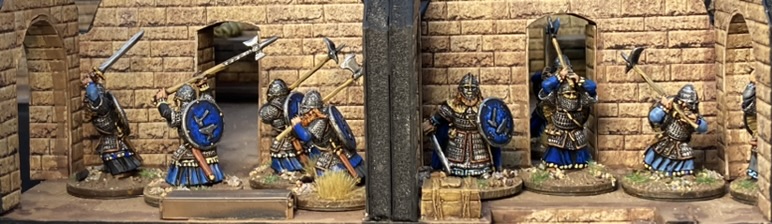
Corridor combat: Durinn’s Folk vs Goblins deep in the mines. Plastic goblins made from Oathmark, Wargames Atlantic and Perry Miniatures parts
The shields come with a nice moulded hammer and anvil design which I highlighted in various shades of blue before blocking in the metalwork and adding a few rivets for variety.
The shield recipe, layering up from Royal Blue to Mid Blue to Voidshield Blue and a little white.
Mid-painting over a black undercoat
These are cracking models and entirely compatible with all of Colin’s previous work for different companies.
Posh shields!Three generations of Patten Dwarves: LEFT – Thistle & Rose (ex Vendel Miniatures); CENTRE – Conqueror Models; RIGHT – Ragnarok Miniatures
An Orc from Knucklebones Miniatures about to get a headache – assuming the ceiling is high enough to swing that halberd!
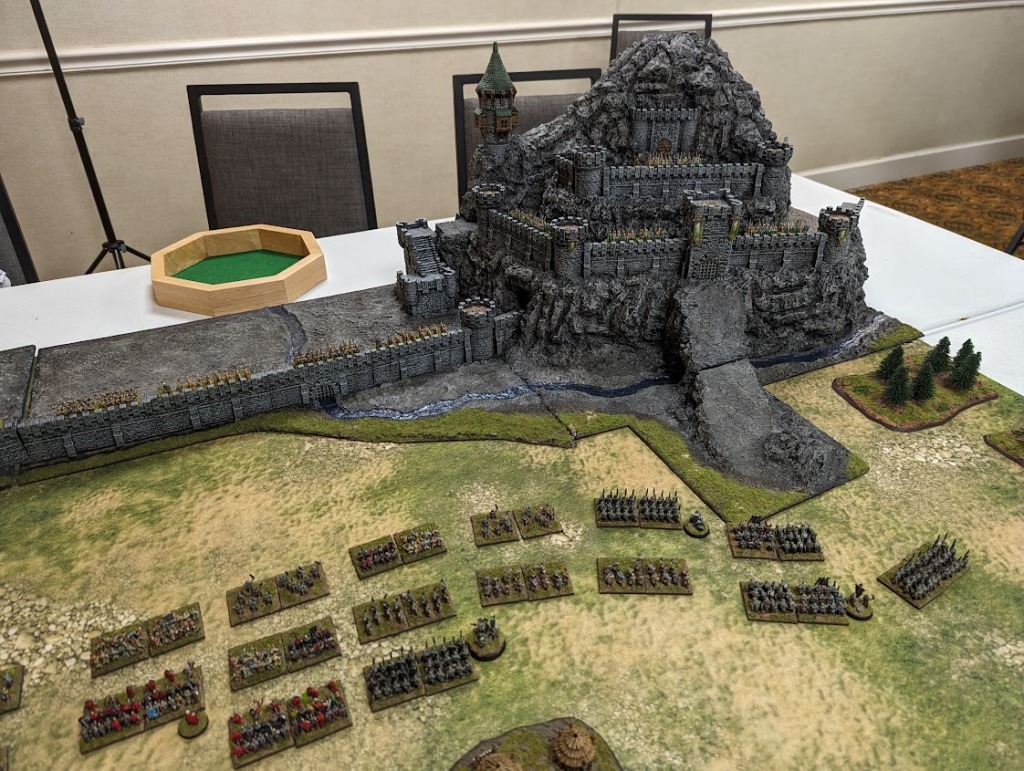
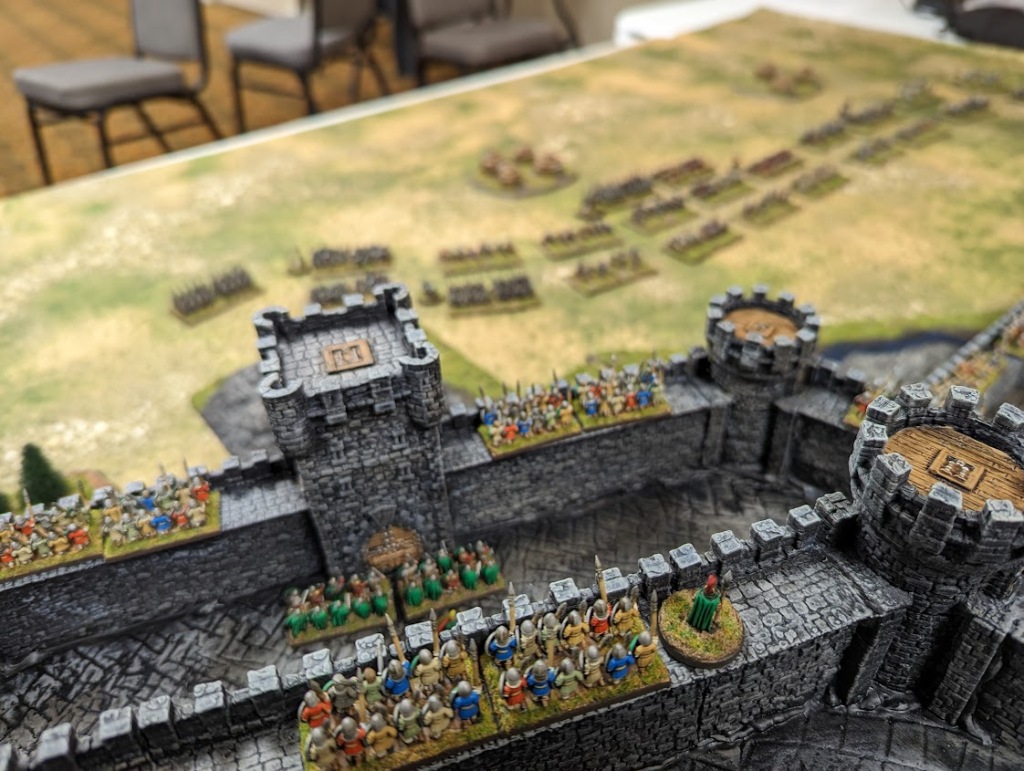
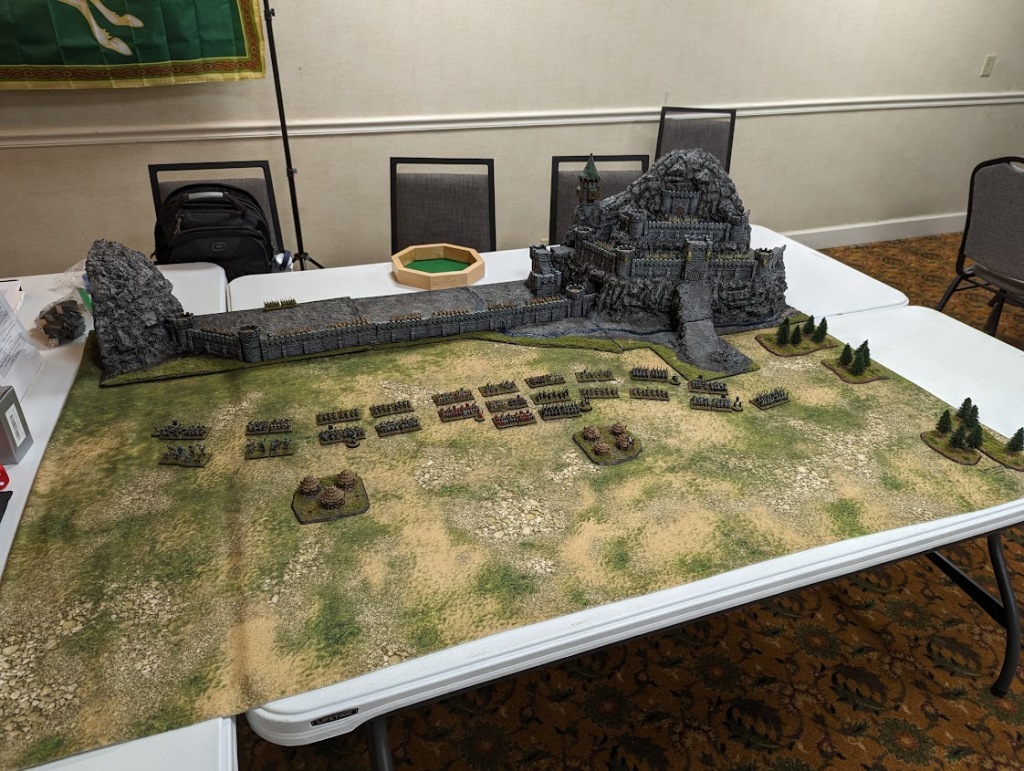
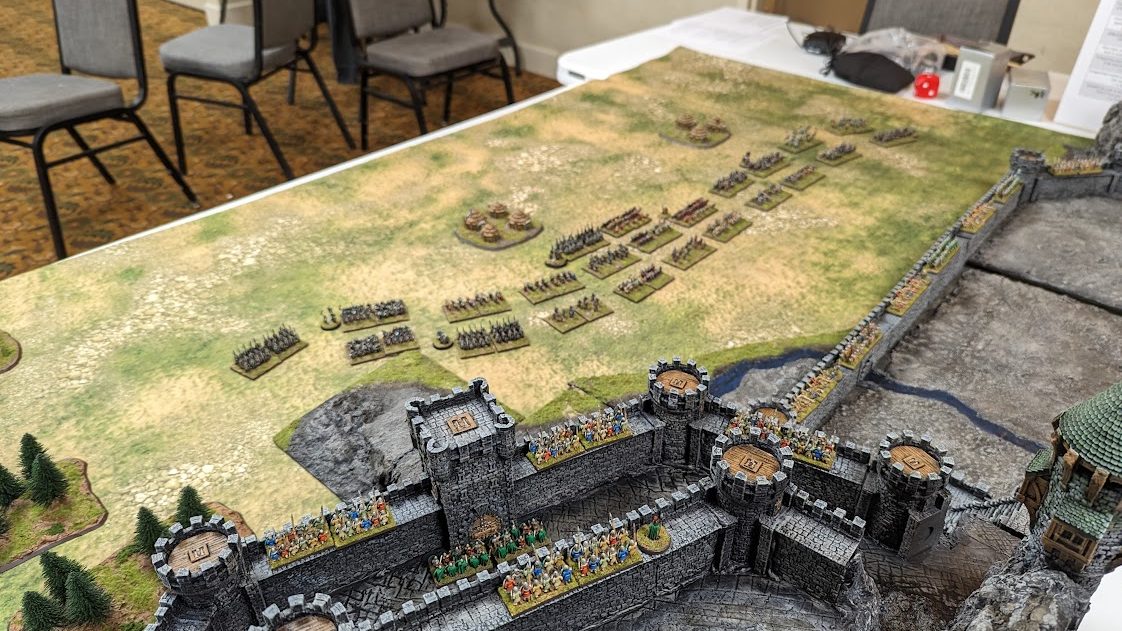
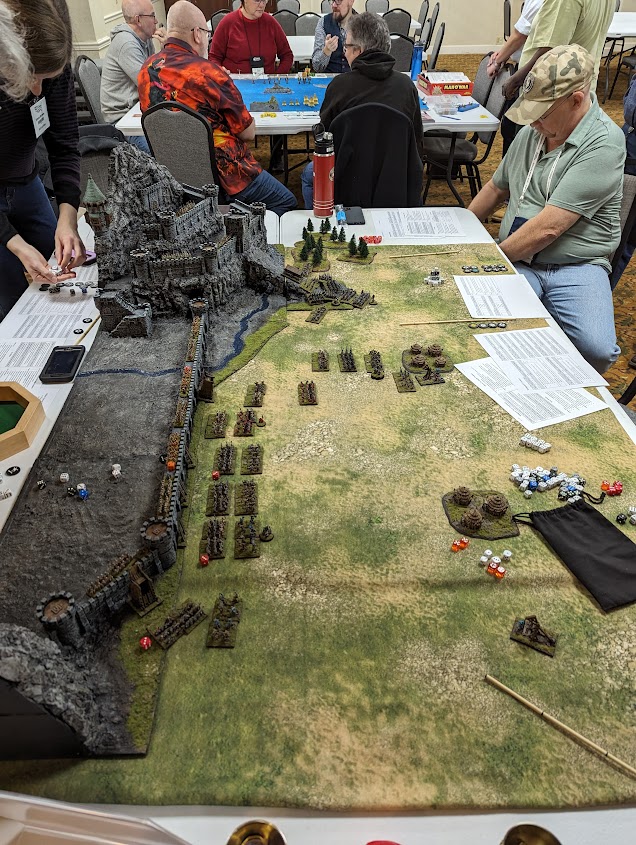
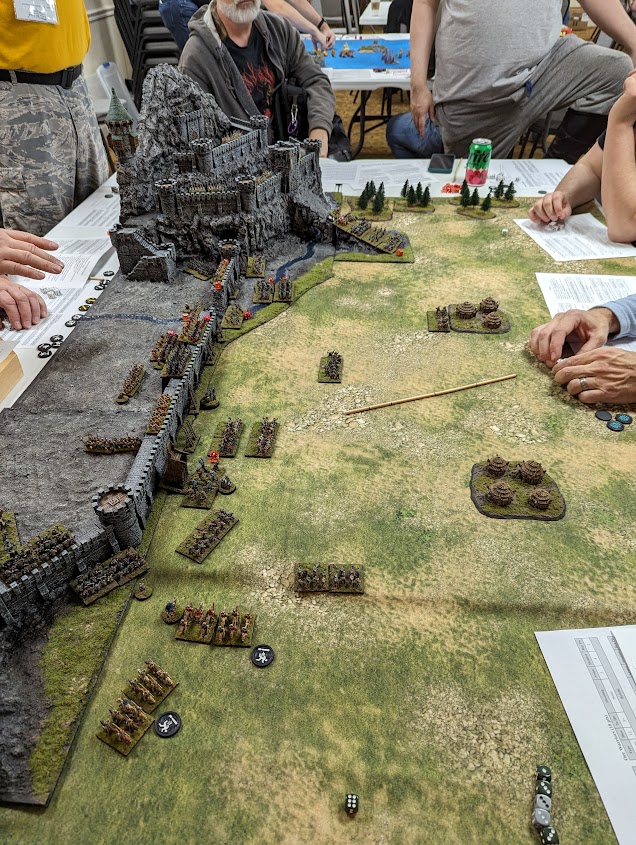
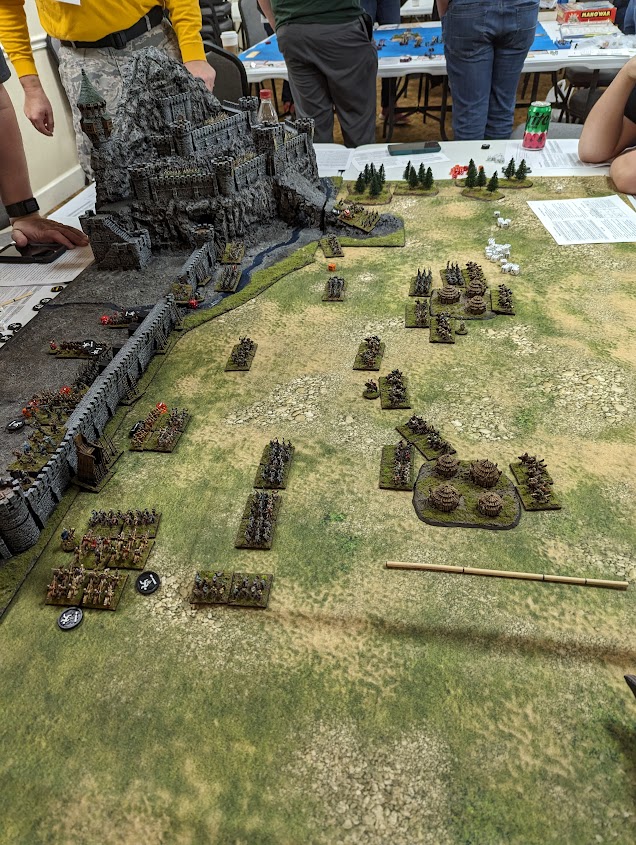
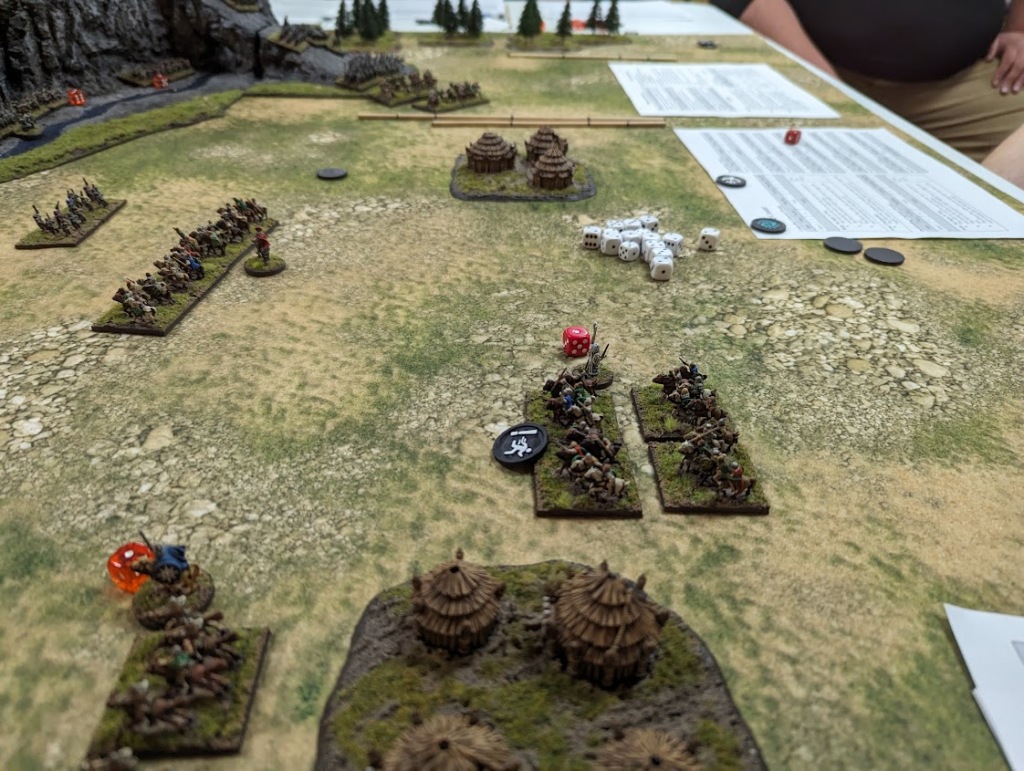
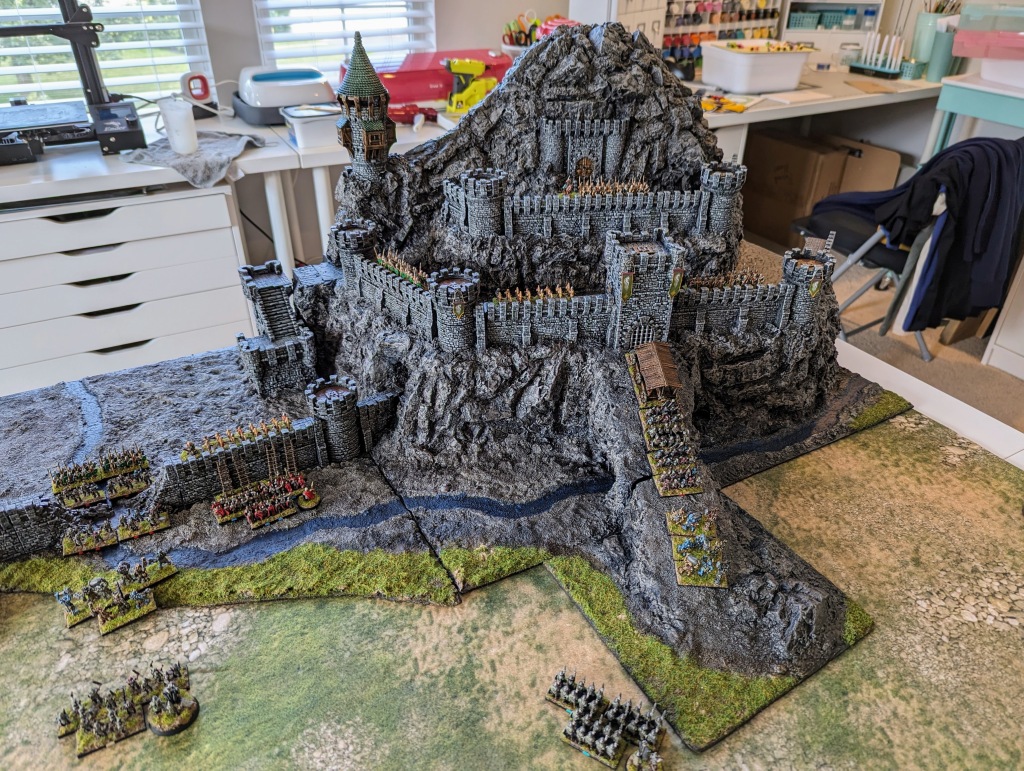
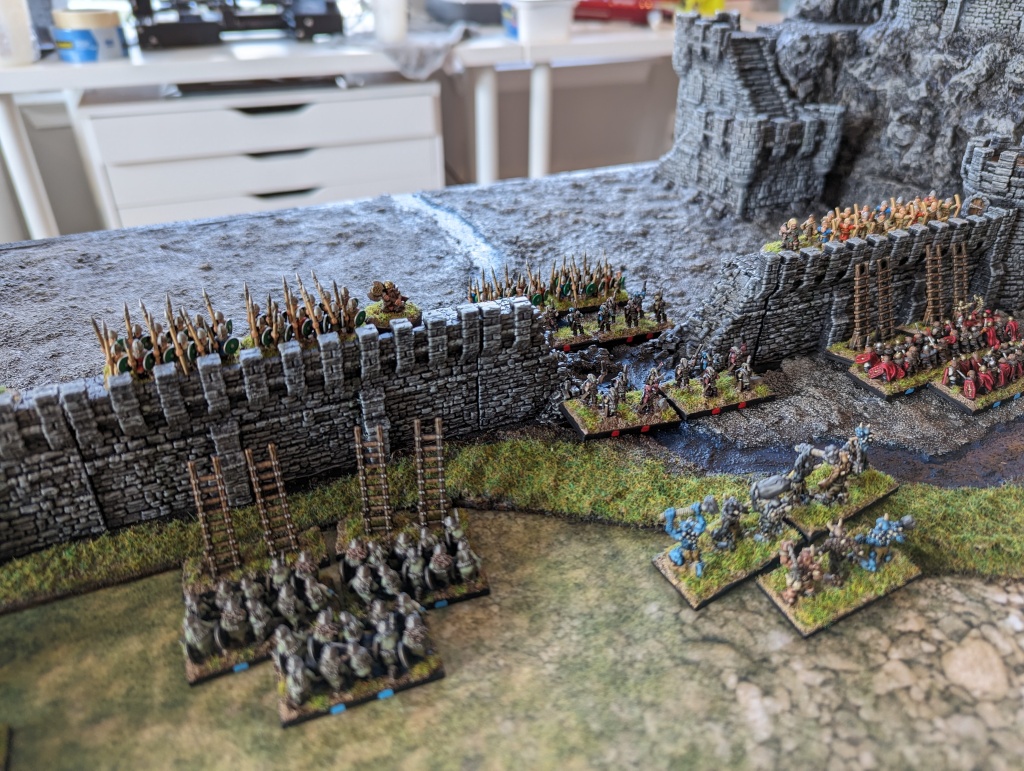
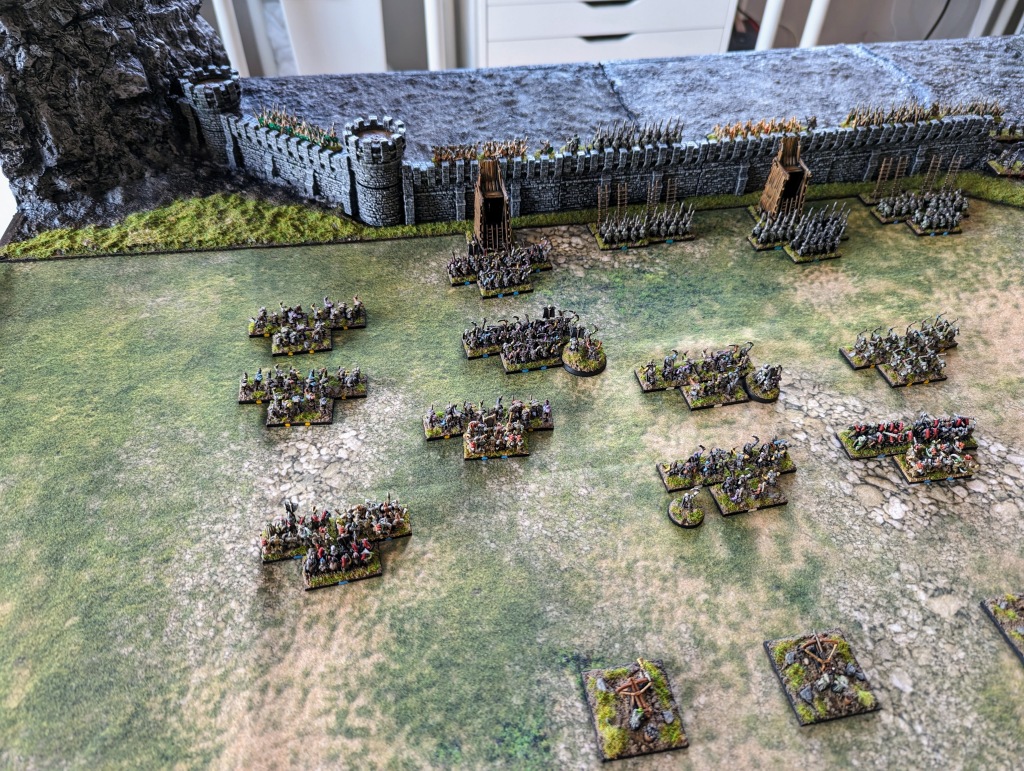
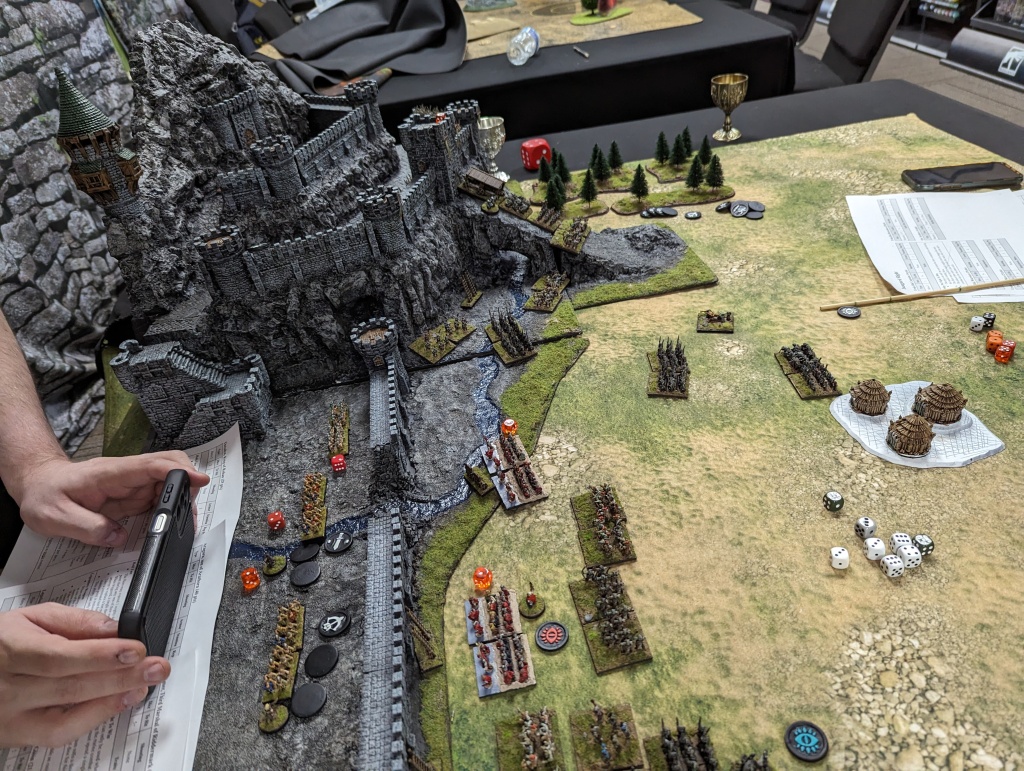
The Fall In convention took place on November 4th and 5th in the US and amongst the many games was this fantastic Middle-earth battle in 10mm, presented by Chris Grau. Chris had spent some time planning his own version of Helm’s Deep and decided to run with my forthcoming Midgard Heroic Battles rules.
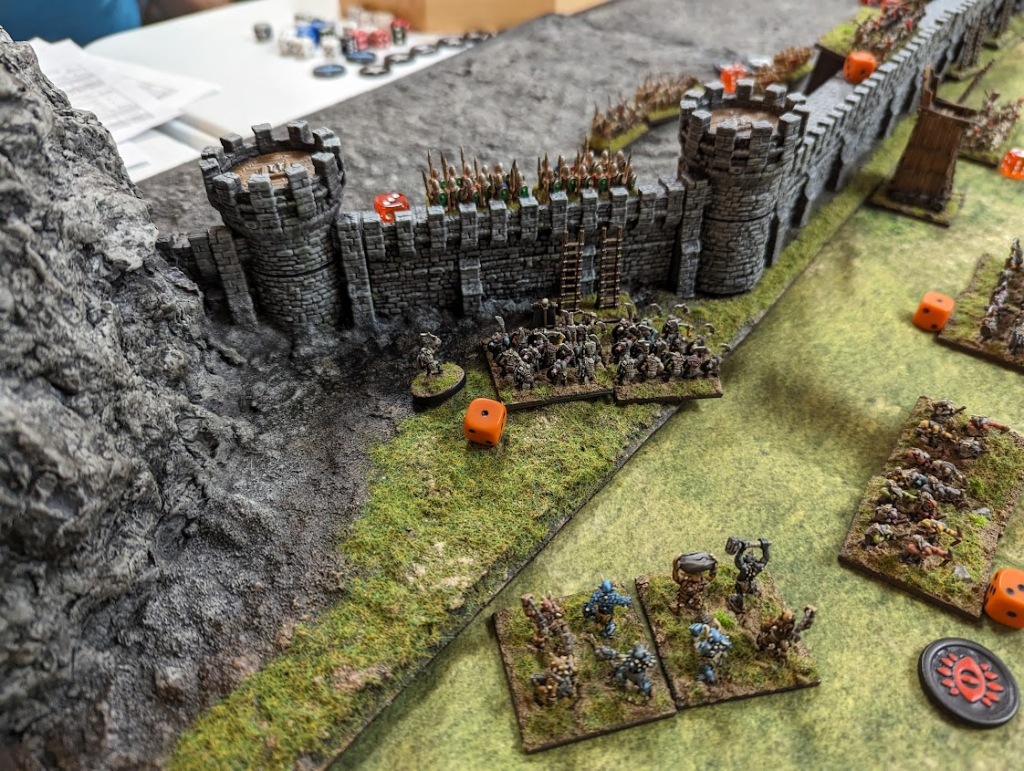
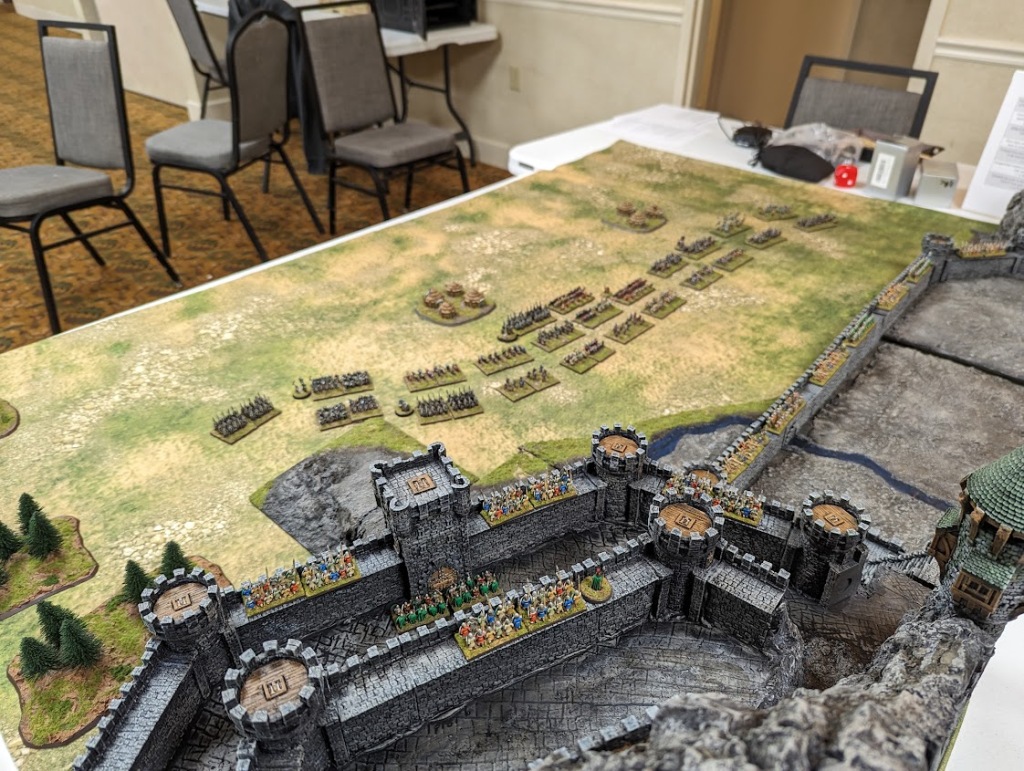
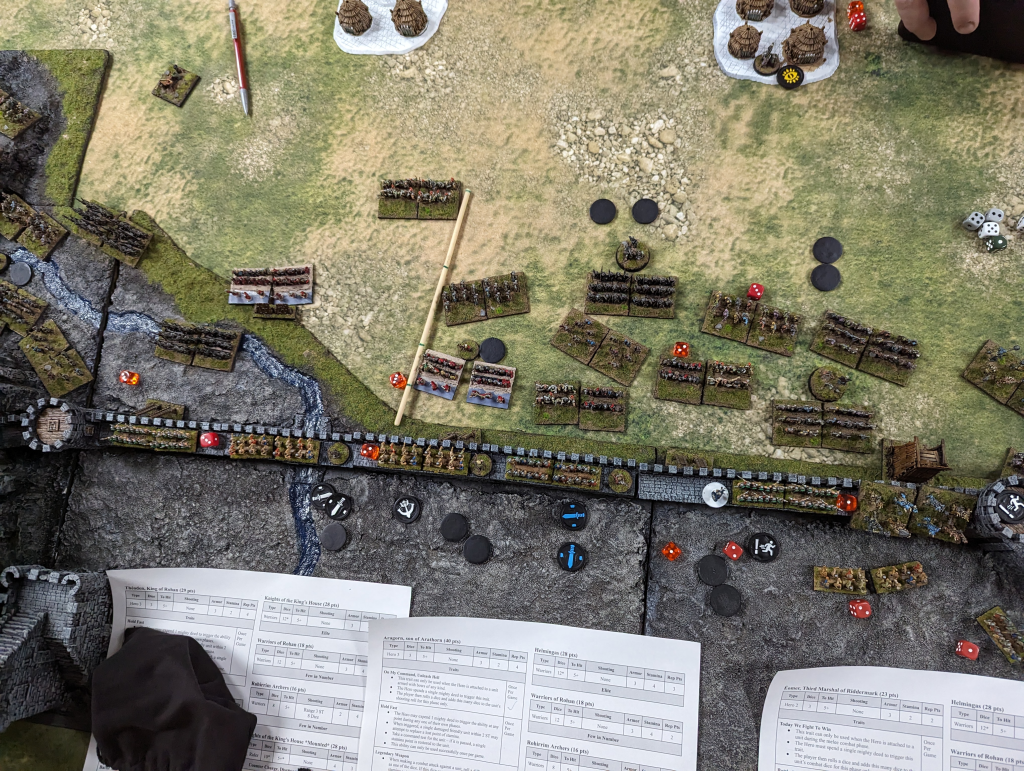
Over two days, this stunning terrain piece played host to 21 players and four games, with a pair of victories apiece for Rohan and Isengard. Chris had adapted the rules to add siege weapons and gave the Isengard players a menu of options, so each battle ended up slightly different.
Some of the highlights included:
Isengard not bringing a battering ram and instead trying to set off the “Fires of Orthanc” in front of the Hornburg gate. When the devilish device didn’t go off right away, Theoden’s personal guard charged out to drive off the Uruk-Hai and just kept winning combat all the way down the ramp for the rest of the game!
Isengard sent a unit of Uruk-Hai scouts to climb the mountain slopes above the Hornburg, causing chaos when they descended directly into the Hornburg’s outer wall.
Everyone’s favourite archer – Legolas – died in 3 of the 4 games. He was somehow a magnet for arrows and Uruk-Hai blades.
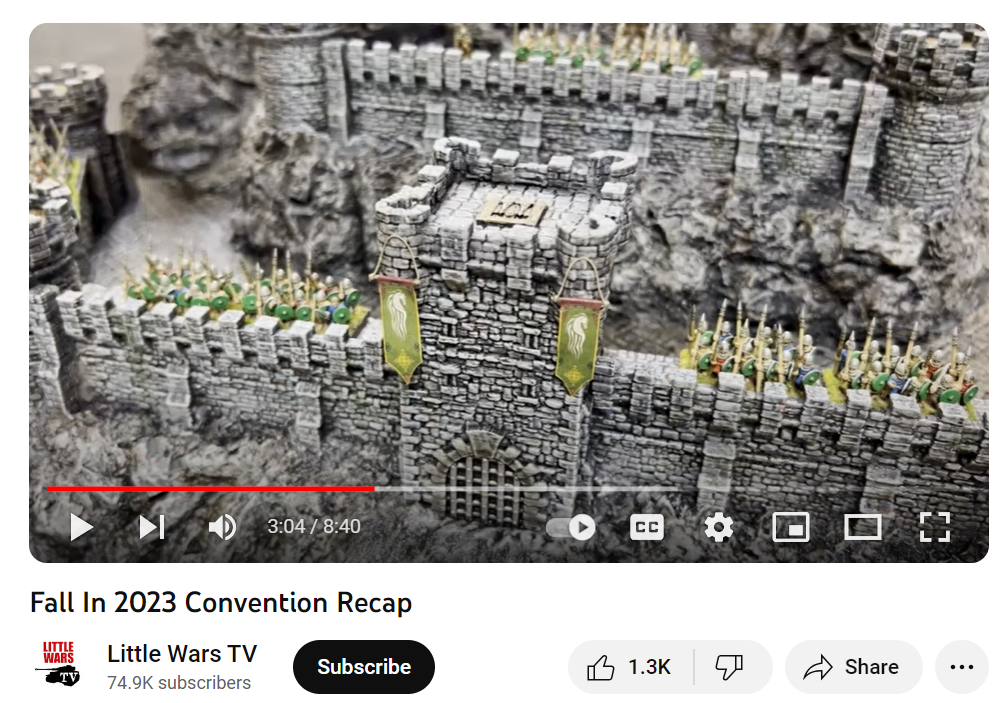
Little Wars TV also included some footage of the game in one of their videos of the event, which you can watch here – Helm’s Deep features at 2:40.
I had a number of messages after the event from players and onlookers – clearly Chris had done a great job demoing the rules. Many thanks! Release date is TBC but will be 2024 – keep watching the web!
I’ve always enjoyed painting minis but never really got the hang of taking photos (generally because I had friends who were better at it than me), but one of the things I picked up from numerous photo sessions at Wargames Illustrated magazine was simple: backdrops massively improve your shots.
Jon Hodgson has always been adept at creating landscapes that have a strong narrative quality – seen to great effect on his work for The One Ring RPG (Cubicle 7) and Beowulf (Handiwork Games) – so it was a pleasant surprise a few years back when he branched out into miniature backdrops.
Originally available as part of Jon’s Patreon, these were later made available as packages on Drive-Thru RPG and Wargames Vault. However, they all required the user to download and print them out; not a big deal for some of us, but definitely not as accessible as they could be.
Orcs – plastic conversions using various kitsFomorian Lord by Alternative Armies
Jon has a history of running successful Kickstarters and decided to put together a trial project – a spiral bound book of the backdrops that could be propped up and used for miniature photography straight out of the box.
With the project being wildly successful, I was pleasantly surprised when my copy turned up early, and couldn’t resist getting outside to get a few snaps on the next clear day.
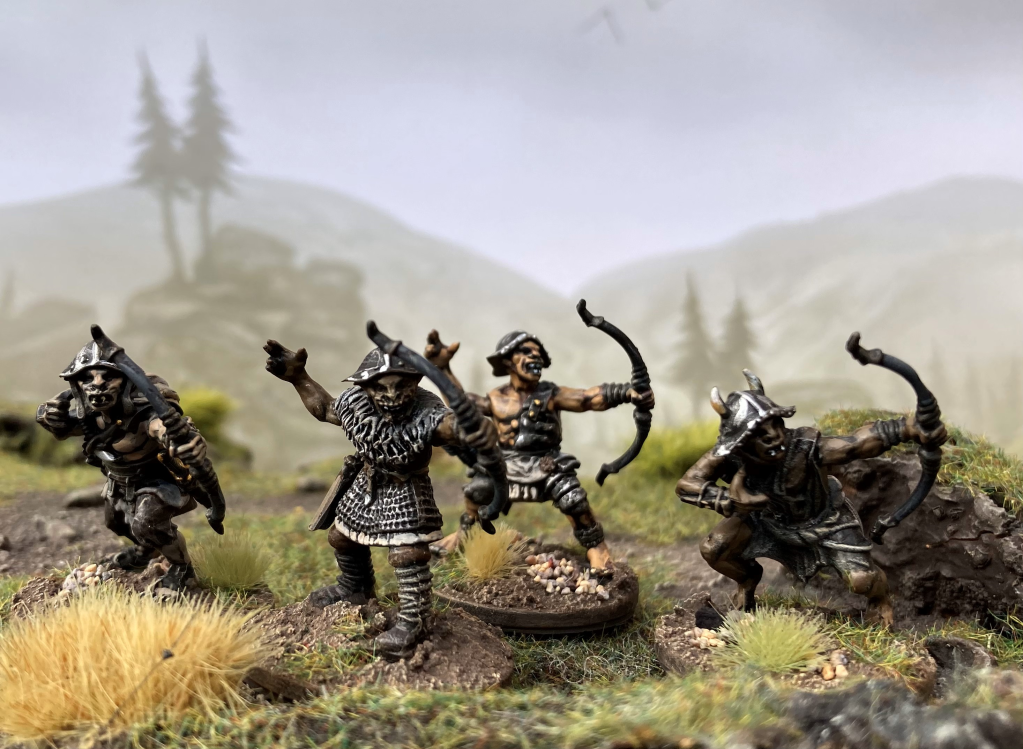
Orc archers on the prowl – conversions of Gripping Beast, Mantic and Wargames Atlantic plastics.This backdrop certainly feels like Mordor or Angband! Orcs converted from various plastics – Oathmark, Warlord Games, Gripping Beast, Games Workshop, Wargames Atlantic.
The printing is absolutely gorgeous – unsurprisingly, these are better than the versions I was printing myself at home. Although the book is slightly smaller than I’d like (A4, but I understand that the logistics of a bigger print would have made the project and postage unviable),
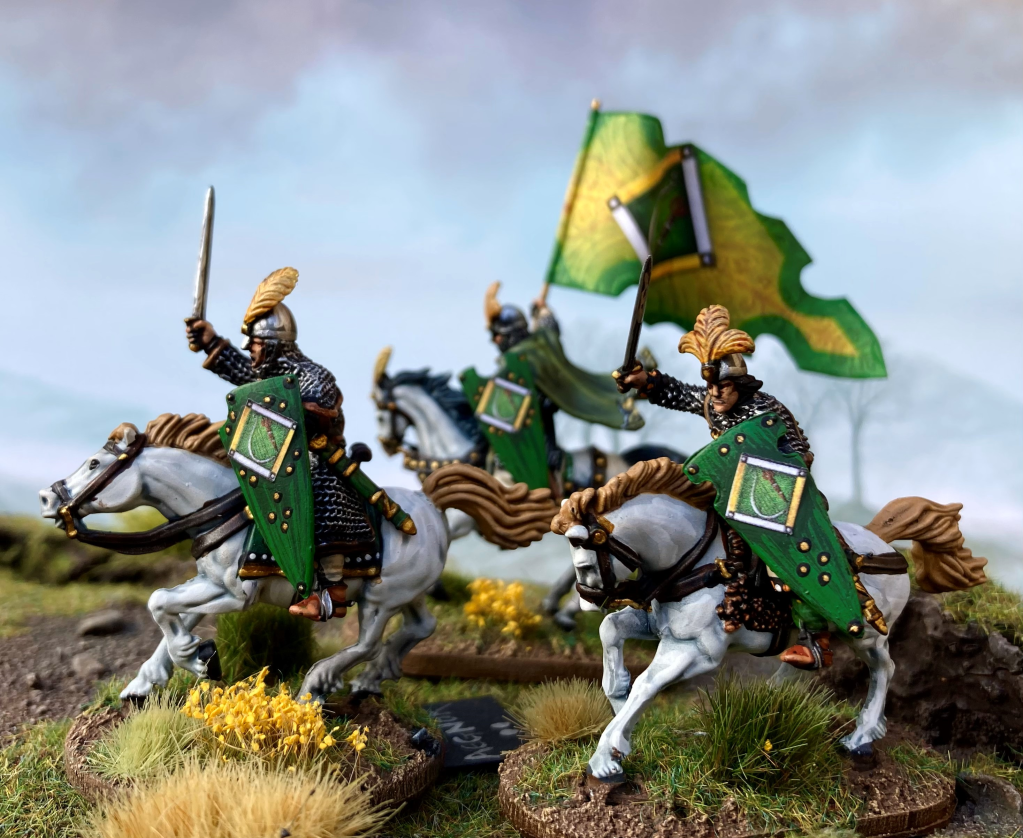
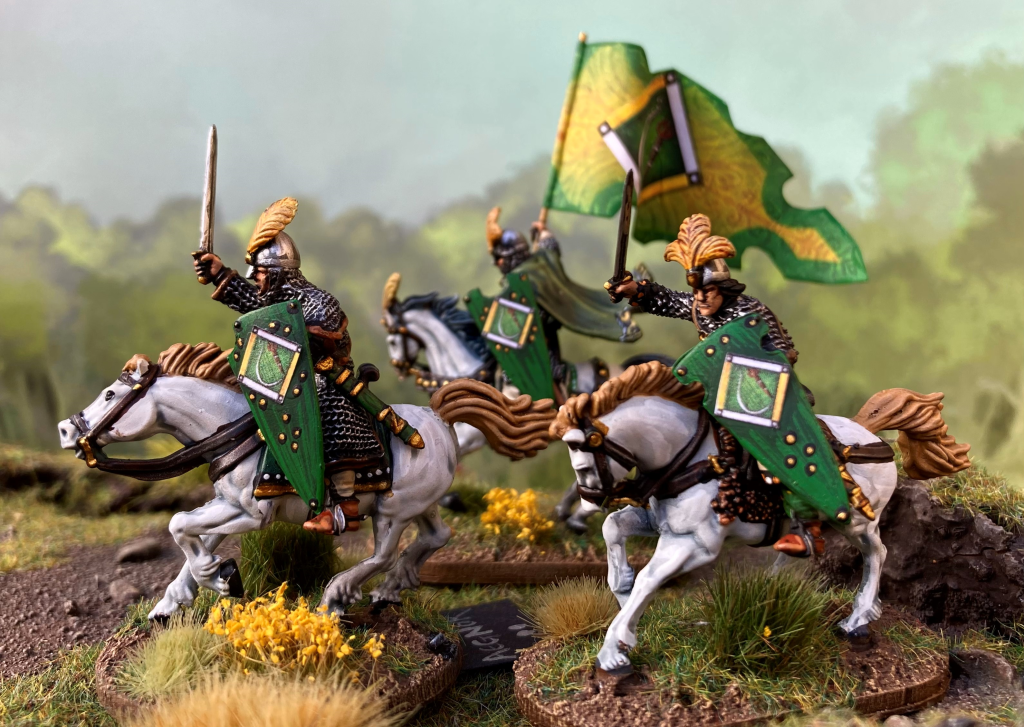
The book is brilliantly easy to use. As you can see from the pics 0f the Elf Cavalry below, I had fun quickly changing the backdrop between shots to see how the atmosphere changed between different pieces of art.
Elven Riders converted from Oathmark Elves, Victrix Norman Knights and Reconquer Miniatures.
There’s nothing fancy being used here – I just placed the minis on a small terrain piece in natural light, propped up the book behind them and got snapping using an iPhone.
Chris’s outstanding Helm’s Deep model during play testing
Following on from his successful ‘Fords of Isen’ game at Historicon 2023, Chris Grau of Feldgrau Productions will be running four games of Midgard Heroic Battles at November’s Fall In event (3-5th November 2023, Lancaster, PA, USA).
Midgard can be used for a wide variety of historical, legendary and fantasy settings, but has been popular with several play test groups for gaming some of the bigger actions from Tolkien’s Middle-earth. With a grounding in historical tactics but an emphasis on heroic leadership, Midgard is very much at home with games set set in the world of the Lord of the Rings. The rules – due to be published by Reisswitz Press – aren’t out yet, but Chris is kindly running preview games to give you a taste of what to expect.
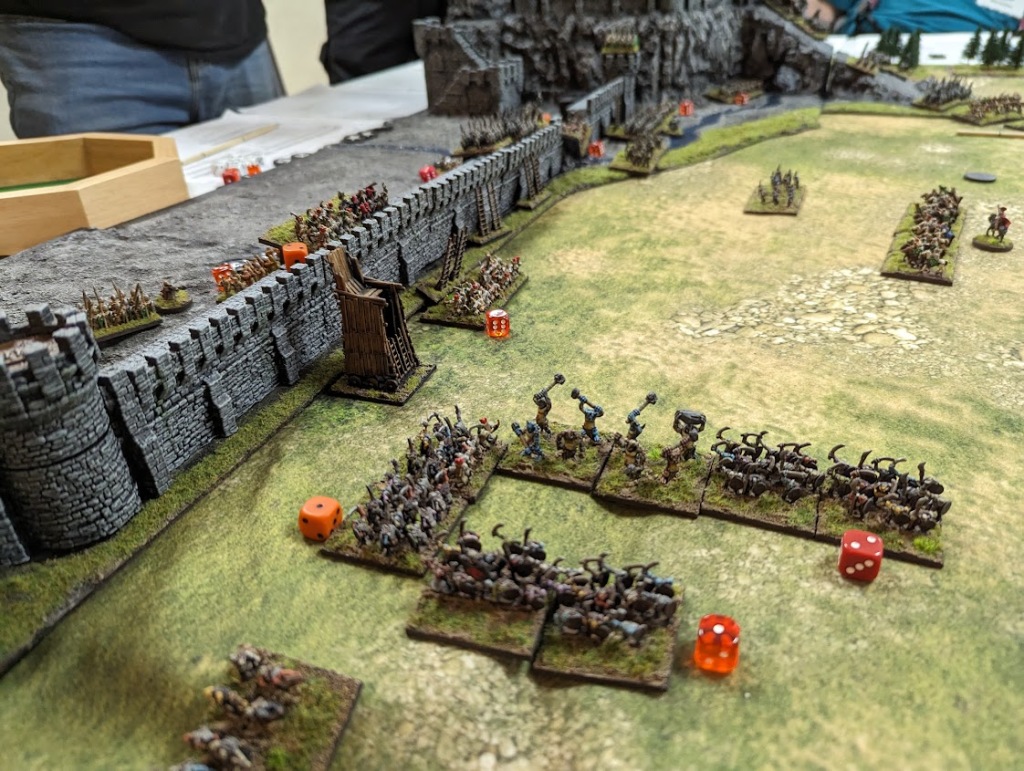
Uruk-Hai and Trolls attempt to storm the walls and the breach in the Deeping Wall
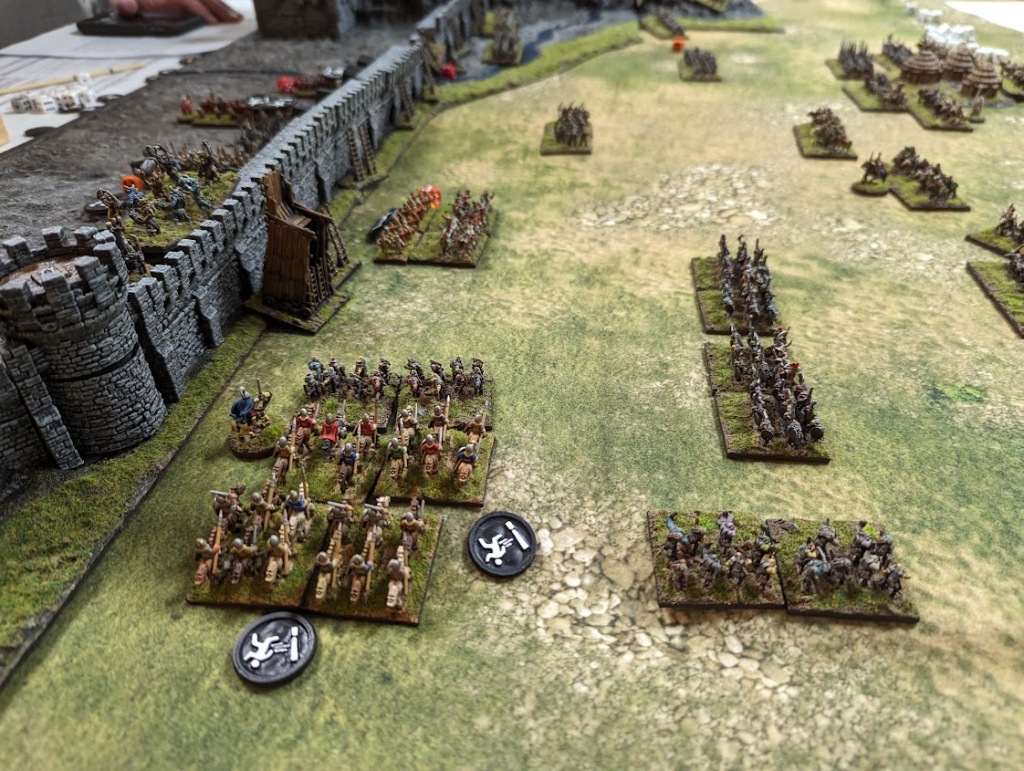
Chris has a fantastic set-up using 10mm miniatures and has been busy building his own version of Helm’s Deep, shown here in play testing.
It’s refreshing to see a model of this famous battle that isn’t just a copy of the one shown in the Peter Jackson movies, and the small-scale miniatures allow an epic feel to the game.
More play testing shots with one of Chris’s buddies getting a Legolas-eye view from the wall. At the top, you can see the goblets of Reputation, the driving mechanism behind victory and defeat in Midgard Heroic Battles
Apparently, the pre-booked slots for the games have already gone, but Chris says ‘I’ll accept walk ups if I have open spots. It’s not uncommon for at least one person who signed up to not come. I’m also happy to have people watch and learn the rules,’ so sounds like it’s worth dropping by if you’re interested.
Slough Feg and Medh, the Bride of Crom. Minis by Northstar photographed against a Jon Hodgson backdrop.
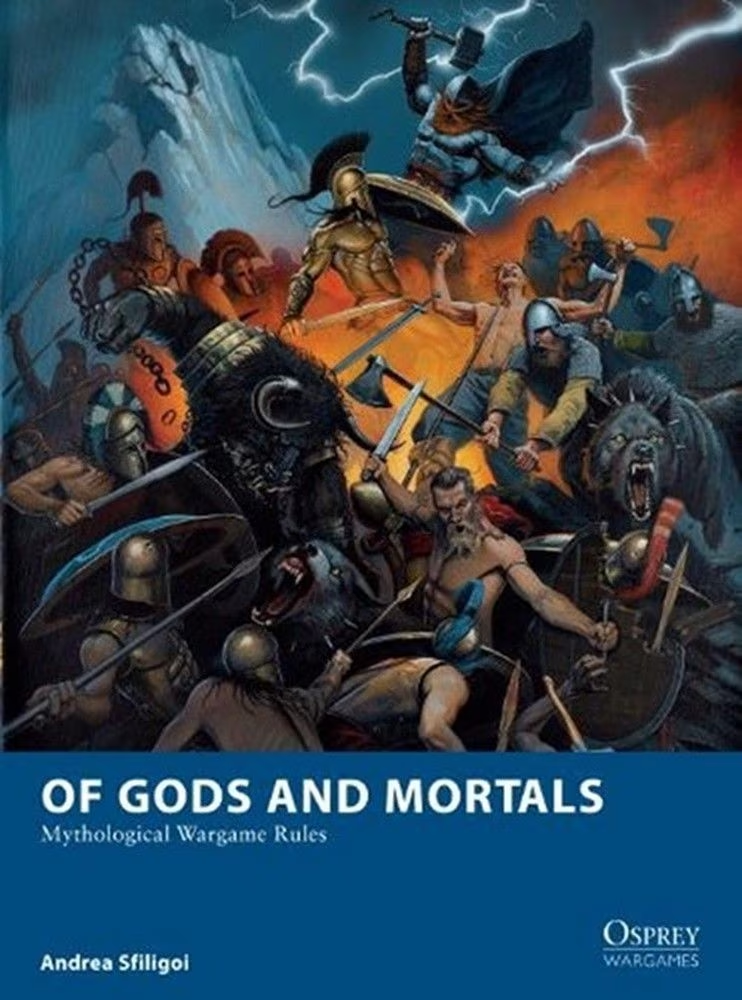
Tom WD and I are big fans of Osprey’s Of Gods And Mortals game, published ten years ago but still getting played by us on a fairly regular basis. Fortunately Kev Moon and friends at the ELMS club in Leeds are also regular players, so we like to get together every so often to throw dice and deck each others’ gods.
In case you missed it, OGAM is a skirmish game where you play a mythological pantheon. Each player controls a God, several Legends (heroes or creatures) and around 20 Mortals (who fight and pray for their deity). Written by Andrea Sfiligoi and using some of the mechanisms from A Song Of Blades And Heroes, it’s published by Osprey as one of the ‘blue book’ series. Games last about 90 minutes and are invariably fast-paced and somewhat wacky.
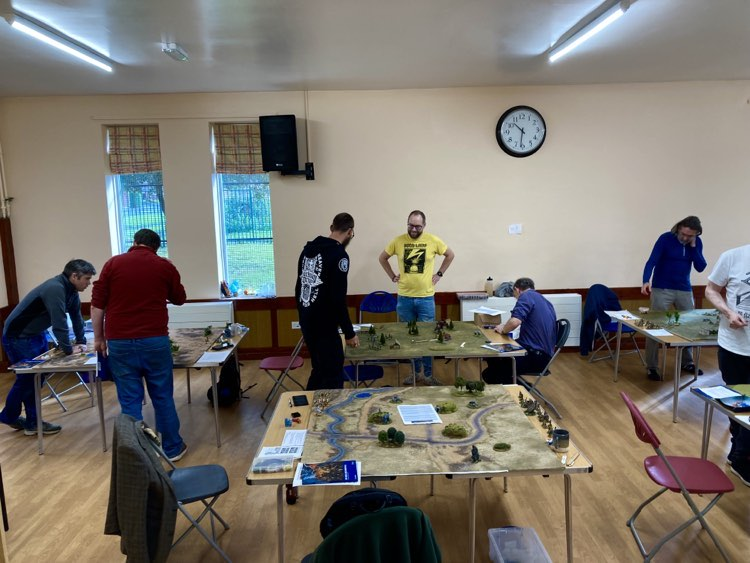
Although we usually pit Gods from the same pantheon against each other, Kev had decided that this event was going to be ‘open season’, so we saw Greeks, Celts, Norse, Egyptians, Japanese and pre-Islamic Arabs taking to the gaming table. With 11 players, we each played three games against different opponents.
Crom Cruach – AKA an AD&D Purple Worm with a brown paint job
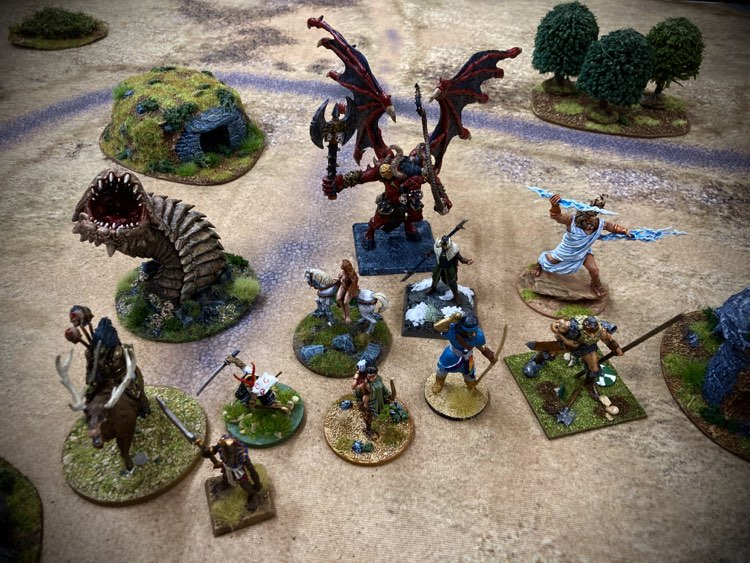
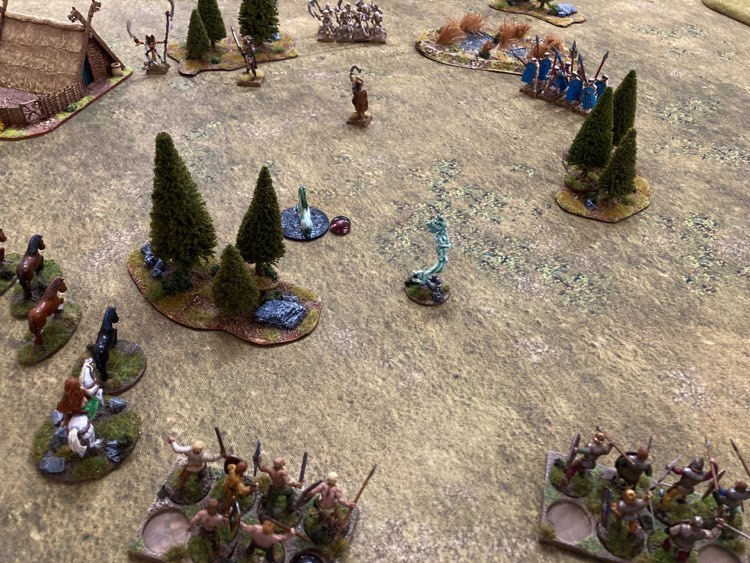
I took the opportunity to pull out some of my Celtic mythological figures that don’t see the light of day often enough. Crom Cruach, the Bloody Crooked One, is a Celtic god of death and destruction who features heavily in 2000 AD comic’s Slaine series. Fortunately I had recently painted a mini for him, so he became my God.
Warlord Games’ Skull Swords
For followers, I didn’t need to look any further than the Skull Swords from Slaine. Warlord Games produced a superb range of models for these for their Slaine Miniatures Game last year, also including a fine Drune lord (Slough Throt).
Drune Priest, Weird Stone and Slough Throt
Following on with the Slaine theme, I also added two units of Half-Dead warriors from the Alternative Armies range. These weren’t going to have much fighting impact but would provide valuable power for Crom Cruach during the games. Forces for OGAM are usually built to 900 points – I managed to bring this in at just less than that. Here’s the roster if you’re interested:
Once gathered at the venue, the eleven players put out their Gods for a quick photo shoot. There were other Celtic pantheons alongside Greek, Egyptian, Norse, Japanese and pre-Islamic Arab – quite the variety!
The Gods assemble
The ELMS club had kindly provided all the tables and scenery. Each table was set up with a different scenario and ready to play, so all that was left to do was to pair off and get started.
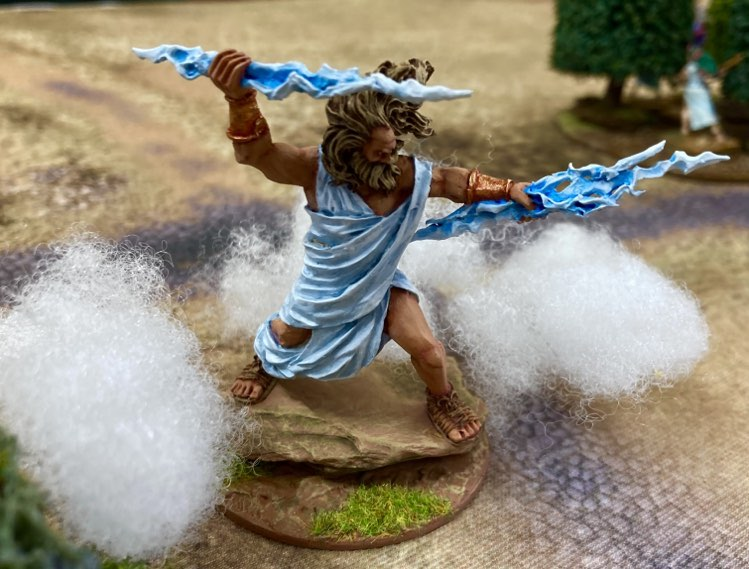
My first game was against Dean’s impeccably-painted Greek warband, led by Zeus and featuring Herakles backed up by some Spartans, Dryads and Centaurs.
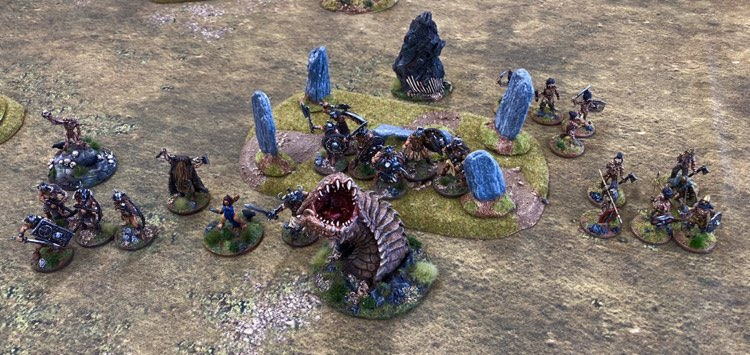
The scenario was a fight to the death around some barrow-mounds, one of which had an undead inhabitant who wasn’t pleased to be awoken. This chap could be activated by the opposite side as a reaction during the game, but didn’t make much impact as things turned out.
OGAM has an unusual deployment rule in that, in most scenarios, units can be placed anywhere except within a certain distance of enemy units and objectives. This led to a situation where Crom Cruach ended up in fairly close proximity to Zeus. When I won the initiative – and knowing from previous games how powerful Zeus can be – I mounted a pre-emptive giant worm strike to try to peg back the big guy.
This was successful beyond all expectations as Zeus was banished on the first turn! He didn’t stay down long as his followers prayed to summon him back, but I managed to resist his lightning bolts and then send the Lord Weird Slough Feg on a mission to take out the Dryads with his ‘Culling of the Weak’ ability. This was, once again, unusually successful (it needs to be said that Dean’s dice were absolutely shocking throughout the game).
Turn 3 saw a very premature end to the game as Herakles mounted an attack on one of my Skull Sword units. I was hoping to get off lightly with just one casualty and a retreat, but Herakles rolling a 1 vs a 6 saw the great hero laid out on the deck. OGAM is very fast-playing, but the Legend characters can be vulnerable, and this was a case in point.
A further attack from Crom on Zeus saw the Olympian God banished yet again, and his followers fleeing the field, so Dean decided to call it a day. A tough one for the Greeks.
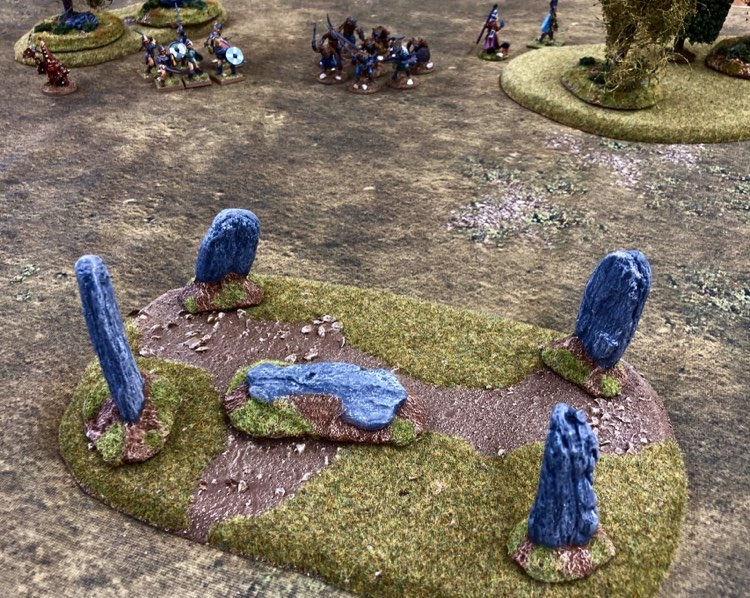
Game 2 was ‘The Stone Circle’, a variant of the ‘Sacred Grove’ scenario from the OGAM rulebook. The scenario involved trying to get possession of the eponymous ancient monument, although the first unit entering would face an attack by the guardian spirits.
My opponent for this was John with his Norse warband, followers of the lesser-known deity Vidar.
Predictably, pretty much everyone hot-footed it for the stone circle, resulting in an epic scrap between the Gods and Legends in the area.
My Skull Sword Champion went down fighting, but Crom quickly gobbled up both Valkyries in short succession.
A moment of black comedy occurred as I spotted an opening and rushed forward the Drune Lord Slough Throt into the stone circle. Naturally, I had forgotten about the guardian spirits! Once dodgy dice roll later and Slough Throt was toast…
Slough Feg once again unleashed his Culling Of The Weak on to the enemy Mortals (Troll-Wolves in this case), and the Viking warriors scarpered en masse as Crom took down Vidar.
Another victory for the followers of the worm!
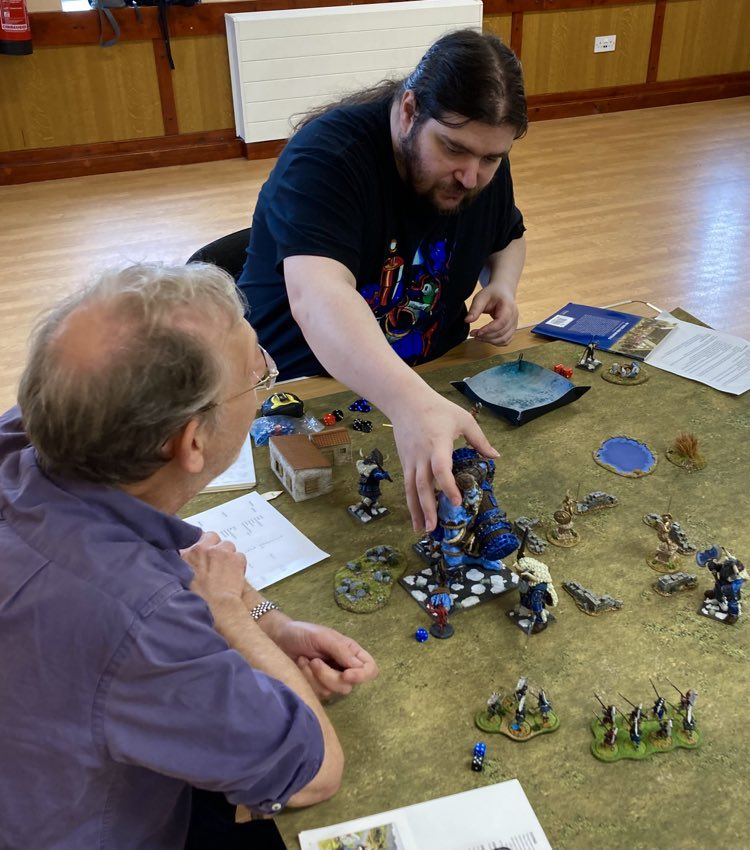
At this point, I had to get a couple of photos of other games. Frost Giants vs Samurai was on the table next door.
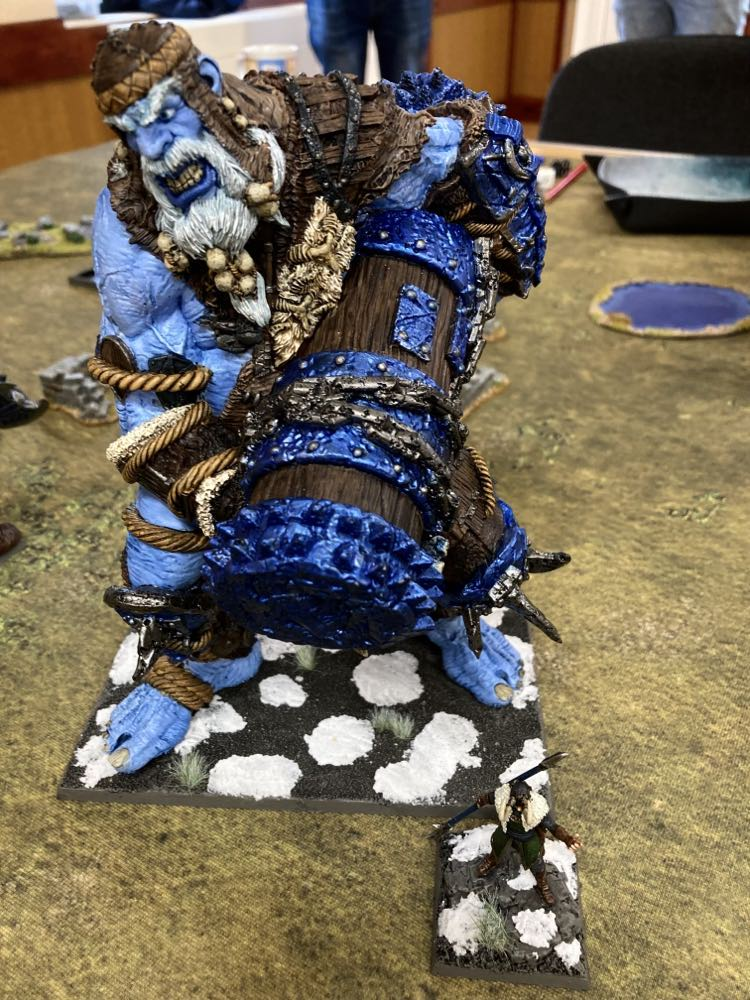
I like my Frost Giants but this mini was absolutely insane! He was being fielded as Utgard-Loki, inside whose glove Thor and Loki sleep in one of the Norse tales, mistaking it for a cave.
Here’s Tom’s Epona-themed Celtic force taking on the Undead Egyptians – more on these later.
The final game of the day was Pandora’s Box – a scenario where you have to get to the centre of the ruined temple and then randomly determine what treasure lies there!
My opponent for this one was going to be Anubis and his Undead Egyptians, played by Oliver, who had some lovely Warhammer models making up the bulk of the force.
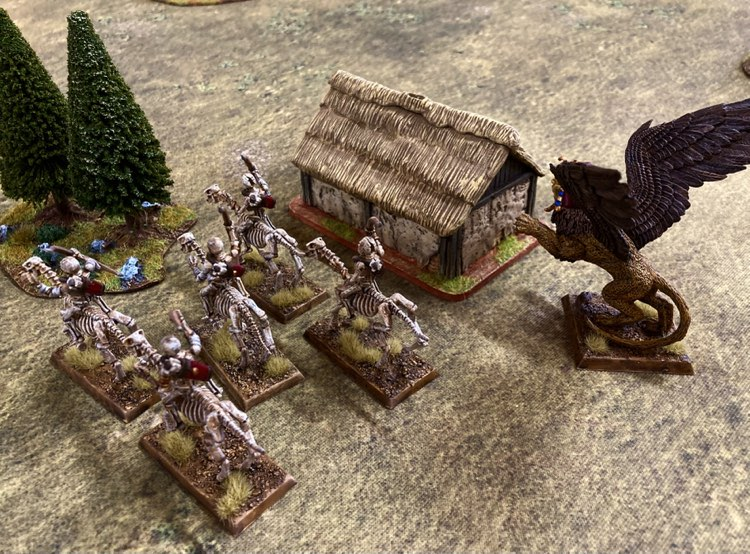
Undead can be a tough nut to crack in OGAM as they are immune to morale tests. I therefore decided to adopt the tactics of taking out as many Undead as possible before going for Anubis himself.
The tactic worked, although those Undead were damned hard to shift, especially with Anubis using Raise Dead every turn! Crom Cruach eventually crunched his way through enough skellibobs to turn his attention to the jackal-faced deity.
Slough Throt got through to Pandora’s Box inside the ruined temple and rolled to discover that he would now have the ability to make poisoned attacks. Which would have been magic, if he wasn’t fighting an entirely undead force!
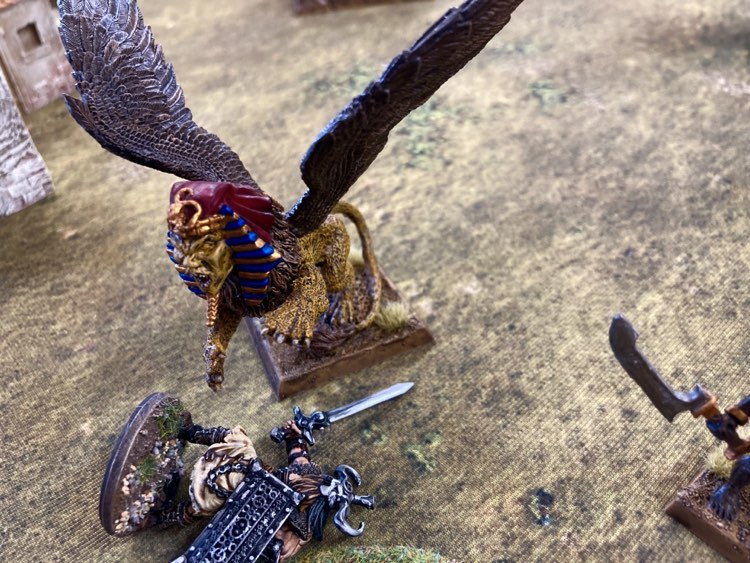
My Half-Dead were set upon and somewhat mauled by the Sphinx (a cracking Reaper Miniature from Oliver’s collection).
And a sneak attack by my Skull Sword Champion ended embarrassingly.
The game eventually ended with a God v God battle inside the ruined temple, exactly as it should. Crom got the better of Anubis and had managed to deplete his followers to the extent that he wasn’t coming back.
All in all, a terrific day’s friendly gaming in a great venue. Tom and I found playing ‘out of period’ (yeah, I know, in a fantasy game) slightly odd, and I left with a hankering for a themed event next time out. OGAM is still a brilliant game though and will need more playing very soon. Many thanks to Kev and the ELMS group for hosting. We’ll be back!
While Midgard Heroic Battles is going through the editing and quality control process here in the UK, there’s an opportunity to try out the rules in the USA coming up.
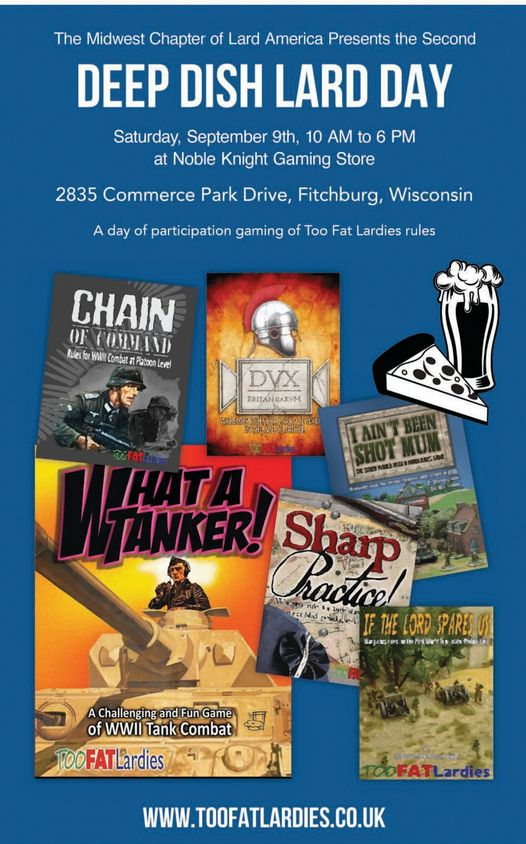
Expat and long-term play tester Scrivs will be chipping in to the Deep Dish Lard Day at Noble Knight Games in Wisconsin on Saturday 9th September, where there’s an opportunity to play a wide array of Too Fat Lardies games run by stateside Lard enthusiasts.
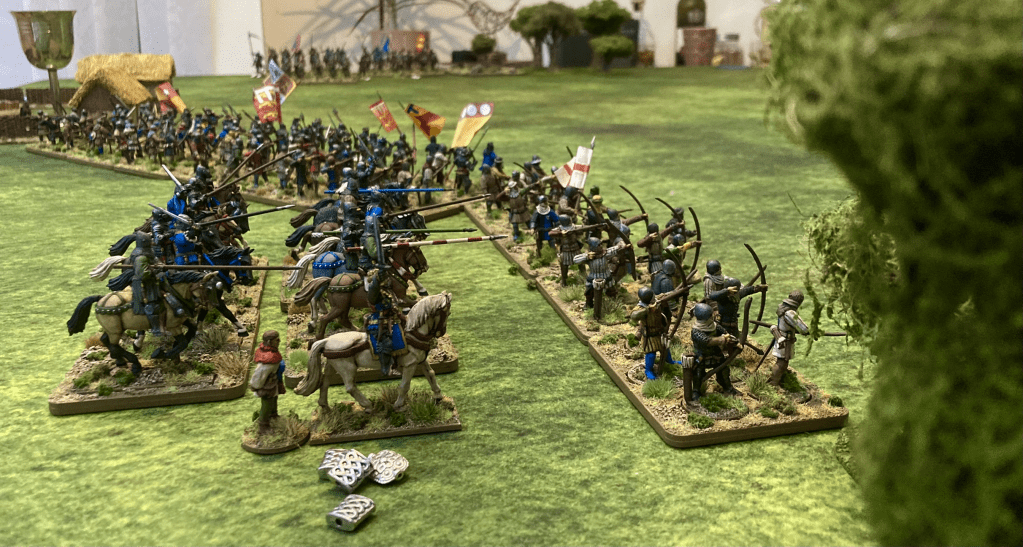
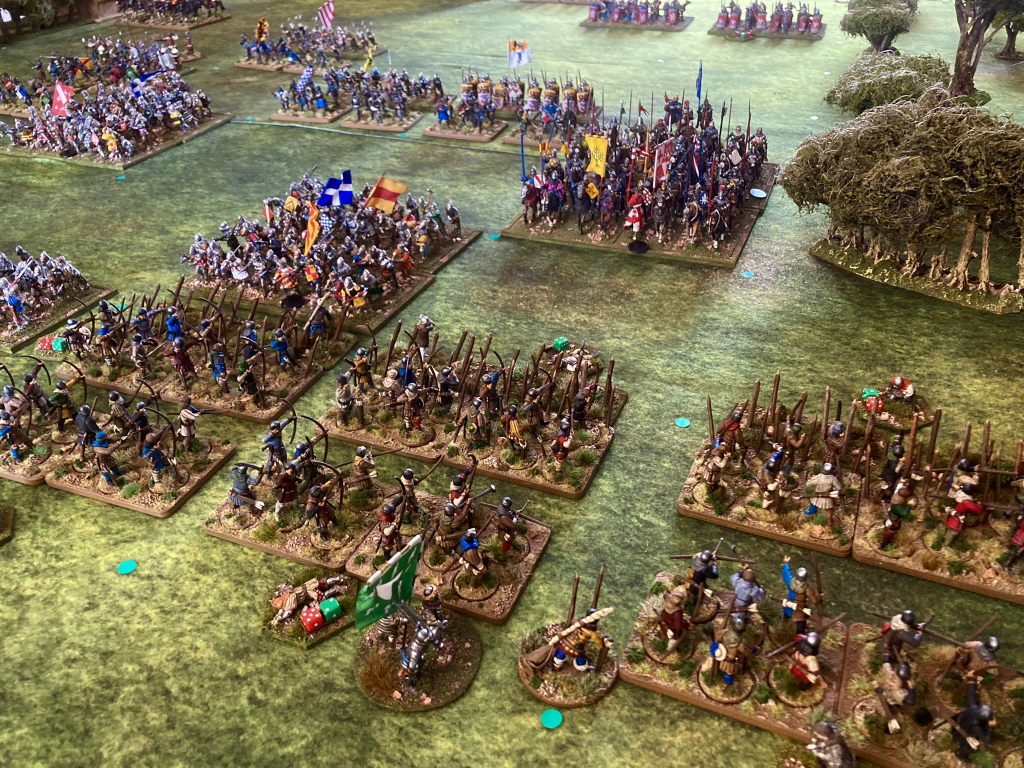
Scrivs will be running games of Midgard set in the Hundred Years’ War between France and England using his fabulous collection of 28mm Perry Miniatures.
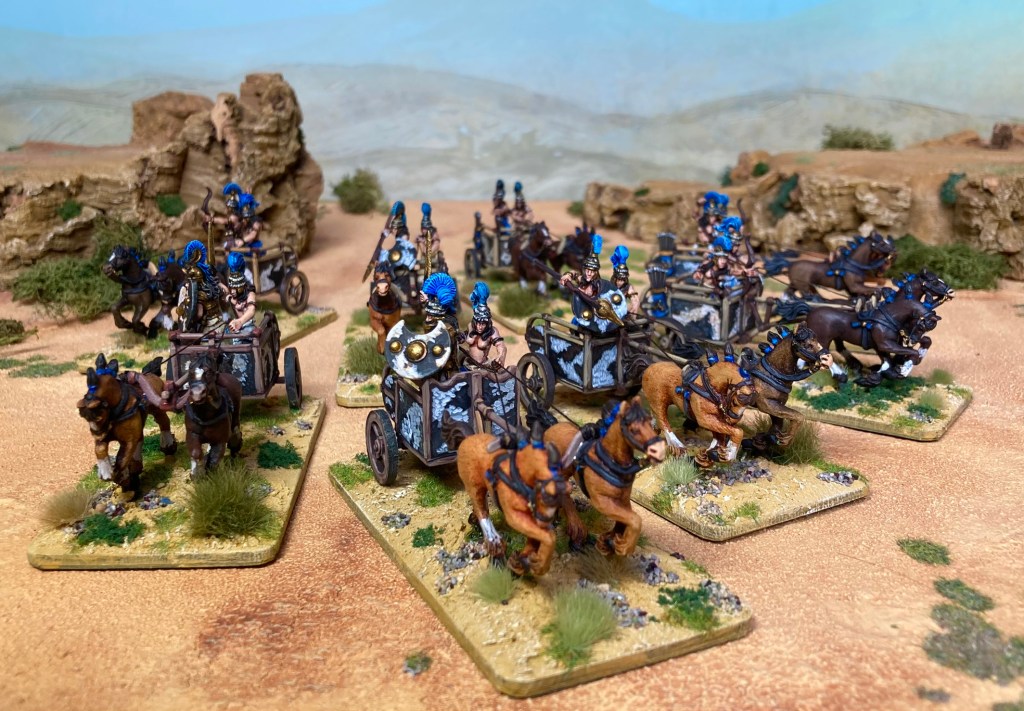
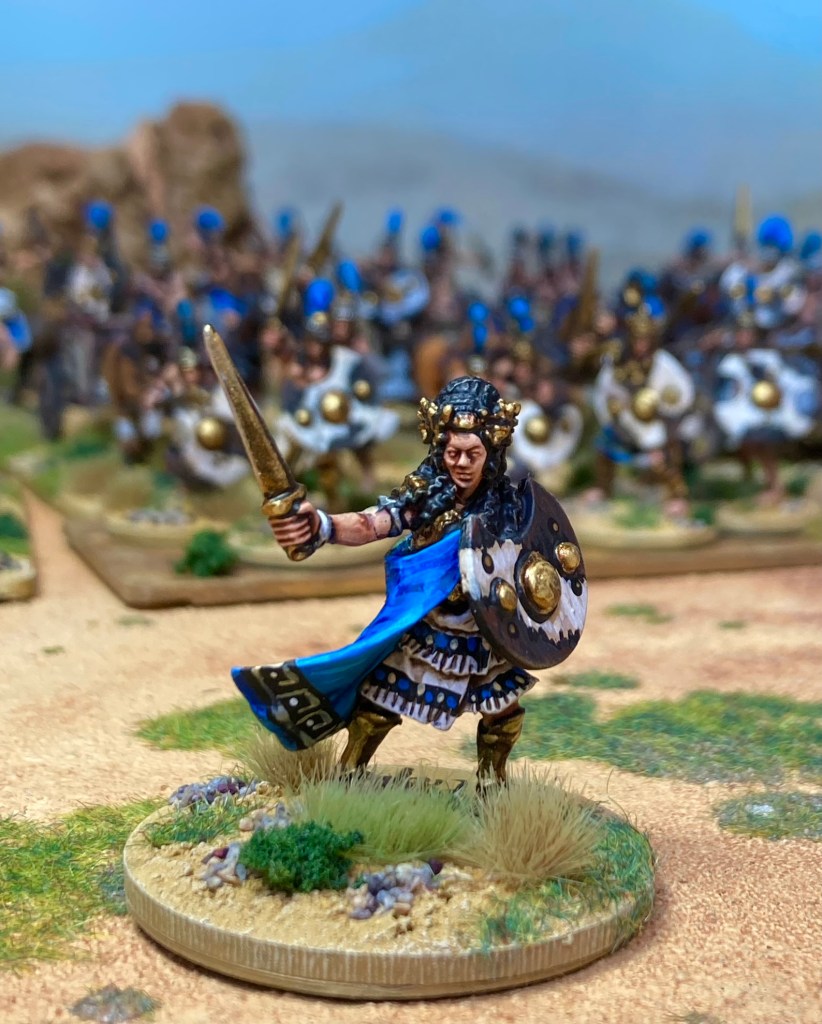
This has been a slow-burning project but a renewed interest in the Trojan War over the last few months has pushed me towards getting these Lucid Eye Amazons on to the table.
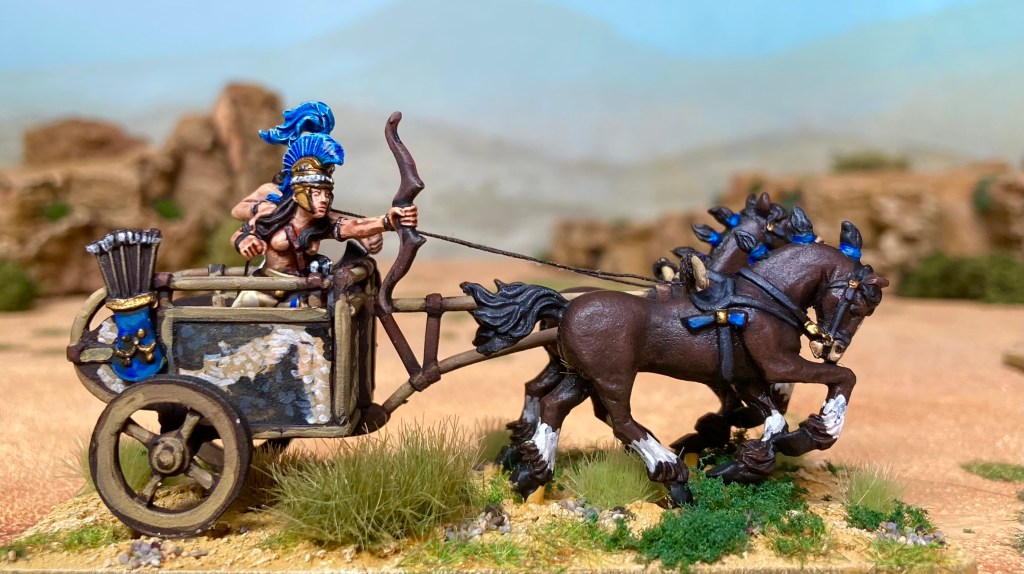
To be honest, these don’t really fit Penthesilia and her 12 Amazon bodyguards described by the classical writers, but I love the Mycenean look that the talented Steve Saleh has used in creating these sculpts.
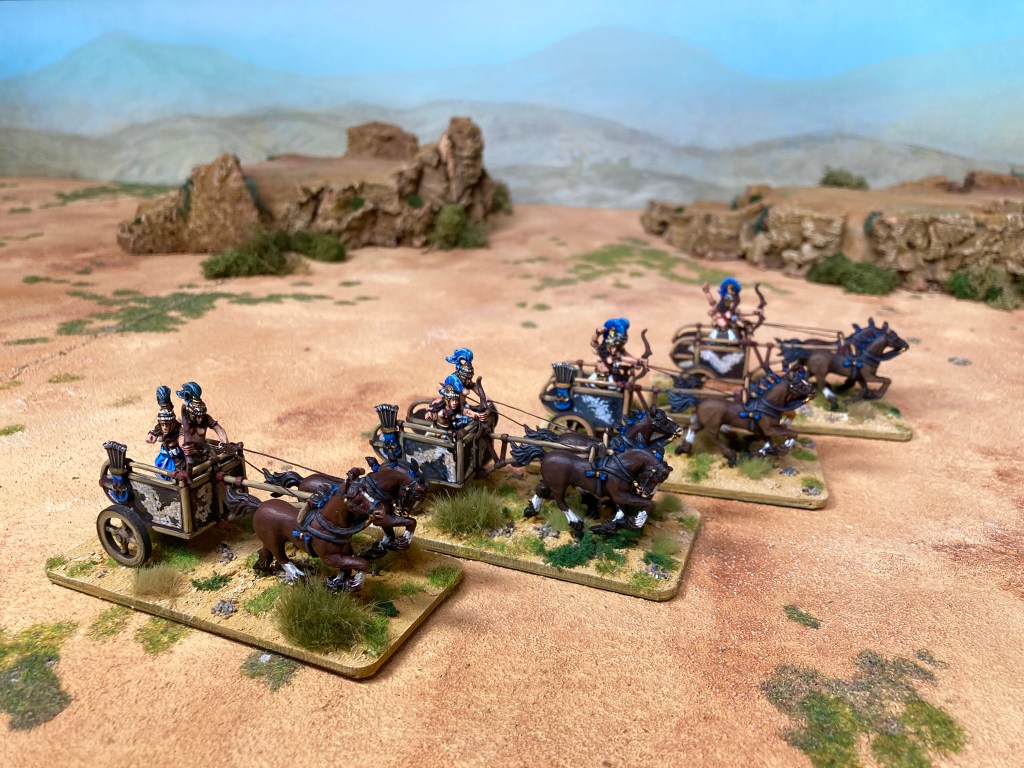
Although I’ve currently still got the bulk of the infantry on the painting table, I thought I’d celebrate the completion of the chariots with a quick photo shoot of the war host so far. These will be heading for use in games of Of Gods And Mortals (OGAM) and my forthcoming Midgard Heroic Battles rules.
The background used here is an enlargement of one created by Jon Hodgson Illustration and used with his permission. As you’ve probably gathered, I’m a huge fan of these miniature backdrops to add a more ‘illustrative’ atmosphere to pics than a photo background.
If you’re interested in Jon’s backdrops, you can buy the A4/A3 downloads on RPG Vault/ Wargames Vault, back his Patreon, or there is a forthcoming A4 spiral-bound book that has been funded by Kickstarter and is available to pre-order.
Next up will be completing the remaining infantry which I hope to crack on with over the next few weeks.
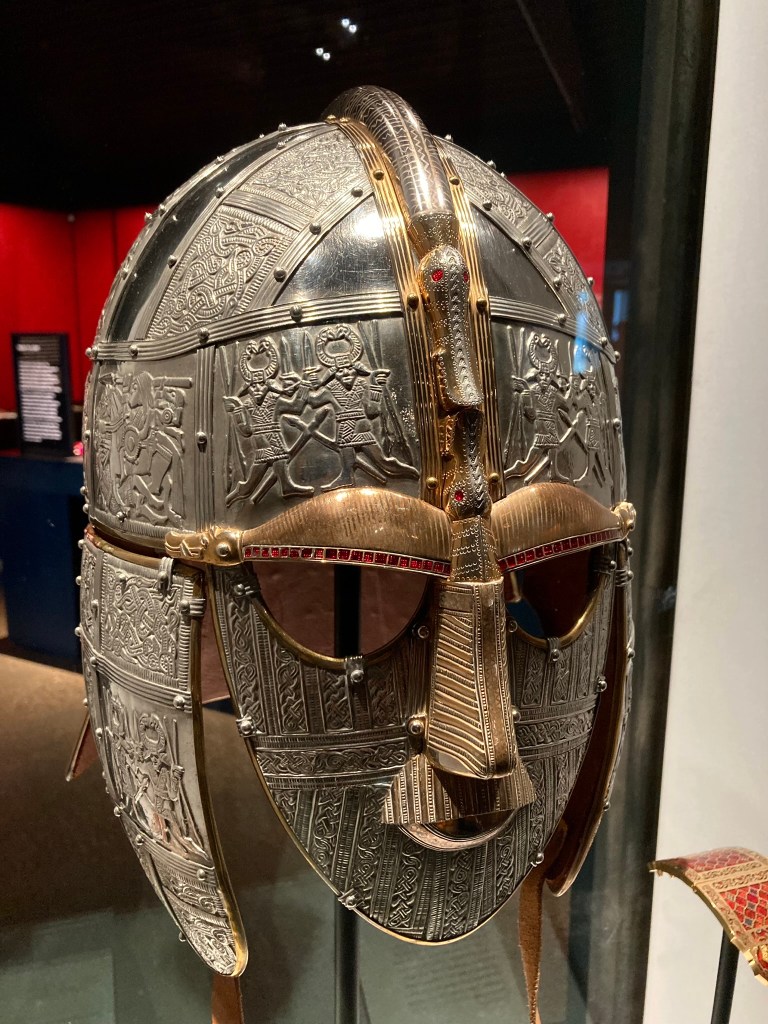
Sutton Hoo has been in my awareness for nearly my entire life; from seeing the iconic helmet and shield at the British Museum as a child, admiring Angus McBride’s illustrations in Osprey books as a teenager and visiting the end of the excavations on site in the early 1990s, I have collected the miniatures and refought the battles. So, it was a great privilege to be asked if I’d help to put on some Anglo-Saxon wargames as part of the National Trust site’s activities in July 2023.
My son was also inspired after watching the Netfix film The Dig and decided to join me, along with chums Pete and Tom. Pete kindly volunteered to drive us all down to Suffolk, and so began the Sutton Hoo wargaming road trip. It didn’t start so well – with Tom unfortunately being laid low with Covid – but the remaining three of us packed up Pete’s car and hit the road on Saturday morning.
Despite driving through some squally weather, the sun was out by the time we hit the lanes of Suffolk and we were treated to a beautiful late afternoon visit to Sutton Hoo. The National Trust have done a wonderful job with the site – a far cry from the concluding excavations that I remember from my visit thirty-odd years ago.
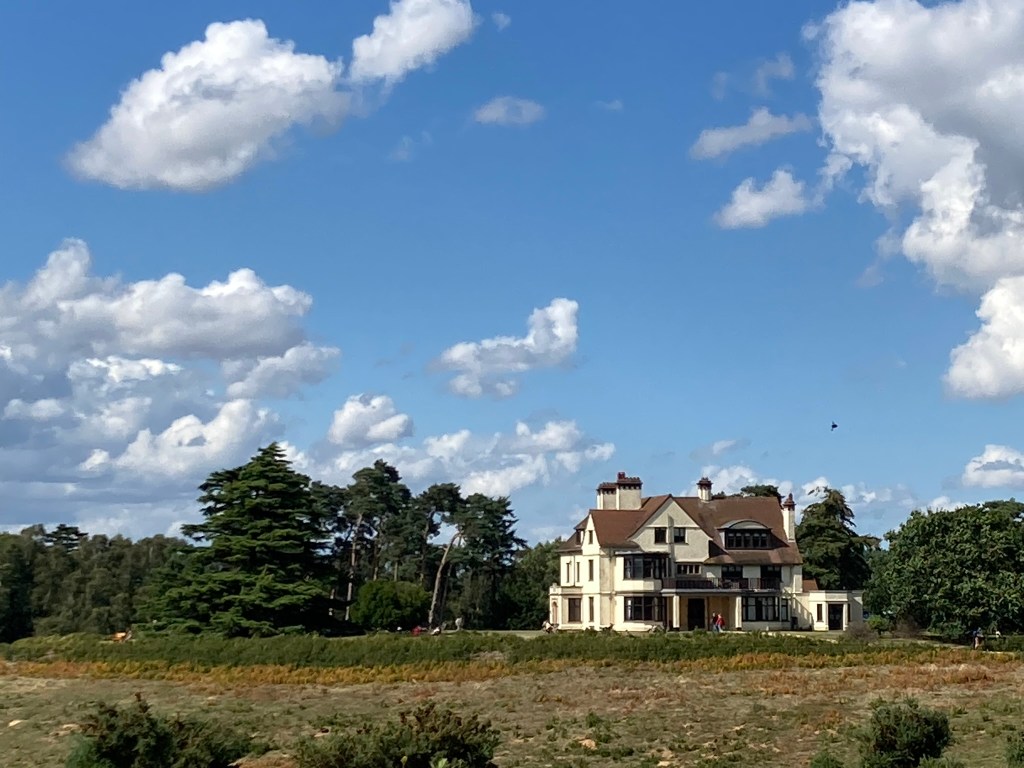
Tranmer House in the sun
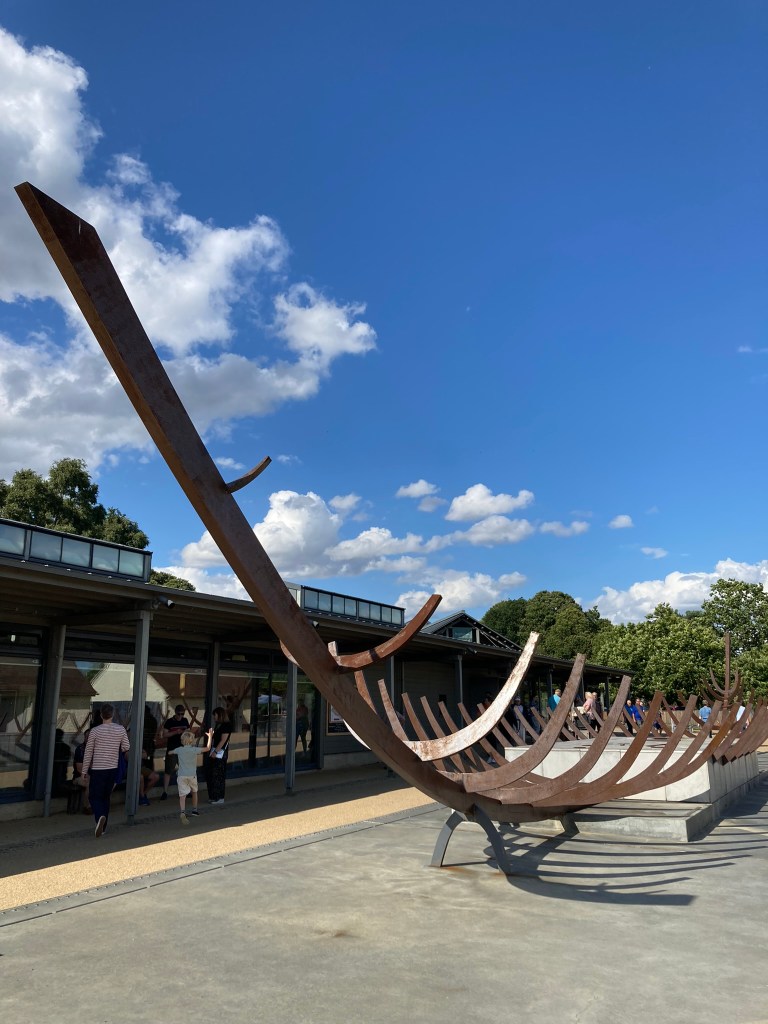
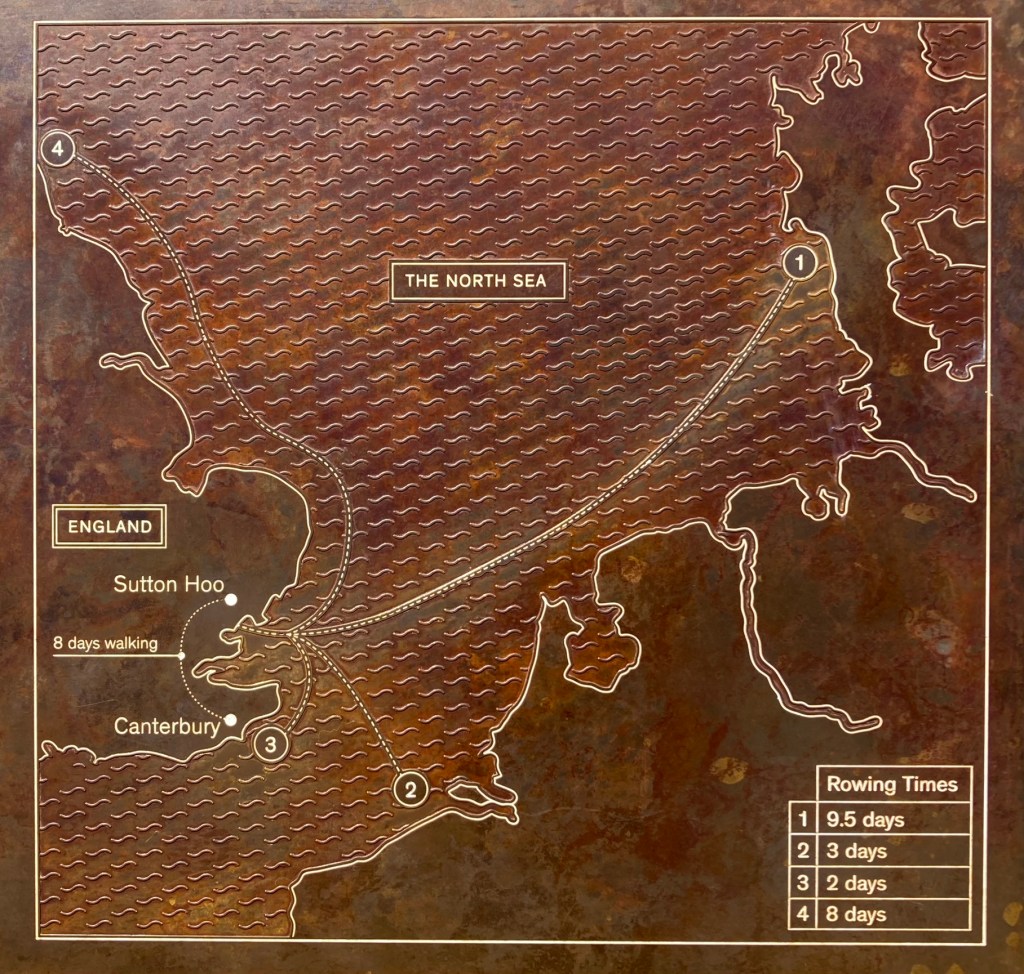
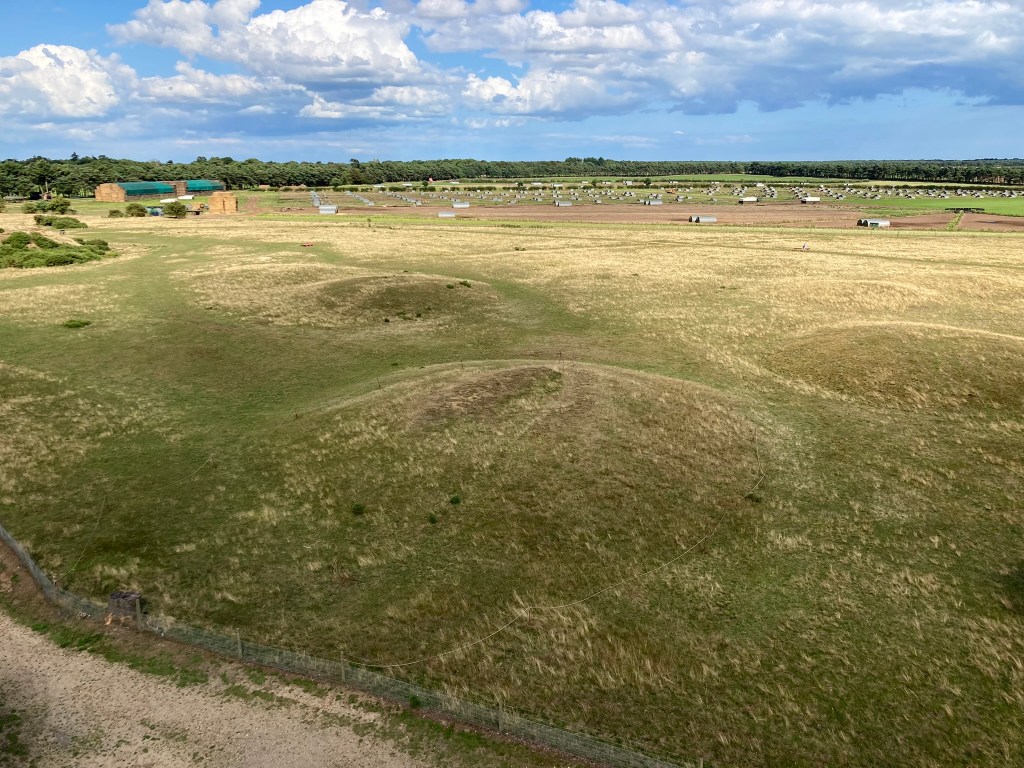
We headed straight out to Tranmer House followed by the obligatory tour of the grave mounds. I was most impressed with the viewing tower with its well-presented information on the geographical links and connections of East Anglia – essential for understanding how a site like this was near the centre of an active and powerful kingdom 1400 years ago.
We also ran into a friendly NT volunteer at the mounds who was able to give us more information about the area and its history, as well as some more background on Edith Pretty and the excavations of 1939.
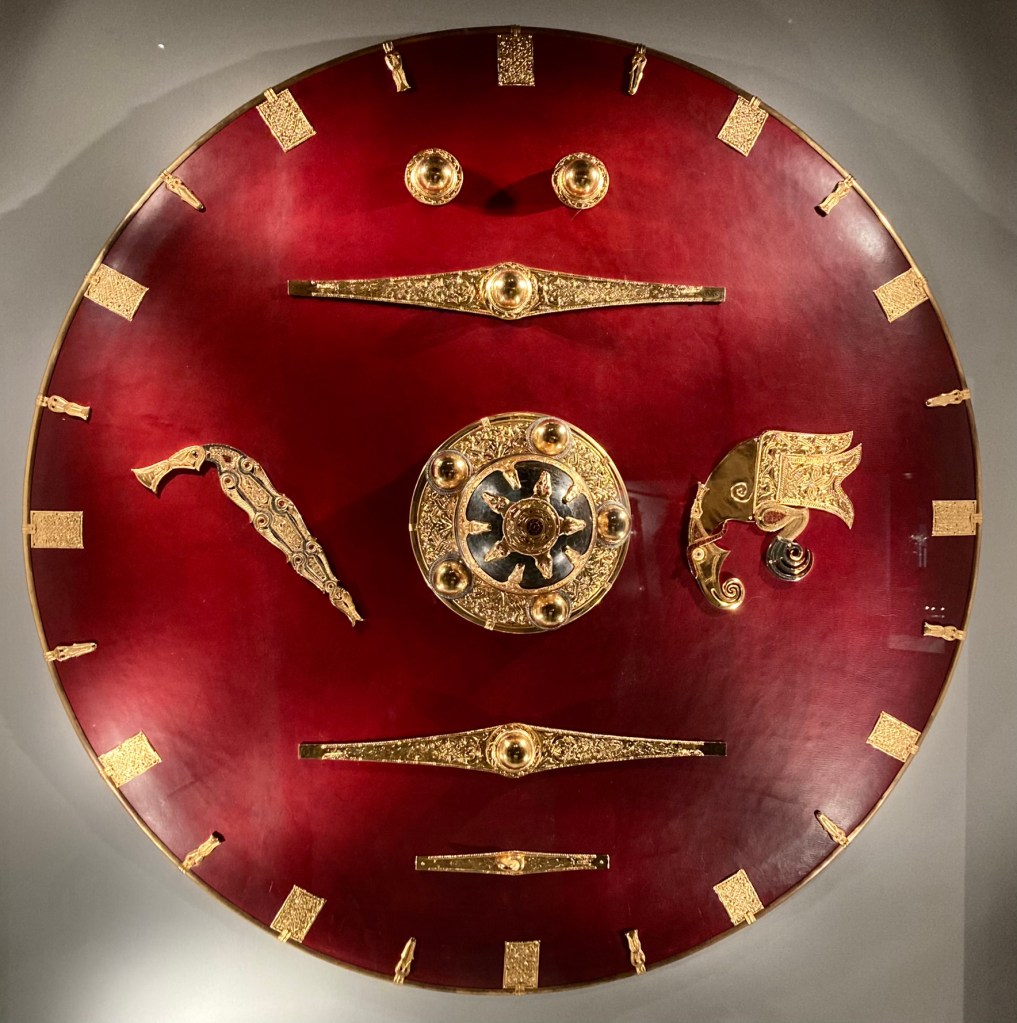
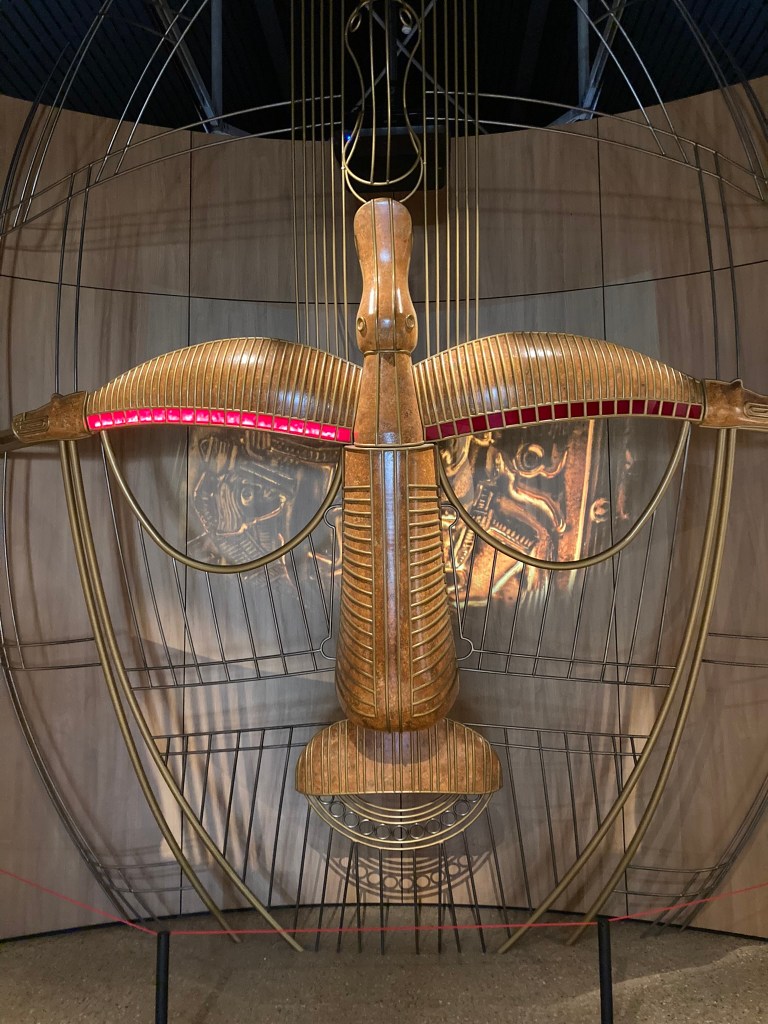
I could happily have sat out by the mounds for several hours, but time was pressing and we needed to get back to the rest of the site. There is a visitor centre next to the shop and café with a state-of-the-art exhibition explaining the history of the site and interpretations of the treasures, alongside outstanding replicas of the helmet, shield, sword and other grave goods.
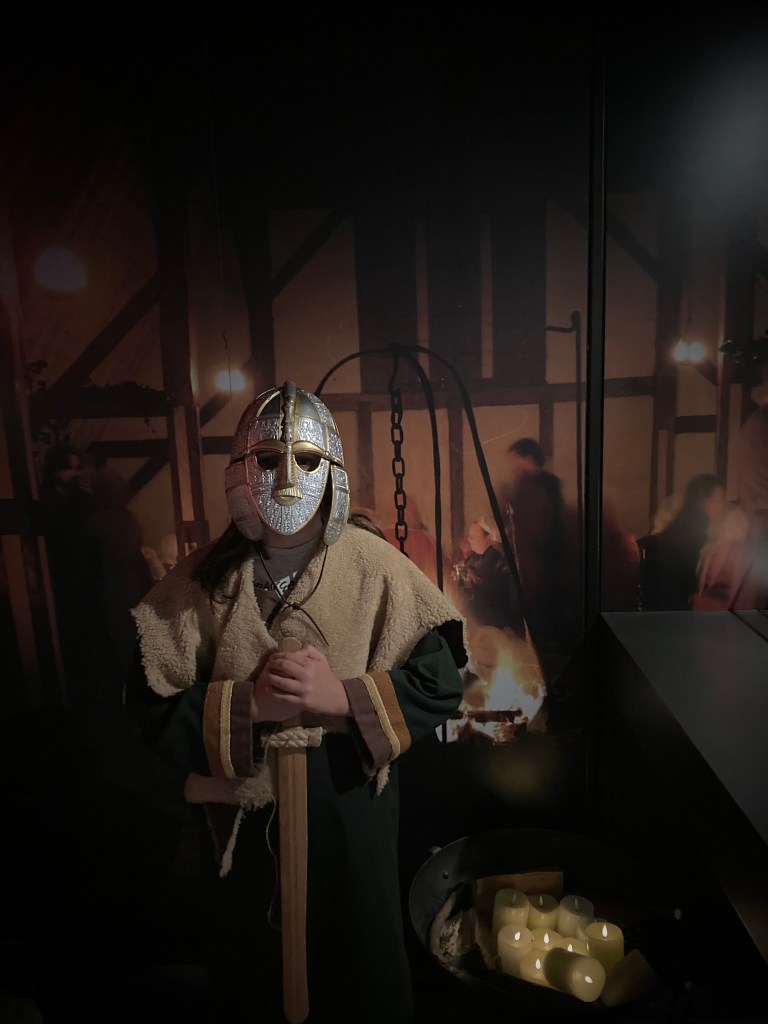
Naturally, my son found the dressing up section and turned in quite a spooky impersonation of Raedwald! We also enjoyed playing some hnefatafl before closing time, at which point we headed off for the less glamorous but perfectly comfortable Premier Inn in Ipswich.
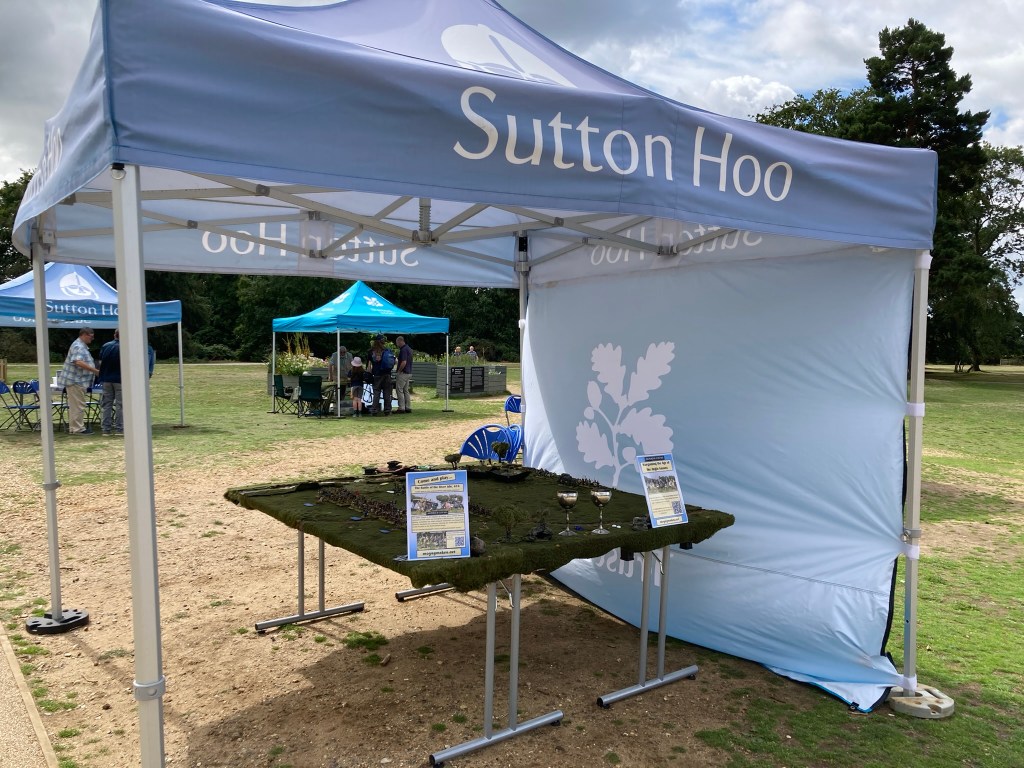
Sunday was the day for the event and we arrived back on site to find Joshua and Andy from the NT putting up gazebos for the gaming activities. Yes, we were gaming outside!
Rain wasn’t forecast until the end of the afternoon, but we knew that wind was going to be the main issue. The Sutton Hoo site is at the top of a ridge above the River Deben (the access point for the boats used in the ship burial in Mounds One and Two) and catches a fair breeze, to say the least. Fortunately, we had come prepared: feeling somewhat like a roadie setting up a gig, I produced two large rolls of gaffer tape (duct tape for our US chums) and we proceeded to stick down nearly every element of the gaming area. In the days when we mainly used big terrain boards, this might have been less of an issue, but with modern terrain cloths we were in danger of taking off!
If it moves, stick it!
It took a while, but eventually everything was secured into position. The biggest issue was the A4 document holders which acted somewhat like a sail – fortunately, several layers of tape combined with East Anglian flint rocks took care of it.
If gaffer tape isn’t enough, flint is the way!
The day passed in a pleasant blur, with visitors crowding the four event tables all day. Local gamers Richard and Ernie (also a NT volunteer) had brought a game of Too Fat Lardies’ Dux Britanniarum.
Dux Brittaniarum action with Richard and Ernie
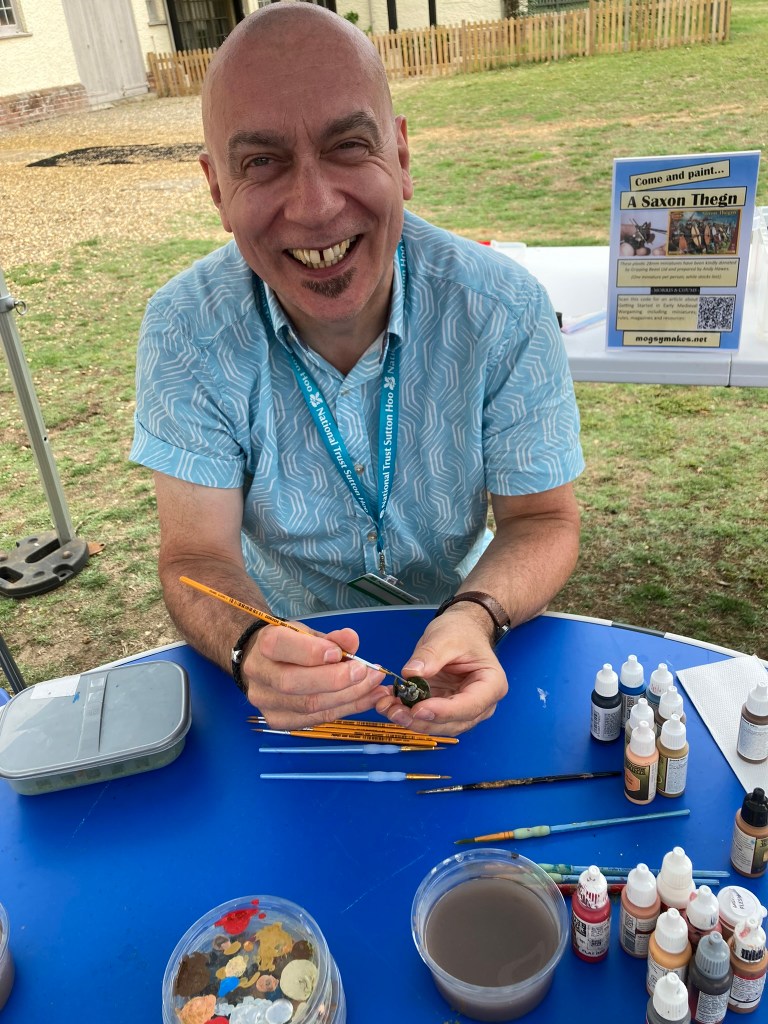
NT staff member Andy hosted a busy ‘paint your own Saxon thegn’ table, kindly sponsored by our the ever-generous Lord Sherwell at Gripping Beast.
Andy H runs the painting table with aplomb
Pete did a sterling job of hosting my 15/18mm Battle of Degsastan game (with no breaks) for a seemingly endless stream of visitors – there were great cheers emanating from his gazebo at regular intervals, so clearly people were enjoying it. Grateful gamers also collected the sample bags of 18mm Saxon miniatures donated by Daniel Mersey of Wiglaf Miniatures.
Pete runs his 467th game of the Battle of Degsastan, 603
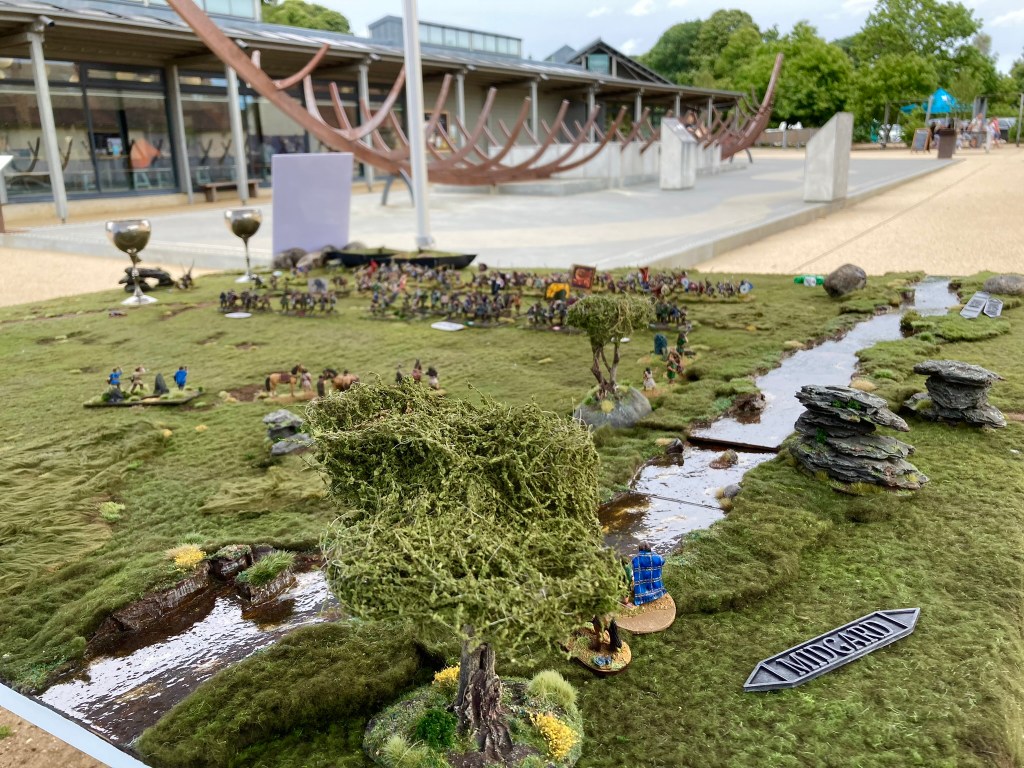
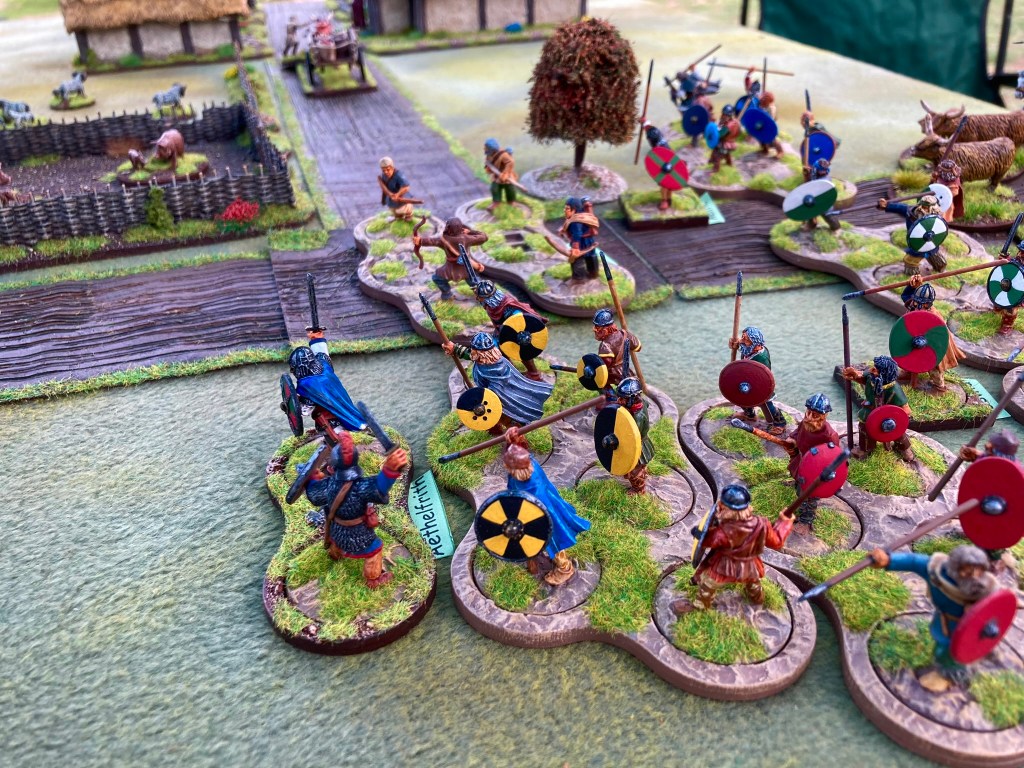
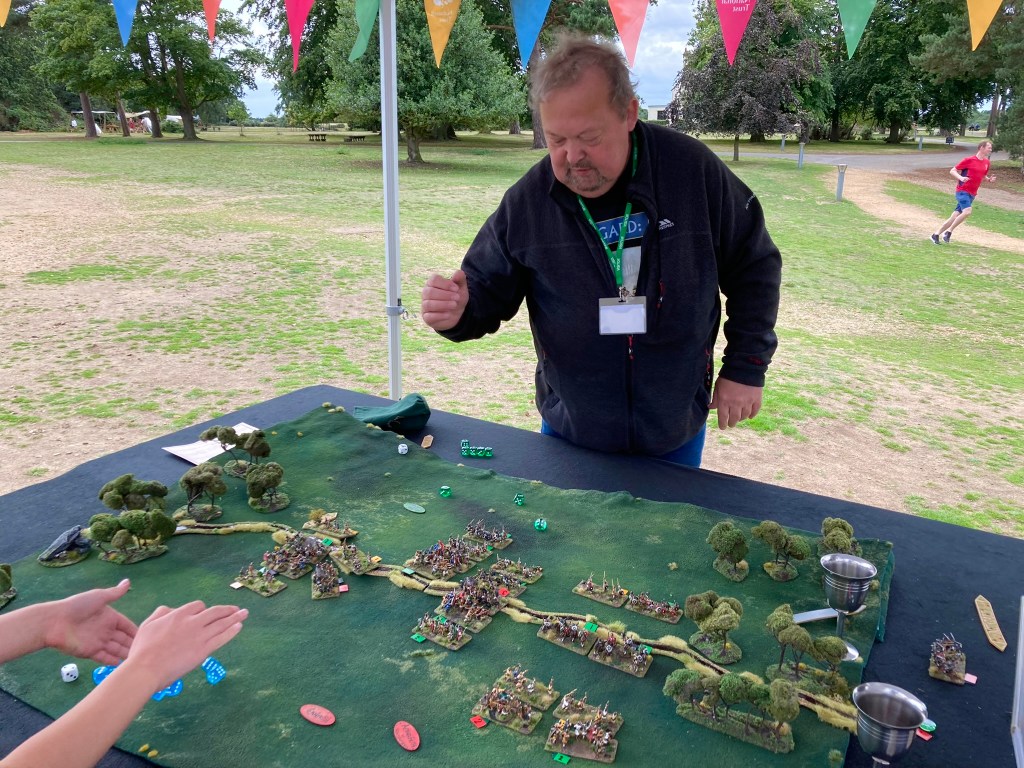
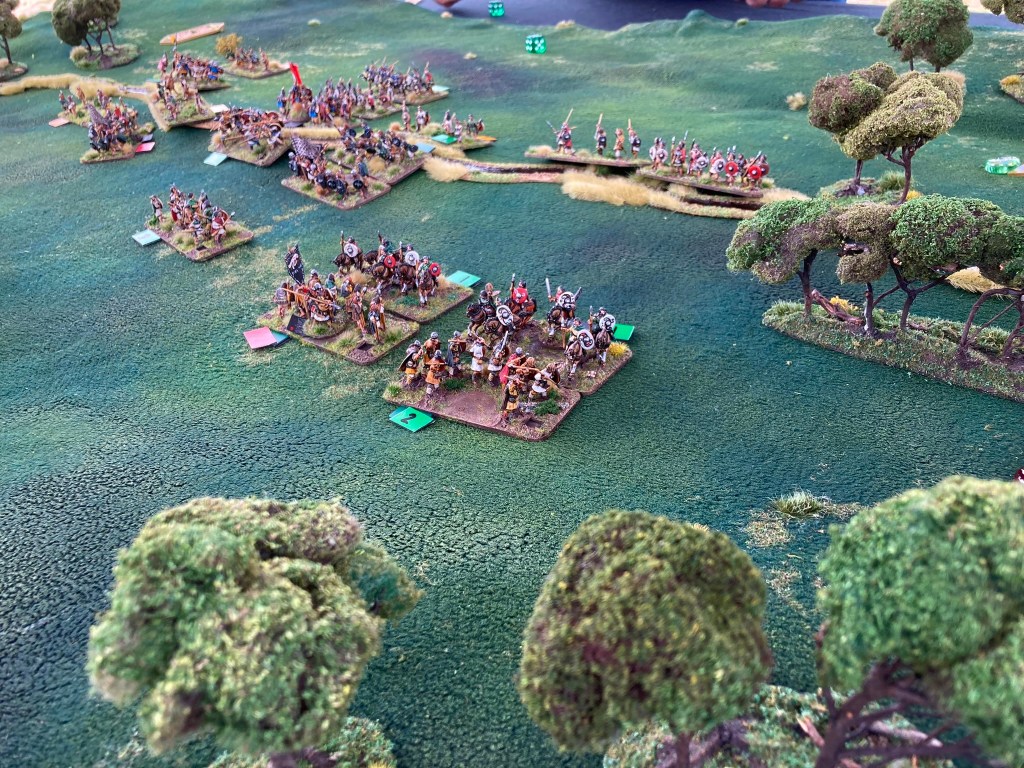
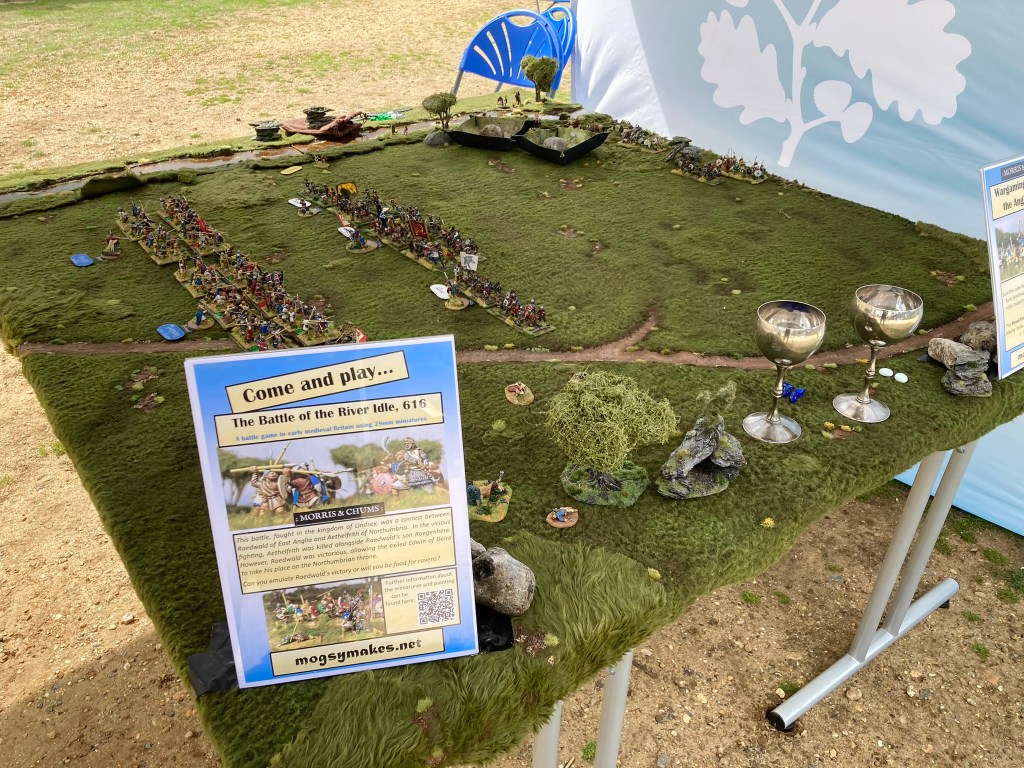
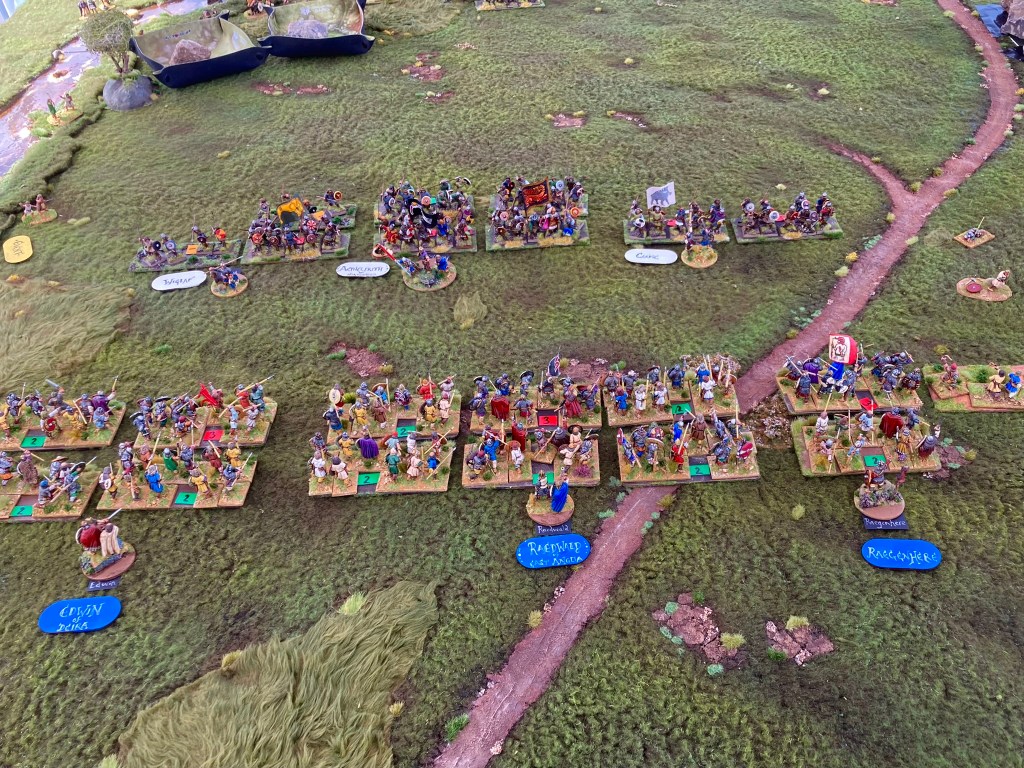
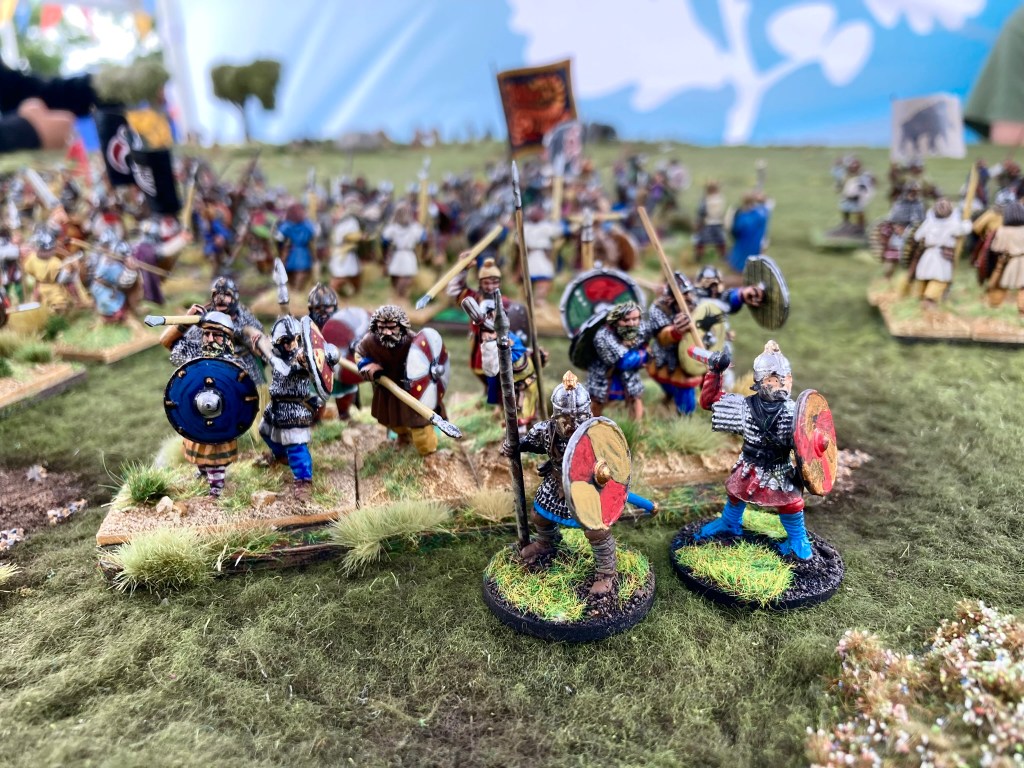
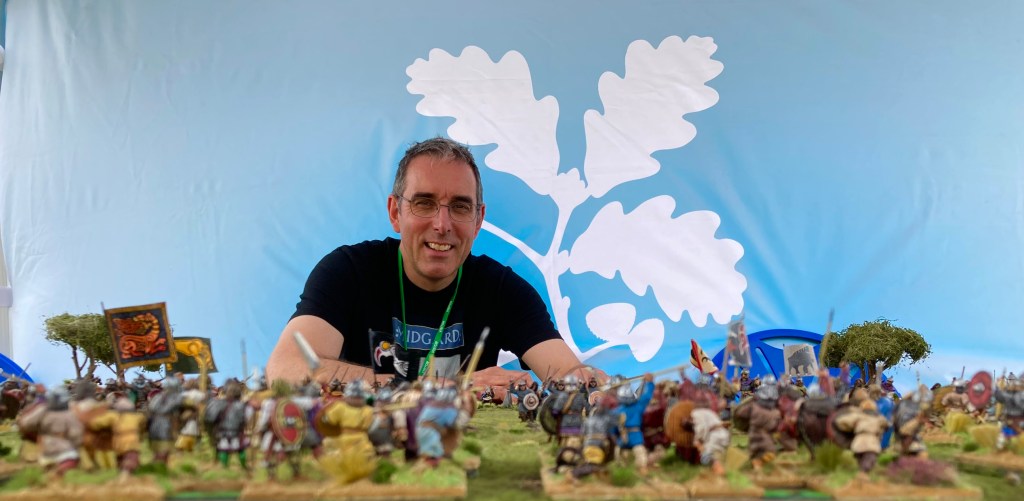
My son and I ran the Battle of the River Idle using 28mm miniatures around ten times in various forms, with victory going to the East Anglians and the Northumbrians in equal measure. Historically, this one was particularly relevant to the site as it’s the battle where King Raedwald of East Anglia (the most likely occupant of the ship burial in Mound One) triumphed over Aethelfrith in 616/617.
The royal family of Northumbria gets usurped by Dave Blue-Boots and his son Bob Blue-Tunic! Some of the minis from the painting table found their way into the front lines…
There was much hilarity as families were pitted against each other and bloodthirsty children charged their miniature heroes into battle. One enthusiastic participant managed to wipe out the entire East Anglian royal family in just ten minutes with a spectacularly unlucky display of dice rolling!
River Idle action as the forces close for battle
Rules used were my own Mead-Price (designed to play a battle in 30 minutes) which are available as a two-page download if you’d like to try them.
Many thanks to Josh, Andy and the Sutton Hoo NT team for making us so welcome, Pete for the heroic driving and game hosting, and Gripping Beast and Wiglaf Miniatures for your generous contributions. It was a great privilege to be involved.
7th Century Saxons by Northstar and Gripping Beast
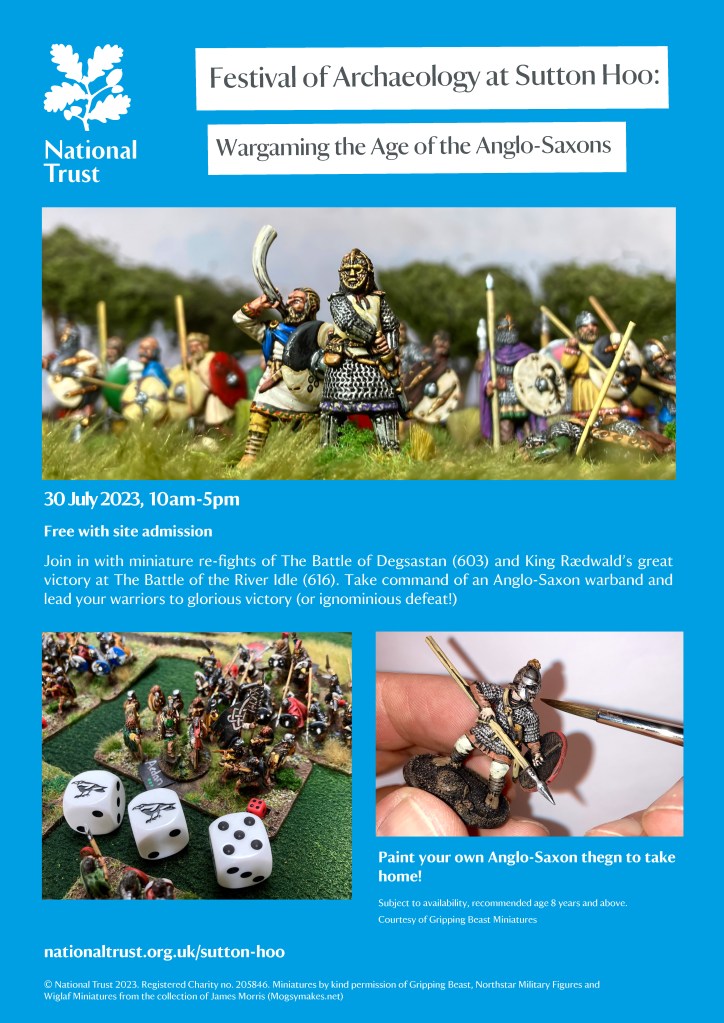
We’re very excited to be heading down to Sutton Hoo at the weekend for the National Trust’s Festival of Archaeology. We’ll be running participation games for two 7th Century battles – Degsastan 603 (using 15mm miniatures) and River Idle 616 (using 28mm miniatures), as well as helping to host a painting table where you can ‘Paint your own Saxon Thegn’ – many thanks to the generous lads at Gripping Beast who have donated all the models for this activity. There will also be a game of Too Fat Lardies’ Dux Britanniarum (hosted by Ernie and Richard) that I’m looking forward to seeing.
Given that we’re running public participation games, I’ve opted to use a 2-page set of my own rules called Mead-Price which play in around 20-30 minutes. They’re really simple but include a couple of concepts from Midgard Heroic Battles (mostly goblets!)
18mm Wiglaf Miniatures who will be appearing in our Battle of Degsastan game. Wiglaf have also kindly donated some give away bags of their minis for the event.