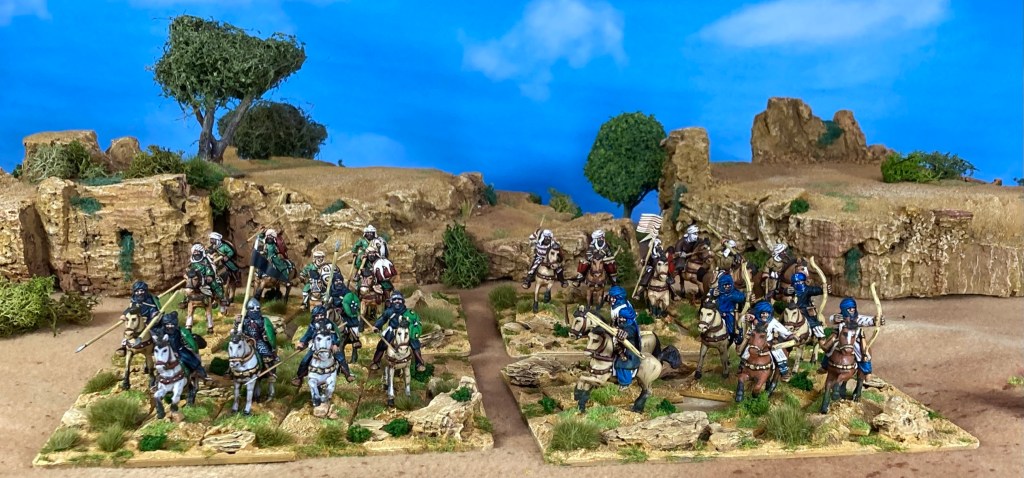
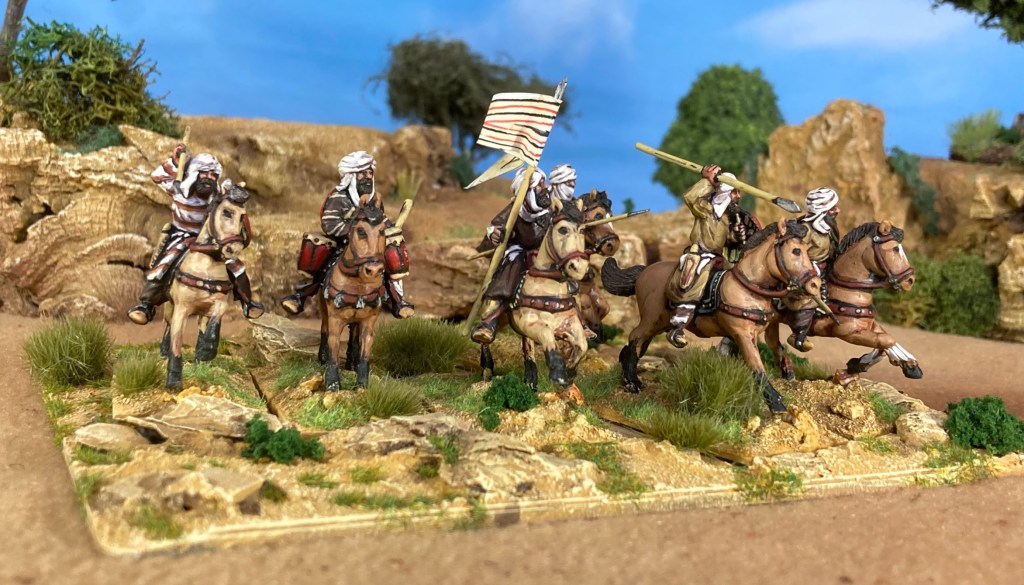
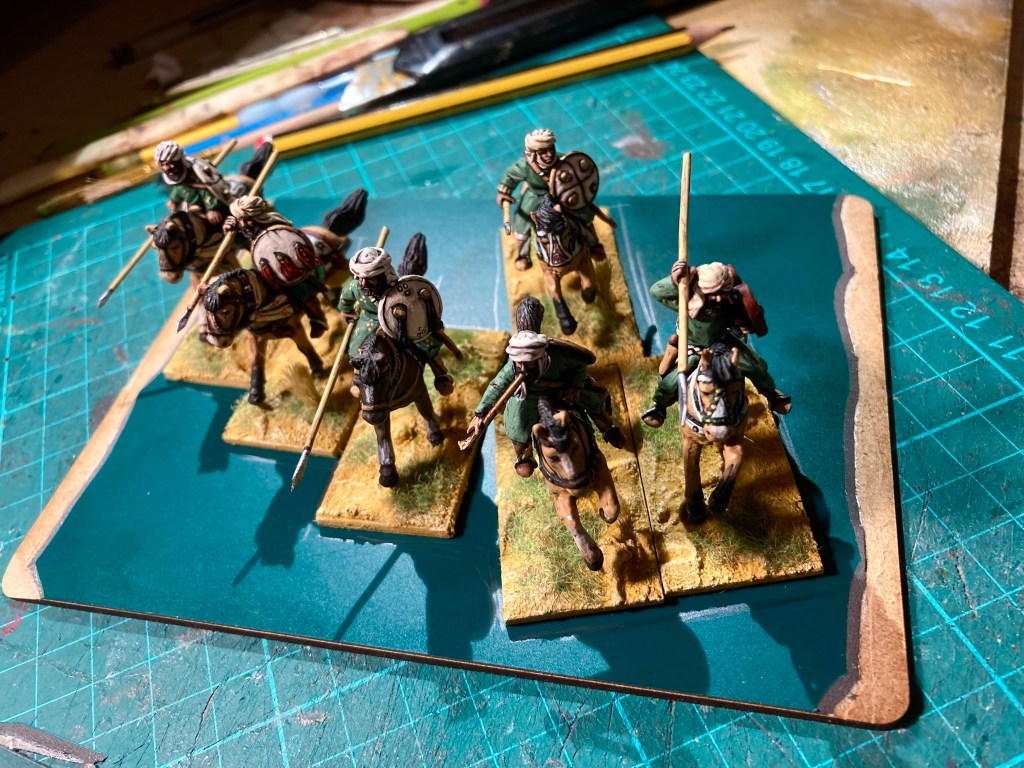
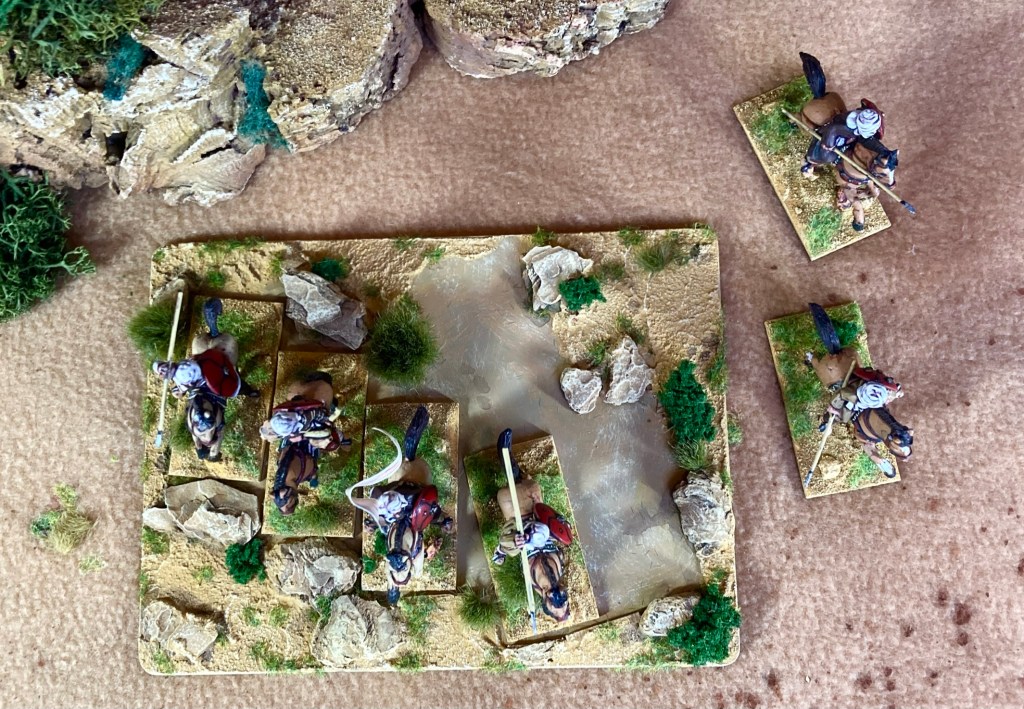
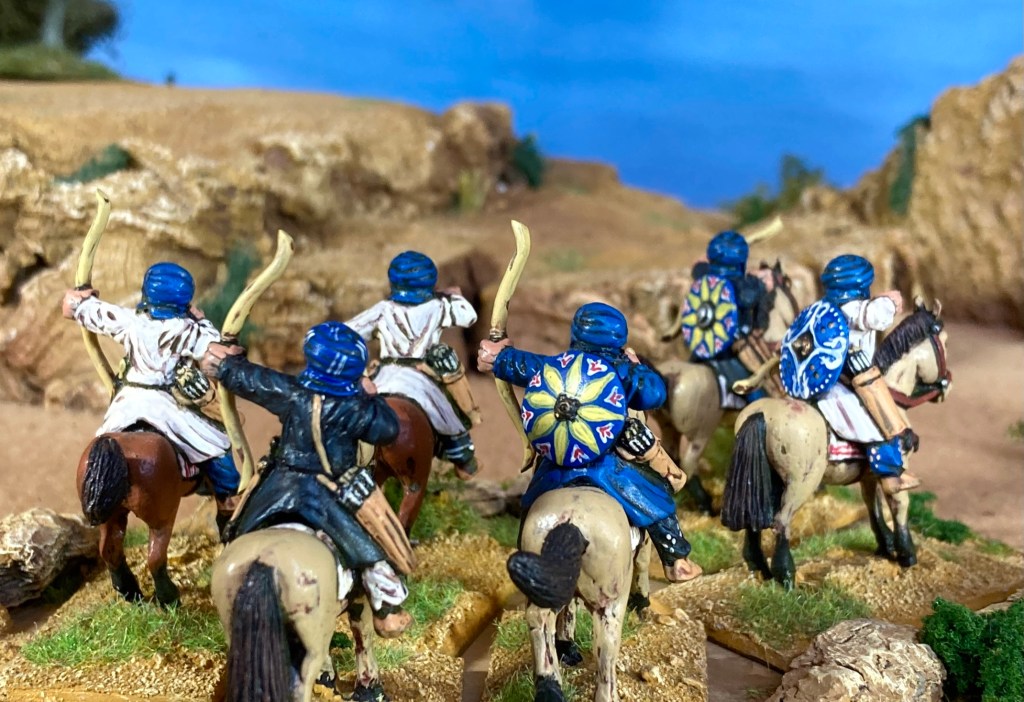
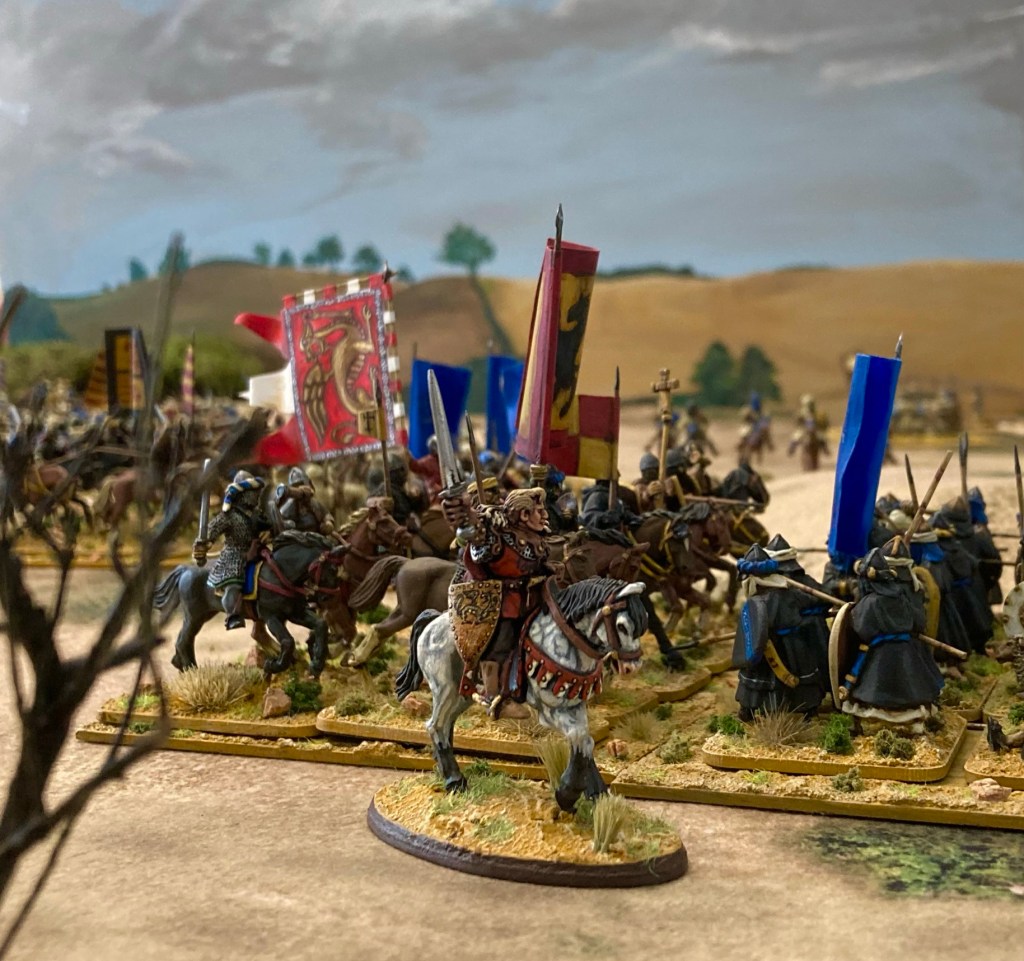
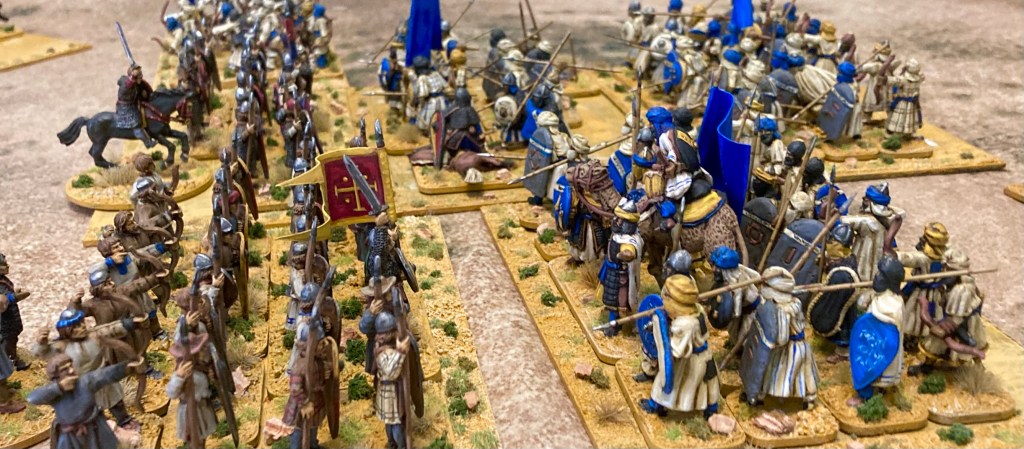
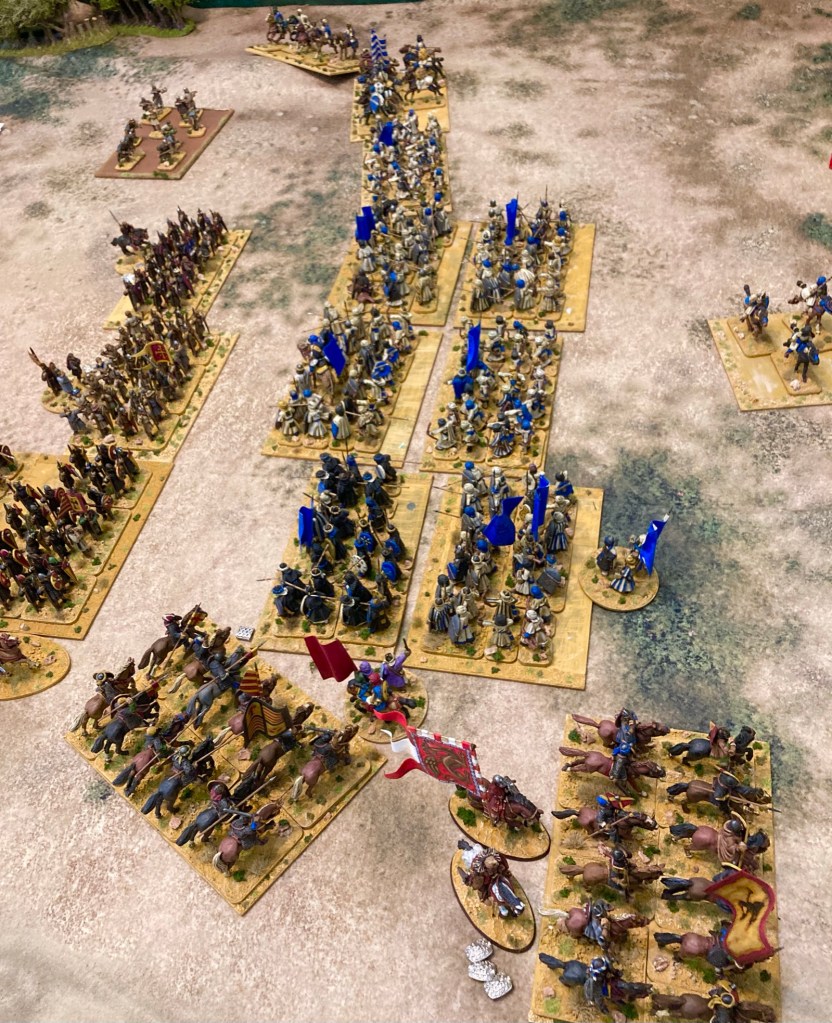
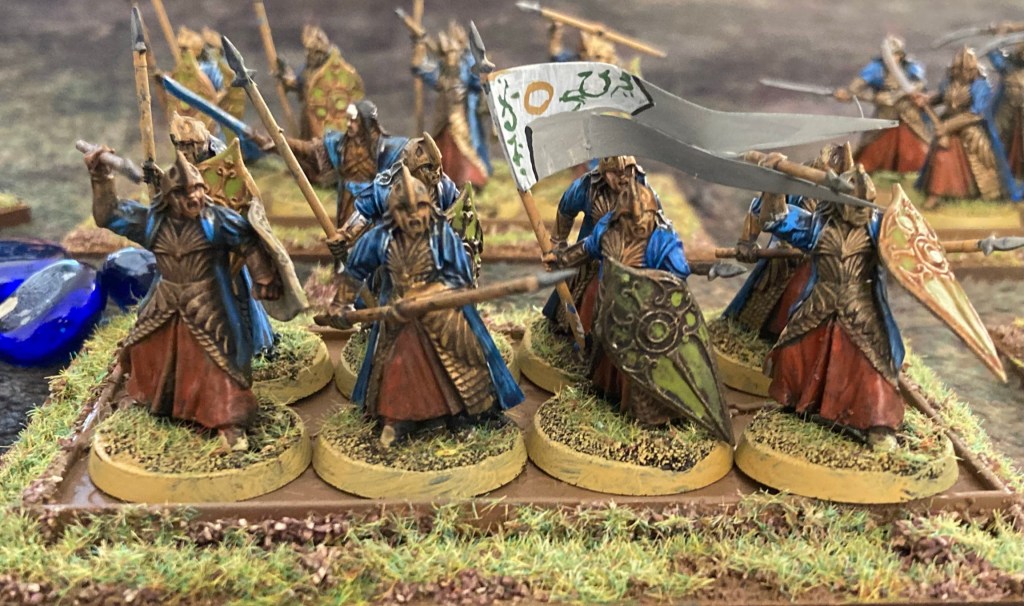
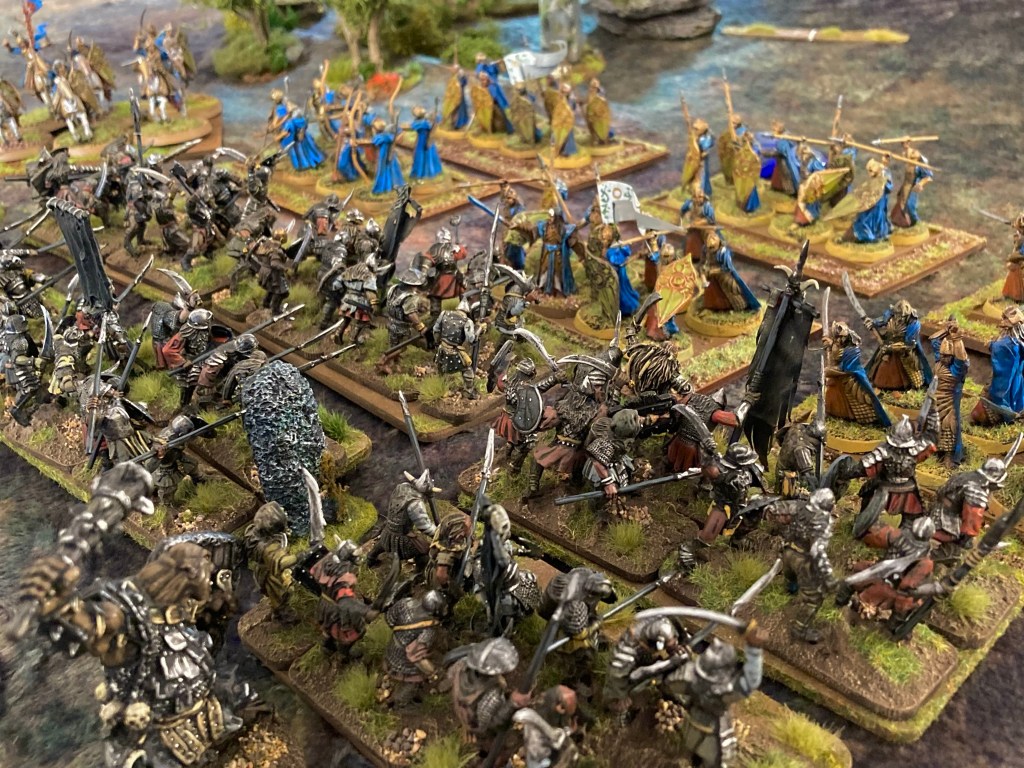
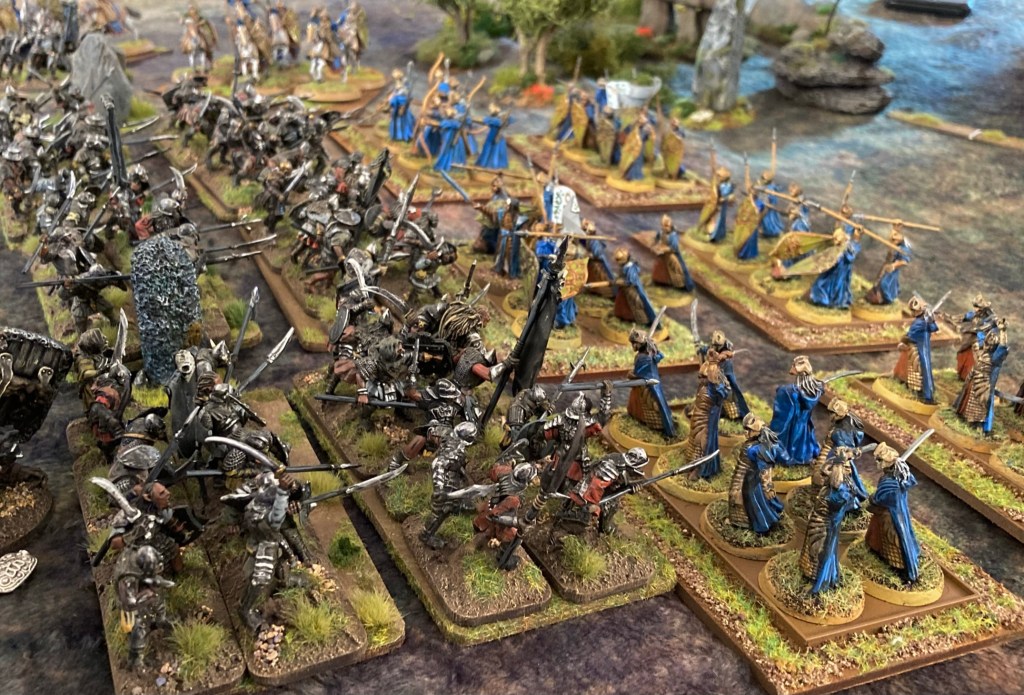
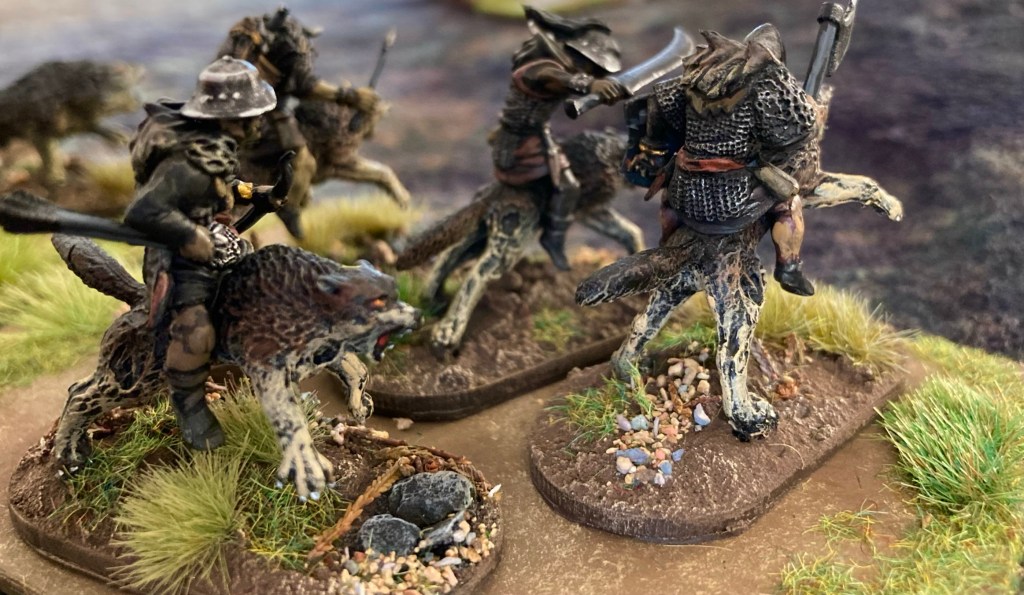
Glorfindel gets a smiting…

…or some more Second Age scrappage from the gaming table.  

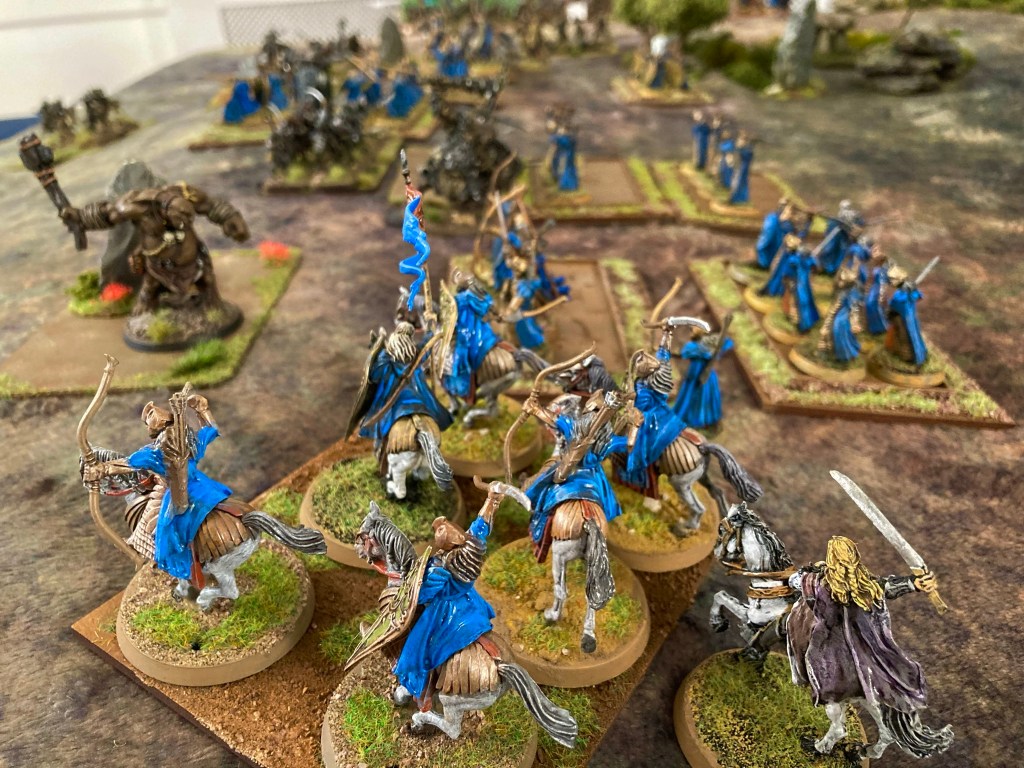
Paul W and I notched up another test game of my Midgard rules this week with his Elves commanded by Glorfindel versus my Orc host under Akdar, Captain of Trolls. 

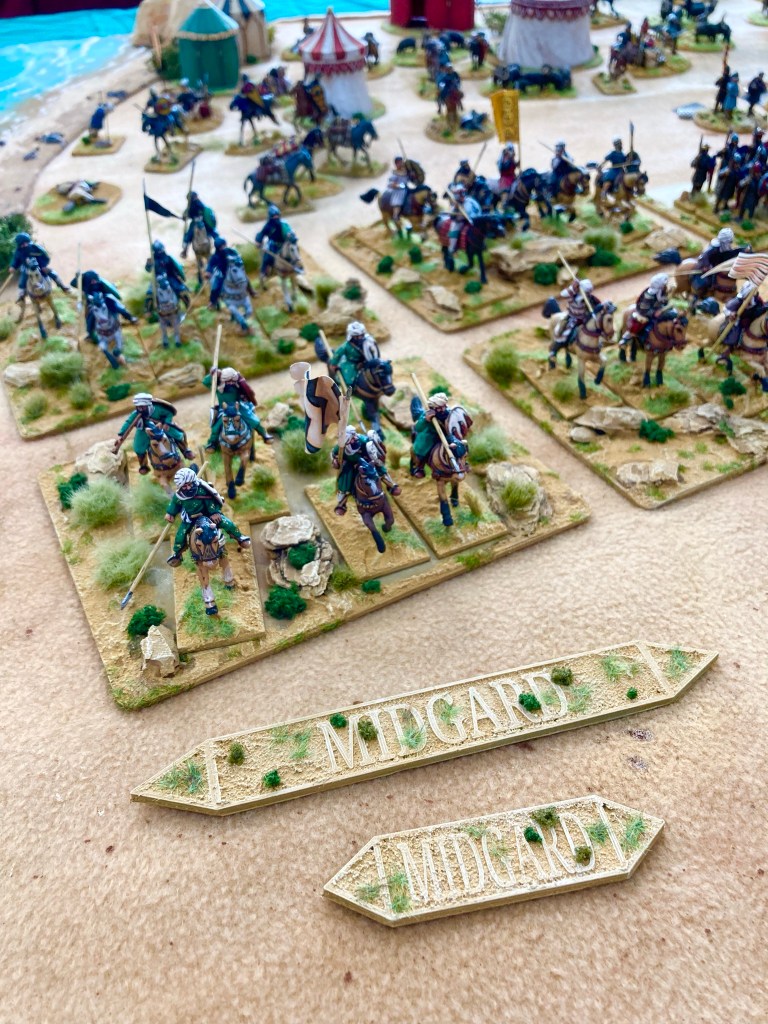
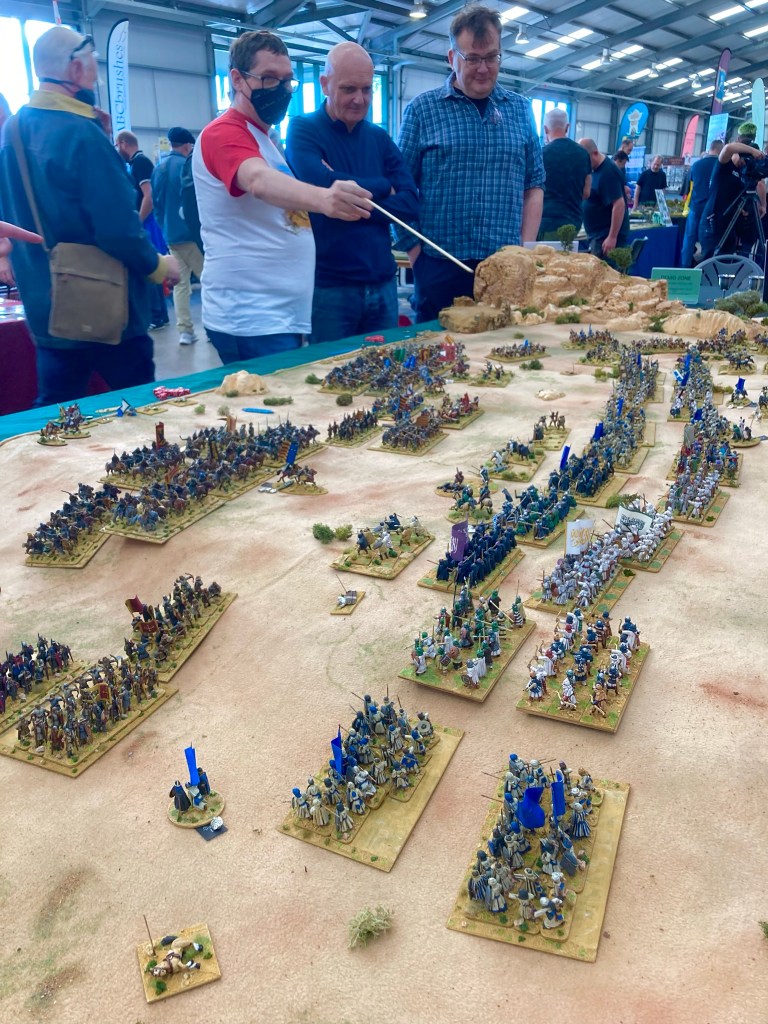
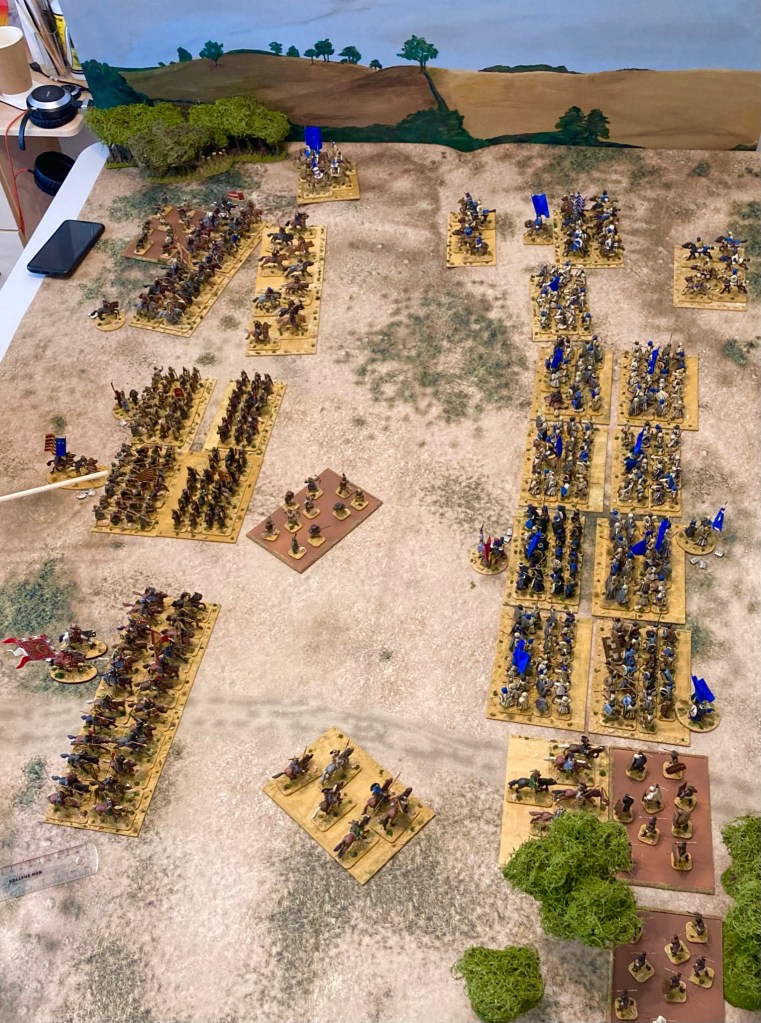
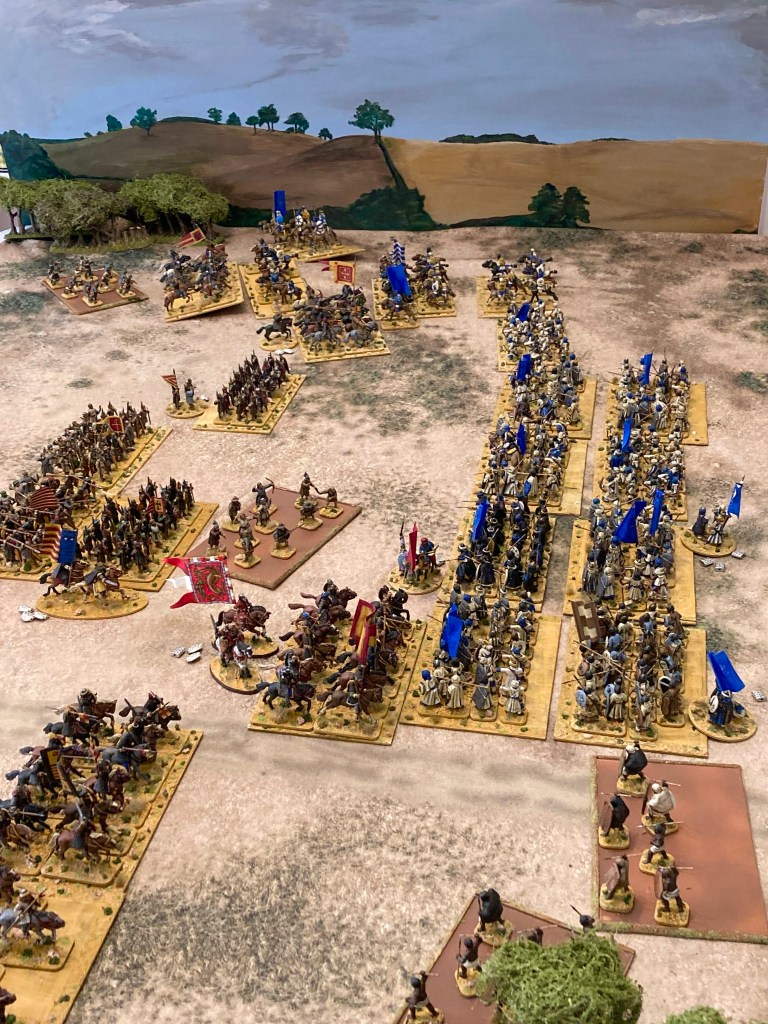
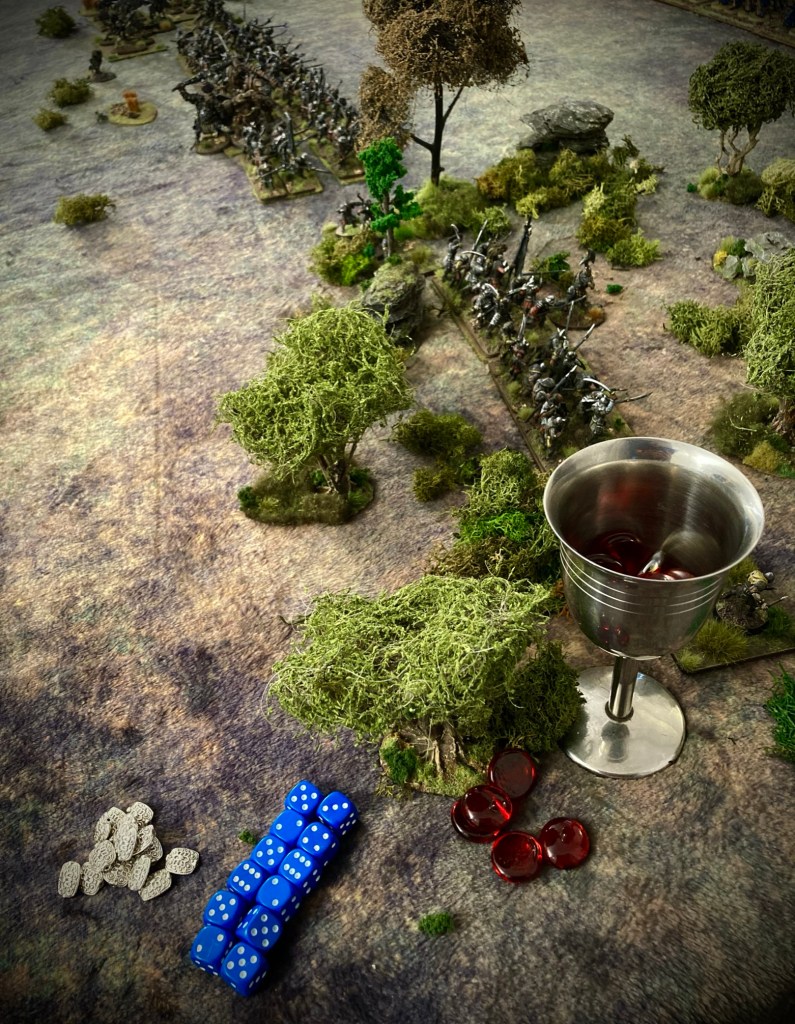
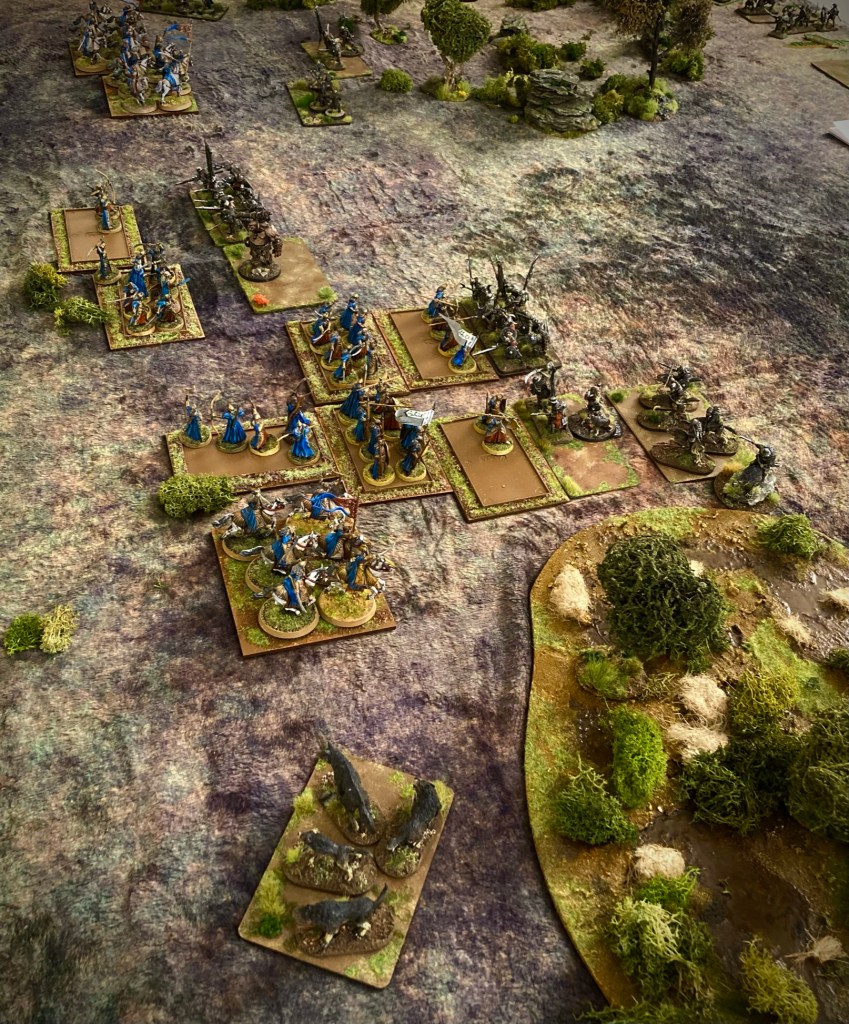
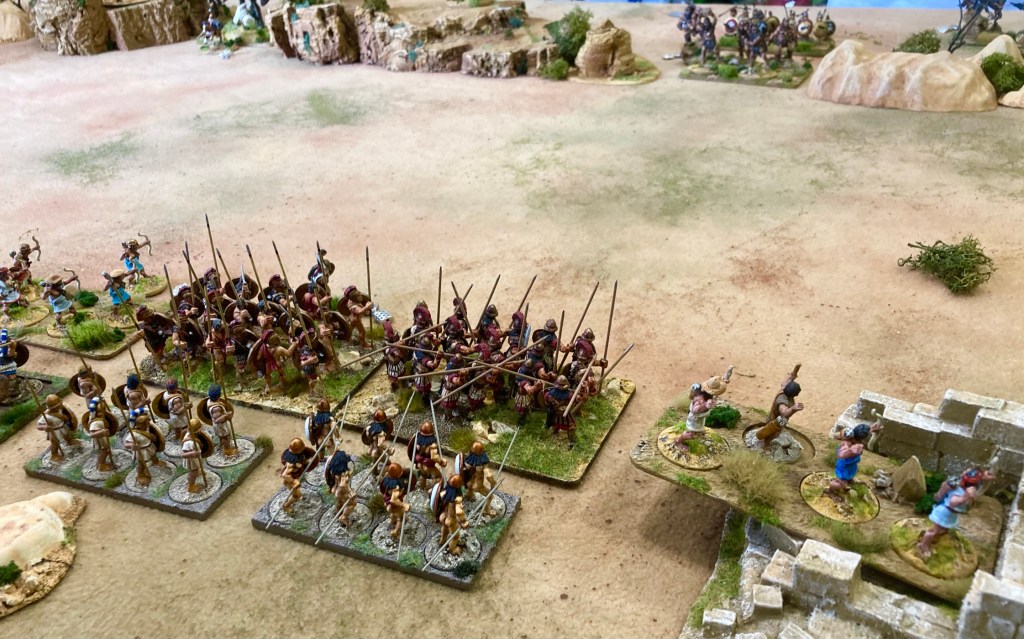
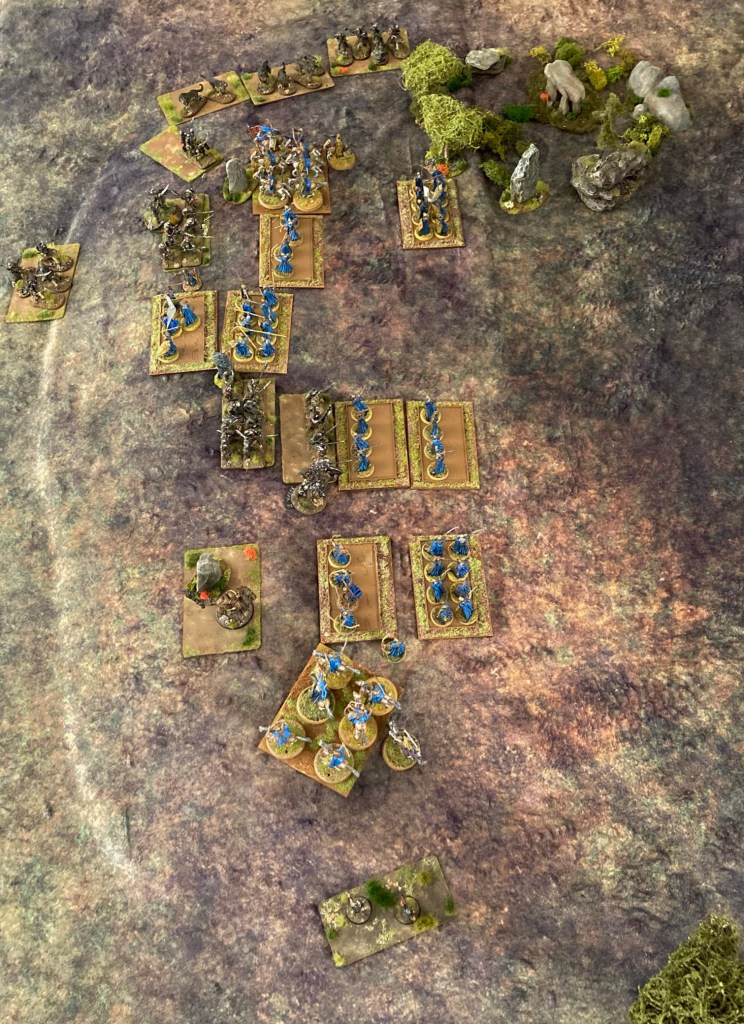
Game set-up before the first turn. Martin has designed and printed us some funky rulers for measuring!

While the basic flow of the rules is pretty much sorted, we were spending some time fine-tuning the different traits that give character to the troops.  I also laid out a large area of woods, rocks and swamp to force some of the fighting into rough terrain. 

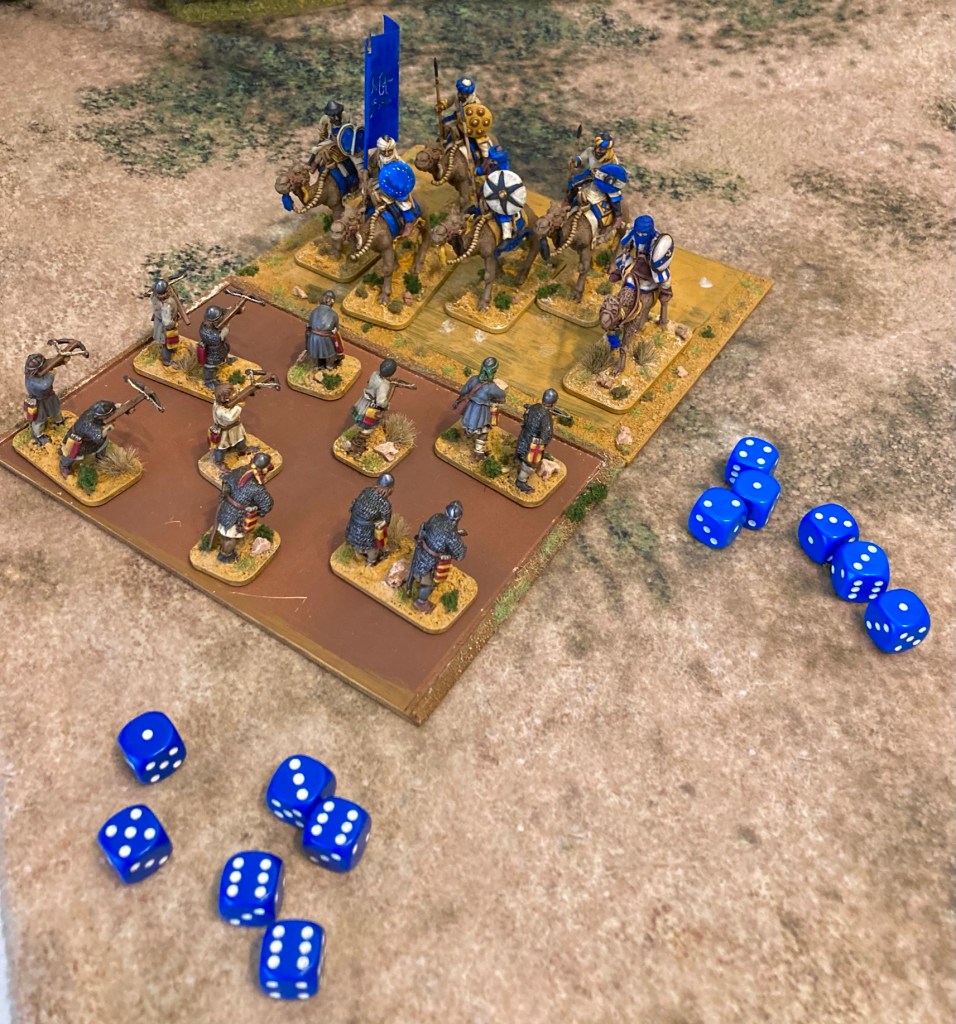
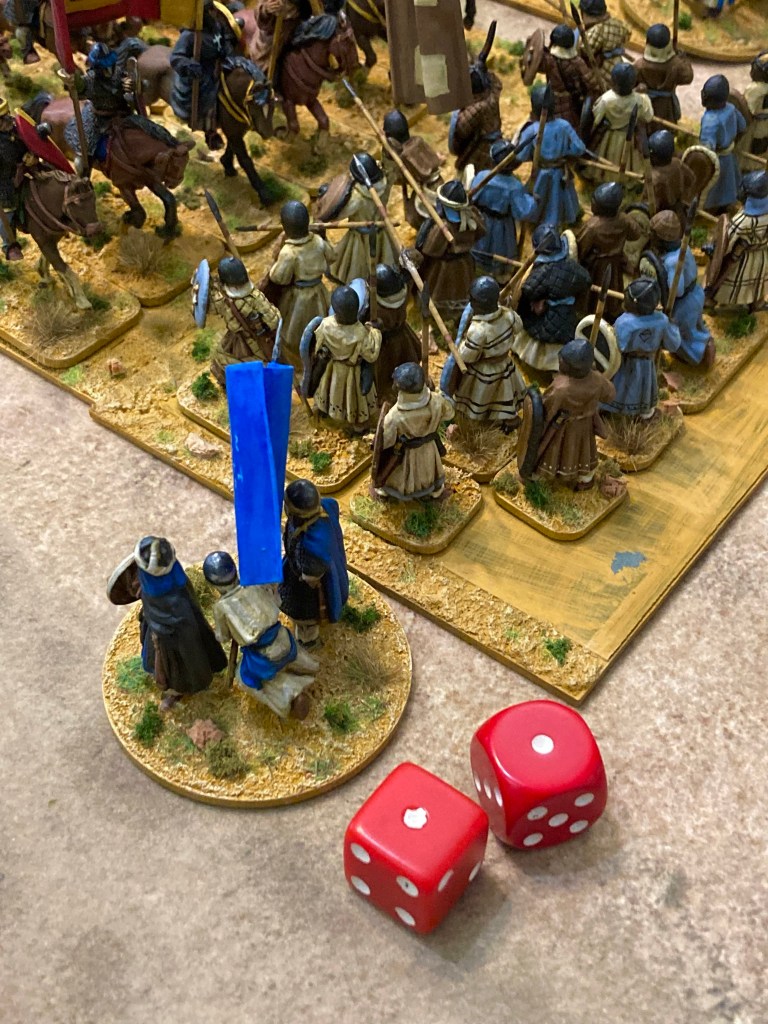
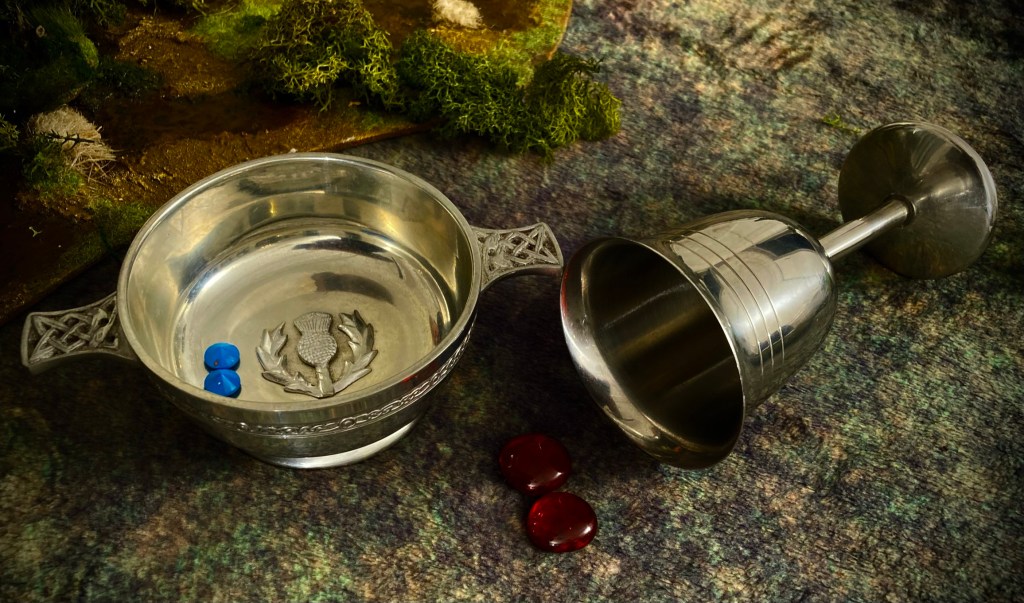
Might Points, dice and Orc goblet of Reputation ready to go. When the goblet runs dry, it’s game over.

The Elves turned out to be the attackers (clearly oppressing the Orcs who had been minding their own business) and the two battle lines were deployed.  With the advantage of numbers, I decided on a cunning plan involving (a) an Orcish flank attack through the woods on the right and (b) hiding the shock unit of Trolls from Elven archery behind a screen of feckless Orcs.  What could go wrong? 

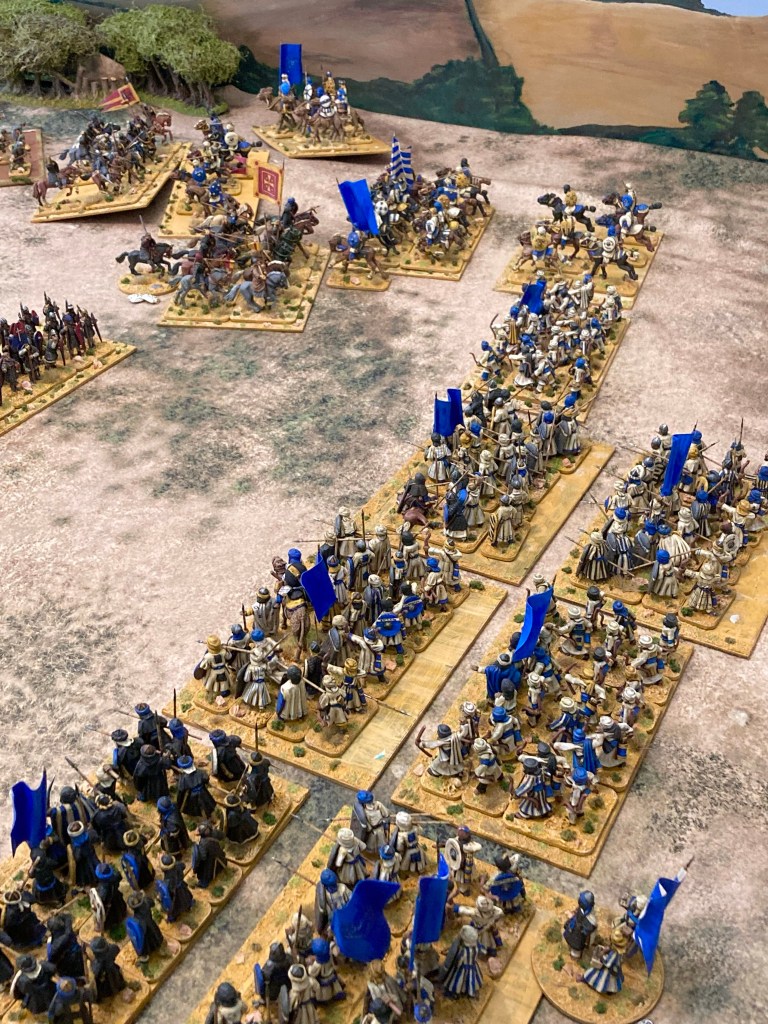
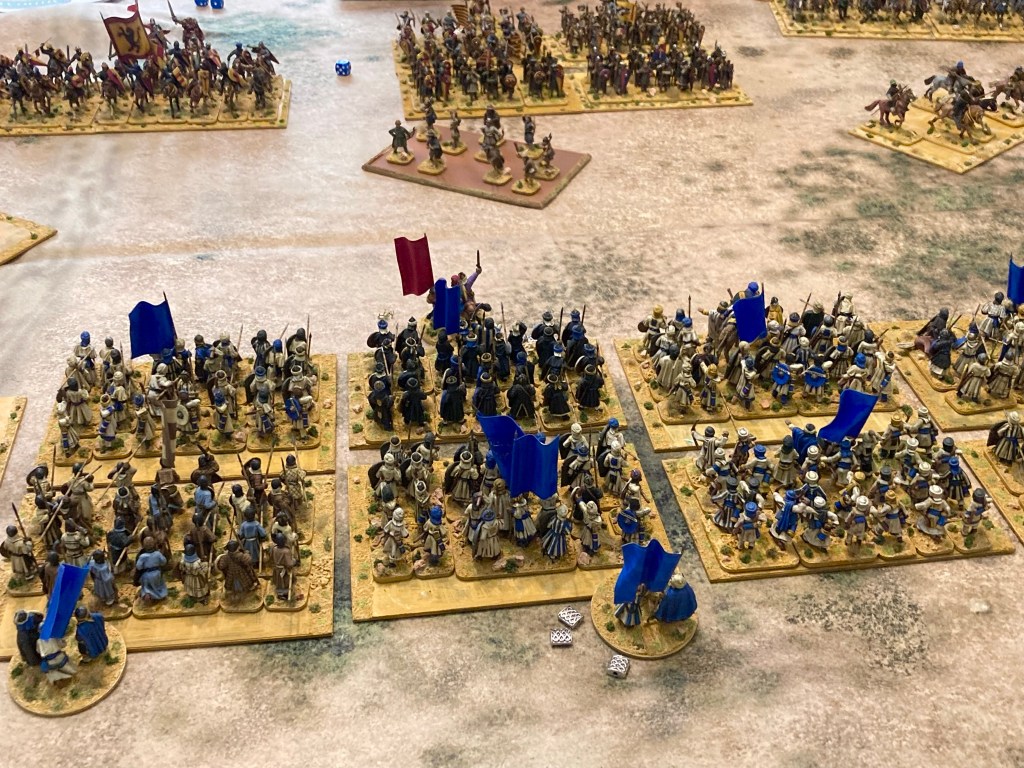
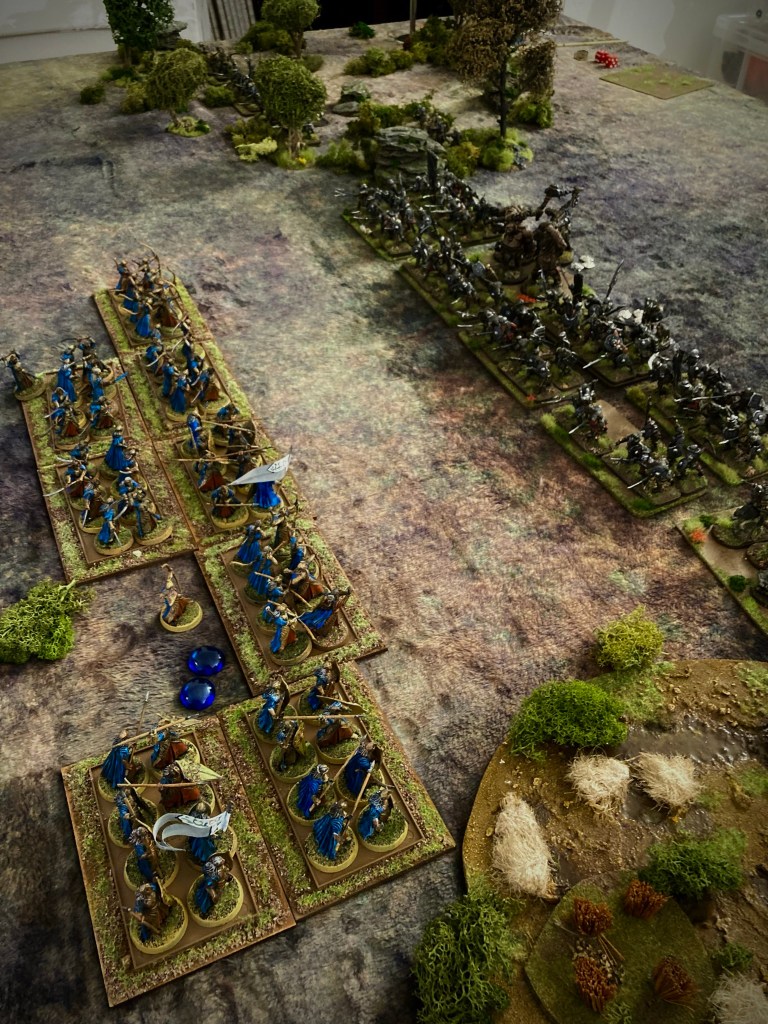
The battle lines close. Orcs actually follow orders for once.

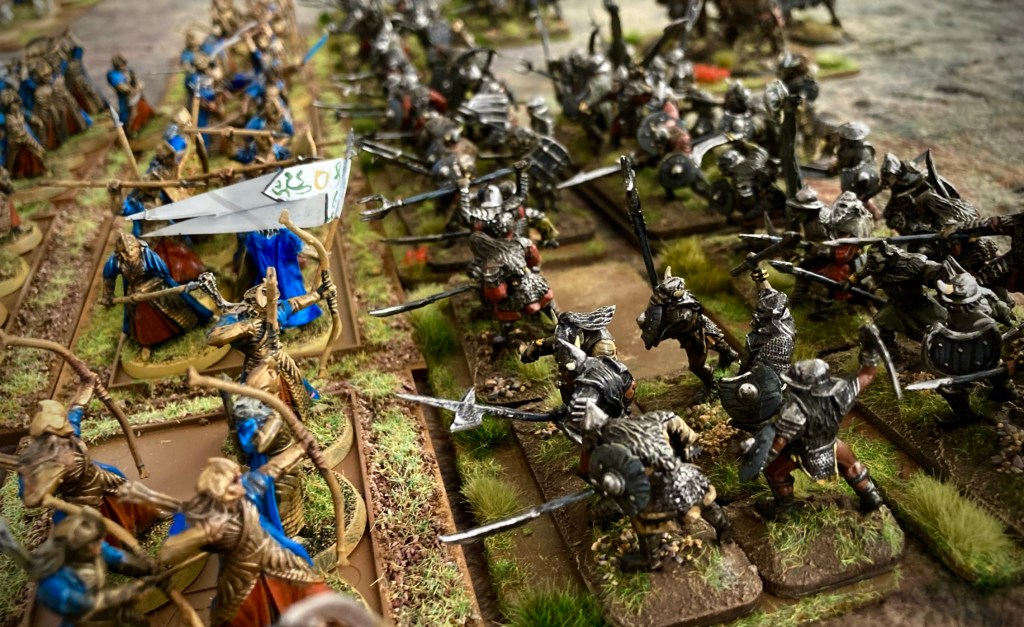
The game opened with a mass Orcish advance in the centre where every single Orc actually did what they were told (for once.) This left the Elves facing what looked like an organised attack, so using their drilled trait, the main Elven line smartly stepped back and held off combat for another turn.  As the Orcs finally came into range, Paul’s dice failed him big time and what should have been a withering hail of arrows turned out to be a paltry trickle of shafts.  The Orcs laughed this off and charged in. 

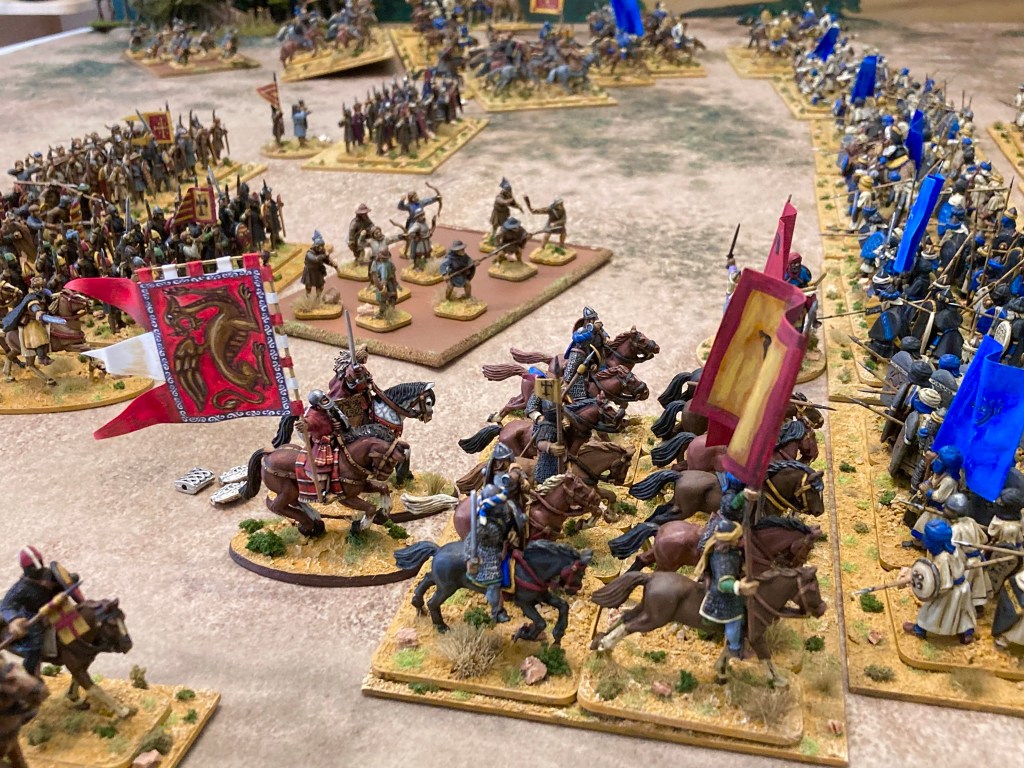
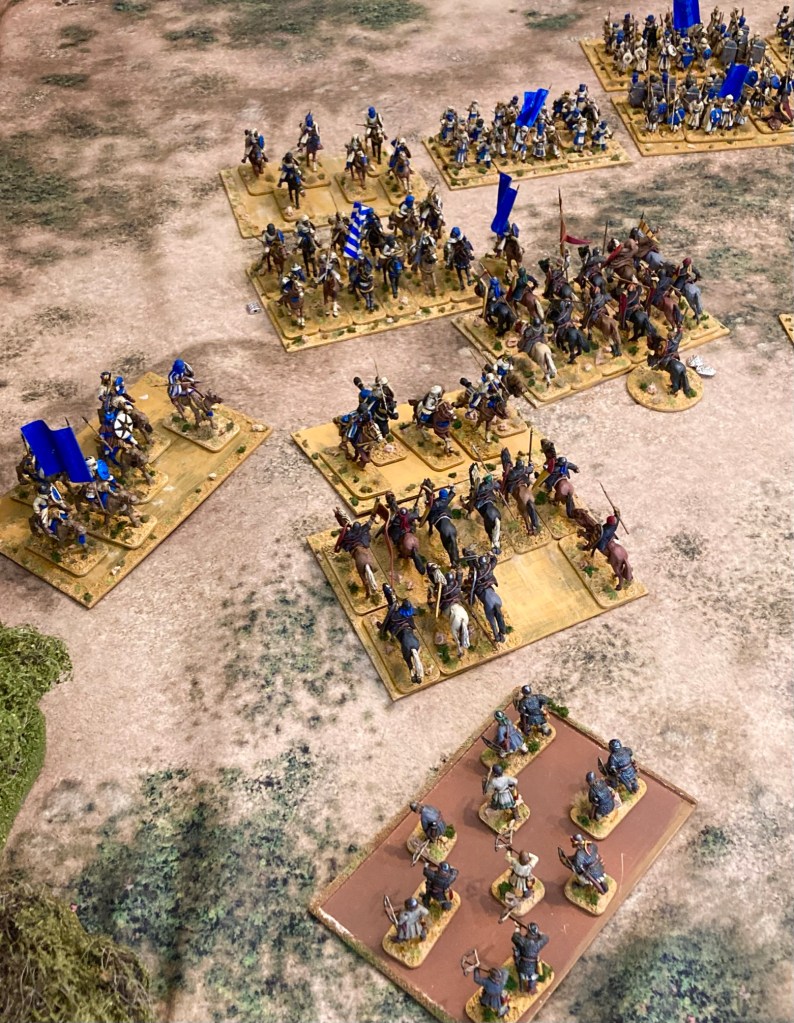
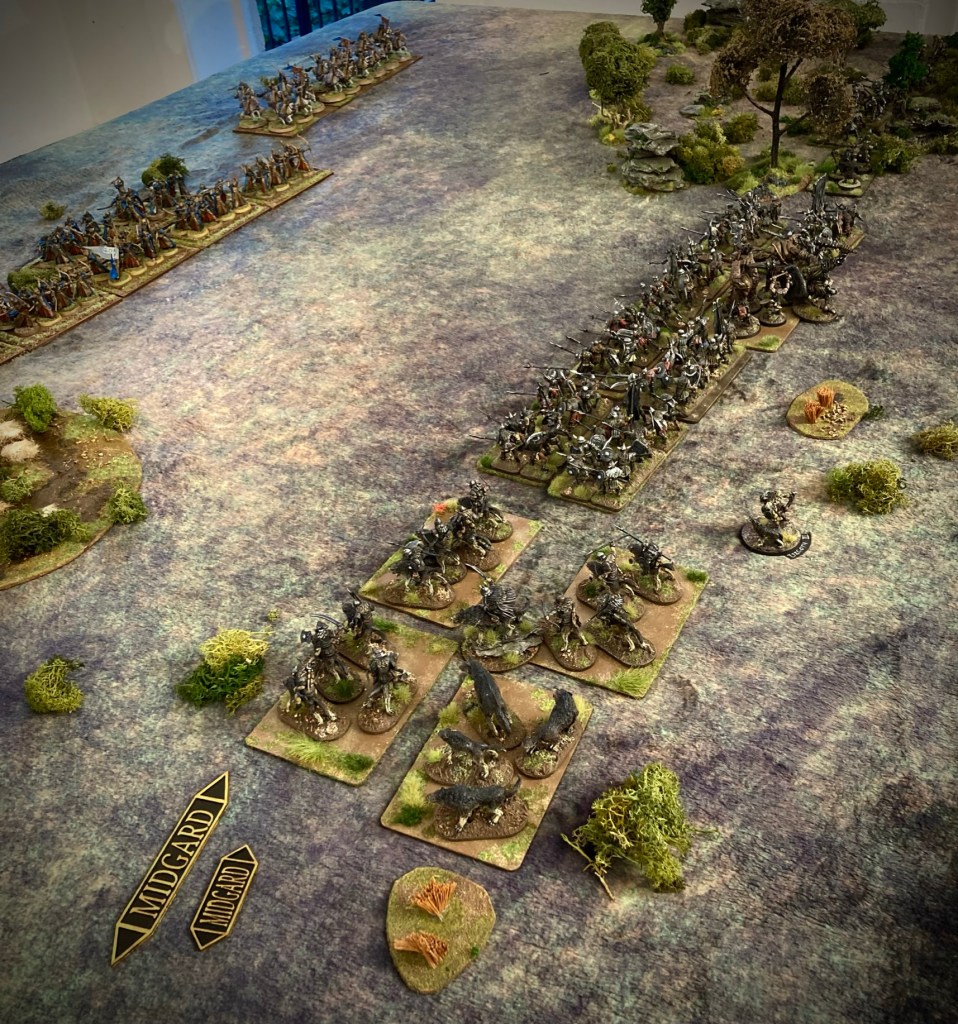
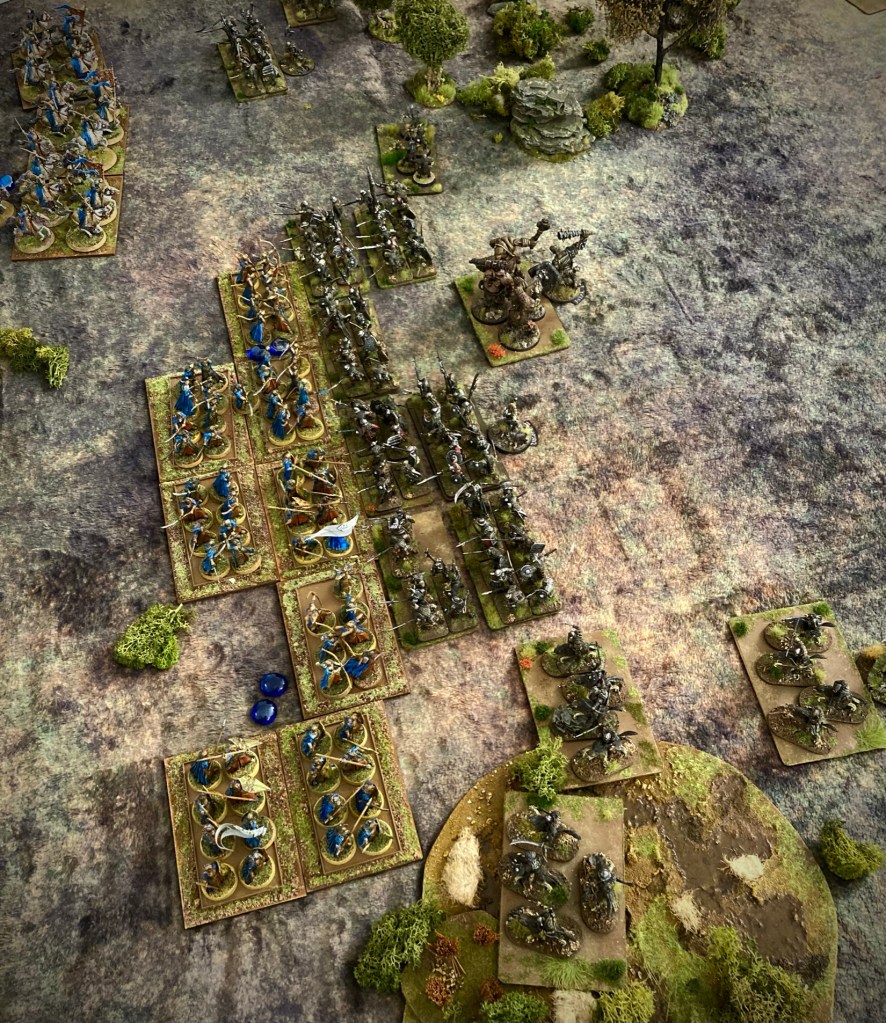
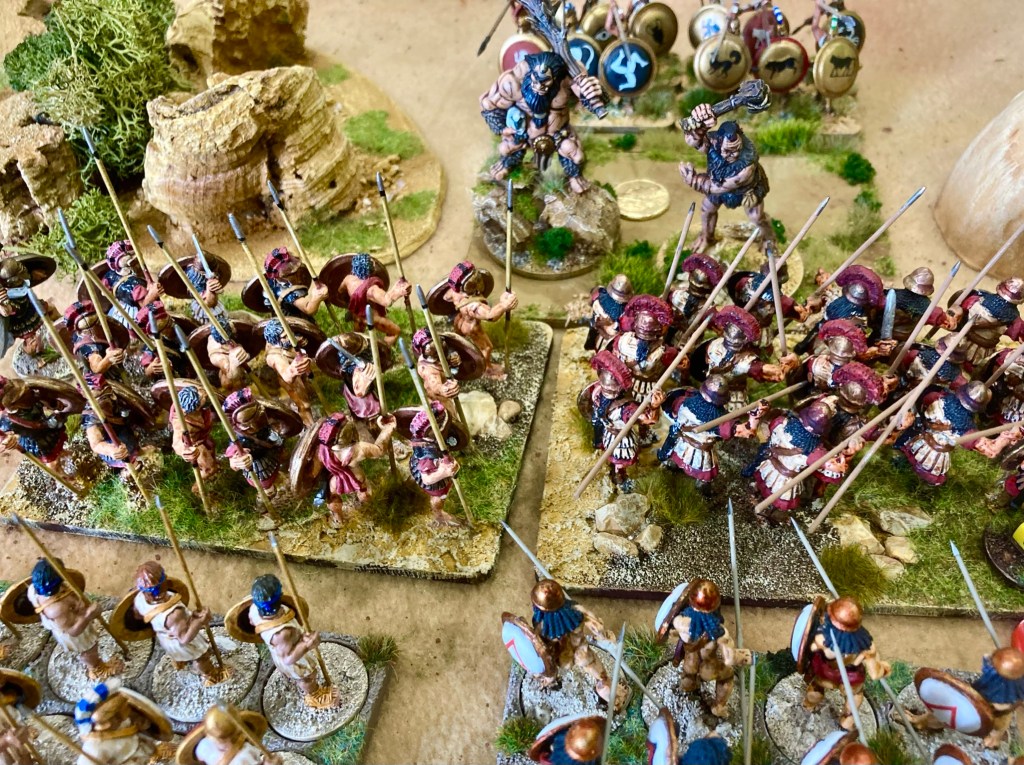
All out-scrapping along the line, although Akdar couldn’t whip his unit of Trolls into shape (top of pic). At the bottom, the Warg riders are about to get a shock from some Elven archery.

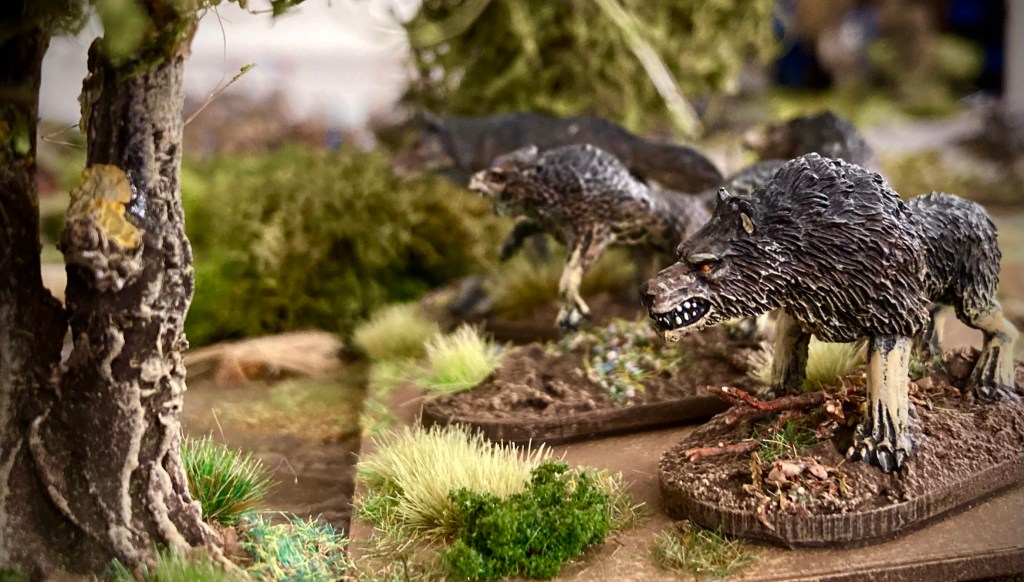
However, the Elf swordsmen and spears took chunks out of the Orcs, staggering the advance.  The archer units on the ends of the line finally got their eye in – one of my Warg rider units was wiped out by Egalmoth and his archers in a single round of bowfire.  

Orcs come out of the trees and don’t quite make it = blade fodder for the Elves!

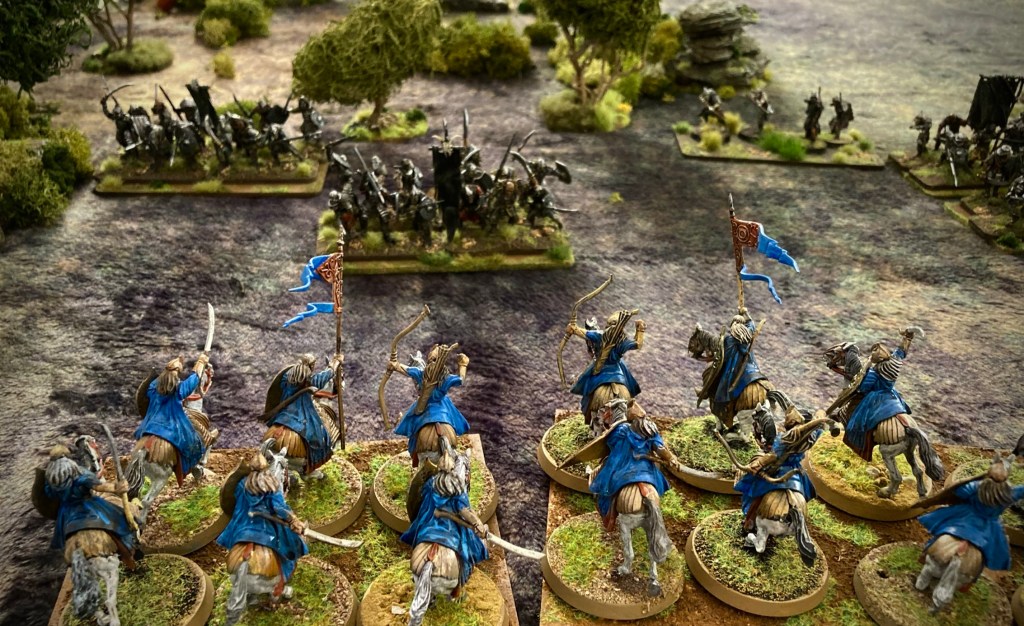
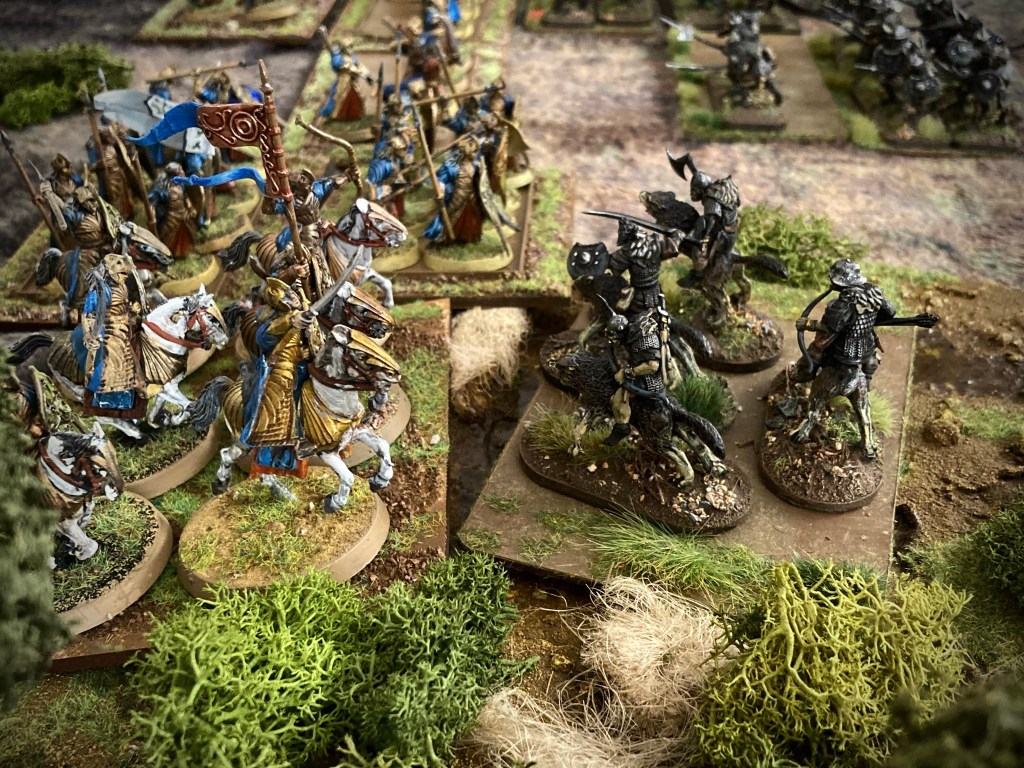
The bold Orc attack in the woods looked threatening and then stalled due to poor leadership – caught with their units halfway out of the trees, the Orcs were charged by Glorfindel’s heavy Elf cavalry.  Badly mauled, they fell back into the trees and didn’t play much more of a part in the battle. 

Single combat! The essence of Midgard.

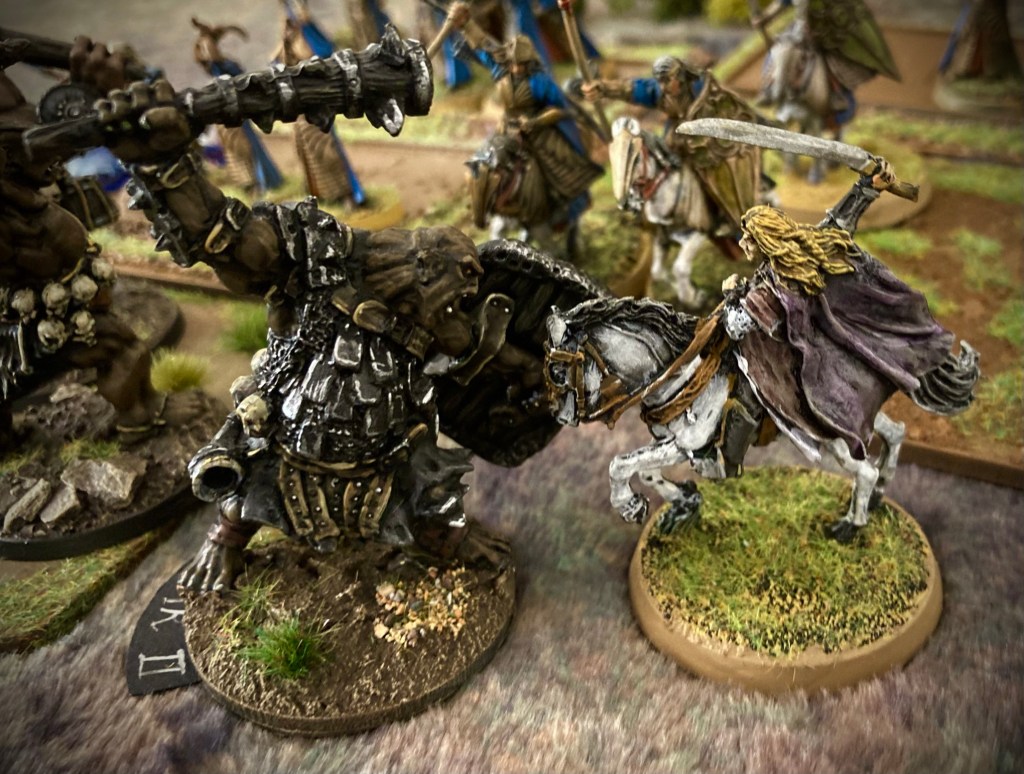
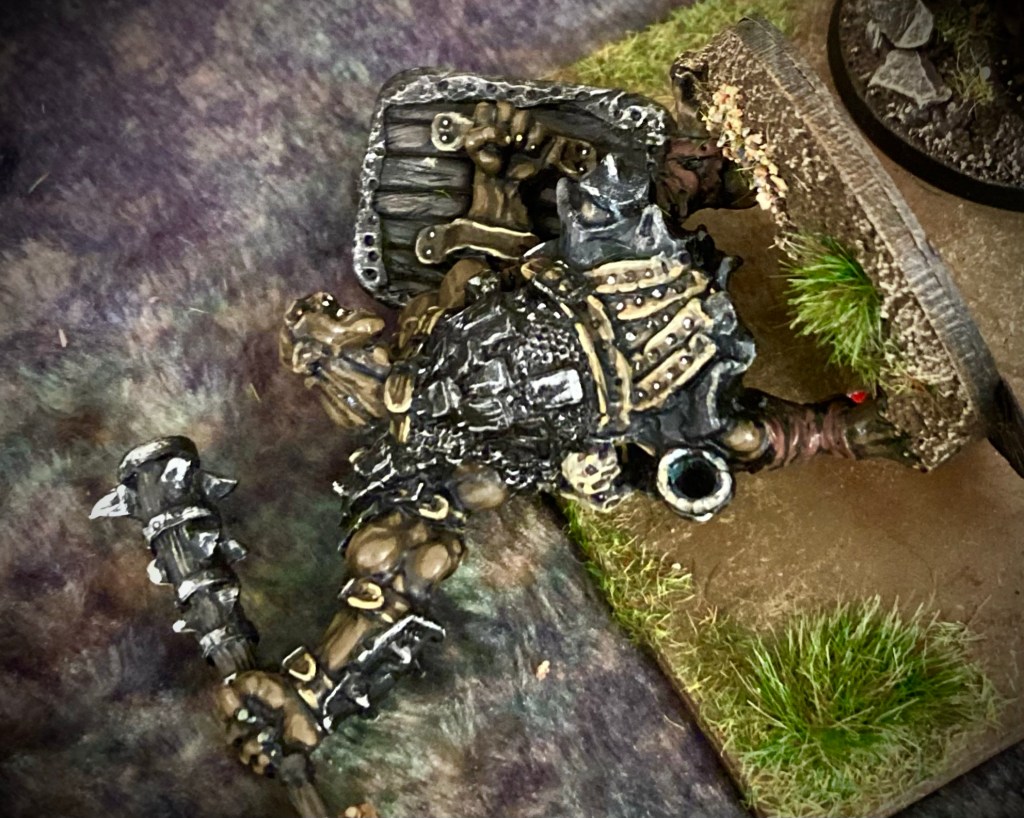
As the front line of Orcs buckled, Akdar brought up his trump card – a unit of Trolls which cleaved its way through the Elves.  Challenged by Glorfindel to single combat, he accepted – both suffered a wound before Akdar dealt the decisive blow and battered the unfortunate Elf into the ground (despite Glorfindel being a fairly buff character, Paul’s dice rolling at this point was shocking ).  I was quietly thinking of Fingon vs Gothmog at this point! 

Casualties on both sides as the Elves hold firm.

However, this brief moment of Orcish hope was not to last. Although the battered Elven line was just holding the centre, they were winning on the flanks.  Ecthelion stepped up with his Elf warriors who finished off the Troll bodyguard, Akdar falling to a chance blow.  This was enough to break the Orcs’ Reputation and they fell back in disarray towards Angband, pursued all the way by Glorfindel’s vengeful riders. 

I was really pleased with how the rough terrain rules had worked (albeit to the disadvantage of my Orcs) – although it can restrict movement, the main effect was in loss of command and control.  The different character traits were also used to good effect, especially by the Elves.  Paul and I had a useful discussion afterwards about single combats and, as ever, I added a few notes about clarifications to add to the ongoing manuscript for Midgard.  

More soon. 

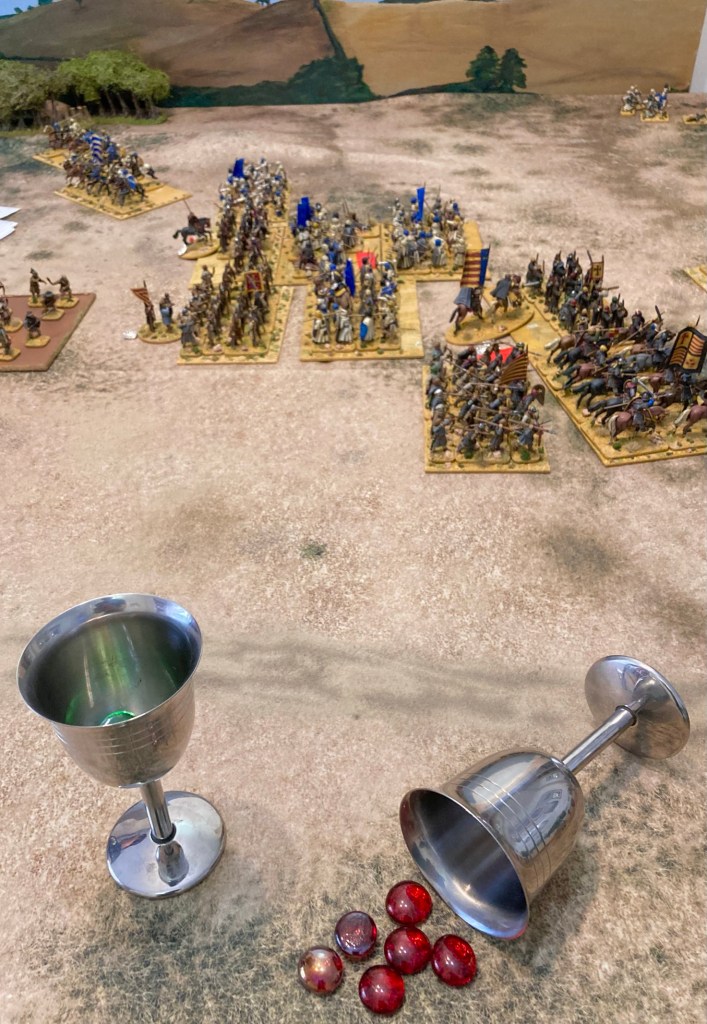
Elven Reputation is still at two, but the Orcs’ goblet is empty. Back to Angband for an early bath.

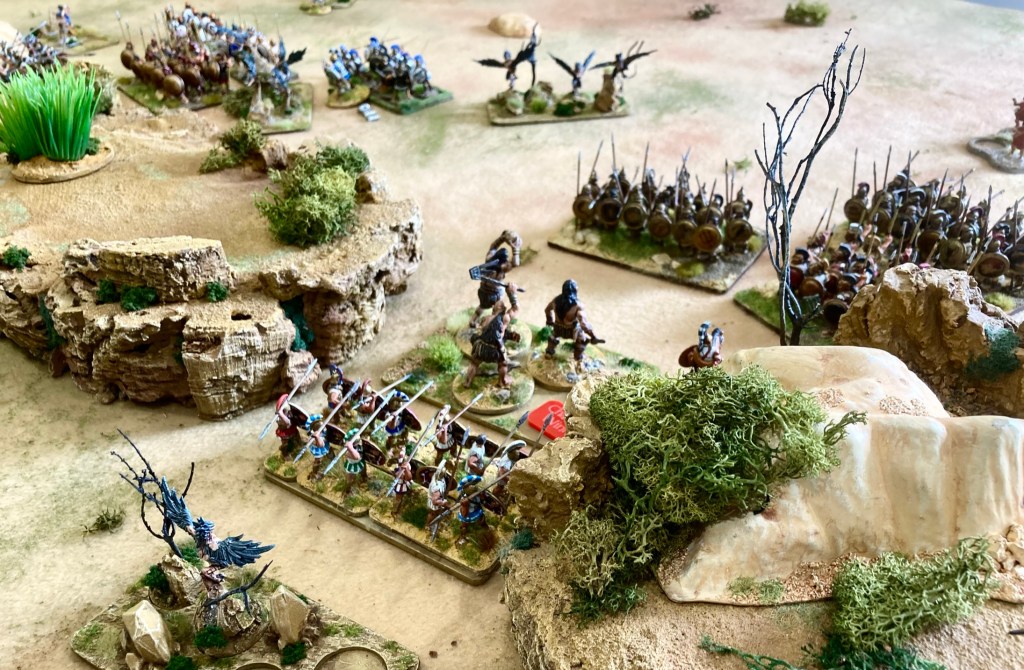
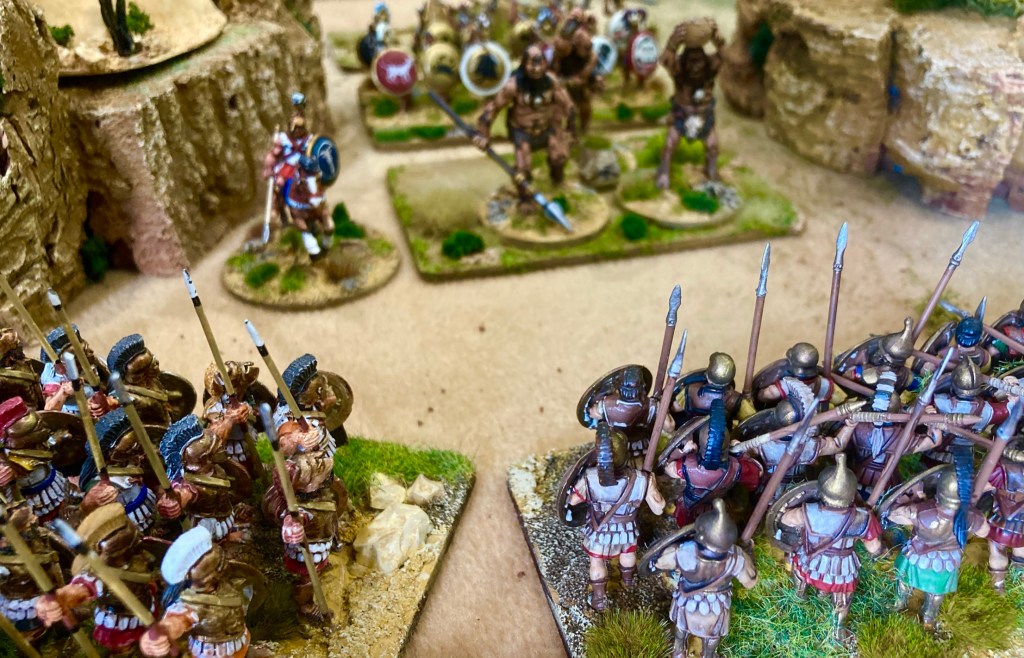
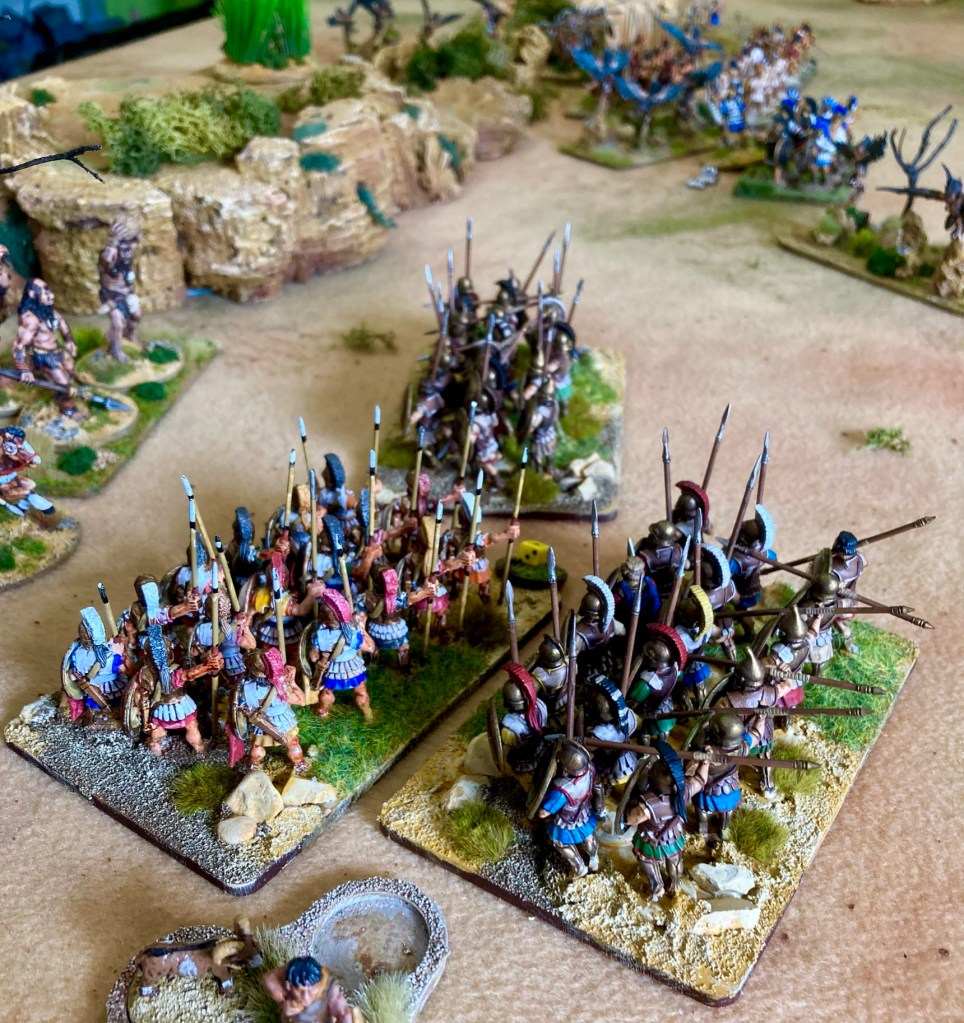
Greek Midgard 1: Basil and the Horn of the Minotaur

Continuing the current run of Midgard play test games, we ran a big Greek mythological battle using my rules, for which I constructed a plot line seriously inspired (i.e. ripping off) some of the most famous Greek myths (and Ray Harryhausen).

Greek hero Basileus has been set three (highly dangerous, possibly fatal) tasks by the King of Athens in return for his daughter’s hand in marriage. Fortunately, Basileus is favoured by the Gods and has a large crew of warriors in a small fleet of ships (the Argianauts).

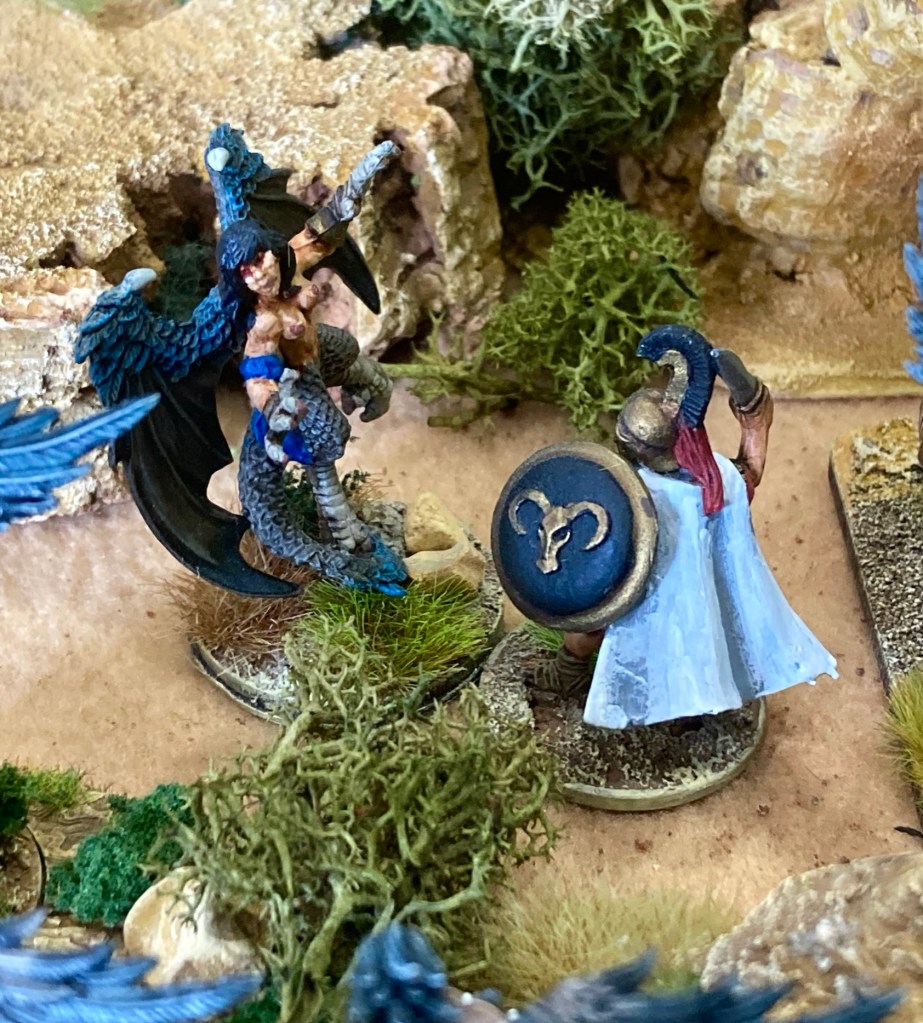
Left: Hagne the Harpy and Typhus the Steersman locked in single combat. Reaper Bones and Foundry figures painted by Martin H.

I shan’t go into the battle in great detail, as gaming compadres Martin and Tom WD have already covered much of the action in their blogs (click on their names above to see their reports.) However, I shall chuck in a number of pics, a few individual shots of the newest models in the collection, and some game development chat.

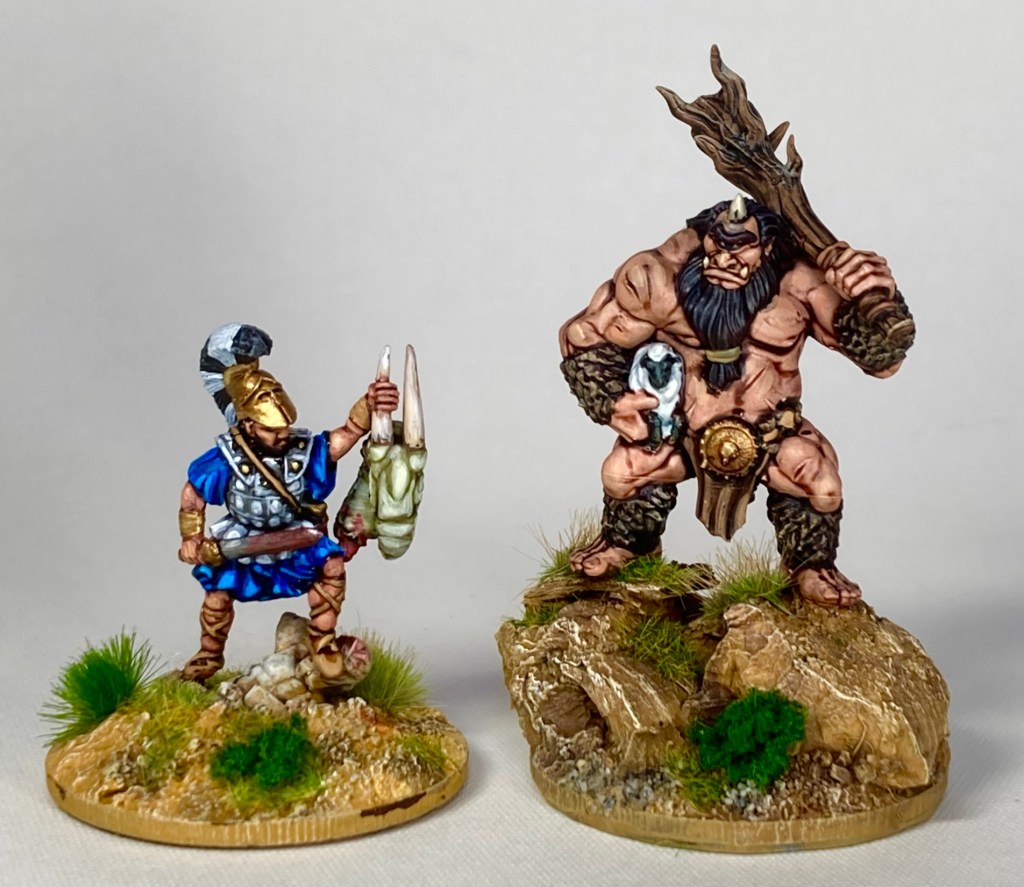
Basileus (Basil) and the Cyclopes’ leader, Tossus. Basil is the plastic Jason and the Argonauts figure from Salute 2013; Tossus is a 3d printed Cyclops designed by Artisan Workshop and purchased from Etsy.

The scenario for this latest game was None Shall Pass, one that we’ve played several times before and always gives a tight game. However, this time the defending force would be holding two passes in a mountain valley rather than river crossings. Sailing to Crete, Basil and his Argianauts have raided the Horn of the Minotaur from the ruins of the palace of Knossos, but now they need to escape the irate attentions of King Minossos and his unsavoury followers to get back to their ships.

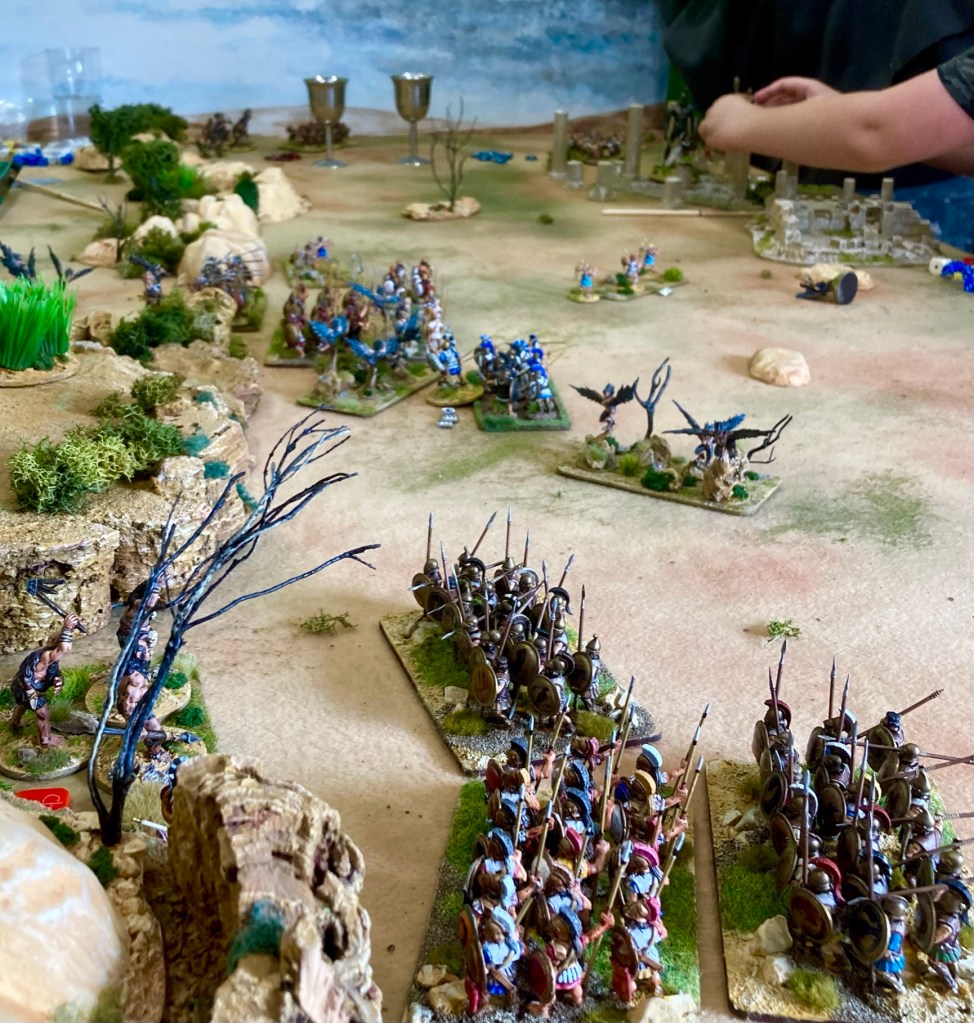
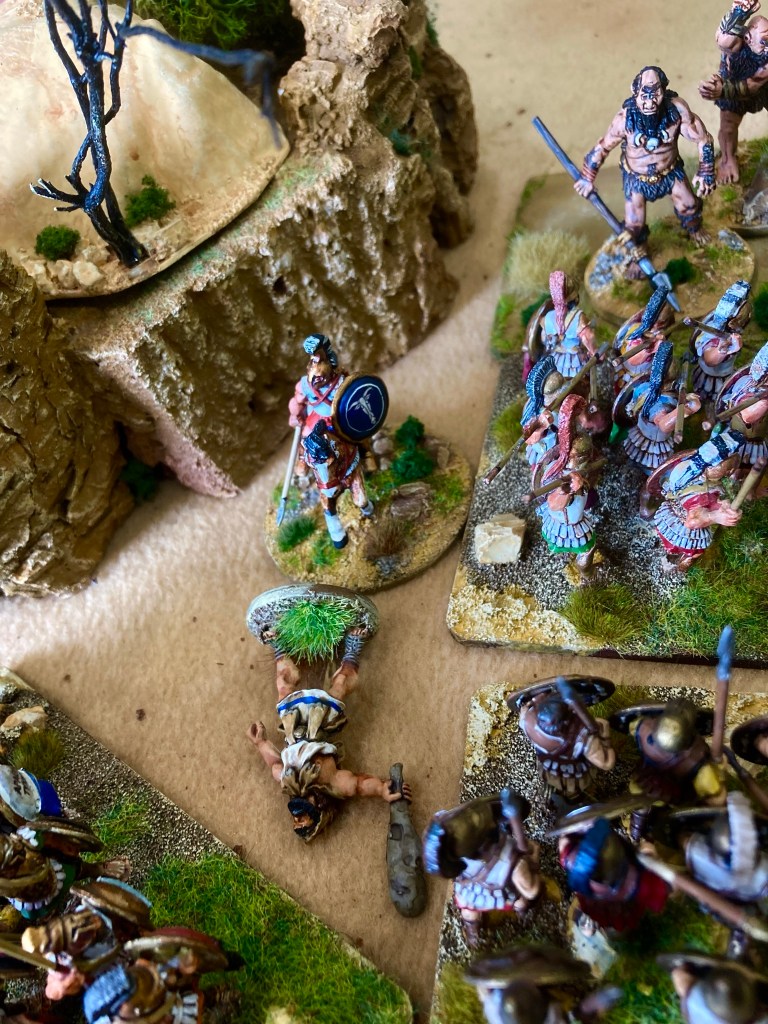
Start of the game: Basileus’s hoplites (a mix of figures from Martin and Tom WD’s collections) line up against the passes defended by Cyclopes.
Hoplites pressure Tossus and the Cyclopes

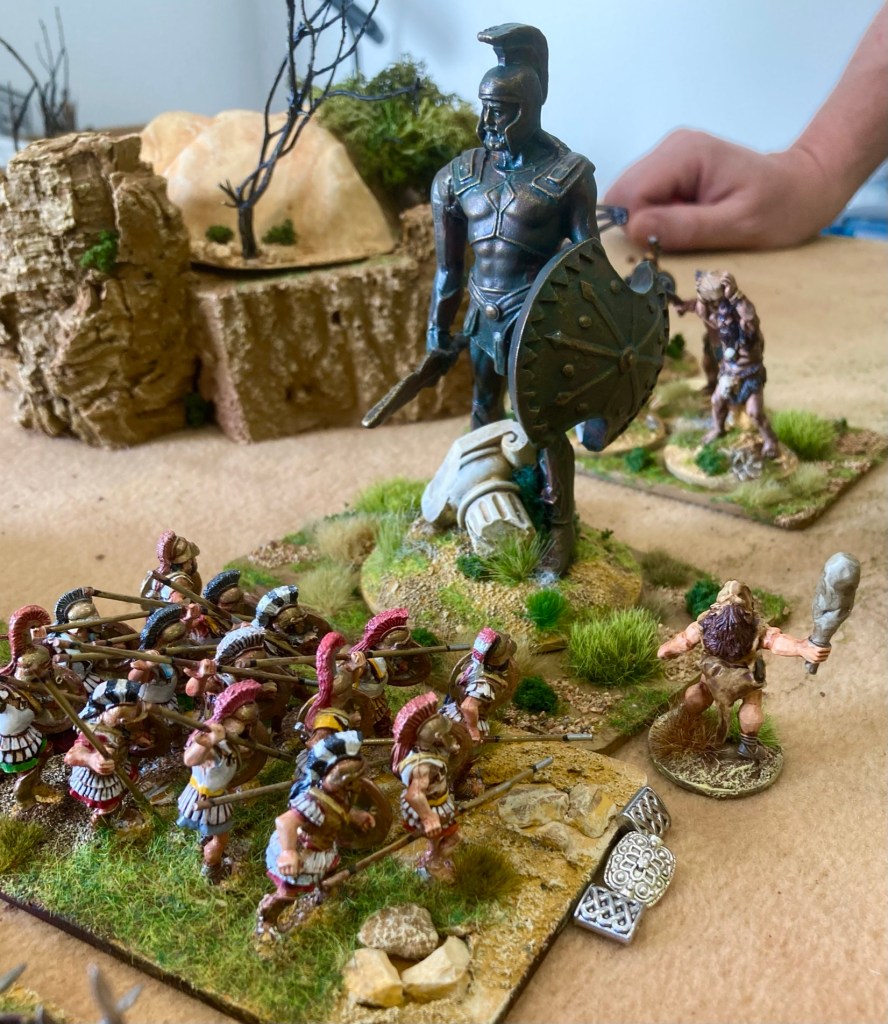
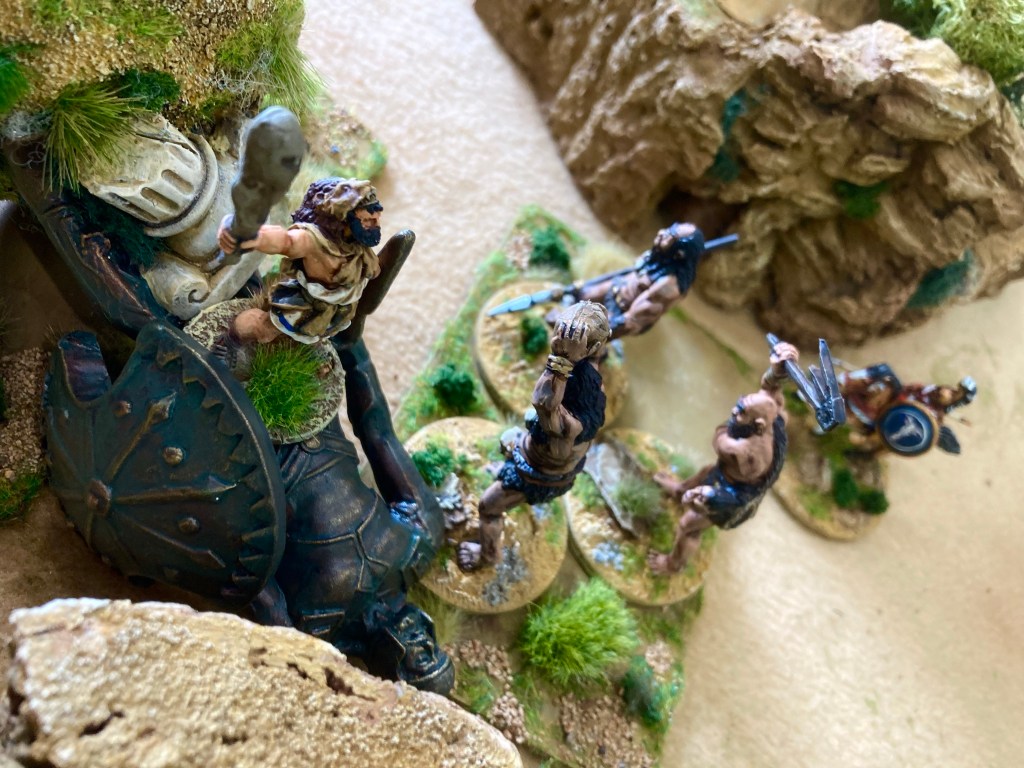
Heracles and the Argianauts take on the Bronze Giant. Hoplites and Heracles are by Foundry and from Martin’s collection; the Giant is actually a tourist souvenir of Achilles that I bought for 10 Euros in Crete and repainted.

Suffice to say that the Cretans and their beastly allies put up one hell of a fight, putting Heracles out of action, killing Typhus the Steersman and holding one of the passes right until the bitter end. However, with the death of King Minossos and his Cyclopes, a much-relieved Basil broke through one of the passes and made his escape.

Testing the flying rules was one my key intentions for this scenario. Flying creatures are by no means the focus of the game but I wanted Midgard to have sufficient rules to allow some flying heroes and units on the battlefield (e.g. Perseus, the harpies, the odd wyvern, dragons and so on.) I also wanted to create rules that would allow the flyers to be highly manouverable and a nuisance to the enemy, but not to dominate the battlefield.

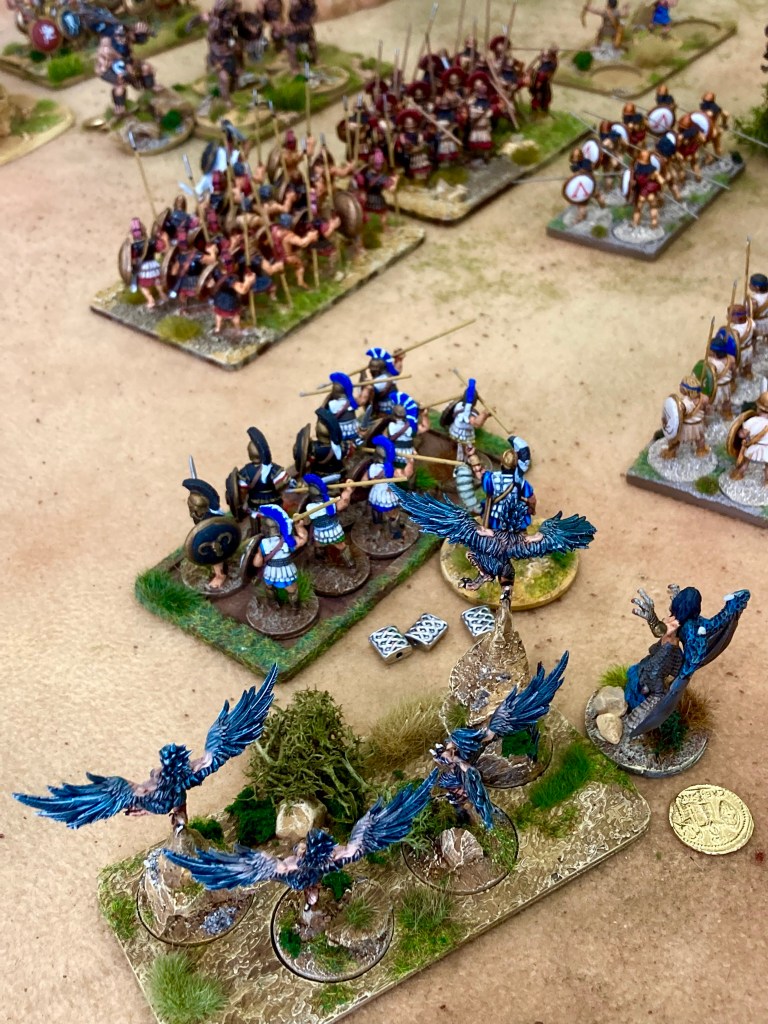
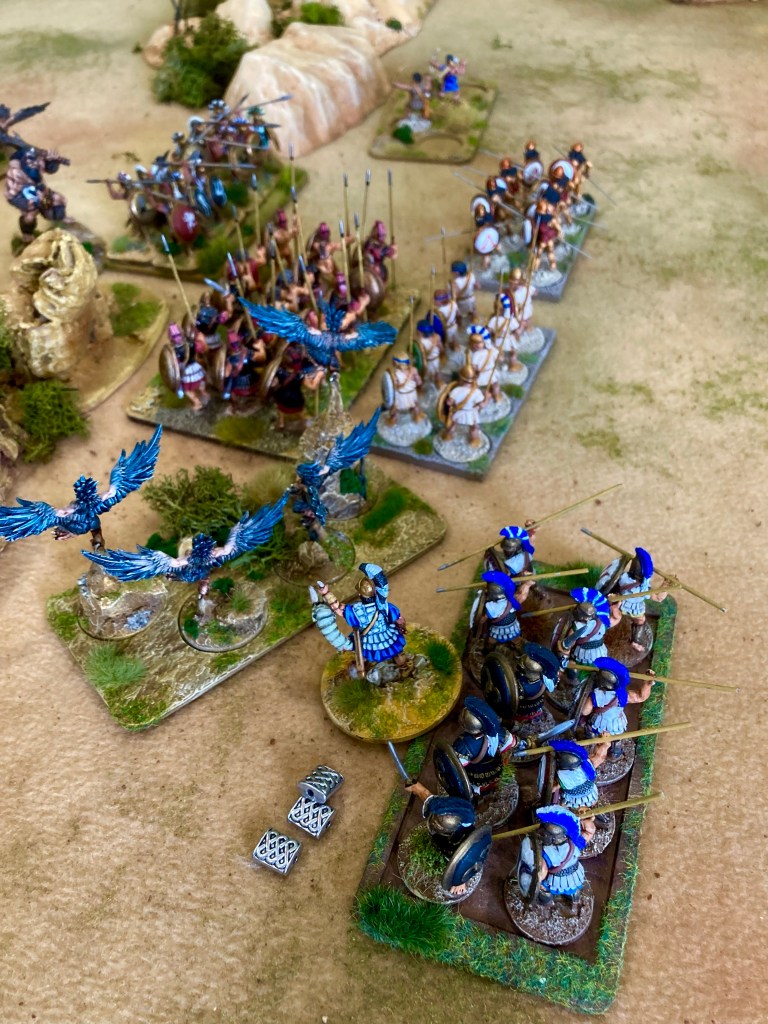
Harpies causing trouble, mounting a swooping attack on Basileus and his bodyguard.

Paul and Tom (controlling two harpy units each) caused a lot of consternation amongst Basileus’s troops, in particular picking off archers with swooping attacks. However, the one ground attack where the harpies landed and took on a hoplite unit ended in disaster. We were all agreed that the balance felt about right for these light, harassing flyers.

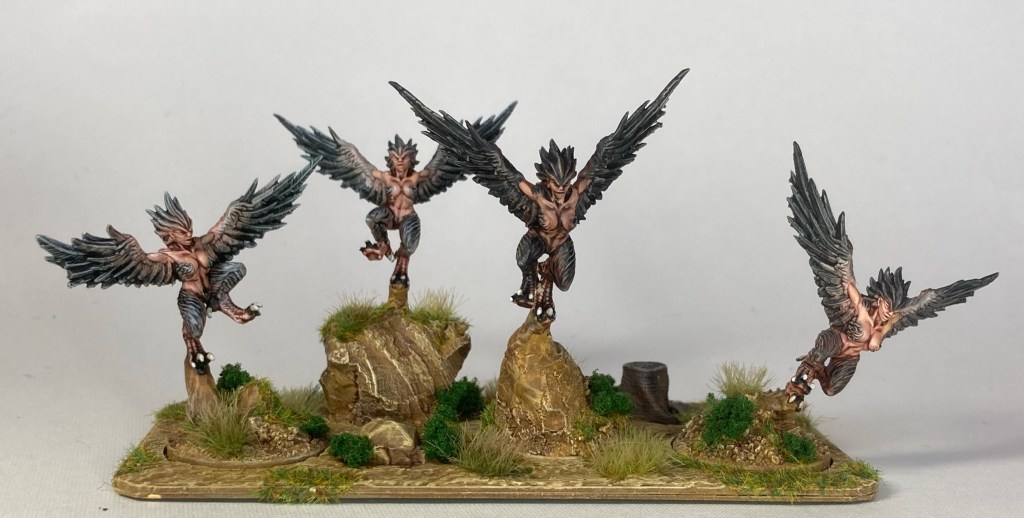
Harpies on their unit base for Midgard

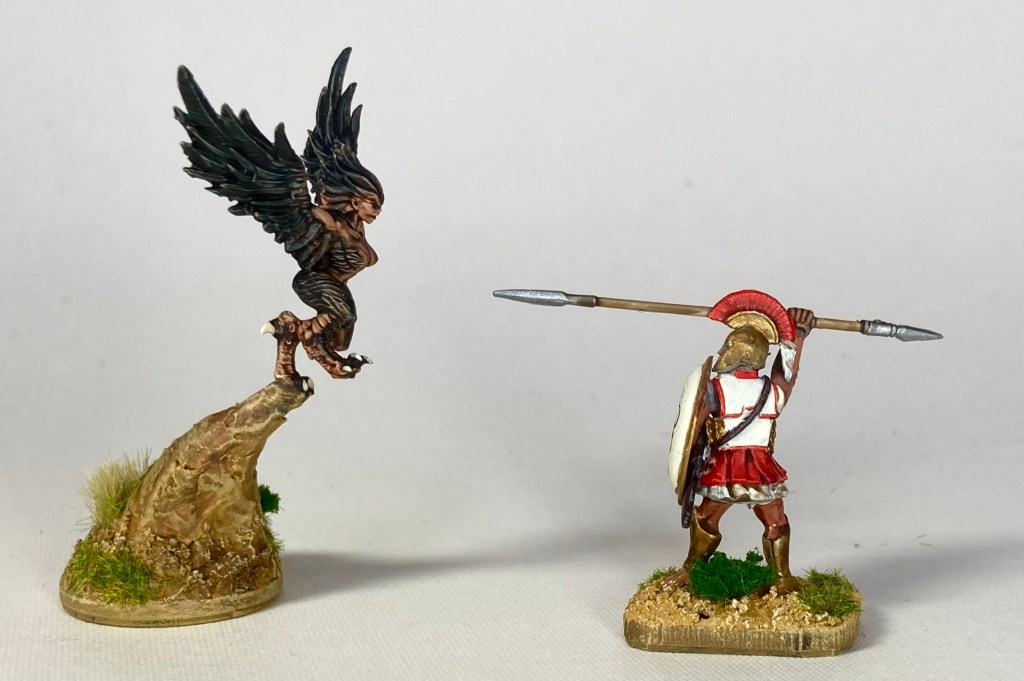
Some of the new toys for this game included a bunch of harpies – these ones are 3d prints from Artisan Workshop and purchased from FullyCycled on Etsy. There are only two poses but I varied them with different basing heights and angles. The paint job is 95% GW Contrast Paints: the skin is various mixes of Guilliman Flesh and thinned-down Wyldwood with a slight highlight of acrylic flesh. Wings are various layers/ mixes of Gryph-Charger Grey, Talassar Blue, Wyldwood and Black Templar before being dry-brushed with a light grey acrylic.
Artisan Workshop harpy facing off against a Warlord Games plastic hoplite for scale.
Three of the harpies from Artisan Workshop. Number 2 and 3 are the same model, varied by paint job and basing.
The troublesome harpies elect to land and attack in the rear, resulting in destruction by Basileus and his men.

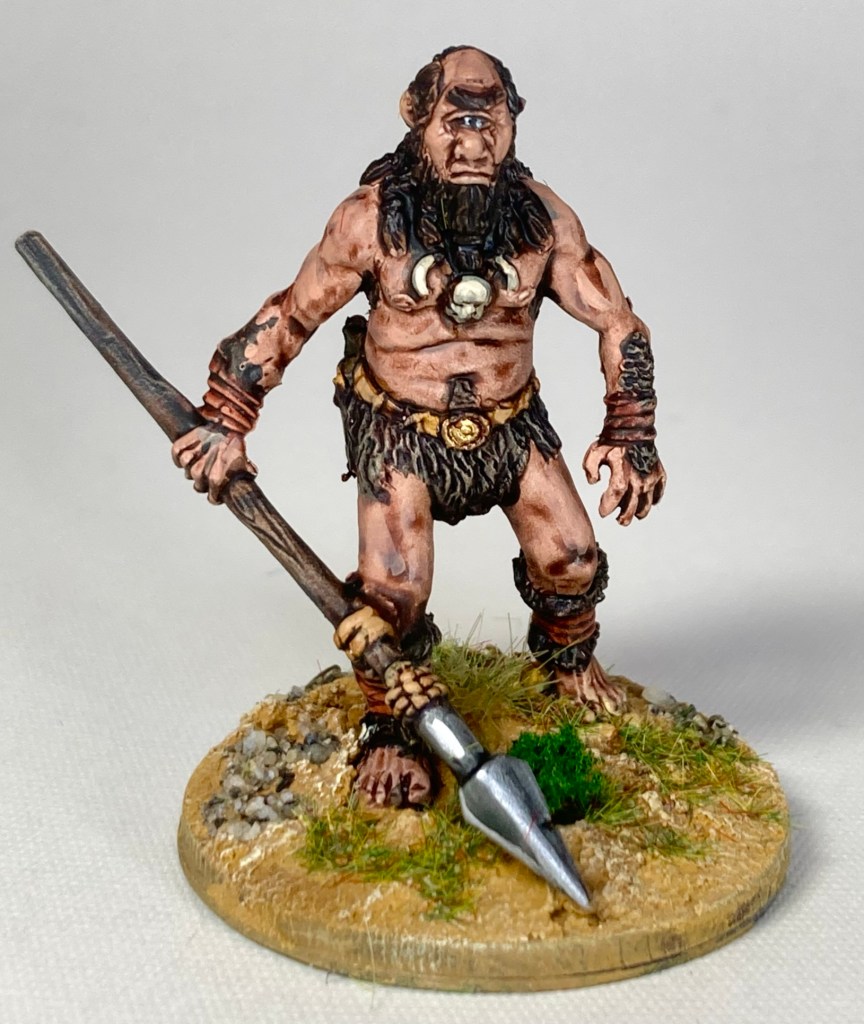
Other new models were a box of Dark Alliance 1/72 plastic Cyclopes that my son had bought me for my birthday. These were great fun to paint (another quick job using mostly GW Contrasts again) and made some tough units for the Greeks to take on. There was a good natured discussion about whether the Cyclopes should have a penalty for throwing rocks given their lack of binocular vision – one to ponder for the army lists! 🙂

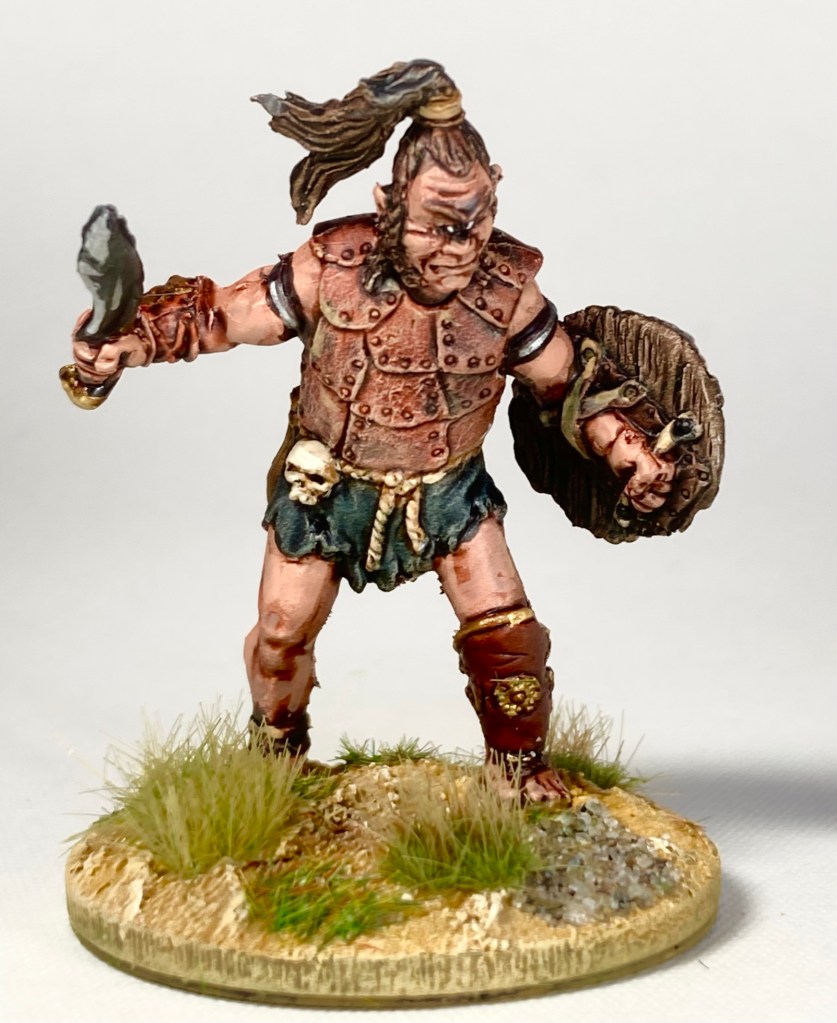
One of the Cyclopes, a 1/72 soft plastic figure by Dark Alliance. At around £8 for a box of 12 of these guys (3 each of 4 poses), you cannot go wrong! To give an idea of scale, the base is 40mm round.
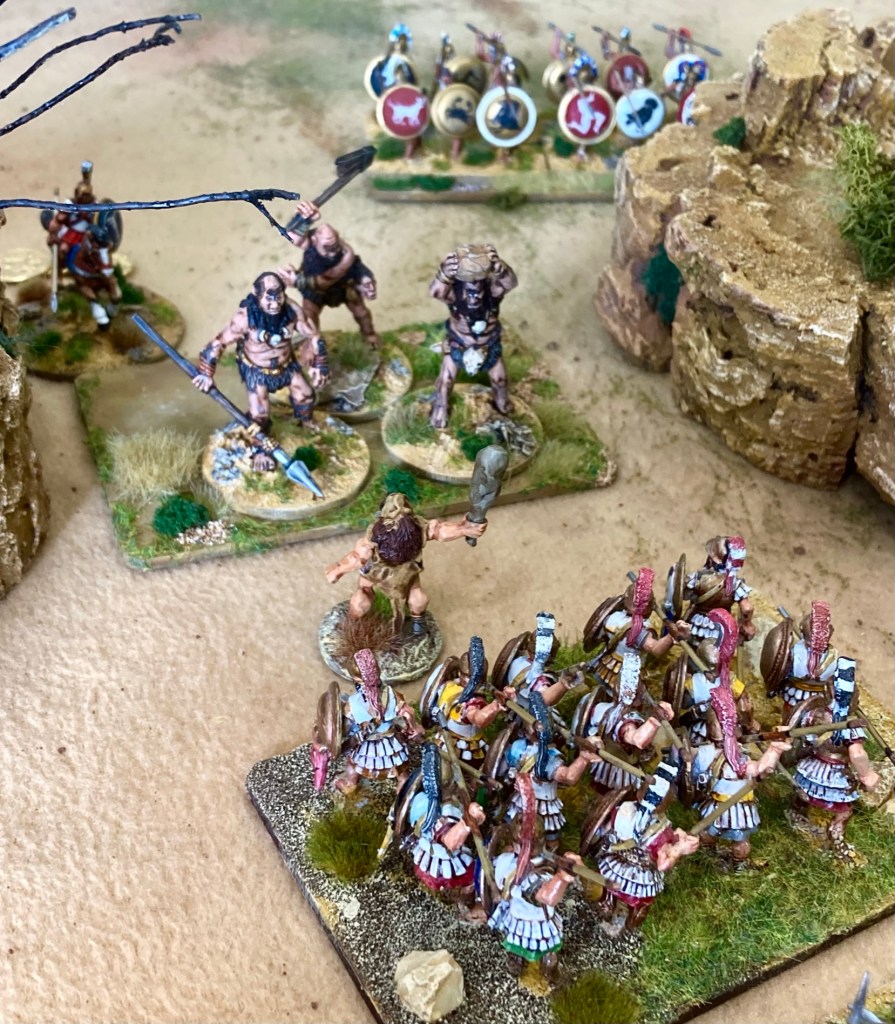
Cyclopes hold the pass

Another of the Dark Alliance Cyclopes – this chap has a minor conversion, replacing his right hand and club with a spear.

Challenges to single combat feature heavily in Midgard and this game was no exception. Shockingly, Heracles (the most powerful hero in this battle) lost out to Minossos, showing that sometimes the dice just go against you! There was a fine narrative moment when Hagne the Harpy slew Typhus the Steersman in a challenge, but Typhus managed to down the harpy leader with a final stroke of his sword. Exciting stuff.

Heracles triumphs over the Bronze Giant…

…only to be decked by the much smaller King Minossos a few minutes later!
Hagne the Harpy and Typhus the Steersman slay each other in bitter combat.

Overall, I was very pleased with the game. The scenario gave us a very tense conclusion following the loss of Herakles, with both sides suffering heavy losses. Single combats worked a treat and the flying rules were just about right. I went away with a number of notes about things to clarify in the rules as play testing continues. Hopefully we’ll be able to play Basil and the Argianauts episode 2 in the not too distant future.

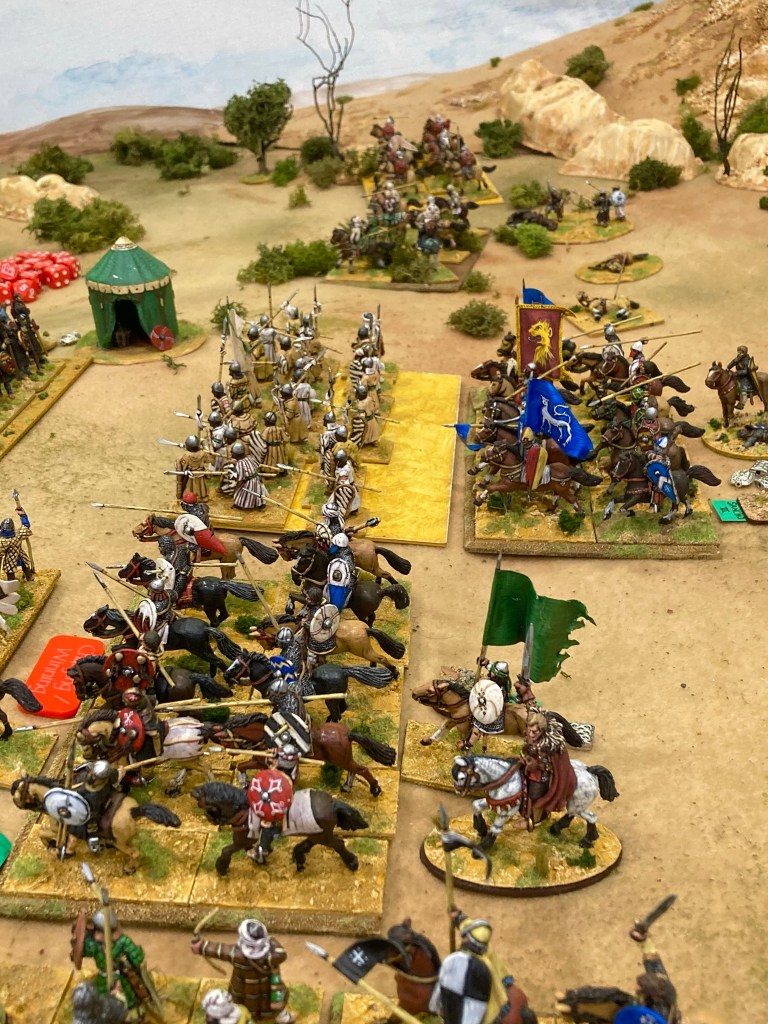
Battle of Graus, 1063 CE – Enter El Cid!

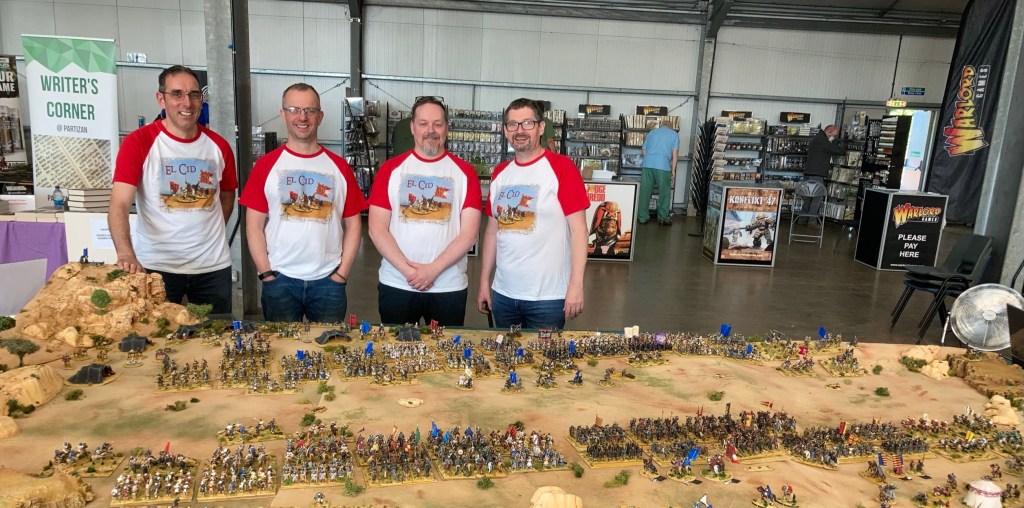
I’ve been working on Midgard – my heroic battle wargames rules – for some time now. Medieval Spain and the age of El Cid have long been popular in my gaming circle and it wasn’t long before Tom WD (king of the pun) started cracking jokes about ‘El Cidgard’. Therefore it was only a matter of time before I pulled my finger out and ran a game. The safe arrival of Scrivs and his collection of El Cid minis in the UK offered us the perfect opportunity, so here it is…

El Cid has fascinated me since I was a kid, so much so that I ended up writing a WAB book and several magazine articles about him back in the noughties. Recently, the release of the Caballero Miniatures 3d printed models (just amazing) and the Legend of El Cid series on Amazon Prime (rough in places but great Spanish locations and stirring battle shots) has rekindled my interest in the Iberian Peninsula.

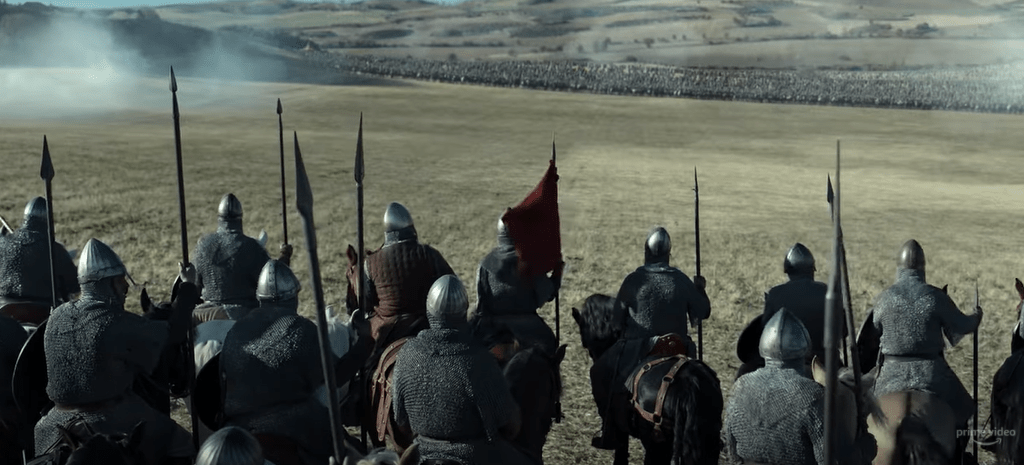
A shot from the Amazon Prime series The Legend of El Cid before the Battle of Graus – stirring scenery if slightly dodgy action!
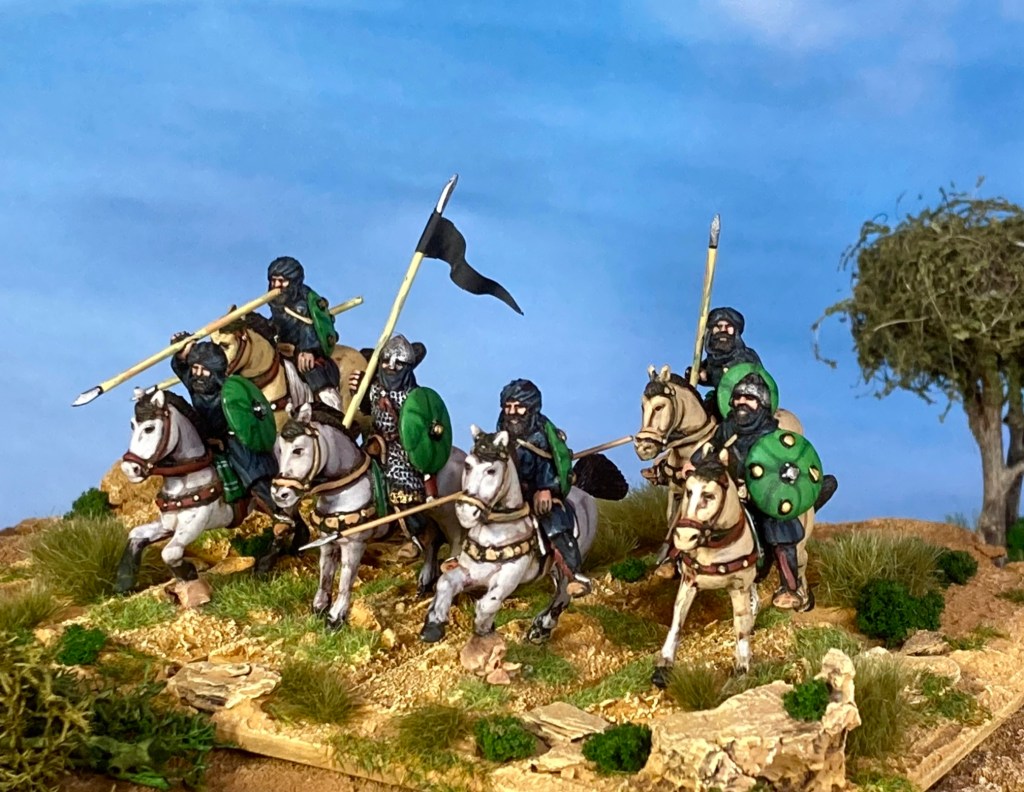
3d printed 28mm model by Caballero Miniatures, printed for me by Fenland Miniatures

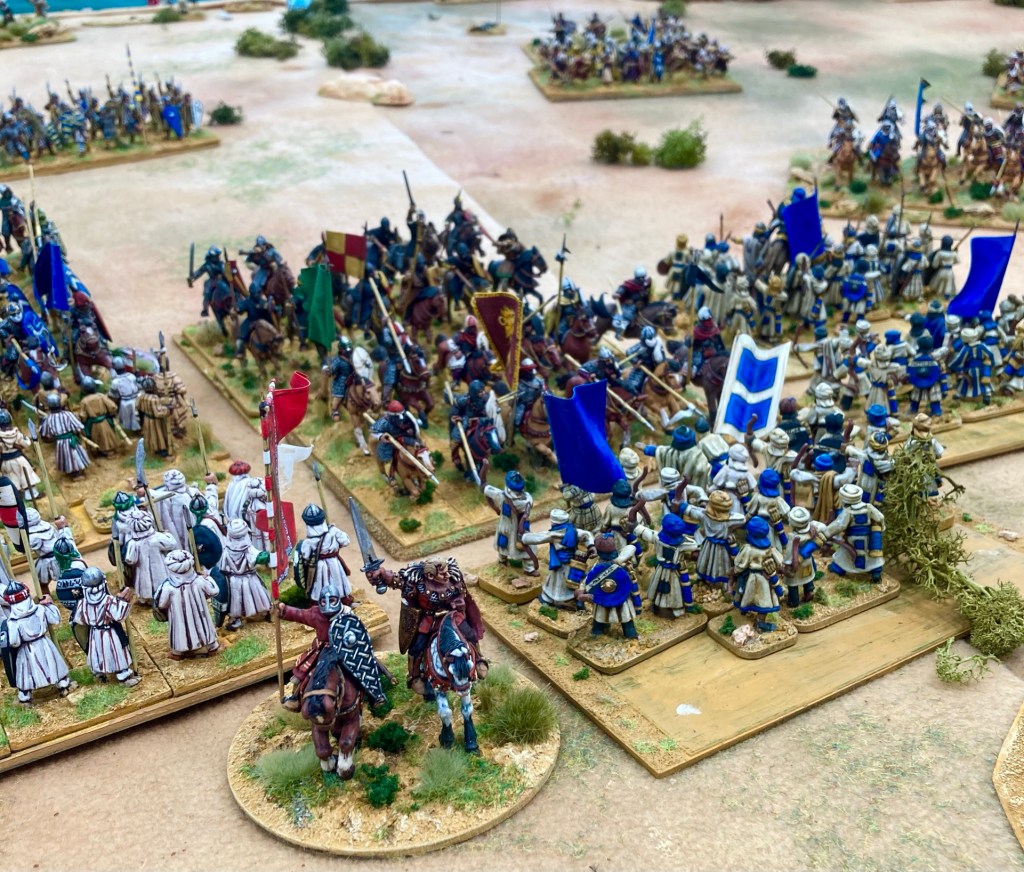
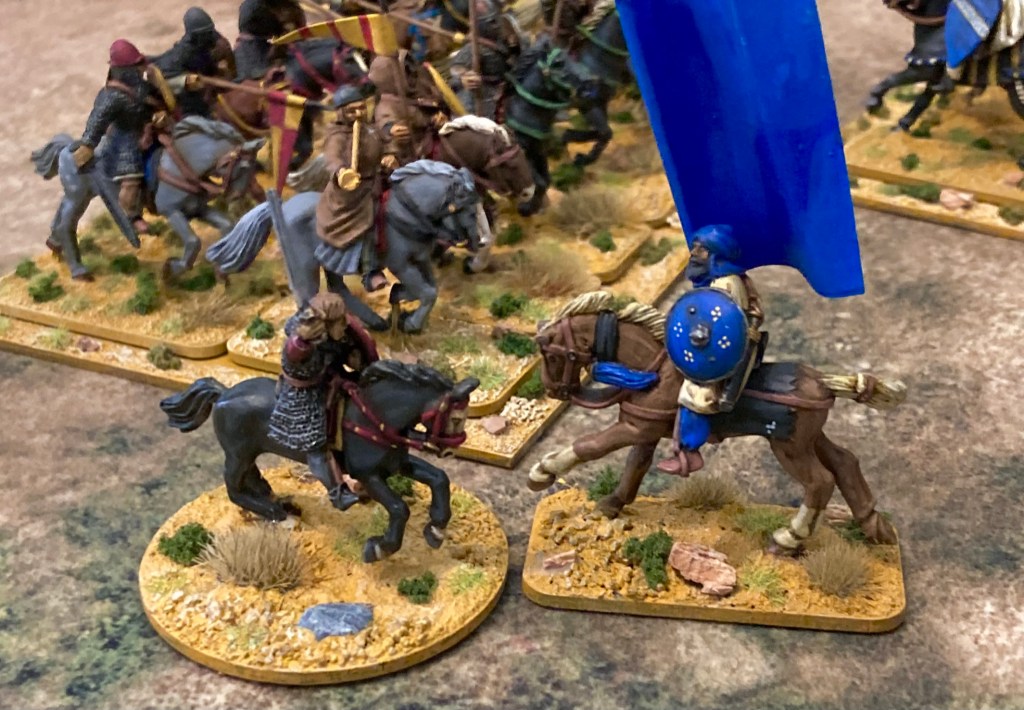
The Battle of Graus was fought on May 8th, 1063 CE. The exact circumstances are unclear but the bare facts are that Prince Sancho ‘The Strong’ of Castile rode with his father’s Muslim tributary, the Emir of Zaragoza, to defend the town of Graus from the Aragonese. The Aragonese were defeated and King Ramiro I of Aragon, Sancho’s uncle, was killed. As Richard Fletcher wrote in The Quest for El Cid, ‘The Graus campaign is a fine example of the complexities which arose in the age of the taifa kings: a Castilian prince defeats and kills his Aragonese uncle in order to preserve the territorial integrity of a Muslim ally.’ It is also notable because, according to his chronicler, it is the first recorded battle in the life of Rodrigo Diaz, later known as El Cid, fighting in the service of Sancho of Castile.

Snippet of a map from my El Cid WAB supplement drawn by Jon Hodgson, showing the location of Graus in the foothills of the Pyrenees. Although part of the taifa of Zaragoza, the Aragonese had designs upon it in 1063 CE.

In wargames terms, I decided that the most likely scenario would be the Castilians and Zaragozans trying to raise the siege of Graus. I therefore elected to have the Aragonese on a hill overlooking the town of Graus with the relief force trying to storm the camp before reinforcements arrive.

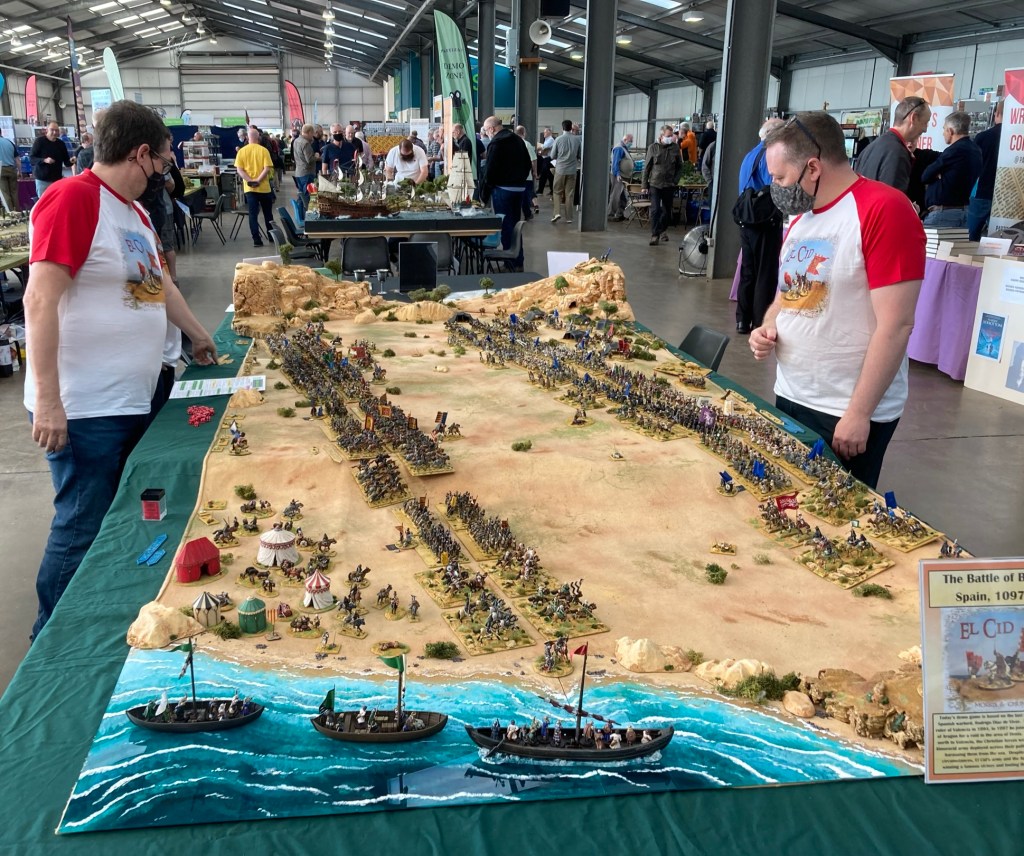
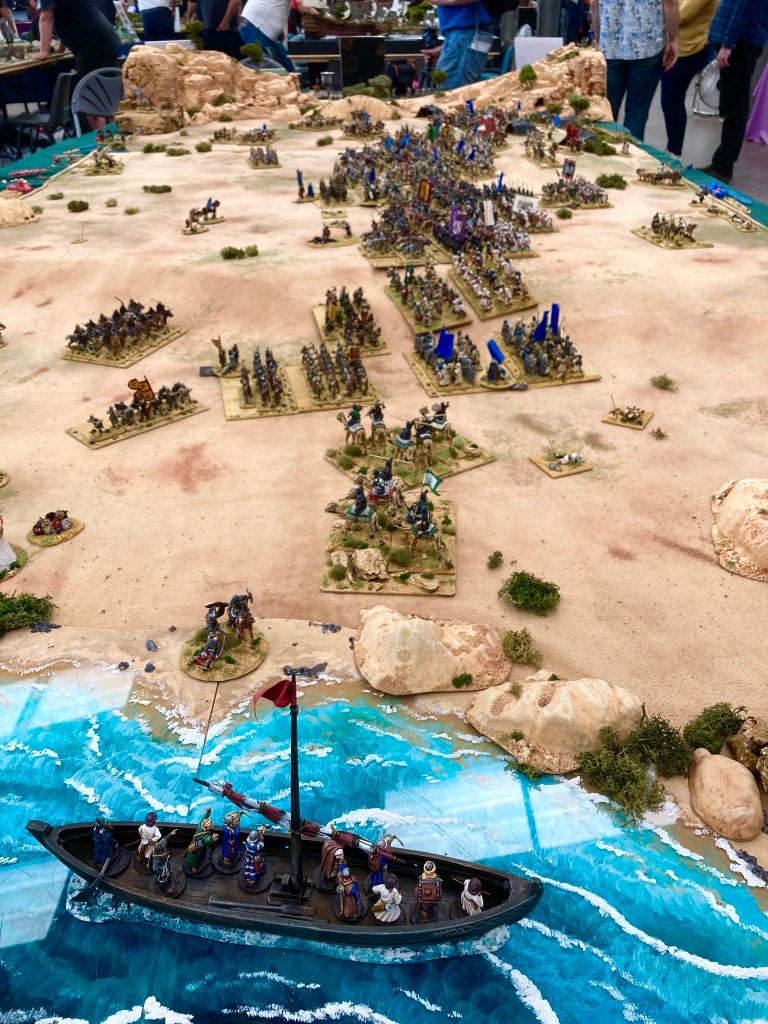
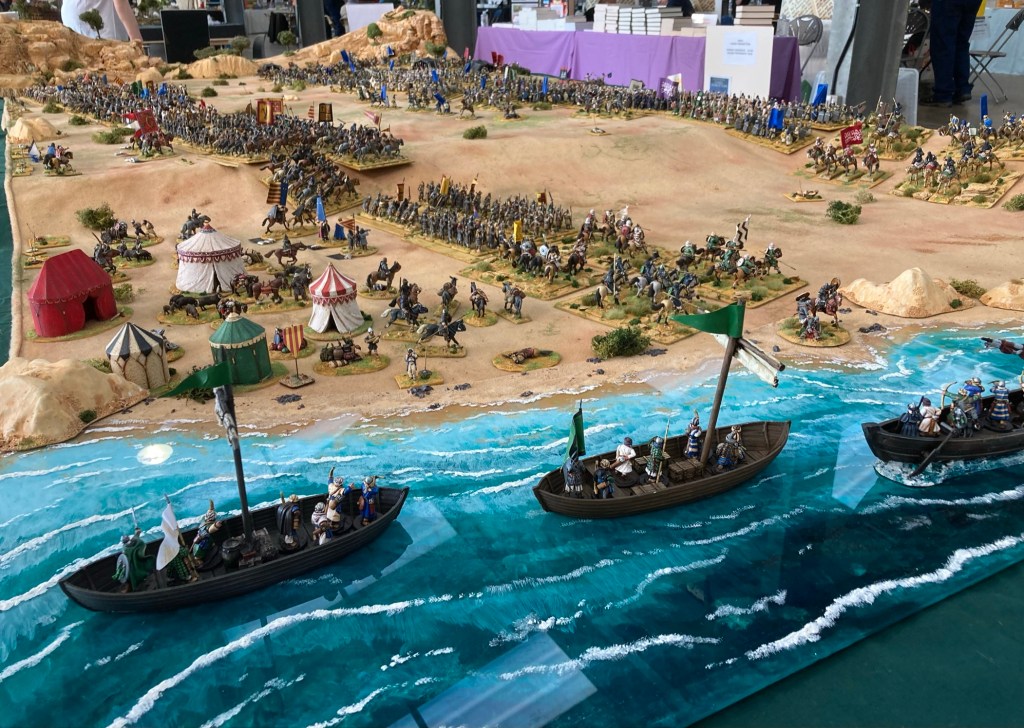
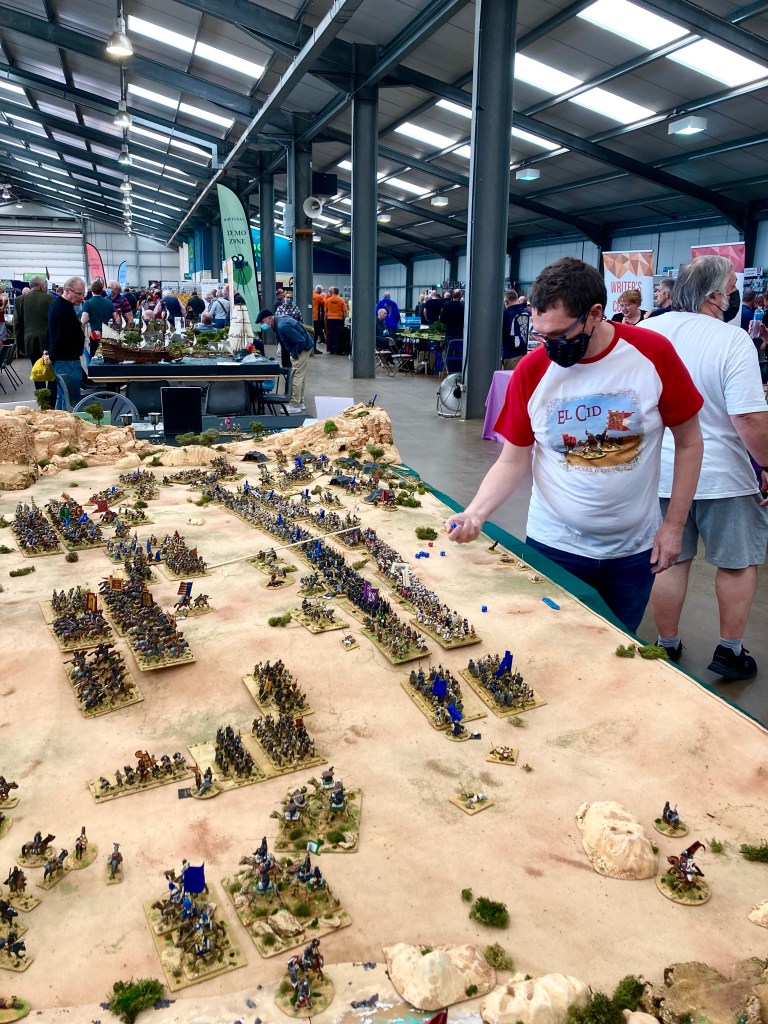
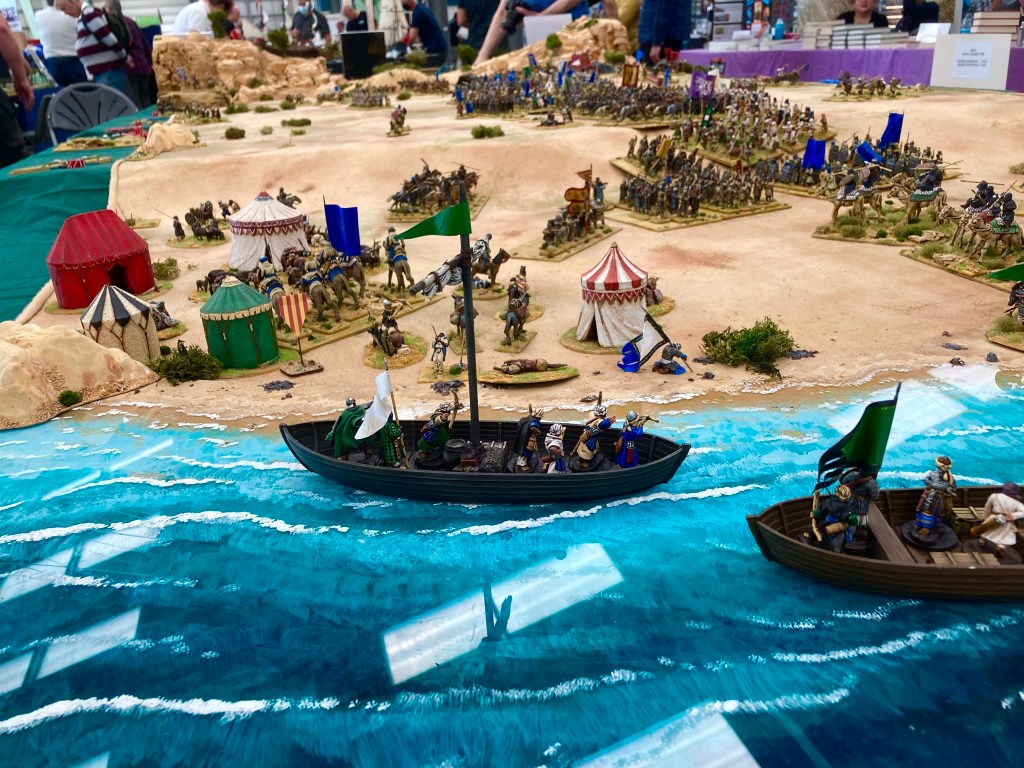
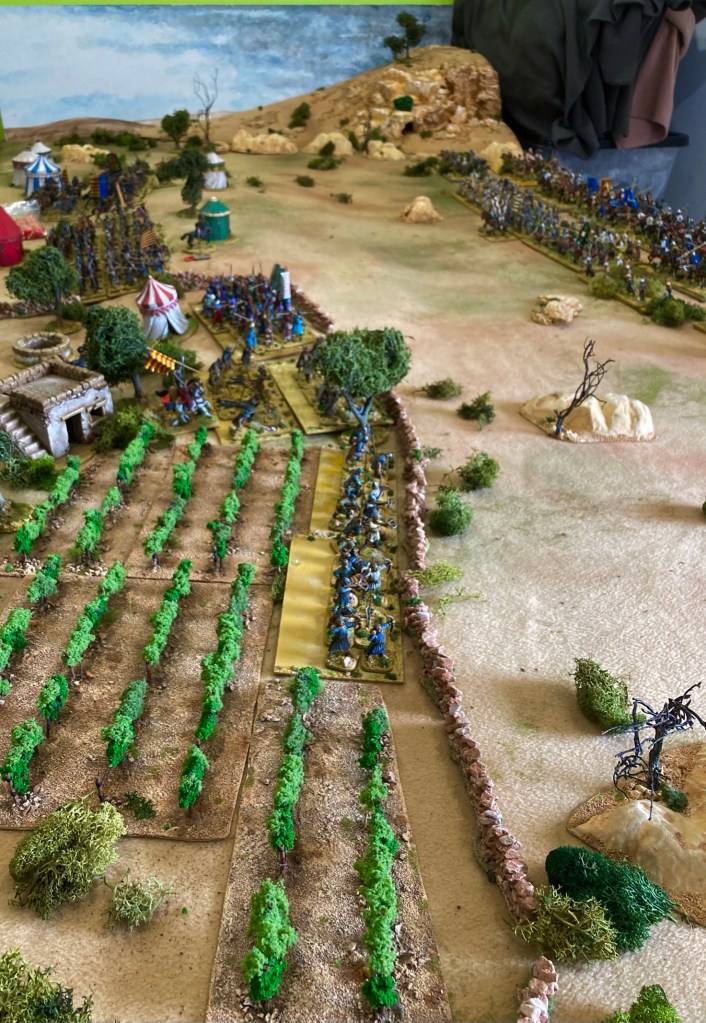
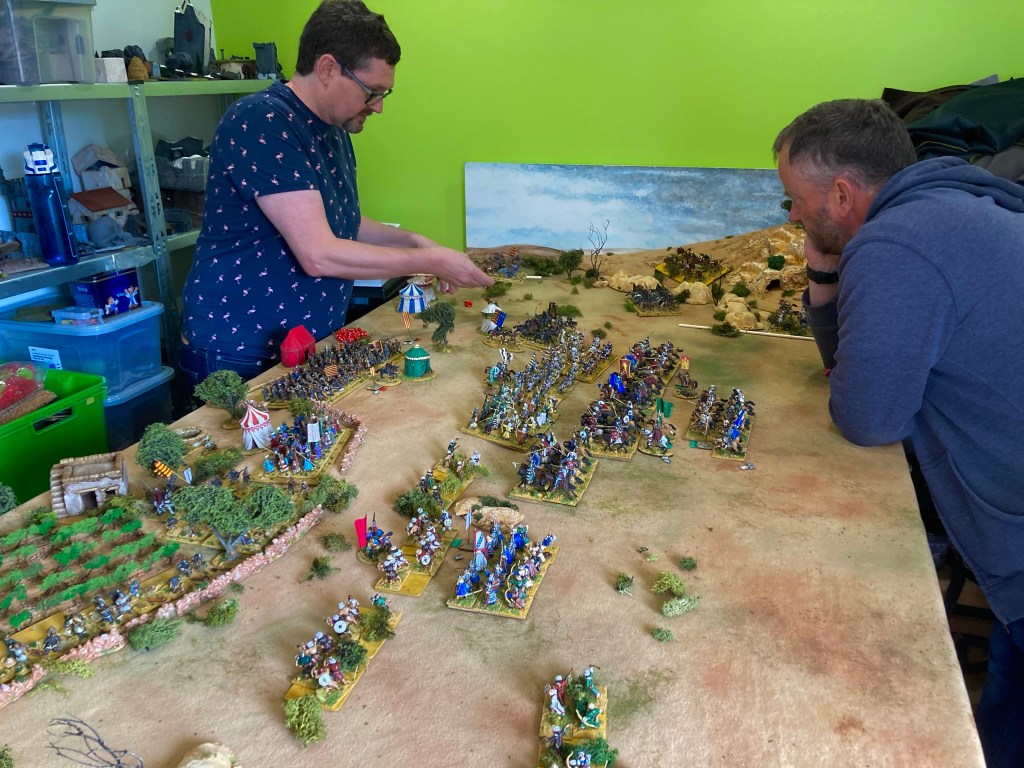
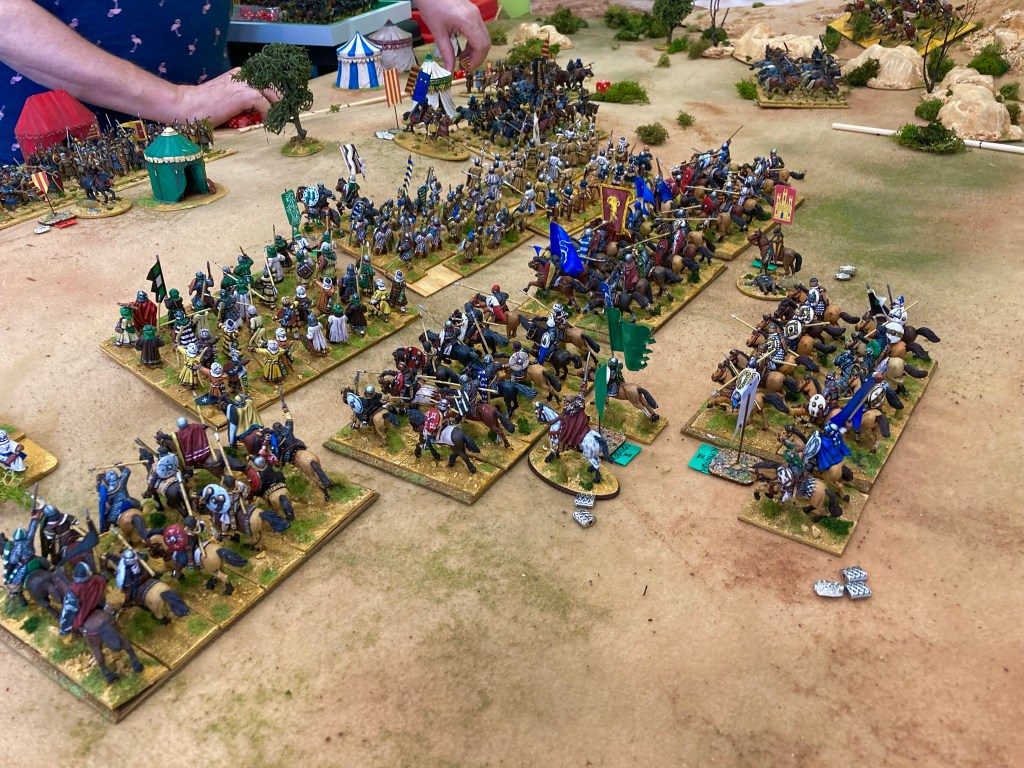
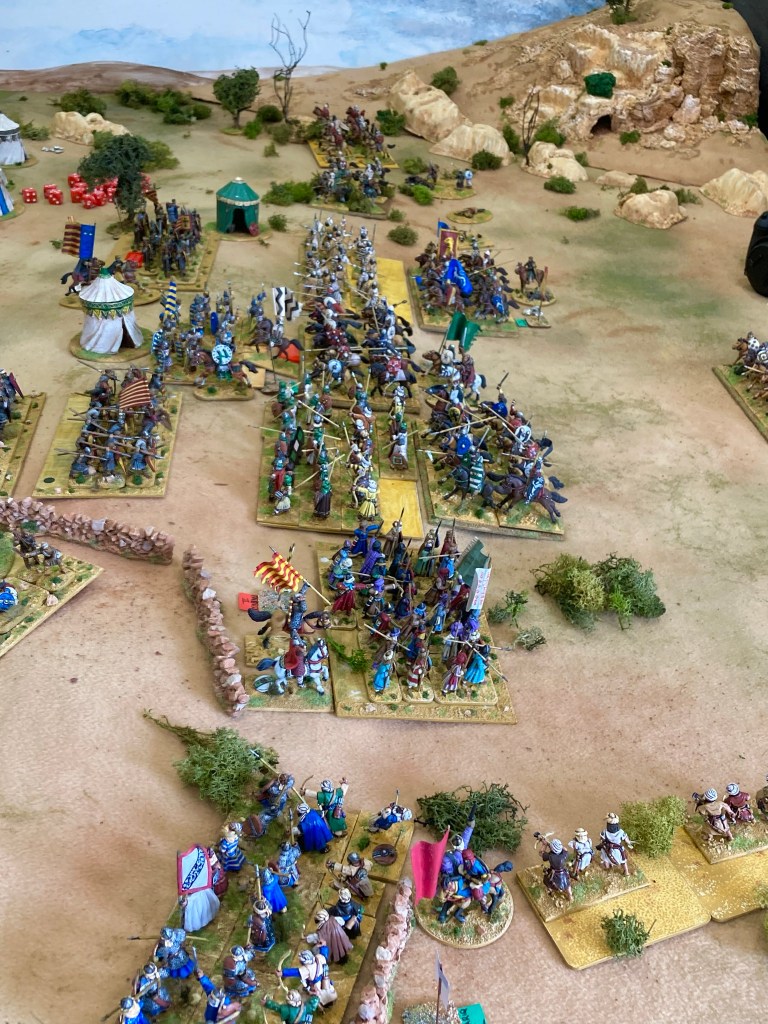
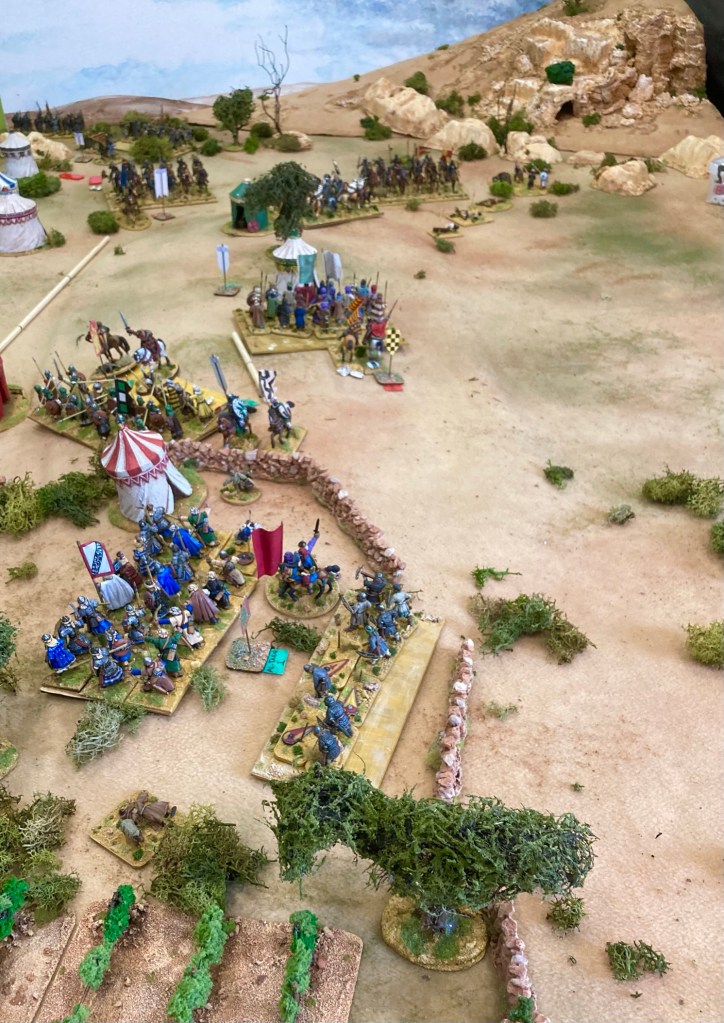
Our reimagined Battle of Graus layout. The town of Graus is off to the left, flanked by orchards and vineyards. The Aragonese camp is on the hill with three tents which were the objectives for the game. The army of Zaragoza and Castile is entering from the right.

Armies were drawn up involving five heroes a side, obviously including Rodrigo Diaz at the side of Sancho of Castile. As this was near the start of his career, I didn’t make him too powerful, but added in several traits to make him dangerous in single combat (he had a reputation for this early in his career) and an inspiring leader of men. The Christian knights were the toughest units on the battlefield although I made sure to back them up with plenty of lighter cavalry.

Having lugged our metal armies out of storage (after a few years of playing with plastics, a box of metal 28mm cavalry is a full-on wargamer workout) we sorted the following forces out for the game. Although all my Midgard games to date have been played with units on a 12cm frontage, we mostly had pre-existing 16cm movement trays for our El Cid collections (based for WAB), so we used bigger units than usual. Midgard is measured in ‘Spear Throws’ (the width of a base) so that meant we also increased our basic measurement to 16cm for the game.

ZARAGOZA/ CASTILE:

al-Muqtadir, Emir of Zaragoza (army general)

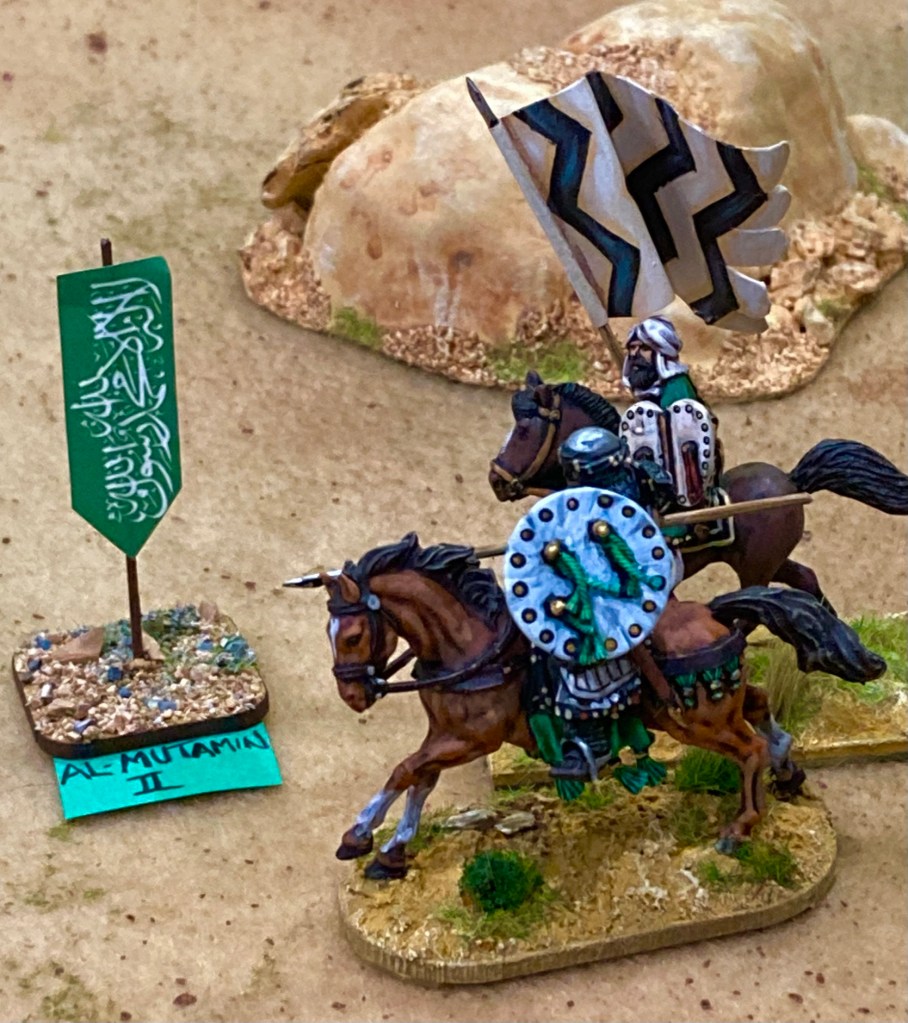
al-Mutamin, Prince of Zaragoza

Sancho ‘the Strong’, Prince of Castile

Rodrigo Diaz de Vivar, Alferez to Sancho of Castile

al-Tariq, Captain of al-Muqtadir’s guard*

2 mixed spear/ bow units

1 spear unit

1 household caballeros hidalgos (knights)

3 units of caballeros

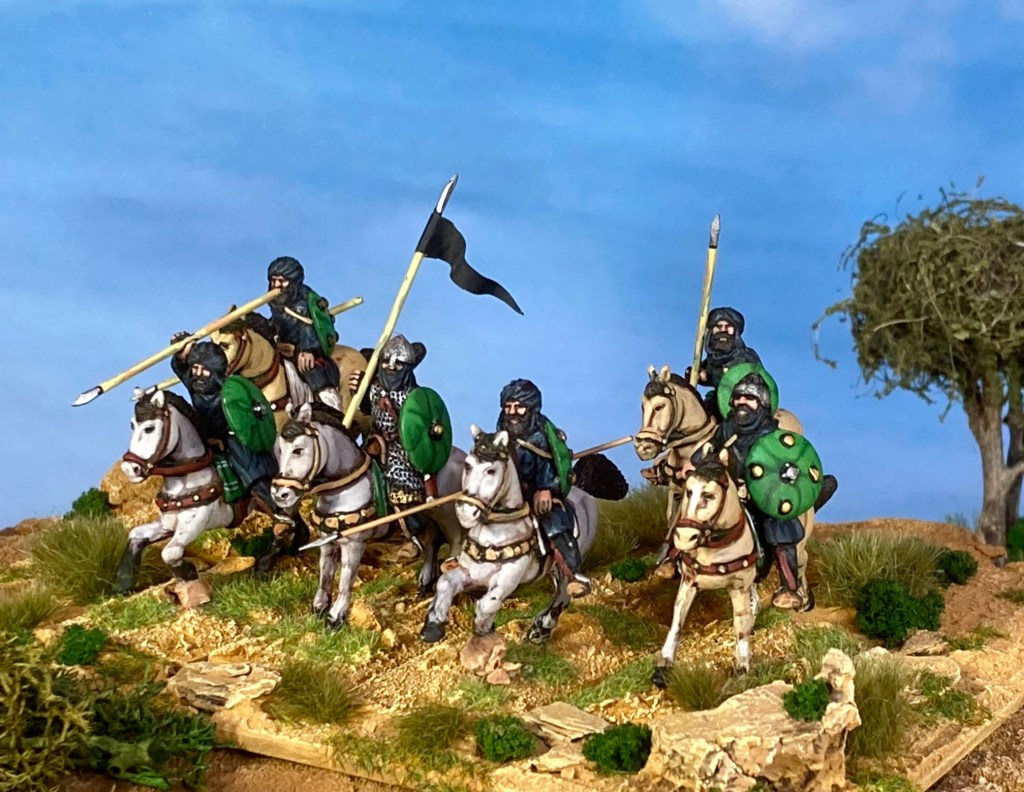
1 Andalusian heavy cavalry

2 jinetes

4 skirmishers with bows and slings

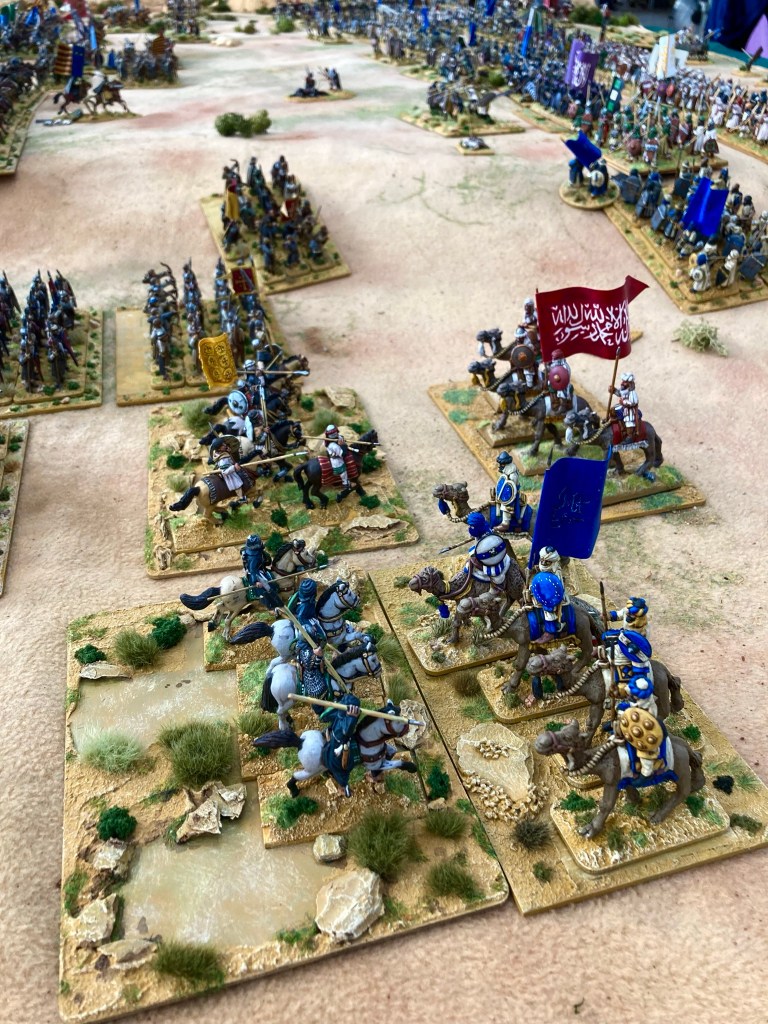
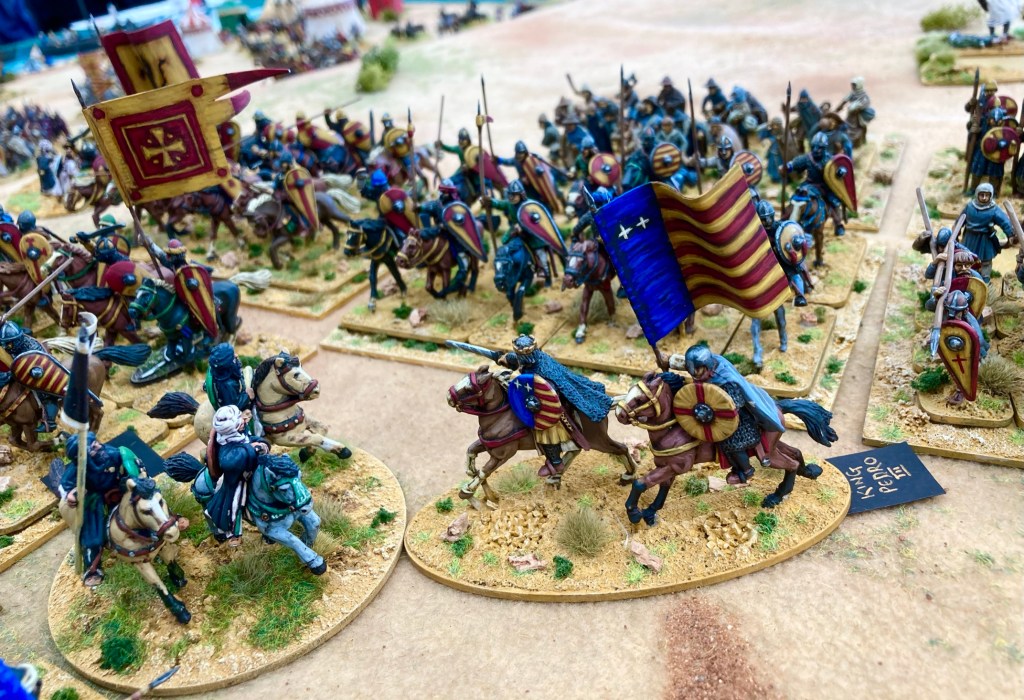
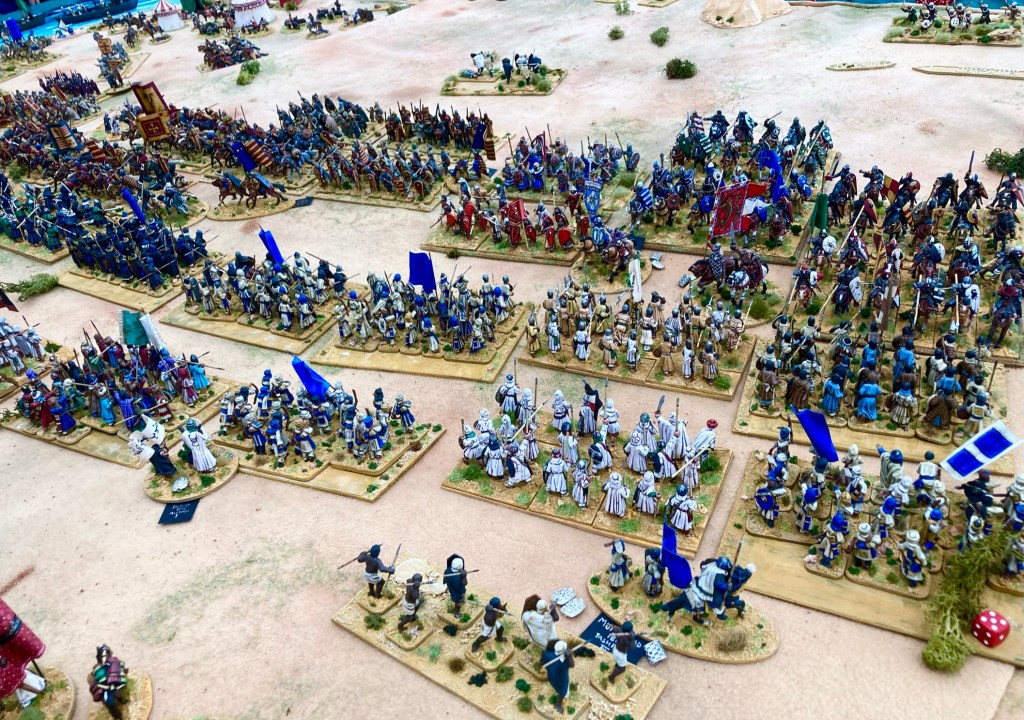
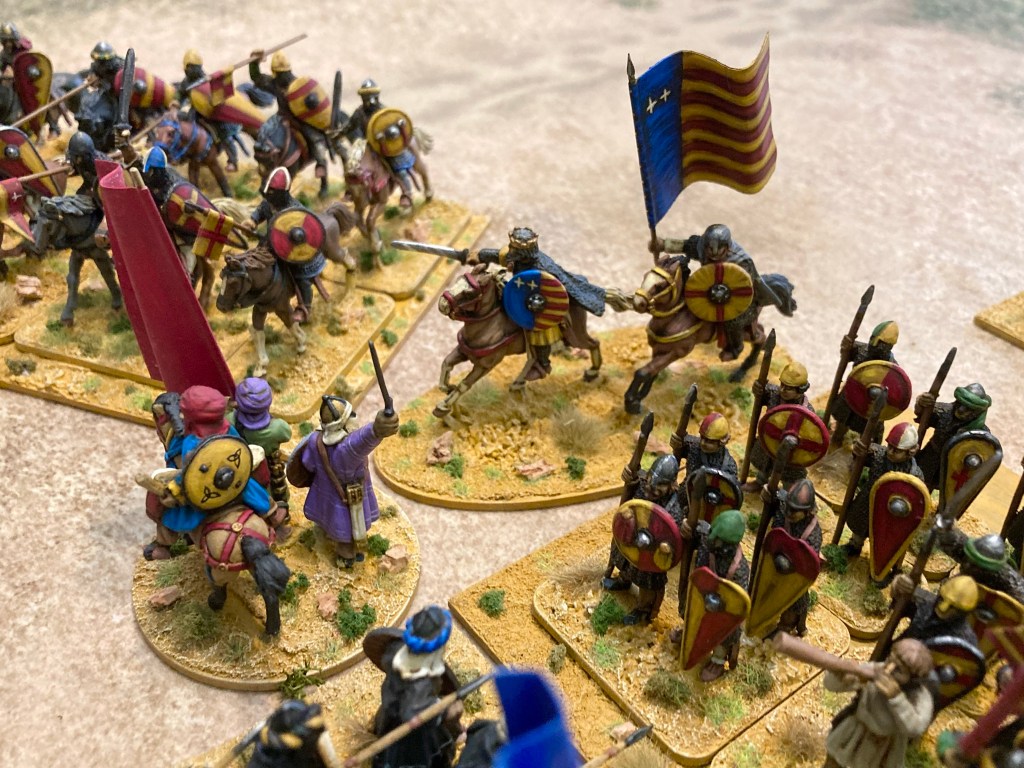
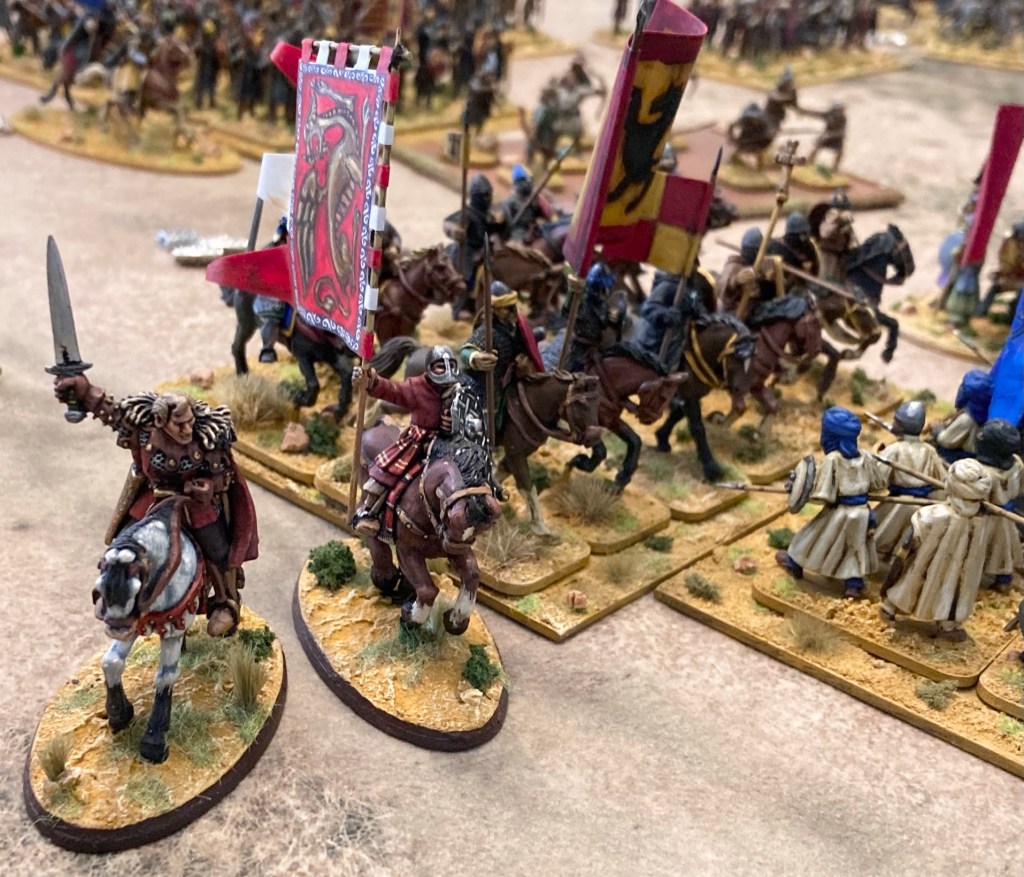
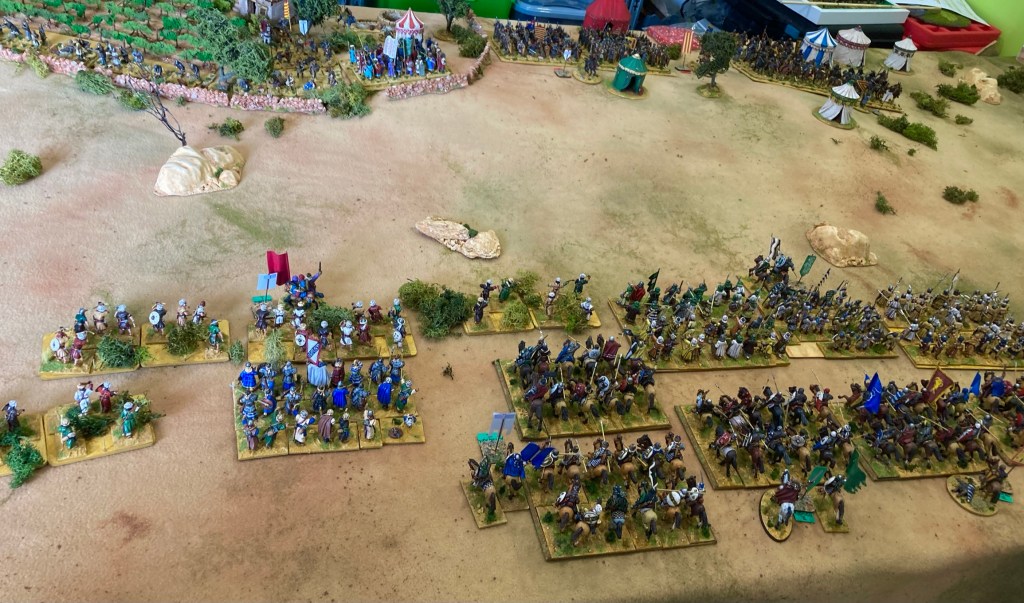
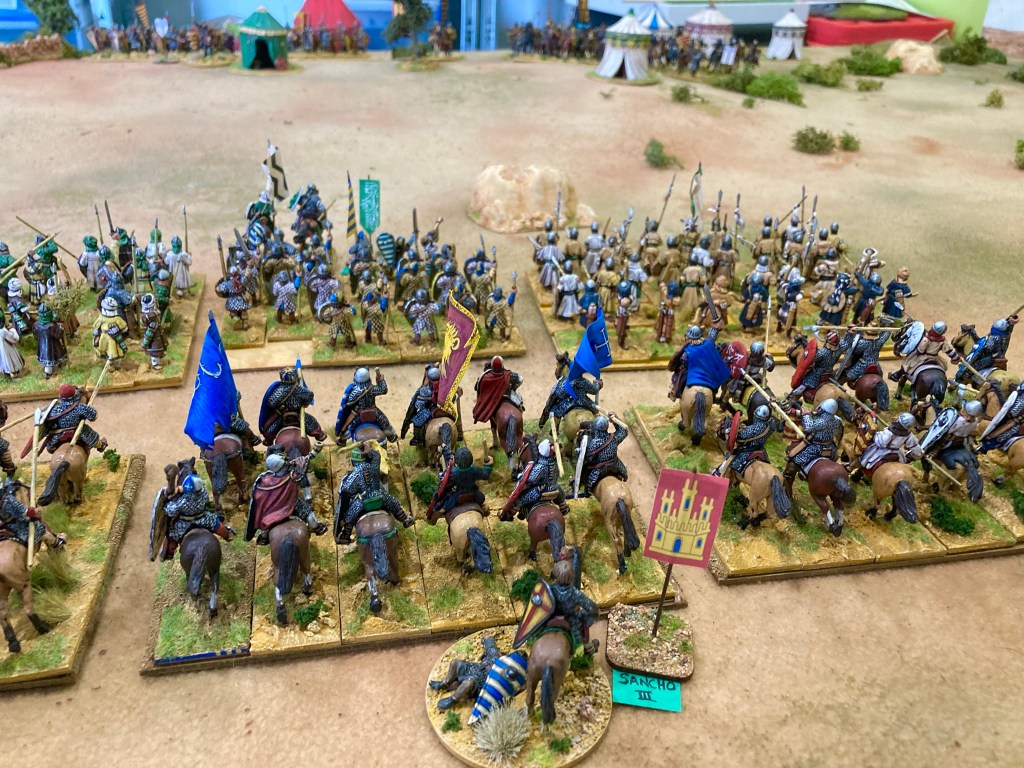
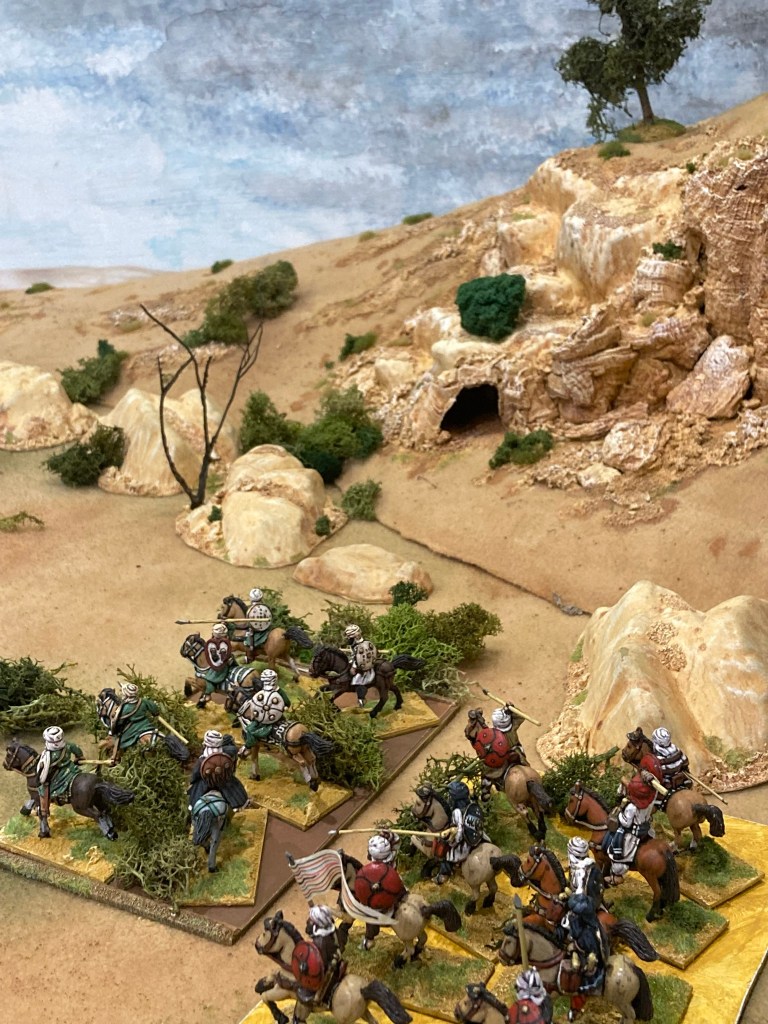
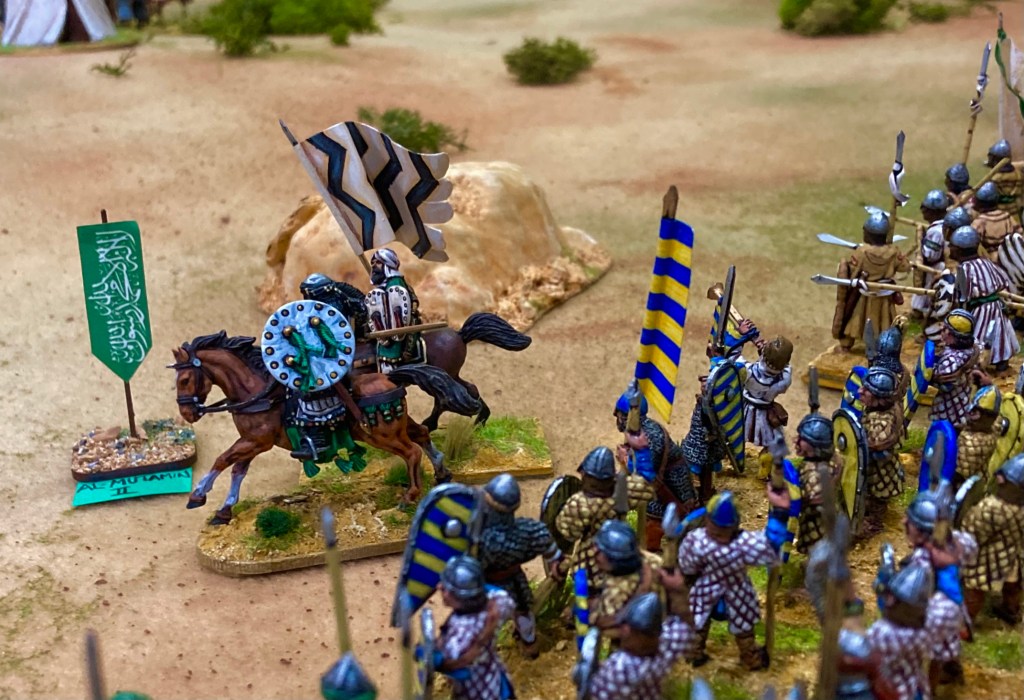
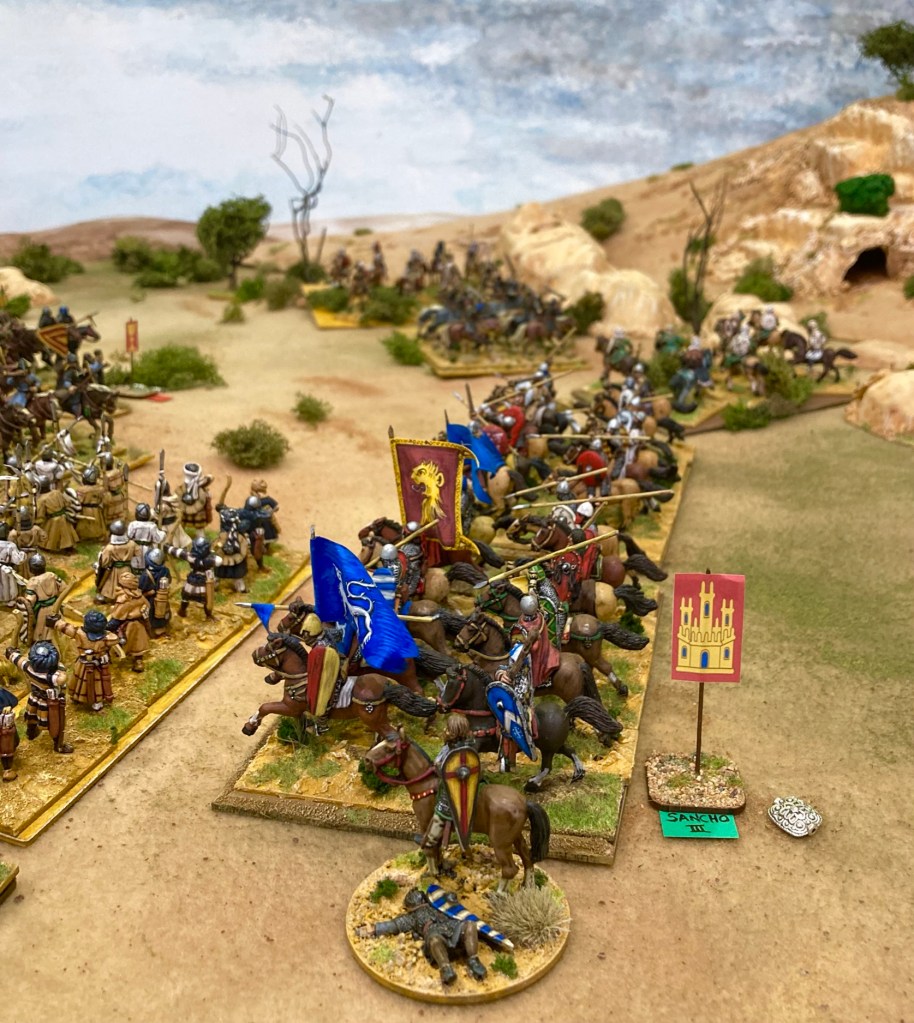
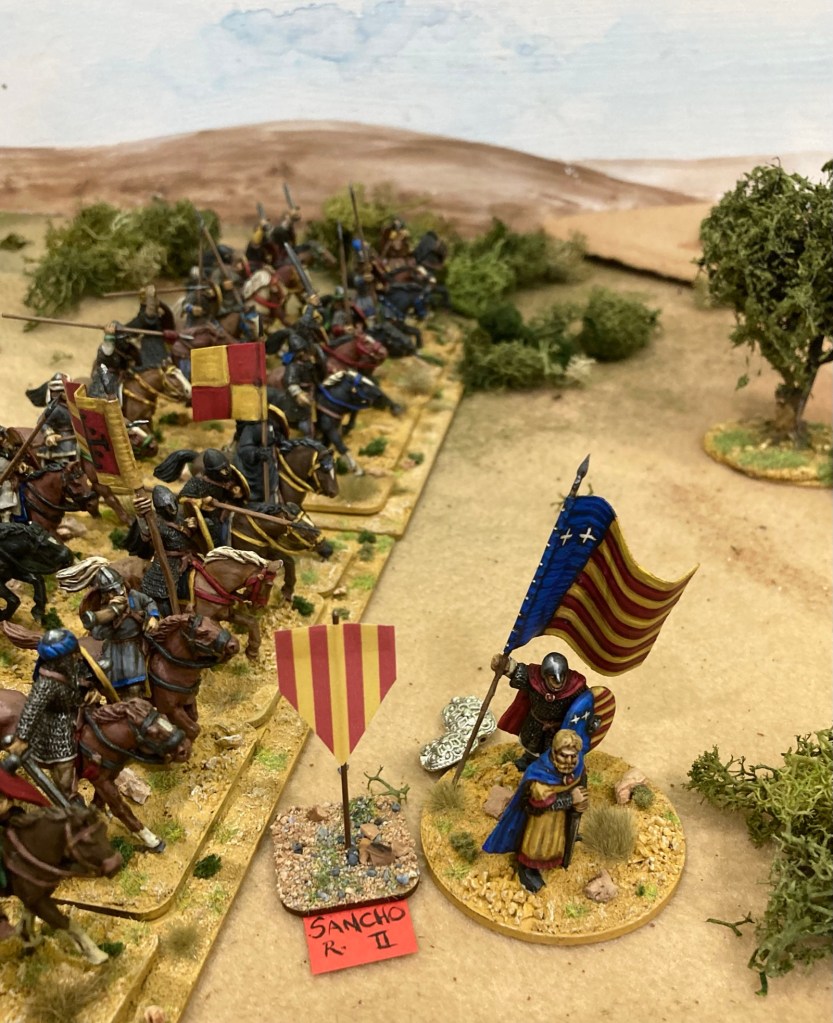
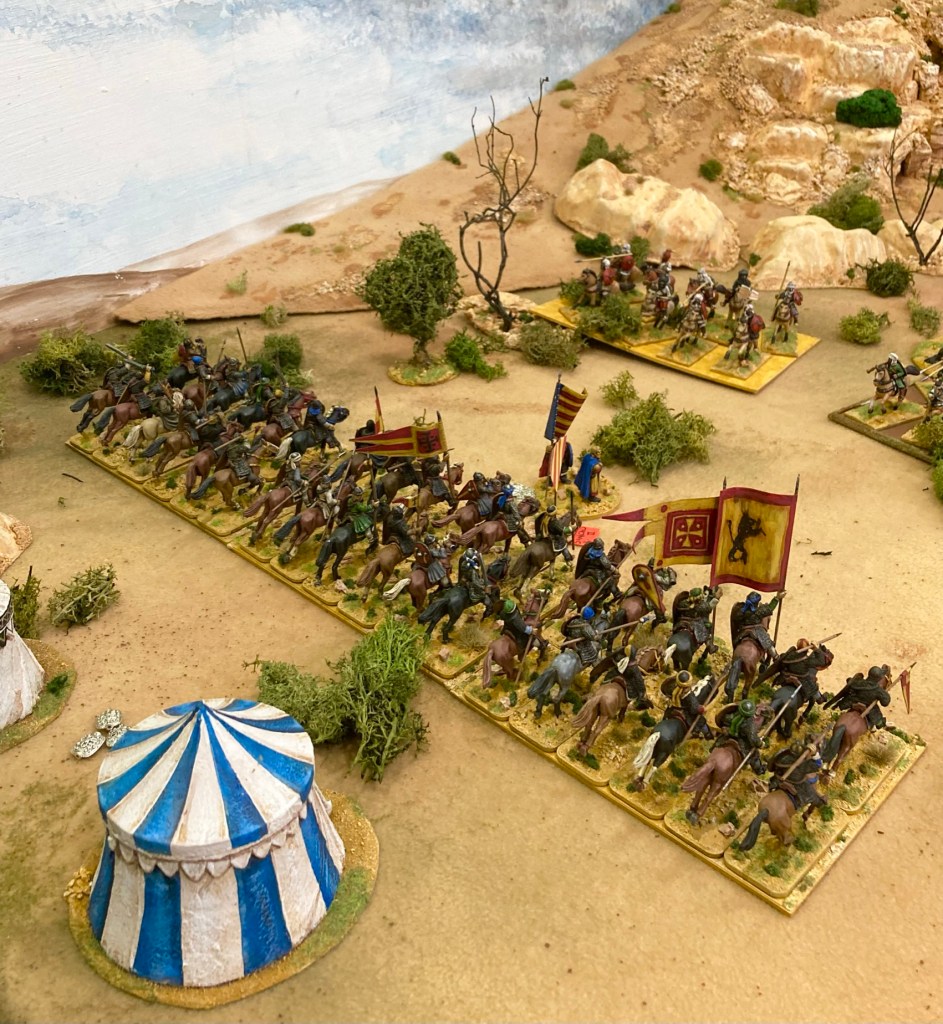
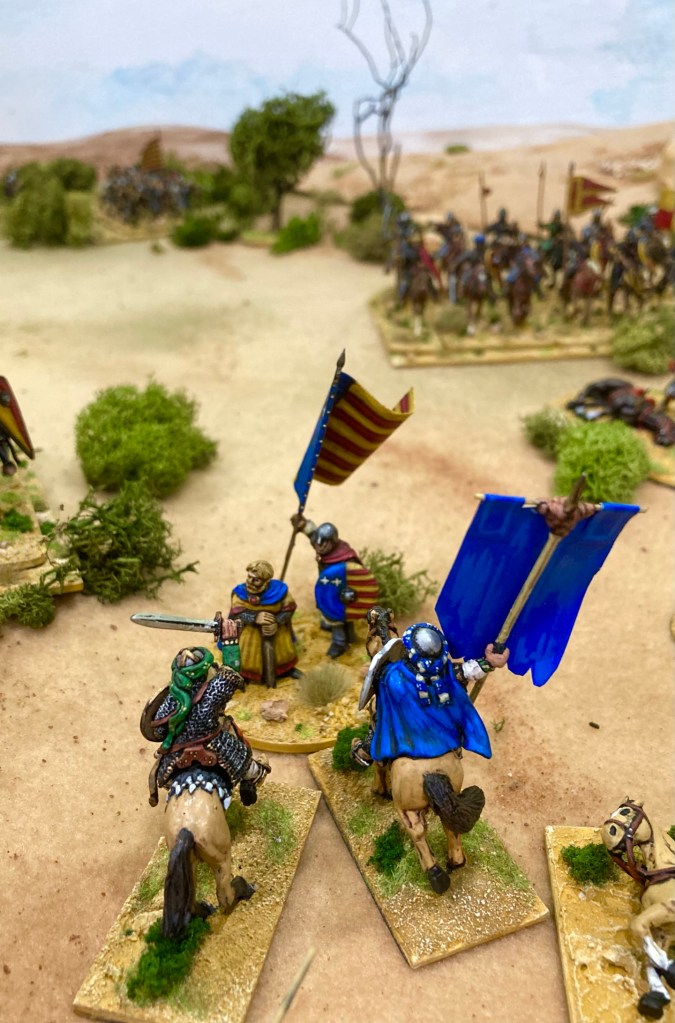
The Zaragozans/ Castilians deploy facing the Aragonese camp. Commanders are marked with named banners – the Emir of Zaragoza is centre with Rodrigo Diaz and Sancho of Castile to his right.

ARAGON:

King Ramiro I of Aragon

Sancho Ramirez, Prince of Aragon [started off-table with 1 x household knights and 2 x caballeros]

Fabien del Urgel*

Garcia de Pamplona*

Pedro Alvarez*

(*these commanders were invented for the scenario)

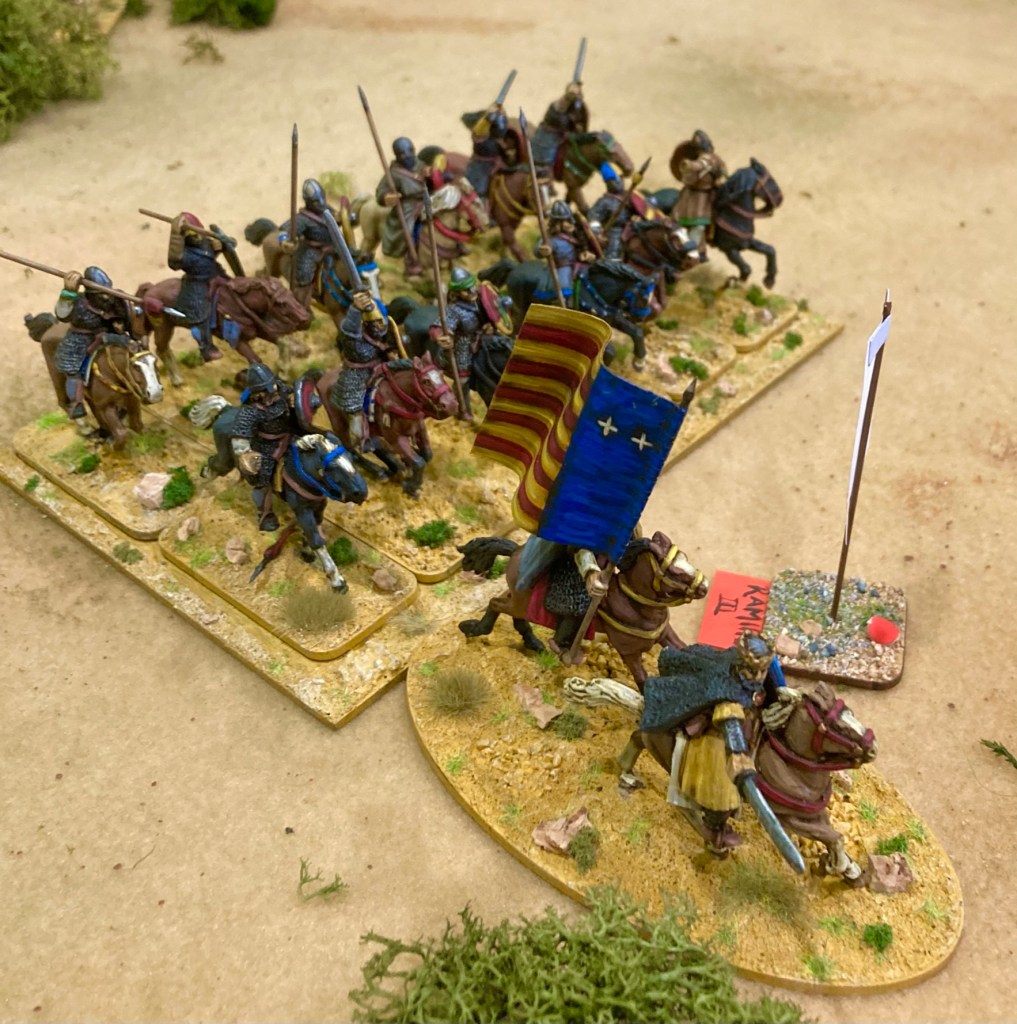
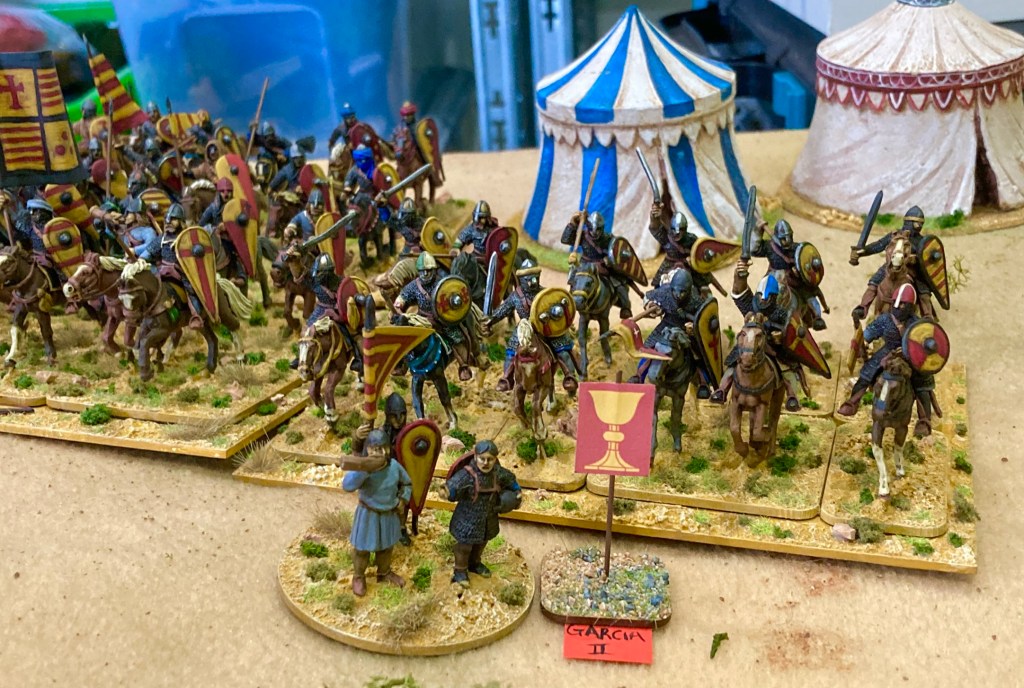
King Ramiro of Aragon and some of his caballeros, later in the battle (the red marker shows his wound suffered in the last hour of the battle). Some of Scrivs’ superbly-painted collection – command stand by Crusader Minis, caballeros from the Perry Miniatures First Crusade range.

2 household knights – caballeros hidalgos

4 caballeros

4 spearmen

4 mixed spear/ bow units

4 skirmishers with bows and slings

We were playing a version of my ‘Take The High Ground’ scenario for Midgard, whereby a force (the Aragonese in this case) has to hold a strategic hill against superior numbers (Zaragoza and Castile) until reinforcements arrive. Reputation (the measure of victory or defeat in Midgard) could be earned by holding on to the strategic salient points on the hill – marked by three tents – from Turn 3 onwards. Prince Sancho Ramirez of Aragon would arrive in Turn 4 with his knights, but at a randomised location on the Aragonese side of the board. As it turned out, these two elements gave a nail-biting conclusion to the game.

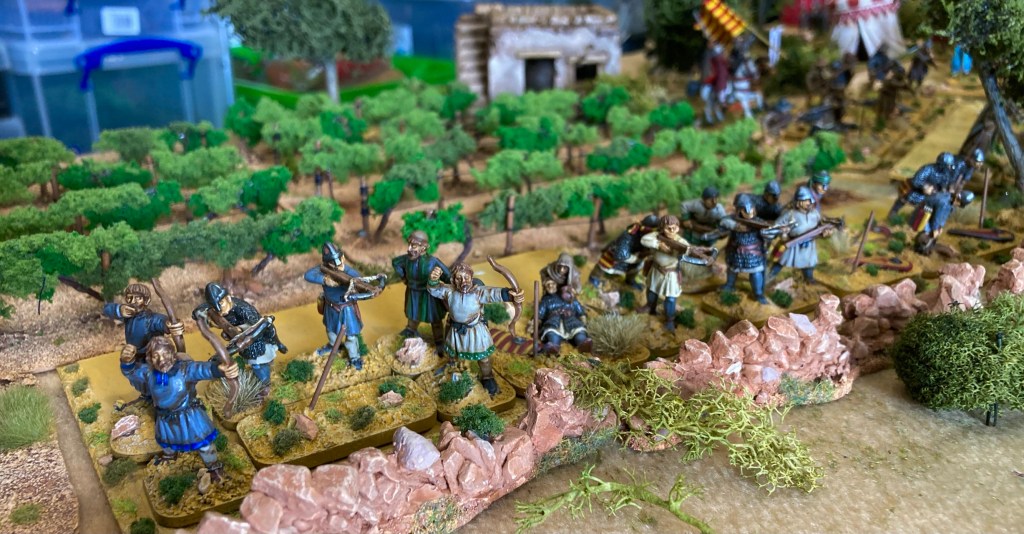
Aragonese archers and crossbowmen hold the vineyard against the Zaragozans. (Perry Miniatures painted by Scrivs). In the background can be seen a red and white tent, one of the objectives for the game.

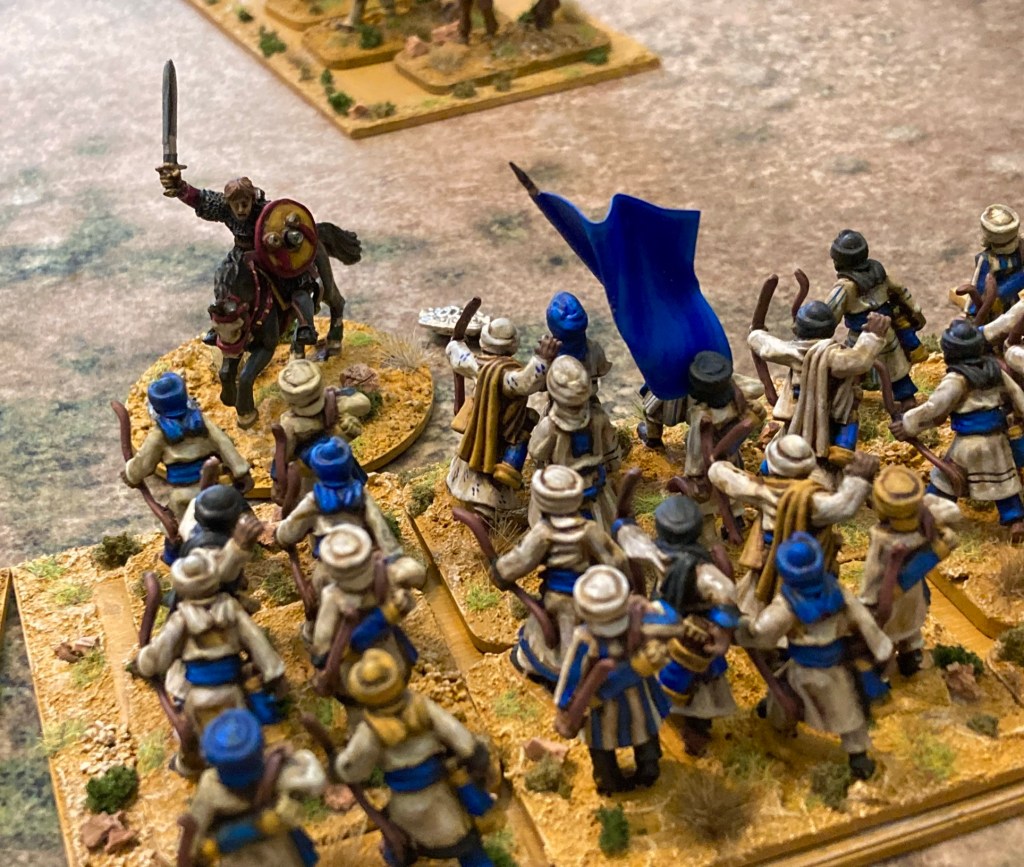
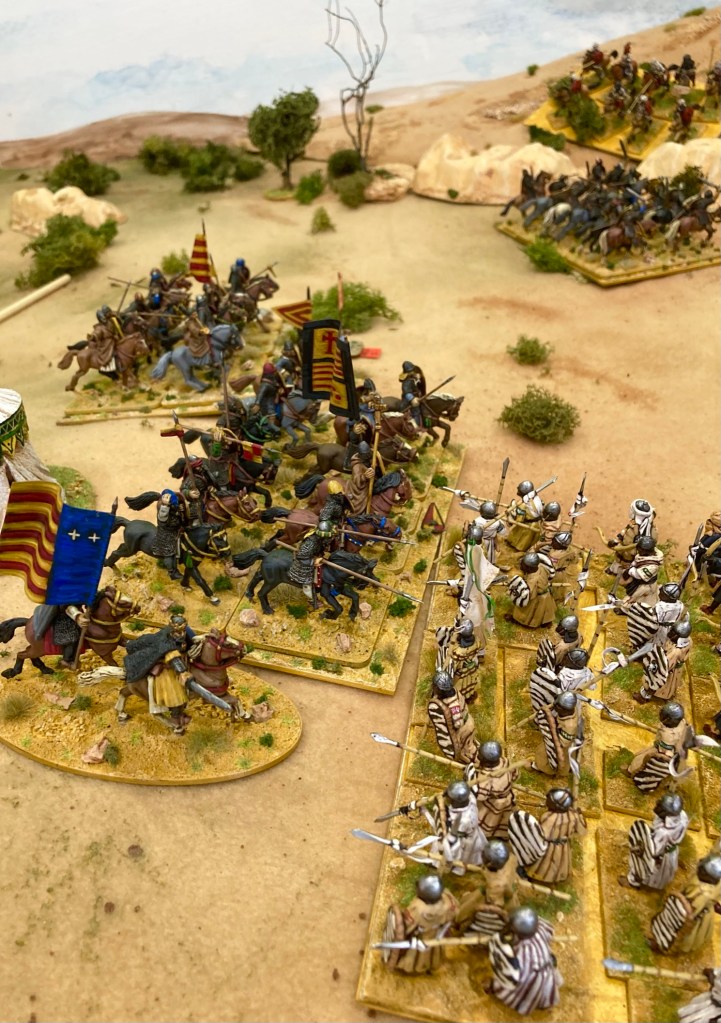
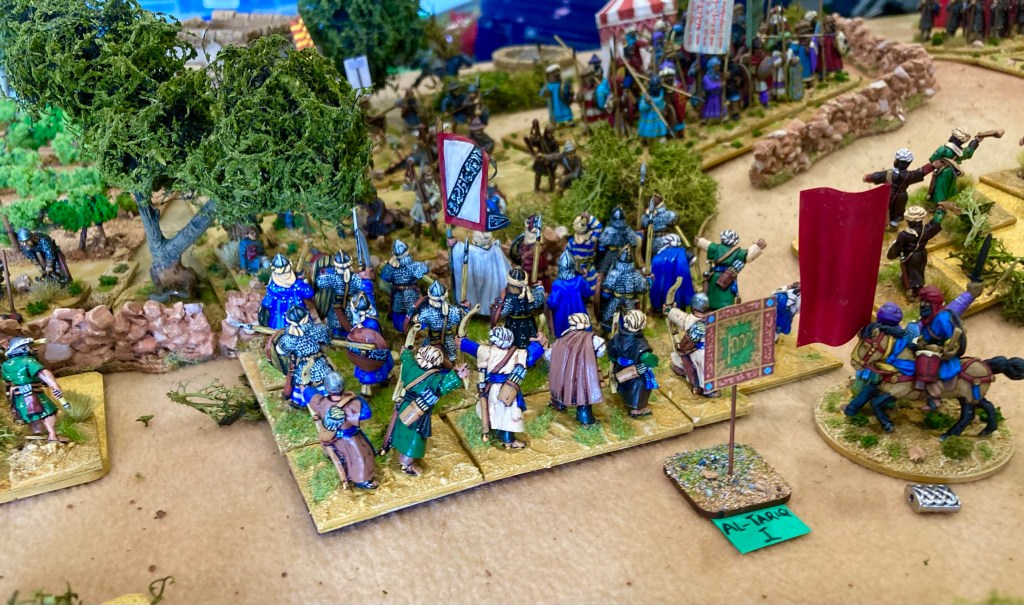
Tom WD and I took command of the Zaragoza/ Castile force and, predictably, ‘razzed them up the middle’ (our default tactic). In this scenario, it’s critical to get to the hill and contest it while the attacker has the advantage of numbers. Wary of archery, we opted to send al-Mutamin up front with the infantry while the Castilians formed the second wave with the more vulnerable caballeros. I’d chosen to have one end of the hill in the vineyard/ orchards to test out the rough terrain rules, which actually worked a treat (much to my frustration!) Al-Tariq, a low-level commander of the Zaragozans, was tasked with breaking through the Aragonese skirmishers, which he did before being repeatedly repulsed!

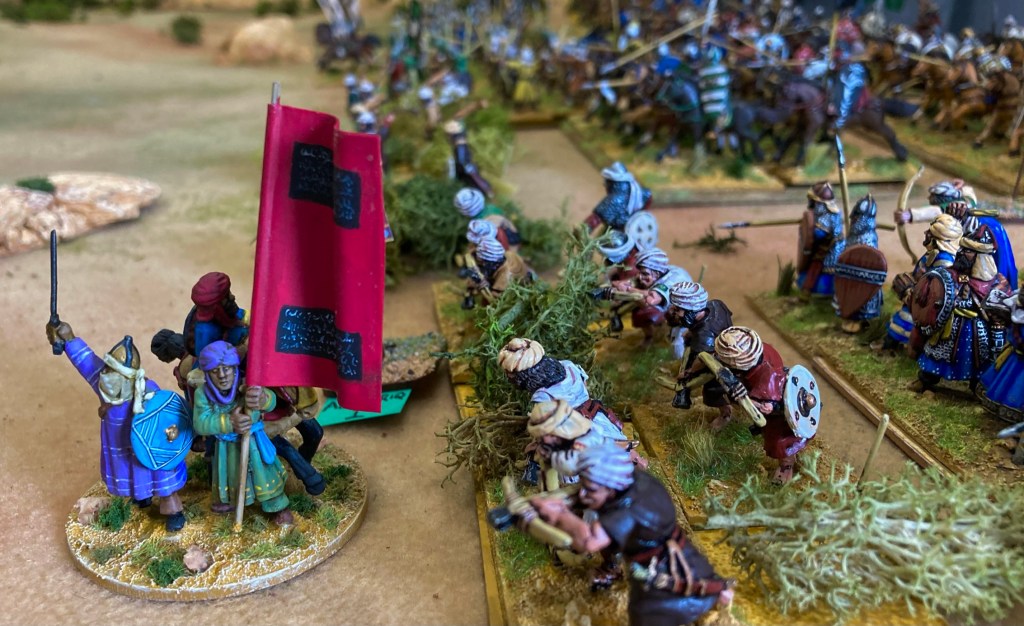
Al-Tariq of Zaragoza sets out on his exhausting task to break into the vineyard!
Fabien of Urgell organises the defence of the vineyard and orchard.

On the Aragonese left flank, Garcia of Pamplona sent a unit of knights to sort out the Zaragozan jinetes backed up against the foothills. In true jinete style, the Zaragozan light cavalry evaded the charge, then encircled the caballeros and shot them to pieces with javelins!

Zaragozan jinetes do their thing and hold the Castilian right flank
Al-Mutamin (a 3d printed Caballero Miniatures figure) takes command of some veteran Foundry spearmen at least 35 years older than him!

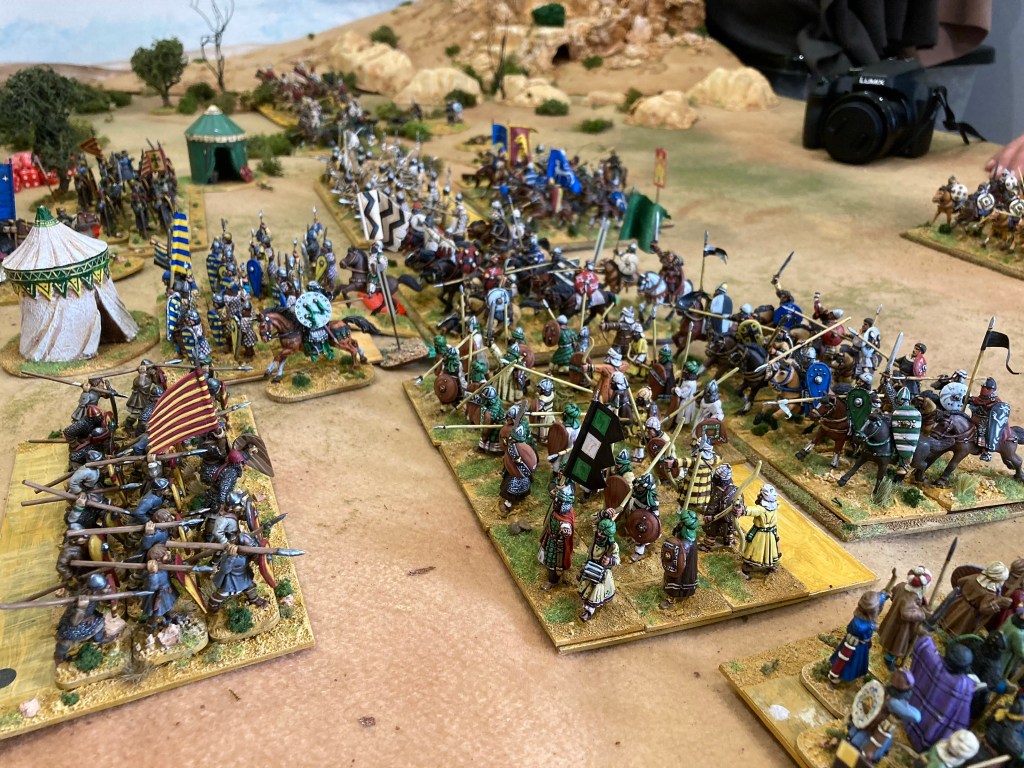
In the centre, full-on scrapping was breaking out as al-Mutamin of Zaragoza pressed his spearmen and archers forward into the Aragonese line.

Turn 3: the Zaragozans clear the main part of the hill, apart from King Ramiro’s Aragonese knights

Ramiro’s knights take on Zaragoza’s mercenary Sudanese spearmen; Ramiro is wounded in the fight

Al-Tariq gets driven out of the orchard for the umpteenth time. A better commander would have probably carried this off, but with his single Might Point (metal token on the right), al-Tariq’s leadership is limited.

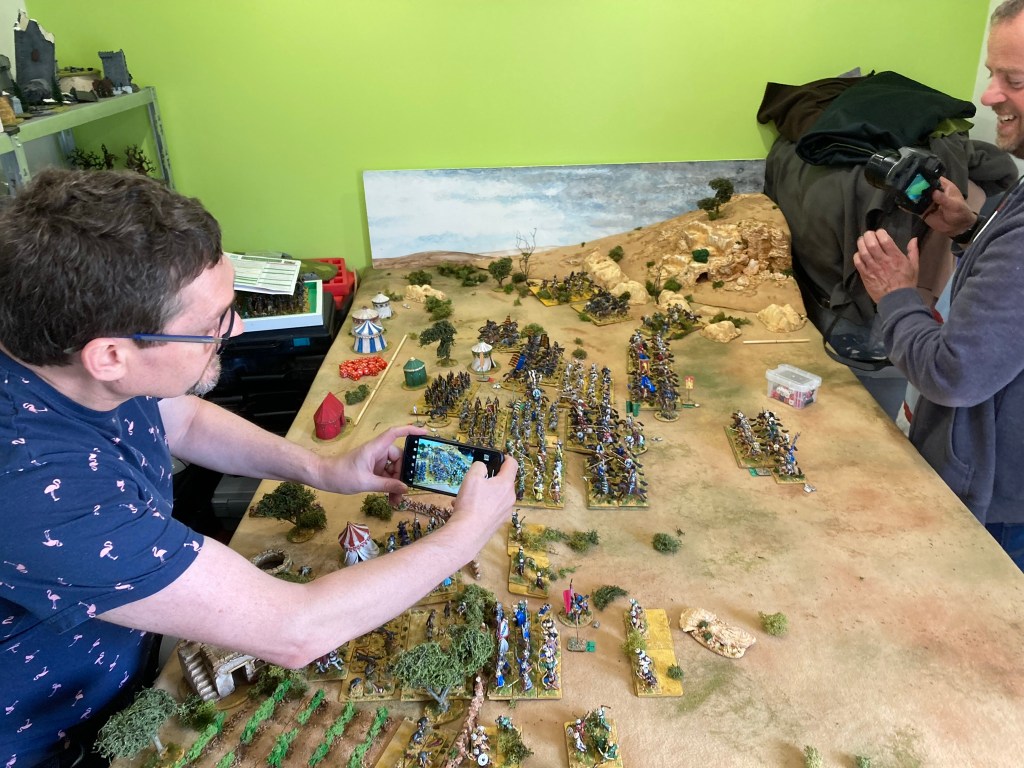
The obligatory ‘photo phase’!

Sancho of Castile ready for action in the second line. At the top, a unit of Aragonese knights can be seen being pincered between two units of Zaragozan jinetes!

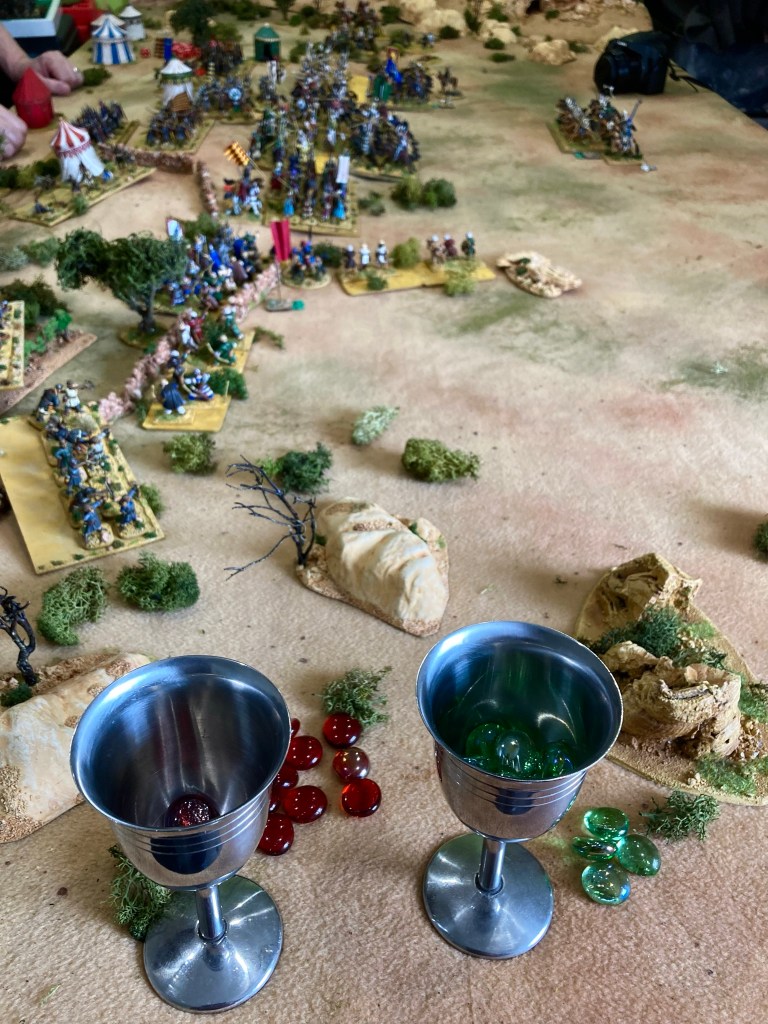
The game was properly teetering at this point, as the Aragonese goblet of Reputation dropped to zero during Turn 3. However, hanging on to two of the three objectives put some Reputation back in the pot to stabilise their losses. Could they hold on?

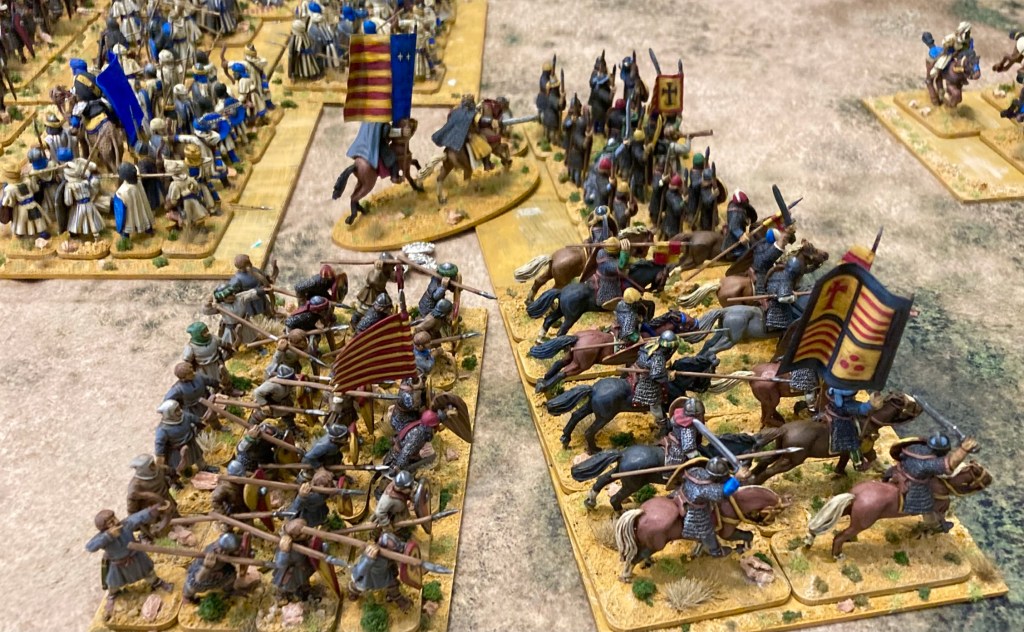
Reputation goblets in Turn 3 – Aragon in red and Castile/ Zaragoza in green. The Aragonese are struggling here but swung back soon after

Turn 4: Sancho Ramirez arrives from Graus with the reinforcements!

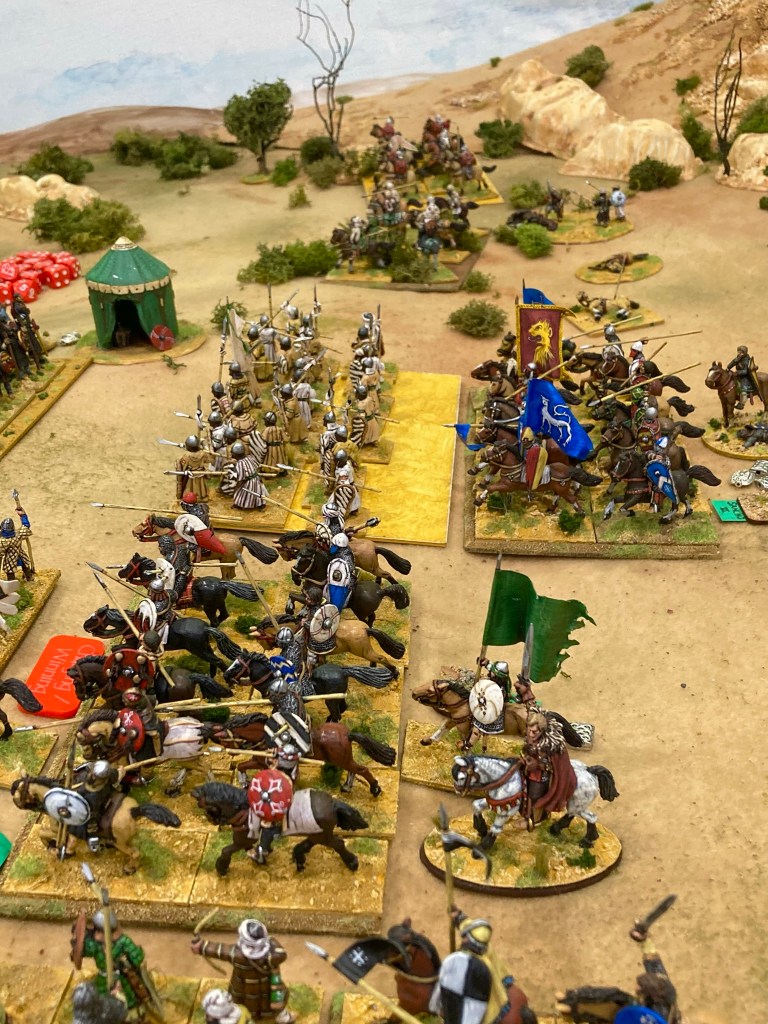
At the start of turn 4, Sancho Ramirez arrived with the Aragonese reinforcements. There was a tense moment as Scrivs diced to see where they would arrive and they turned up on the Aragonese left flank – at the top of the table. The Zaragozan jinetes – placed there by Tom to counter that exact possibility – went into combat, fighting a rearguard action to delay the arrival of a wave of angry tooled-up caballeros. They did well, but both units were broken by turn 6.

Sancho Ramirez’s knights charge forwards to clear the jinetes.

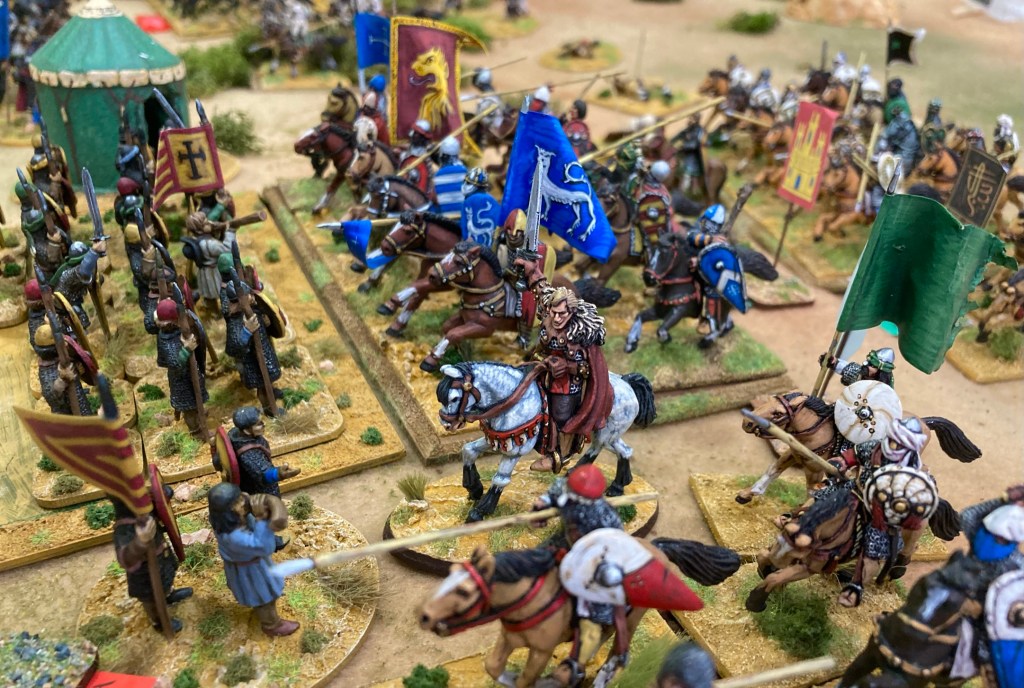
Rodrigo Diaz challenges and defeats Pedro Ansurez in single combat but takes a wound in the process.

In my enthusiasm to take the orchard (and hold the tent objective within it), I’d carelessly let Fabien of Urgell jump the wall and bring a spear unit into the main battle on the left flank of my Castilian knights. This went badly (units being hit in the flank have a short life expectancy) and they were dispatched in short order, losing yet more Reputation – knights are worth more than regular troops, so this was a faux pas on my part!

The Aragonese jump the wall (centre) before getting a flank attack on the Castilians

Turn 6: Fabien of Urgell mounts a decisive flank attack on the Castilian knights

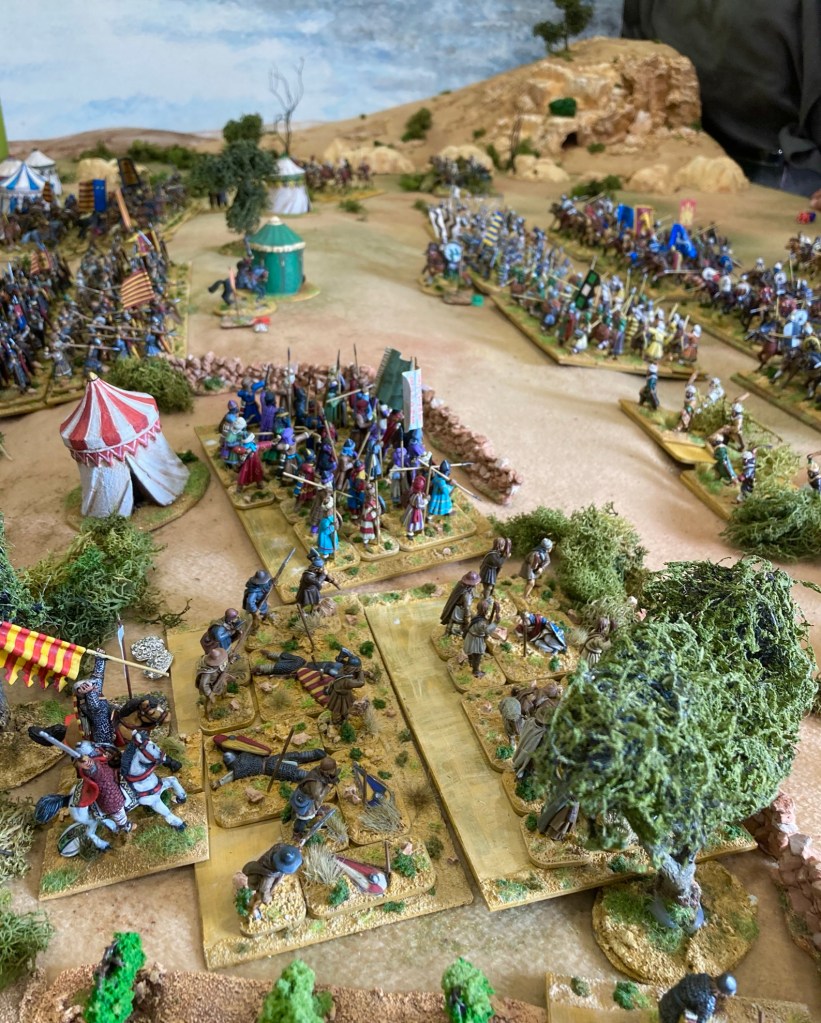
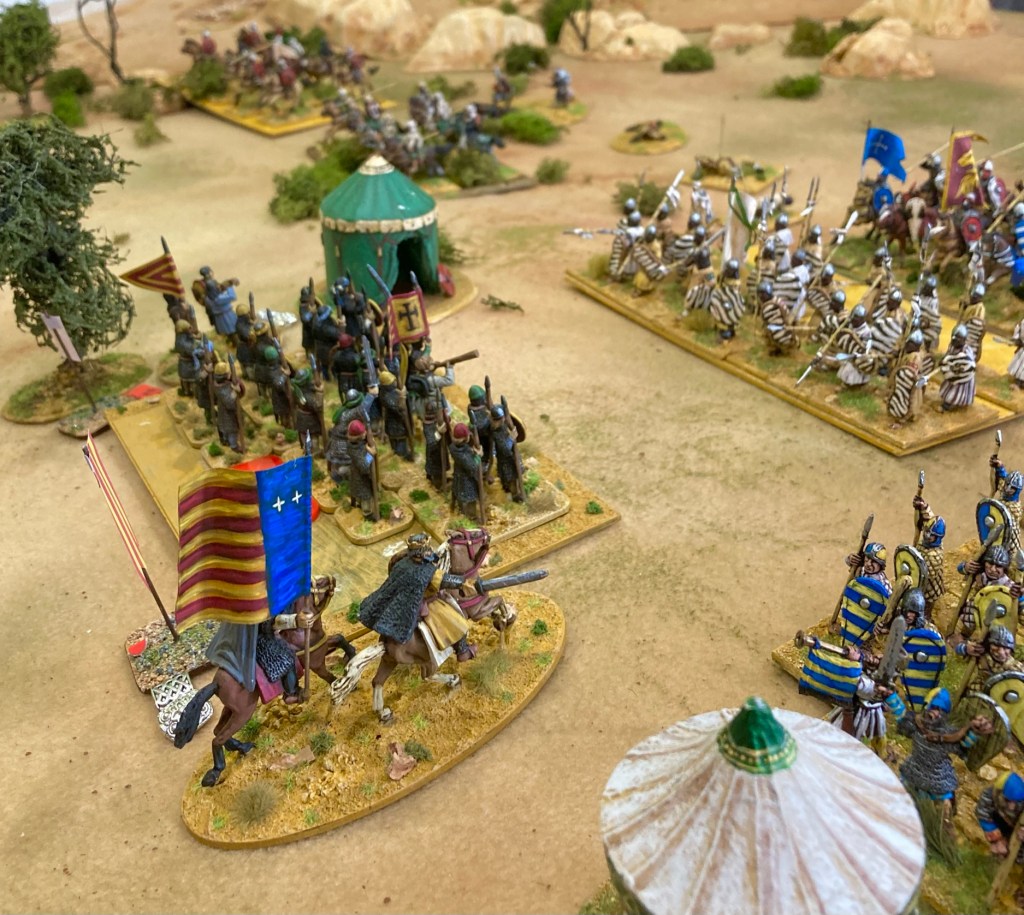
Al-Muqtadir of Zaragoza brings up his rearguard to face Sancho Ramirez of Aragon. Dead knights and horses litter the battlefield.

With the game near its end, al-Muqtadir’s guard crashed into Sancho Ramirez’s knights, and I got talked into issuing a challenge to single combat, which didn’t go as planned! Sancho Ramirez struck down the ruler of Zaragoza (four Reputation points lost in two minutes), but suffered a fatal wound himself as his knights were destroyed by the Andalusians.

Have a single combat, they said. It’ll be fun, they said.

Several other units also broke in the final turn, including the heroic Zaragozan jinetes, leaving both sides bloodied and battered. However, the loss of the Zaragozan Emir and the unit of Castilian knights charged in the flank by Fabien of Urgell meant that the Aragonese had snatched a bloody win. King Ramiro was wounded and his son killed, but he held the field and the town of Graus. Al-Mutamin (now the Emir of Zaragoza), Sancho of Castile and Rodrigo Diaz would have to retreat with their bloodied forces. Victory to Aragon!

The end of the game – a bloody victory to Aragon

Well, this was a corking game, and, I think, a successful first venture into ‘El Cidgard’. The single combat rules gave the right level of heroism for this battle and the Reputation mechanic meant that game swung from an impending Aragonese defeat in Turn 3 to a victory in Turn 6. I was also pleased with the rough terrain rules – despite the continued attacks by the Zaragozans into the orchard, the Aragonese skirmishers managed to hang on until the end of the game. There’s still a few minor tweaks to unit profiles that might happen but the game engine is doing its job.

Do I need to paint any more figures for this? Probably not – although the Caballero Minis 3d prints might see me getting a few command figures done! Do we need to play more El Cidgard? Hell, yes. It’s telling that we all had boxes of unused figures for this game and Tom’s Berber army didn’t even come out of the box.

Celtiberians

My recent Ancients gaming gave me the push to investigate the back of the painting cupboard, where I knew I had squirrelled away one of those projects of shame – 30-odd half-painted minis from 2017. On the back of my Battle of Tribola game, I’d bought some Crusader Miniatures from Nick at Northstar – some rather combative Celtiberians to add to my Iberian forces. I’d got them all undercoated and started, only to abandon them for a new enthusiasm for the Second World War. Weird!

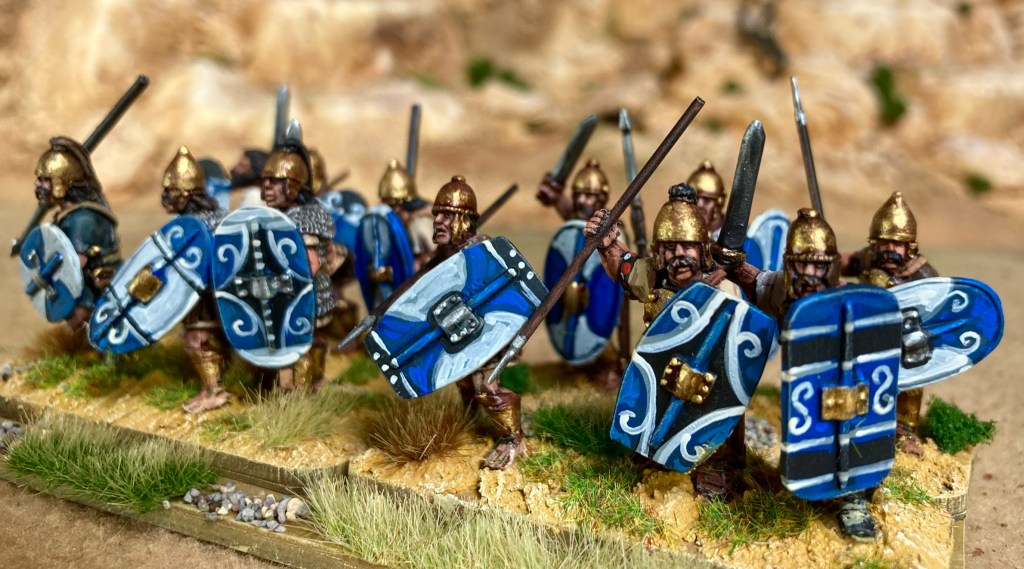
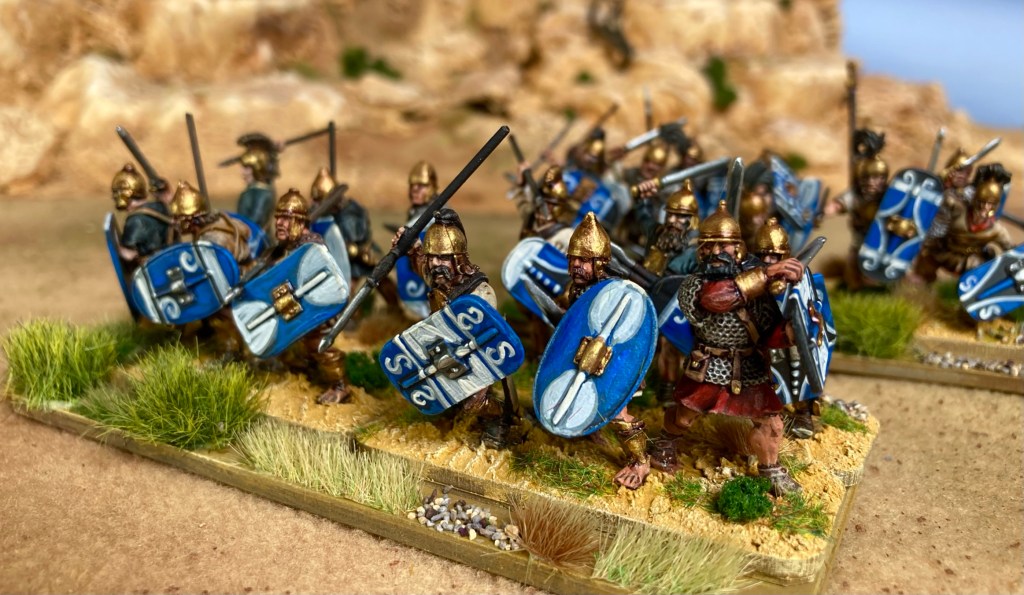
Left: Celtiberian command, all by Crusader Miniatures. The spearman on the left just reminds me of Roman sentries in Asterix, so I felt he had to get based up protecting his boss!

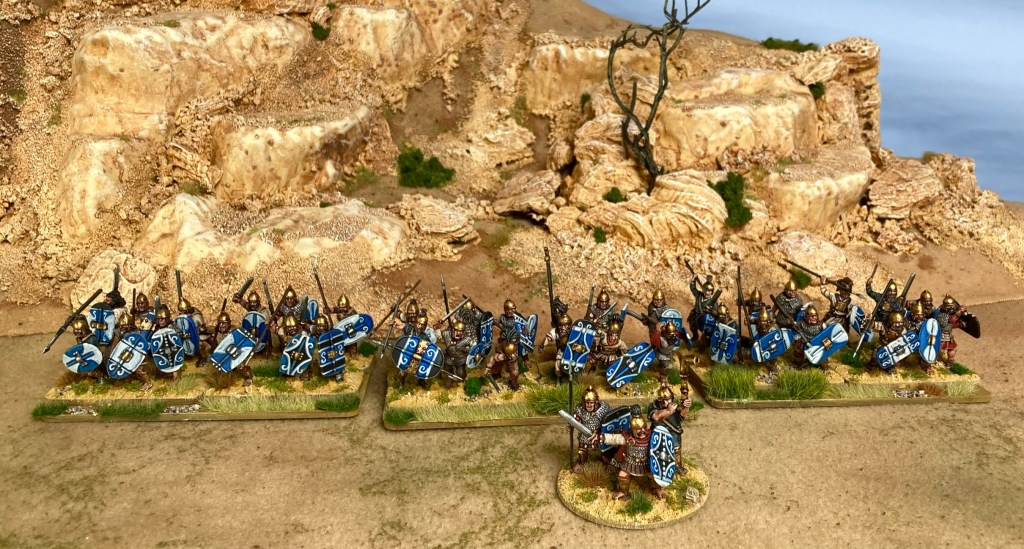
A quick count-up showed me that I needed a few extra figures to pad out the Crusader models to units of 12 (my standard collecting size at the moment), so I assembled some of the Victrix plastics that I’ve had hanging around (my original army is entirely metal). These new figures got a white Halfords spray undercoat in preparation for a quick paint job using mostly GW Contrast paints (my current go-to for speedy army painting); the older ones had been sprayed with Army Painter Fur Brown, which made a good base for the flesh and bronze which is such a large component of these models.

Charge! Three 12-figure units plus the war chief. This will be a contingent in my battle games, or will probably serve as a faction for Saga with a few slingers added in.
I love mixing up different models in my forces (and can’t actually help myself, to be honest). L-R: Crusader with a GB spear, Crusader, Gripping Beast Pict with a Warlord Games Celt head swap; Victrix with a Warlord Games head; Crusader. The shields are a random Celtic selection from my bits box.

Painting was a pretty straightforward affair, just a bit repetitive for this number of models. The brown undercoated models had a basecoat, a wash of Windsor and Newton Nut Brown ink, and then a single highlight. The new white undercoated plastics were faster, with a single layer of GW Contrast (the Guilliman Flesh paint really speeds up my work on skin areas) and the odd highlight where needed.

A Victrix Celtiberian. The tunic is GW Contrast Black Templar – a really quick way of getting dark tunics painted for these tribesmen.

Although I have been known to use transfers on occasion, I really enjoy painting my own shields. The designs are based on various surviving Iberian and Celtic patterns with a bit of artistic licence – what I’m trying to do here is to create easily identifiable units for the gaming table, not an exact authentic representation. I’ve always associated blue with Celts (I think it’s the woad business) so I went with a variety of designs in blue, black and white.

Plastic warriors form the front ranks of this unit – these are Celts by Warlord Games and Iberians by Victrix.

I chop and change how I varnish models – in the past I’ve hand-varnished to avoid dulling the metal areas. This time around, I decided to spray varnish with Testors Matt Dullcote, but I left the wash and metal highlight until after varnishing. This made the metal ‘ping’ and I hope that you can see this in the pics!

The front lines – tufts on the bases and movement trays are by Gamers Grass, supplied by Northstar.
Old and new: Left – metal by Crusader , Right – plastic by Victrix

I always get asked about basing so I thought I’d pop in a photo of two of the units on and off their movement trays. While I admire the incredible diorama effects gamers like Simon Miller get on their unit bases, I need some kind of halfway house where I can play both skirmish and big battle games. I’ve therefore adopted a standard where I have a mix of individual and group bases (in this case, ones, twos and threes). The bases are 2mm round-cornered MDF from the incredible company that is Warbases – I stick a layer of 0.5mm self-adhesive magnetic sheet onto the bottom of this. To get the unit trays, I’ve again used a 2mm piece of MDF (120 x 60mm in this case). These have a layer of self-adhesive steel paper on the top, trimmed to size and then painted to match the bases; finally, another piece of magnetic sheet goes on the bottom of the tray so that it can stick straight into one of my steel paper-lined Really Useful Boxes. It feels like a lot of investment in magnets, but it speeds up my gaming no end as I can just pull a box off the the shelf and know that the figures are already on their unit trays ready for battle.

The current basing arrangement: 12 figures on magnetic bases on a steel-paper movement tray, which in turn is magnetised underneath to stick into a Really Useful Box for transport. Individual figure bases are 20 x 25mm – I’ve always found the extra depth handy to fit large 28mm figures. The overall movement tray is 120 x 60mm.

All my magnetic supplies come from the ever-helpful Trevor and Paula Holland of Magnetic Displays/ Coritani, regular friendly faces from the UK show circuit who also run a mean mail order service.

A Tale of Two Caballeros

Although I’ve resisted getting a 3d printer myself, I’ve been very aware of the explosion in STL files and Patreons, and none more so than the most recent work of Spanish-based Caballero Miniatures. Sculptor and owner Marcos has been hard at work on a project that happens to be a shared passion – the age of El Cid and Medieval Spain.

My friend James at Fenland Miniatures printed off some of the Spanish caballeros (knights) for me. I was expecting to be impressed, but the quality of these blew me away. The phrase ‘extraordinary levels of detail and animation’ feels barely adequate to describe these incredible models.

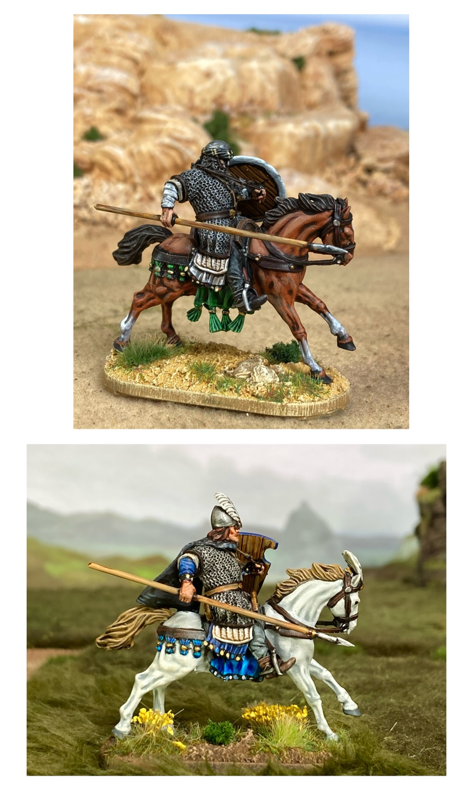
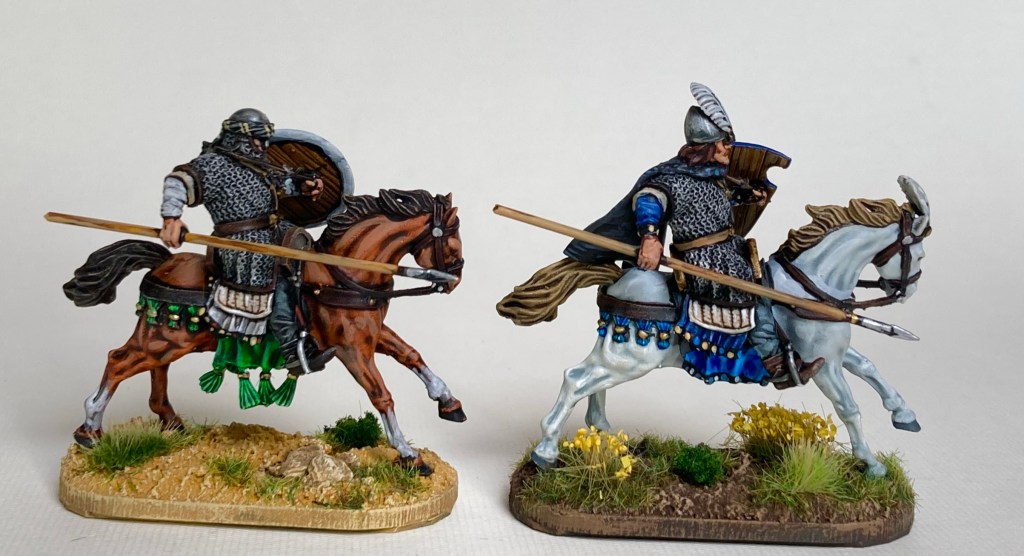
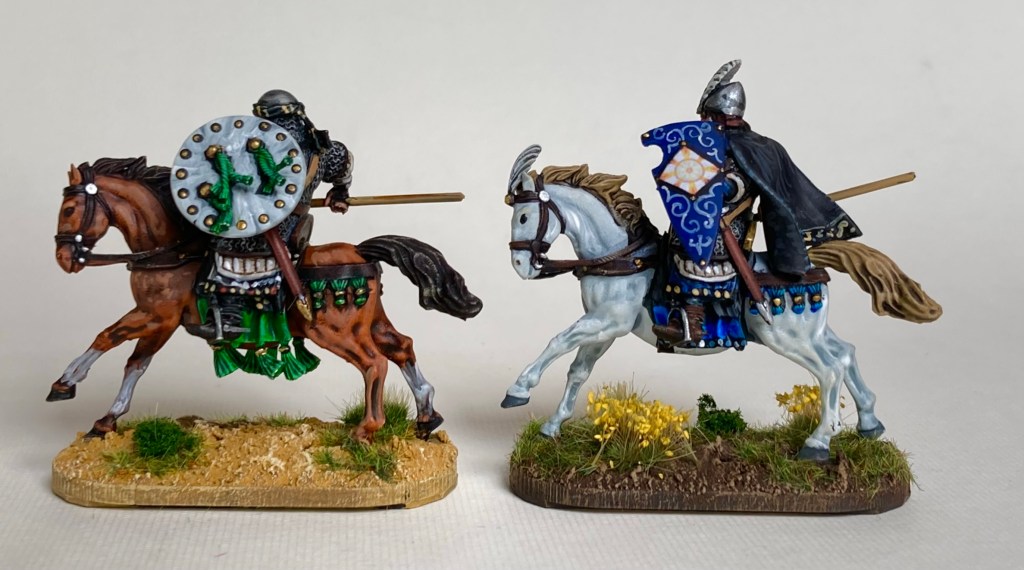
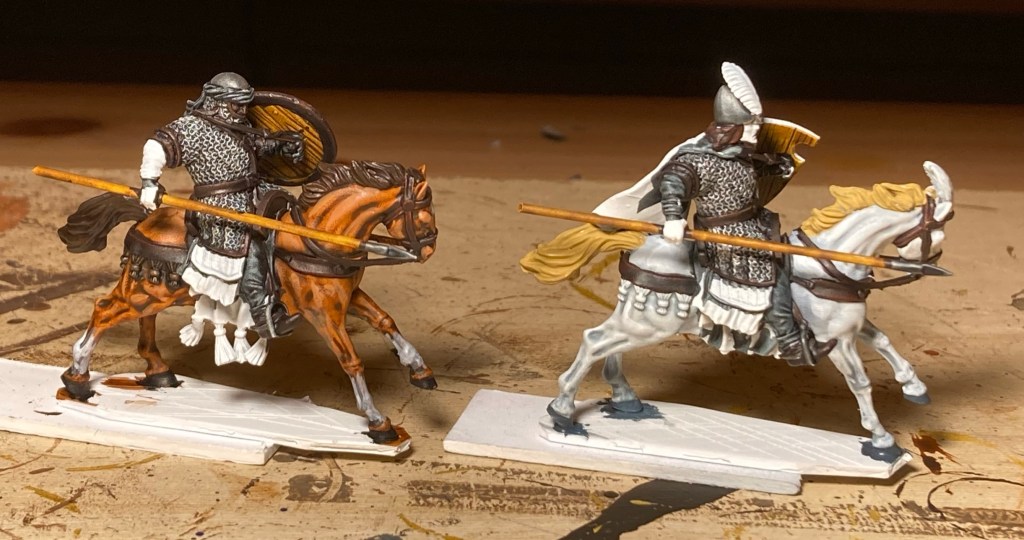
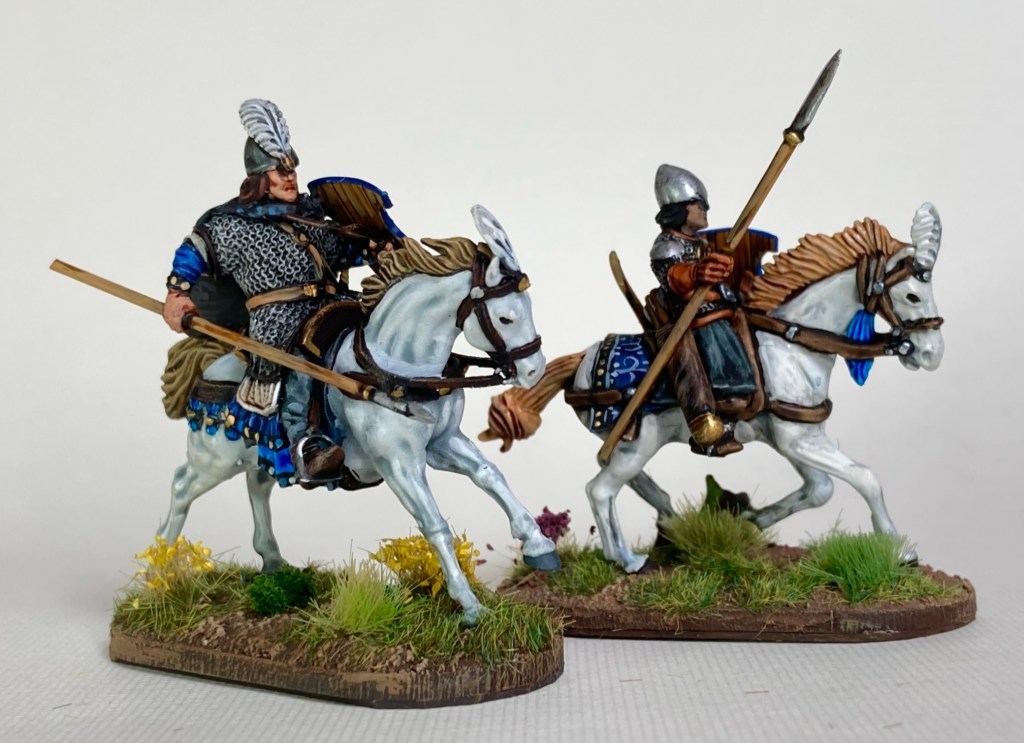
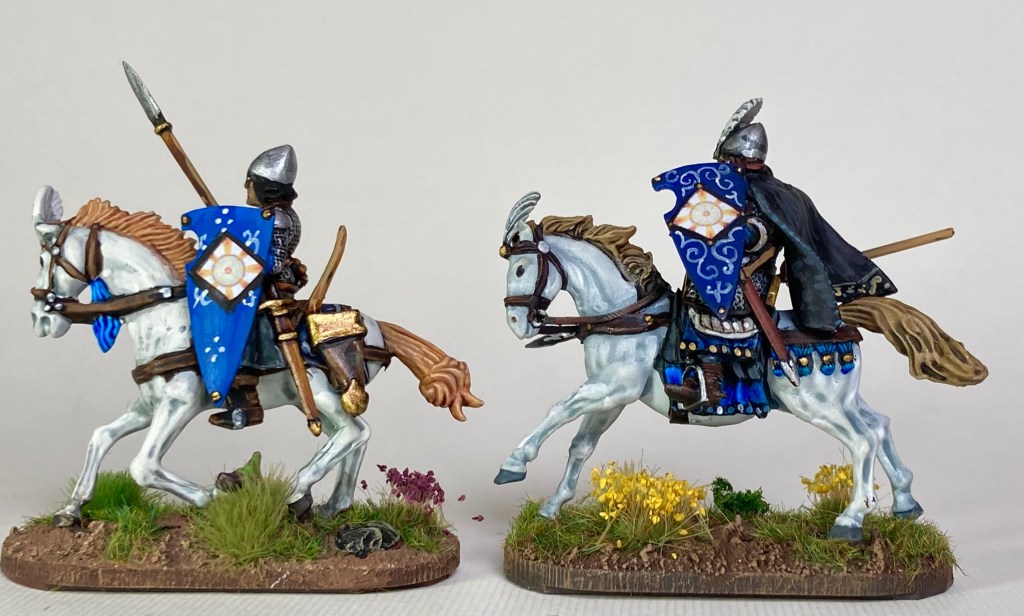
As an experiment, I thought I’d pick two identical knights and paint them up; one as an 11th century Spaniard, and the other a First Age Noldor Elf from Middle-earth.

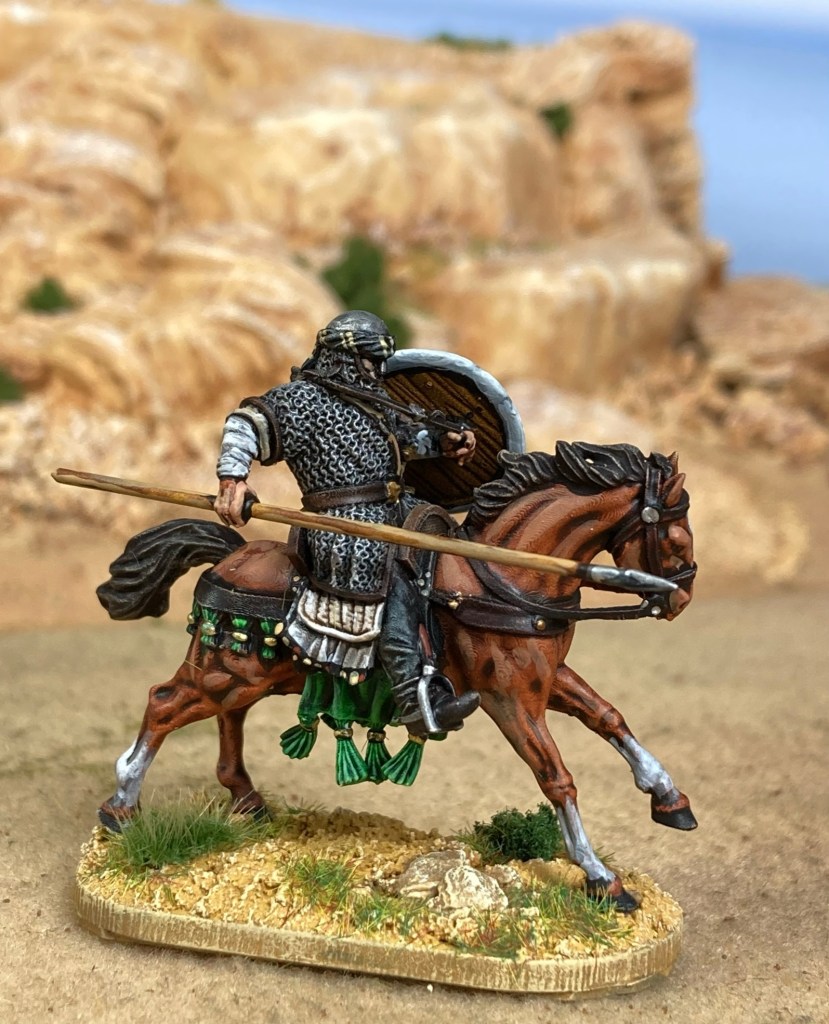
Spanish knight (left), Noldor (right)

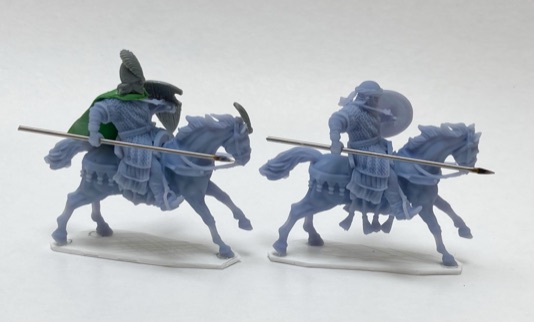
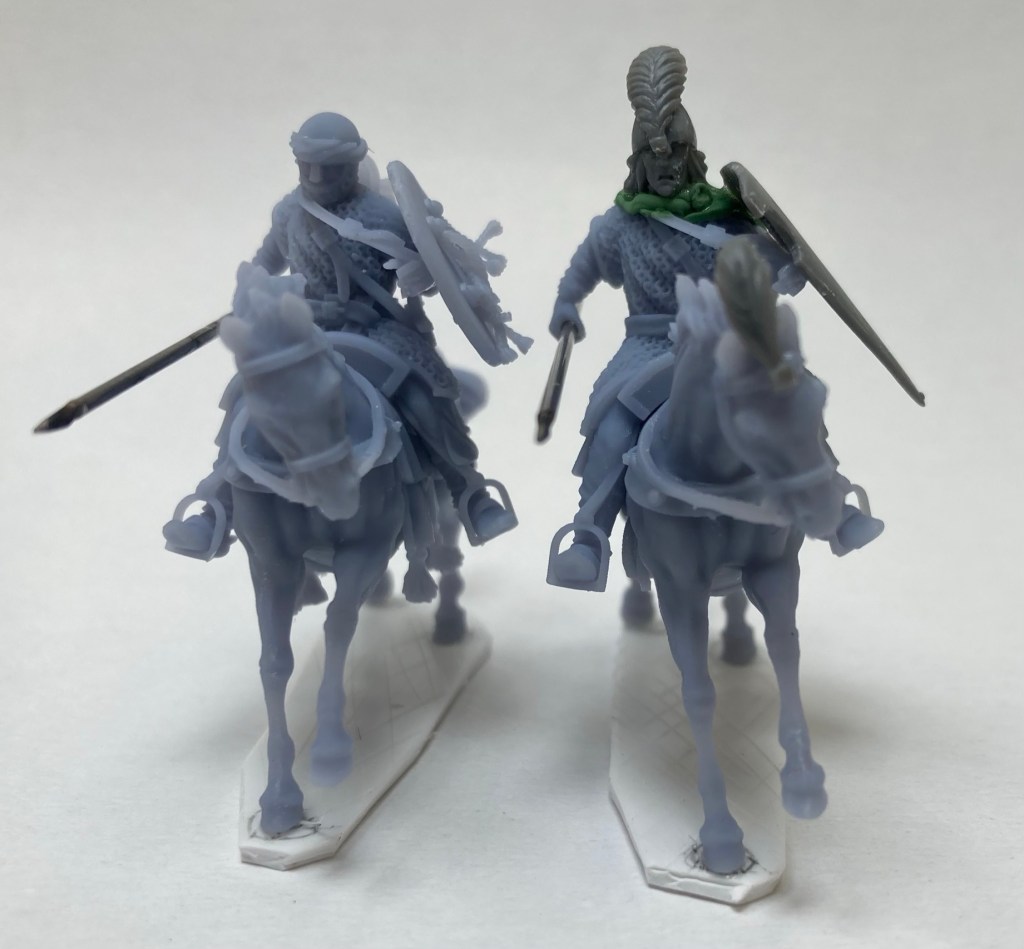
The minis arrived printed in grey resin with an intricate network of supports which was removed with warm water and a pair of clippers. As James warned, there is some really fine detail on the models and I accidentally broke off several of the tassels on the Elf’s saddle (which is why he hasn’t got any – not because he wouldn’t like some!) I trimmed a few areas with a scalpel and added Northstar wire spears for lances. It was an extraordinary experience after years of drilling out hands to take spears to find that there was no need – the precision of 3d printing had left a perfect hole to glue the lance into!

Having decided to convert one rider to a Noldor, I removed the original head and swapped it for a plastic one from the Oathmark Elves boxed set from Northstar/ Osprey. A cloak was added from green stuff along with an appropriate shield and some feather plumes, also from the Oathmark kit.

Riders, shields and horses are all separate pieces but were straightforward to put together using superglue. However, none of the minis came with bases (I understand this is usual with 3d prints) so I had to cut my own from plastic card.

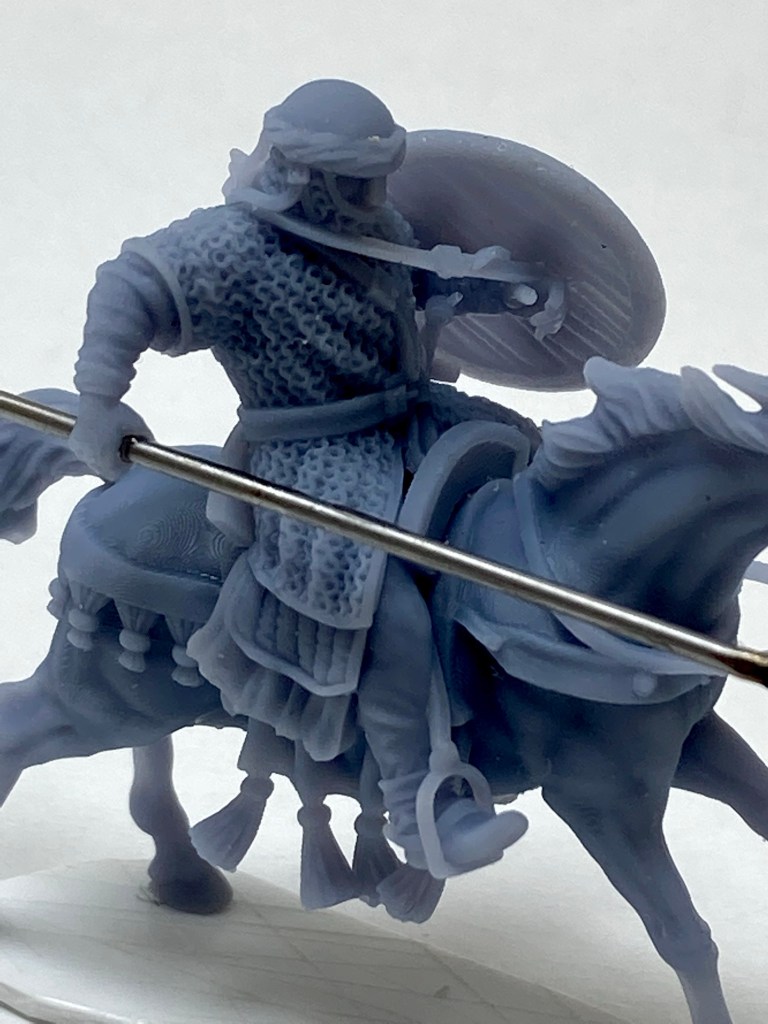
You can really see the astonishing detail in this close-up – note the stirrups, tassels. reins and shield strap – detail that would be impossible in a traditional metal mould. There are some slight layer lines on the horse’s body from the printing, but these were barely visible after painting.
First coats of paint. Both models have had an undercoat of Halfords white primer followed by base coats of GW Contrast paint and standard acrylics.

I won’t go through the painting process in detail but currently I’m using GW Contrasts over a white undercoat and then highlighting them up with acrylics. I decided to go for different colour schemes to emphasize the different cultures, so it was white for the Elven horse (GW Contrast Apothecary White) and blue/ black / grey for the rider; the Spanish horse went chestnut (GW Contrast Gore-Grunta Fur) with green and black clothing.

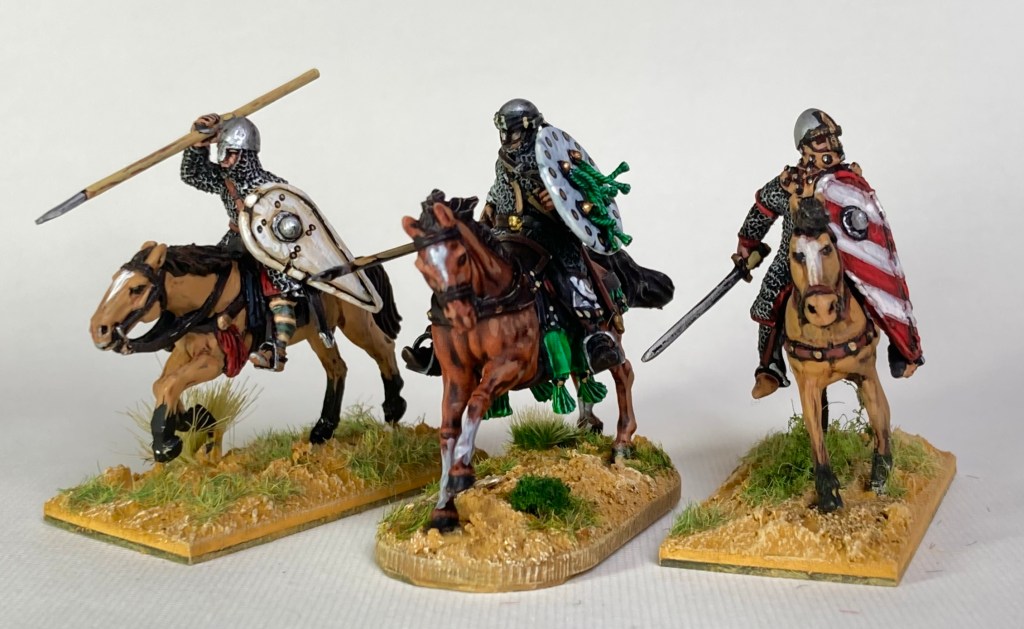
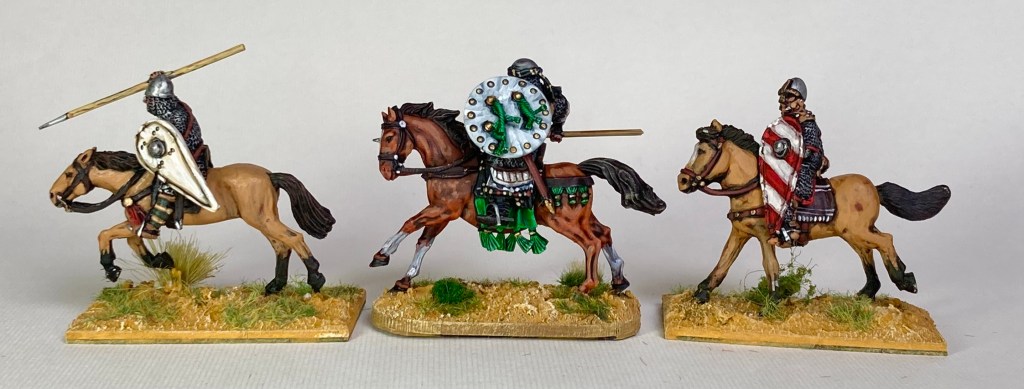
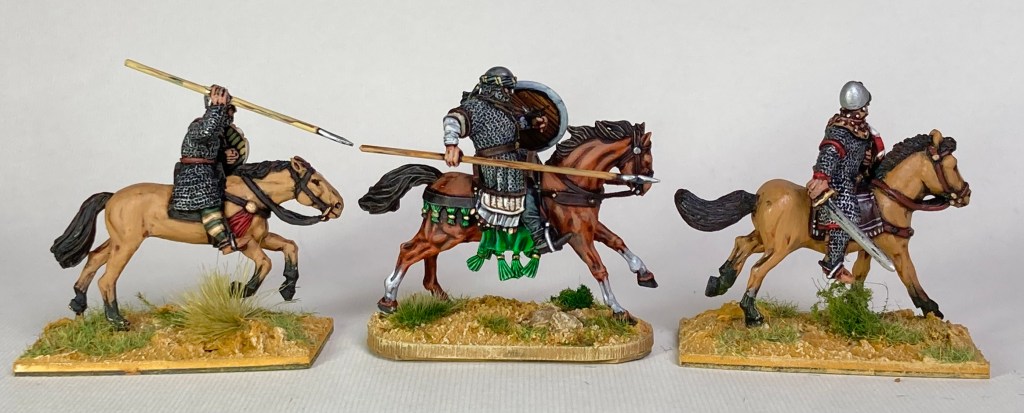
Having got our caballero painted, it was time to see how he measured up to his companions in my El Cid army. Being mostly collected 20 years ago, my force is entirely metal. On the left you can see a Perry Miniatures knight (from the First Crusade range) and on the right, a Gripping Beast Spanish knight (from the El Cid range) with original GB horse.

L-R: Perry , Caballero, Gripping Beast (old horse)

The finished Noldor is due to join a unit with my other converted First Age cavalry, made from Gripping Beast plastic Arab heavy cavalry with Oathmark bodies, arms and heads. I was very pleased with the match between these – they are easily similar enough to mix. I guess the big question is whether I expand the Elven cavalry using more plastics or more 3d prints? A difficult question!

Converted Elf cavalry: Caballero (L), Gripping Beast plastics (R)

Les Poilus

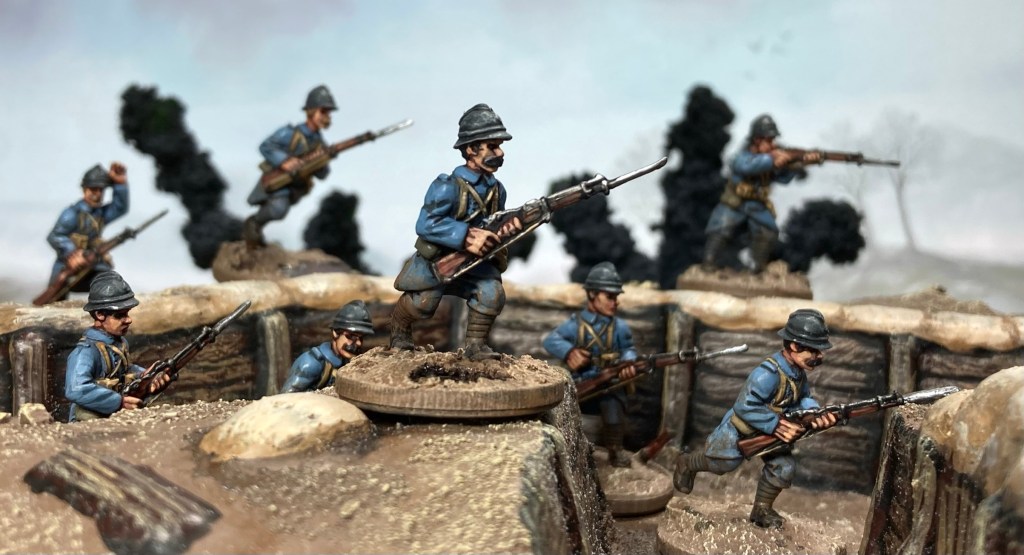
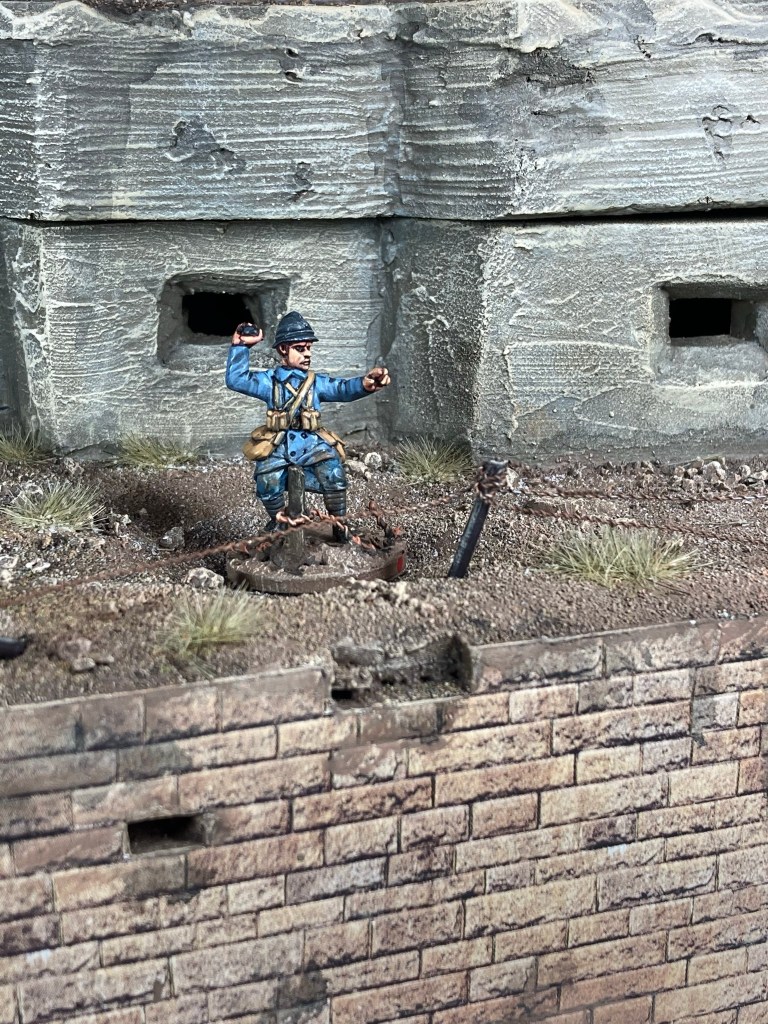
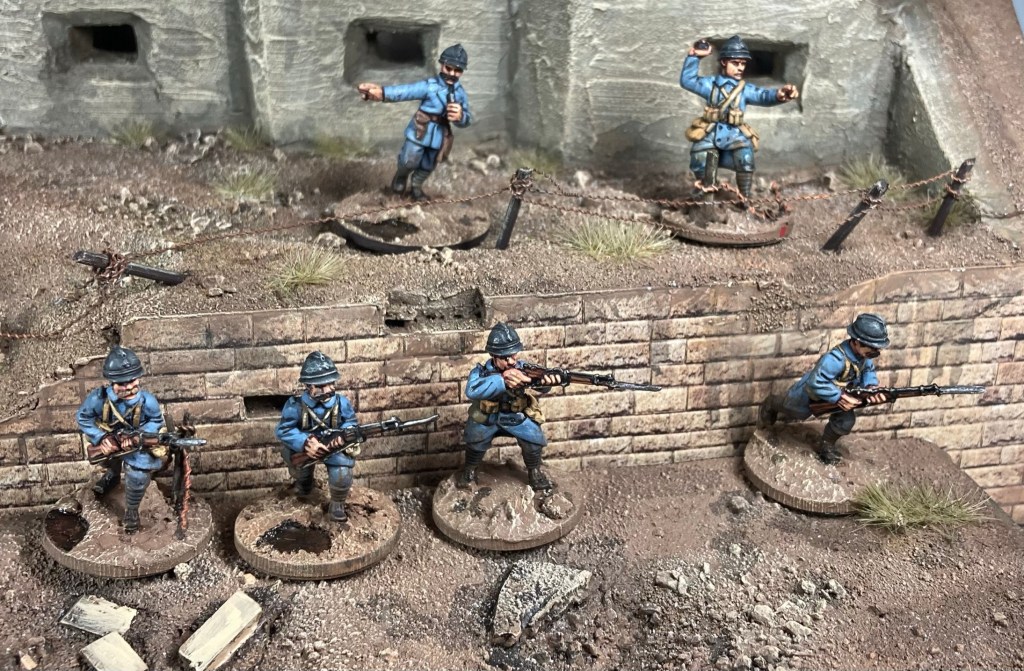
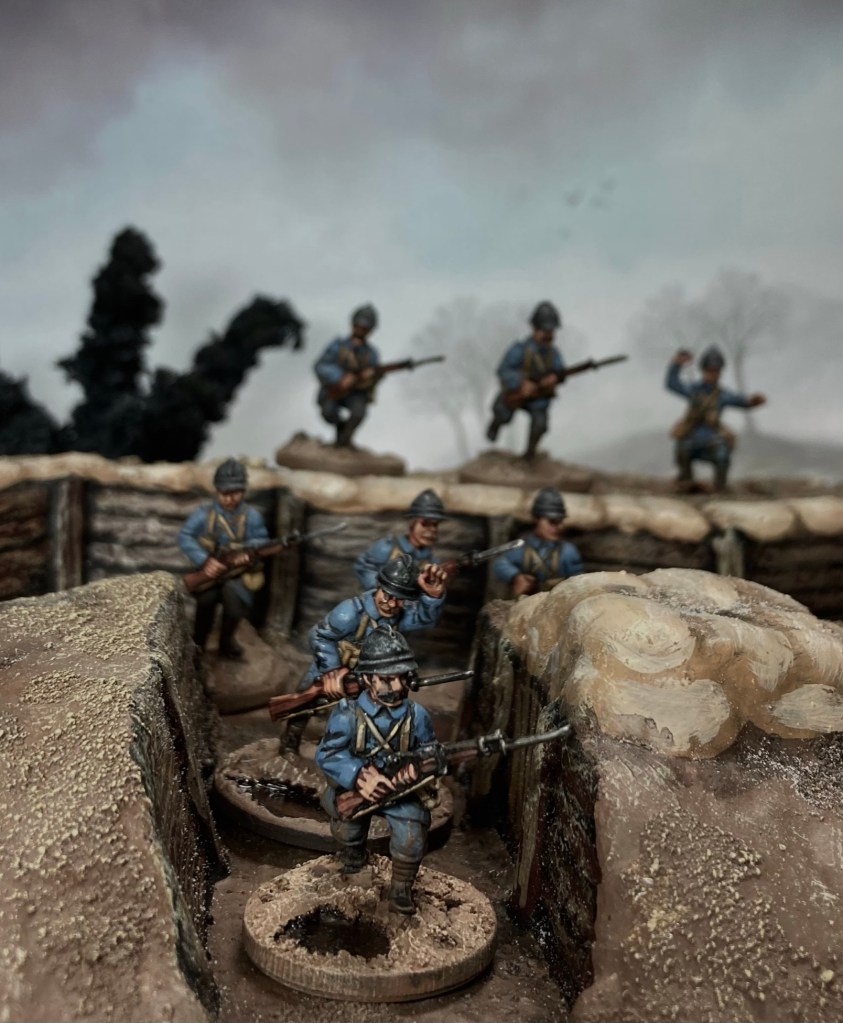
WW1 French soldiers going into action. Woodbine Designs miniatures (by Gripping Beast), trench by Amera, background by Jon Hodgson Maps

At the end of last year, I penned a short article on painting World War One French in their mid-late war horizon blue uniforms, and it has recently seen print in Wargames Illustrated magazine (Issue 403, July 2021). The theme of the issue is ‘Vive La France’ and has a wide range of articles about wargaming with French armies from various periods of history.

Here’s a few out-takes from the photo session that I posed with some of my 28mm figures. The French are lovely sculpts by Soapy from the Woodbine Designs range by Gripping Beast, with a trench section by Amera and a photo background downloaded from Jon Hodgson Maps.

These chaps are patrolling the area just outside the bunkers of Fort Vaux, Verdun. For more on this, see my Fort Vaux page

I’m not going to do a step-by-step painting article here, as that’s available in the magazine, but I will say that the key ingredient in painting these poilus was Army Painter Wolf Grey, available in both dropper bottles and spray cans (handy for doing whole platoons, as I was doing a few years back at the height of my WW1 gaming).

A difficult job in May 1916 – driving Germans off the escarpments of Fort Vaux.

Getting the article done has reminded me that my WW1 project is unfinished business – I have a small bag of soil from Ypres that is just waiting to be used for basing up the next phase of this! More soon, I hope.

Les Poilus in the act of capturing a trench.

Second Age Scrapping

It’s fair to say that Paul W and I are enjoying playing big battles again at the moment. This week’s excursion took us back to the Second Age of Middle-earth with a scenario inspired by the Last Alliance of Elves and Men. As Gil-Galad and the Noldor march south towards Mordor, their path has been blocked by an Orc host: they need to break through as quickly as possible!

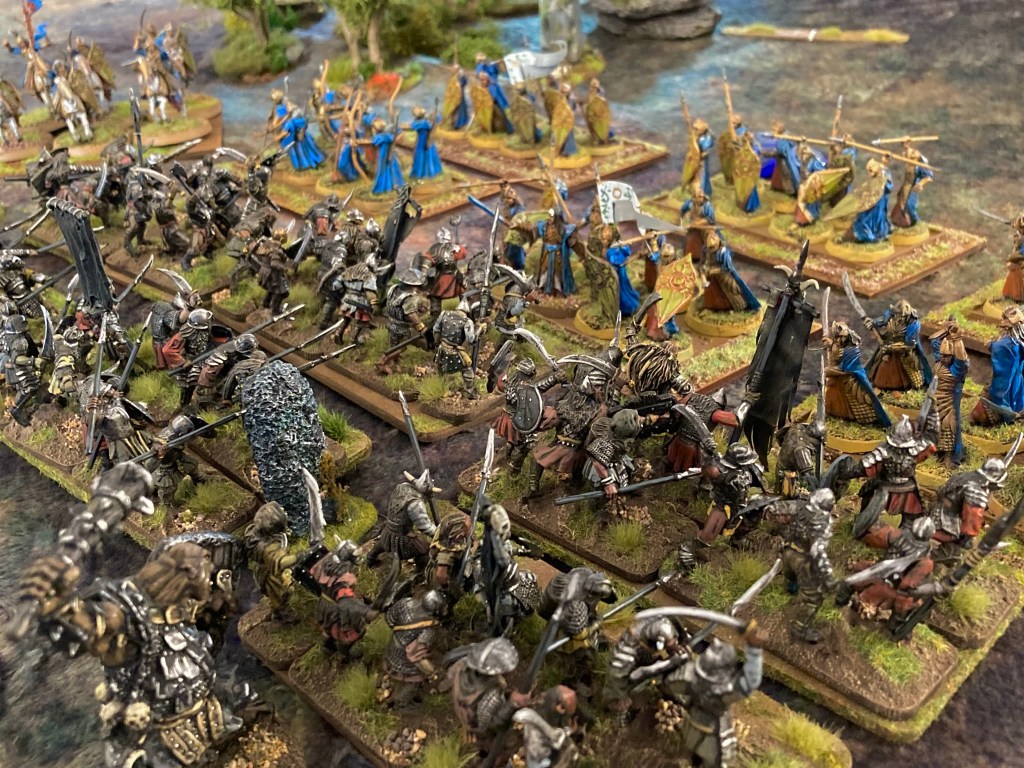
Left: full-on Orc vs Elf scrappage. Orc army by me, Elves by Paul W

Paul W and Paul S divvy up the Noldor and prepare for war

We were, once again, playing my own Midgard rules. The scenario was ‘Take the High Ground’ which was inspired by the Battle of Hastings; in this case, the Orcs had the advantage of the hill (a 4 foot long slope under the cloth, hopefully visible in the pics) but had one quarter of their forces arriving late to the party. The Noldor, meanwhile, had to get up there and take the position in short order. There were three salient points (marked by standing stones) on the crest of the hill which would grant extra Reputation (the factor in Midgard by which battles are won and lost) each turn after Turn 3 in order to emphasize the importance of the slope.

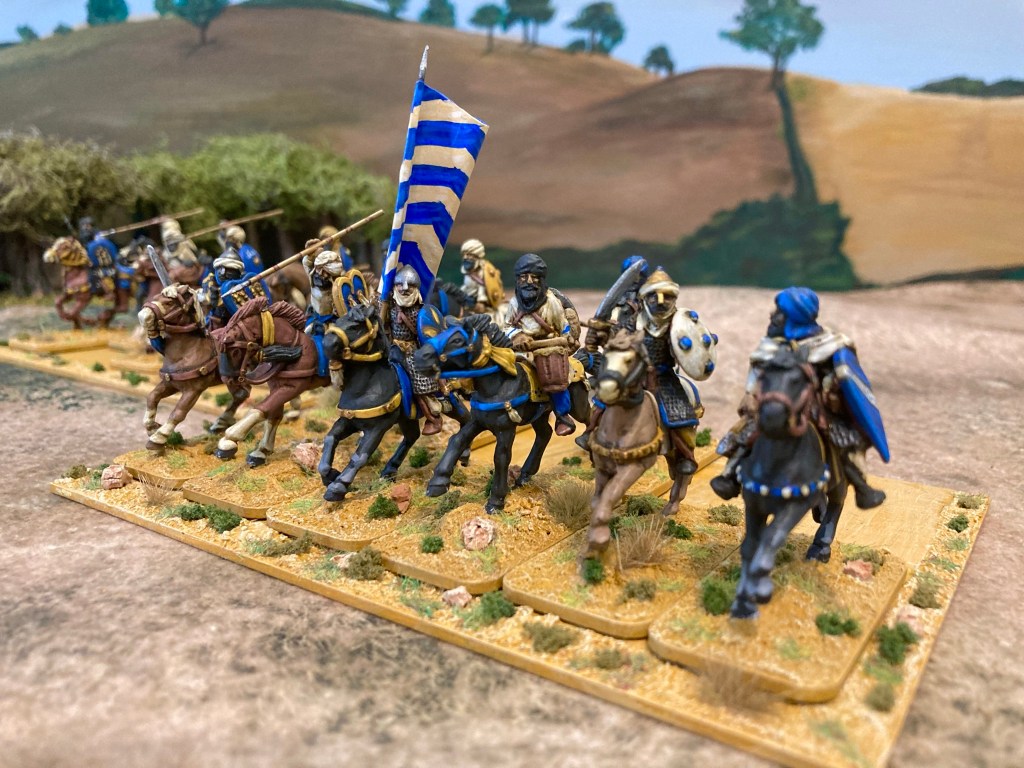
Orcs to the left, Noldor to the right, conveniently colour-coded blue and black! Paul’s Elven army is entirely GW Lord of the Rings minis; my Orc force is a mish-mash of GW LotR and Oathmark plastic goblins with a wide variety of conversions.

Having placed a solid double line of Orc warriors on the hill, reinforced by some Trolls at centre right, the Elves went for a mixed formation of spearmen and archers in the centre and cavalry on both flanks. Predictable so far!

I decided to break the routine by sending a forlorn hope of Orcs down the hill on both flanks to meet the Noldor riders. This wasn’t executed with quite the alacrity I was hoping for (the Orcs were lacking decent quality Heroes to keep them moving) but it did force the Elves to raise a few eyebrows.

Haldir’s Elf archers peel off to the left to deal with a counter-attack. The blue glass beads are serving as Might Points, the mechanism by which Heroes influence their warriors and commit mighty deeds.

Thus the battle began to break off into three zones, with the Elves peeling off troops to the right and left to deal with the Orcs racing, sorry, limping towards them.

Lord Elrond commands the centre.
A combined group of Elf archers and Spearmen hunt down the Orcs on their right.
Akdar, Captain of Trolls commands the Orc centre
Celeborn gets stuck in! Yes, I know that the swords should be straight, strictly speaking, but they’re nice figures!

My lucky Orcs on the right managed a charge against Celeborn and his elf cavalry, doing surprisingly well and holding their ground. Unfortunately for them, Celeborn’s trait was to be able to rally a destroyed section; as a result, the renewed Noldor escaped destruction and drove the Orcs back. Boo!

An Orc captain drives his soldiers forward to hold the hill. The rider is a conversion made from Oathmark and Warlord Games plastics, mounted on an OOP Mierce Miniatures wolf.
Slay the Orcs!

And then it was time for the centres to clash! I pushed my Orcs forwards to take the fight to the Elves and we had a fair old melee raging across the crest of the hill. The Orcs held on despite heavy casualties from the Elven onslaught; with the advantage of the hill plus extra units in support, they were able to weather the storm – for the time being, at least.

Another view down the battle line. All our units are mounted on 120mm wide bases for Midgard.

With luck on our side, the forlorn hope of Orcs on the right actually wounded Celeborn (he was lucky to survive, having rolled a double one, but had a spare Might Point to help save himself). However, it was clear that a gap was about to open up with the approaching demise of the front line of Orcs, so Akdar sent in the Trolls. I’d been holding these back to avoid the inevitable hail of Elven arrows but hopefully now they could do some damage!

Trolls (top right) lumber into position. Meanwhile, the Elven cavalry flank attack (bottom) is being held – just.

Lord Elrond gets stuck in to the Orcs!

Troll Captain Akdar joins the fight – bad news for the Elves.

At this point, we had reached Turn 4, which meant that the Orc late arrivals turned up. A random roll indicated that they were going to arrive on the Orcish left flank, hopefully just in time to save it from the Elf flank attack.

Late-arriving Wargs and Warg riders under Orgul the Swift surge onto the battlefield.
The first line of Orcs crumbles to the Noldor onslaught.

By now, the Orc centre was taking serious casualties and Reputation was teetering. The Wargs tore into the Elf cavalry, but more was needed. Orc Commander Orgul the Swift rode up to the crest of the hill and pitched into combat against Elrond’s Elves. Midgard is designed for heroic deeds and so I chose to challenge Lord Elrond to single combat. Paul accepted and the fight was on!

‘Oi, I challenge you! And I’m not sure that your curved sword fits with JRR Tolkien’s vision of Middle-earth, you know. ‘Aven’t you read The Fall of Gondolin?’

Elrond was a tougher Hero than Orgul, but I threw in both of Orgul’s Might Points in an effort to take down the Noldor Lord in the first round – sadly to no avail, as Elrond won the round and wounded the Orc captain, gaining a point of Reputation. However, the next round luck was with me and the Heroes drew, sparks flying from their blades – both gaining Reputation this time for their heroic display. The final round was too much though – both Orgul and Elrond wounded each other – with Orgul dying as a result. It could have gone either way!

Now the Elves had the upper hand and pressed the Orcs in the centre. With Orc Reputation at zero, I had to hold on to at least one of the salient points to continue the game. The Trolls rushed up but took heavy casualties in their melee with the Elves and were left with a single model in the unit holding the ridge. Unfortunately for him, he was facing two Elven units with bows who took him down in the final shooting phase of the turn. The Orcs fled, hotly pursued by the surviving Elf cavalry: victory to Lord Elrond!

This was a really tight game with plenty of opportunities for both sides to win it. I had probably been quite impetuous in rushing my Orcs down the slope and could perhaps have changed the outcome in holding back, but where’s the fun in that? Orcs gotta Orc! I was pleased with the scenario and the latest rules tweaks are working well. More soon.

Viriathus, Enemy of Rome

Following on from my recent Punic Wars gaming, I found myself stuck at home having to self-isolate. Tom WD suggested a Zoom game to cheer me up so I got organising. Of course, this meant that I’d just have to use my own collection, so I plumped for the fascinating campaigns of Viriathus.

Left: Viriathus and his bodyguard cavalry fight a losing battle against the Principes.

Viriathus (Viriato in Spain and Portugal) was a charismatic Lusitanian warrior who caused serious problems for the Romans during their occupation of Hispania in the 2nd Century BCE. He comprehensively defeated a Roman force under Praetor Caius Vetilius at the Battle of Tribola (we gamed this in 2017 at the Hereward Wargames Show in Peterborough using Simon Miller’s To The Strongest rules – game report, historical background and photos from this one can be found here: https://mogsymakes.net/the-battle-of-tribola-147-bce/ ).

L-R: Viriathus plus chieftains Audax and Ambon. Viriathus and Ambon are from Crusader Miniatures, the others are all Gripping Beast.
I set up a simple scenario based around the Tribola battle, with the Romans attacking a Lusitanian force in the open but with some of the Iberian warbands being concealed on the flanking hillsides and appearing later on during the game. Tom WD messaged me his deployments for the Spanish, while James D (playing the Romans) just adopted a standard triplex acies formation as Vetilius deployed his troops for battle. He was aware that it was hostile territory so kept the cavalry and Triarii handy to cover any sudden appearances!

Roman Commanders Praetor Vetilius and his legate, Marcus. As we can see, Marcus isn’t too chuffed at being posted to Hispania when daddy promised him a comfy job in the Senate.
Initial Roman deployment – two ‘legions’ with cavalry covering the flanks.
The Lusitanians take up position with a force to goad the Romans into the attack with light cavalry, slingers, warriors and Viriathus and his bodyguard in the rear.

We were playing my own Midgard rules again (still testing out ideas) and were experimenting with a couple of new concepts for this game. I’d reduced the Spanish warriors’ attach dice but increased their speed to create a slightly different dynamic to the warbands given their reputation for guerilla warfare, and the ‘Replacement’ trait for Roman manipular formation was also due for another run-out. However, I imposed a penalty on the Triarii to simulate the fact that, if they got into combat, the Roman army would be in trouble. The game uses Reputation to record victory and defeat, and I decided that the Romans would forfeit a Reputation token if the Triarii got into combat, or double that if the combat occurred before any of the Hastati and Principes in the legion had seen action.

The hillsides are full of danger in Lusitania! (My son appeared and decided to add a wolf from my Middle-earth collection into the cave. We decided that any unit encountering this would have to take a Command Test).

I don’t think that James was particularly surprised when some Lusitanian warbands and caetrati under the command of warleader Ambon appeared on the hillside. Marcus promptly wheeled part of his legion to the left to cover this flank, which was an easy manouvre thanks to the Romans’ drilled trait.

Romans advance strongly in the centre and the Lusitanian light cavalry are beaten back.

Roman allied cavalry ride up to deal with the Lusitanian flank attack. Surprisingly, this newly-painted unit acquitted itself well!

The flank attack on the Roman left stalled due to poor leadership, with units not carrying out their orders and Ambon (only a Level 1 Hero) unable to do much about it. This resulted in a combat on Roman terms, with casualties on both sides. Ambon was killed by a Roman pilum and the warbands started to sense defeat.

At this point, the second Spanish ambush (on the Romans’ right flank) was unveiled – two units of slingers emerging from the rocks and trees. Vetilius despatched a pair of units of Velites to deal with them.

More slingers emerge from the woods.

Tom committed Viriathus to the fight, hoping to break his way through Marcus’s legions to the Triarii. However, the Lusitanian cavalry suffered badly and were cut down to a man. Viriathus survived, losing a point of Reputation for having his guard killed around him!

Having escaped the killing of his cavalry, Viriathus joins a fresh warband.

The big fight in the centre continued apace, with the Romans beating back the Spanish. The flank attacks had failed to create the disorder that Viriathus needed for a breakthrough and his men were now being ground down by Roman pressure.

Audax leads the warbands against the Romans.

Praetor Vetilius takes command of the melee and drives off the Lusitanians in the centre.

Marcus’s legion stares down Viriathus and his surviving warriors, who sensibly decide to melt back to the hills.

With teatime being called in all our houses (between Suffolk and Nottingham), we had to call it a day. The Romans had won a clear victory, killing warleader Ambon and retaining 6 Reputation tokens to the Lusitanians’ 1. Had we played another turn, there is no doubt that Viriathus’s army would have broken.

The new rules had worked pretty well. The replacements trait was used on a couple of occasions to shore up the Romans trying to hold off the left flank attack and was instrumental in pulling damaged units out of the line and replacing them with fresh ones. As Viriathus tried to break through. Marcus sent a unit of Triarii in to replace a damaged one of Principes and was justified in doing so – despite the loss of Reputation, the veteran warriors saw off the Spanish in short order.

Despite committing some Triarii to the fight, the Romans have the victory with 6 Reputation tokens remaining. With a mere 1, the Lusitanians are on their way out.

Return to the First Age with Midgard

After an absence of a few months, Paul W and I pulled out our Elf and Orc armies for Middle-earth and set up another game loosely set in the First Age.

Paul has been really helpful with ideas for developing my Midgard battle rules (still in playtesting) and had pretty much memorised my Noldor army list and points values which made life much easier! I cobbled together a somewhat mixed Orc force with some help from my nine-year old son who had decided to join us for the evening’s game (and, probably not unrelated, a cheeseburger).

Left: Orcs and Elves scrap it out over the ancient watchtower.

I decided to put my scratchbuilt watchtower model in as the objective for the game, propped up on a rocky outcrop that would offer some advantages to anyone defending it. We placed a wood on the left flank, but otherwise the battlefield was clear The Orcs were led by a Balrog with a Werewolf, Troll and Orc Captain as lieutenants in command of Orc soldiers, archers and warg riders. The Elves had a goodly number of heroes with the usual mix of spearmen and archers and a sizeable wing of heavy and light cavalry.

Orcs deploy with a double line of soldiers backed up by a Balrog and his Troll bodyguard. A crack force of Orcs led by Akdar the Troll captain has been detailed to assault the tower on the right.
The view from the Elven lines as the forces close.
Akdar the Troll races forward to the watchtower, preceded by archers and warg riders. The silver tokens are Akdar’s Might Points that he can use during the turn to influence his troops and carry out mighty deeds.

The Orcs tried to rush forward towards the Elves but were hampered by some disorder in the ranks; this played into the manicured hands of the Noldor, who unleashed a couple of nasty volleys of arrows against the Werewolf and his Orcish guard, who were pretty much destroyed. The Werewolf survived without a scratch but decided to jump ship to a fresh unit.

Paul’s Elven reputation cup! Still full of reputation tokens at this early stage of the game.

The main Orcish advance didn’t go to plan, but the attack on the tower was much better. Paul got a Noldor spearmen unit in position which was shot at by the Orc scouts before taking a full-on charge from Akdar the Troll and his soldiers. This should have been a more even fight, but the Troll Captain crushed the Elves and drove the survivors back off the hill (with some assistance from Paul’s shocking dice rolling).

Akdar gets stuck in! Farewell Elves. Paul’s Elves are entirely Games Workshop LOTR minis, Akdar the Troll is a Reaper Bones piece, and the Orcs are a combination of plastic kits – largely GW with many conversions.

In the centre, though, Paul was rolling some awesome dice for Elven shooting which put some big holes in the Orc ranks.

The Elves eventually had to stand and fight, coming off worse across the line.

Over on the right flank, next to the watchtower, things got really interesting. Orgul the Swift led a couple of units of warg riders in an effort to hold up the Elves. Outnumbered two to one by enemy horsemen, Orgul opted to draw his scimitar and challenge the Noldor leader to single combat. Despite some heroic dice rolls, Orgul took a wound and then succumbed on the second blow to the Elven blade. Unsurprisingly, the remaining warg riders beat a hasty retreat.

Akdar continued to beat the Elves off the hill. With his trait Fearsome, Akdar’s opponents had to retreat double the usual distance after losing a melee. Unfortunately, the Orcs’ impressive advance took them off the other side of the hill and opened them up to a flank charge from the rearmost Elven cavalry. Ouch.

Akdar gets over excited!

In this final turn, the Orcs lost several units in the centre and had their right flank pretty much rolled up. With the loss of Orgul the Swift, the army’s reputation dropped to 0 and they fled the field, Akdar trying to fight his way out as the sun set.

A good fun game as usual – I’ve tweaked a few areas of the rules recently which streamlined the action. As was my original intent in designing Midgard, we played a game with around 15 units and 4 heroes a side to a decisive conclusion in around two hours, including the heroics of a single combat. My son picked up the rules (and a pink inflatable flamingo) pretty quickly and didn’t object to getting beaten by the Elves! Win-win.

The Elves secure the right flank under the watchtower. Red markers are Charging/ Winning tokens that allow a bonus in these situations.

Did you know that there was an inflatable pink flamingo in the pub function room? Neither did I.

Republican Romans

Following my rediscovery of Punic Wars gaming last month, I pulled the ‘Ancients in progress’ box off the shelf in the painting cupboard, where it had sat unopened for four years. Inside were some half-painted Roman cavalry which demanded finishing off!

Once that was done, I decided to get a few photos of the new cavalry alongside my mini-legion that I’d completed a few years back, so here they are.#

Left: Principes. 28mm plastics by Victrix with an Agema metal character model on the right with green shield.

Obviously, it’s debatable whether you can call these small groups a ‘legion’ at all, but if you’re happy to accept that it’s seriously scaled-down, then it does the job. Scrivs, Martin and I collected one of these each a few years back, basing the Hastati, Principes and Triarii on smaller 80 x 60mm unit bases. The initial plan was to play Hail Caesar with these as ‘small units’ but since then we’ve used them for To The Strongest and Midgard. I’m slightly kicking myself for not using sabot bases now that Saga: Age of Hannibal is available, but hey, I’ll just paint some more for skirmishing!

The mini-legion in battle order
Aerial shot showing the basing.

When I painted this force, I was experimenting with coloured undercoats. This has all been done with Army Painter Fur Brown, which has been left/ washed/ highlighted for the skin, spear shafts and shield backs. If I was doing another legion (never say never) I’d be going with the GW Contrast paints all the way.

Allied Roman cavalry clash with Iberian caetrati and slingers (the Spanish are metal sculpts by Mark Copplestone from the Foundry range, and also some Crusader Miniatures)

Seeing as the cavalry have just been finished, let’s review these first. I confess that these are not actual ‘Roman cavalry’ figures. When Victrix released the Iberian Cavalry set, I snapped one up, despite already owning…errr….substantial numbers of Spanish cavalry in metal. There weren’t yet any Roman cavalry available at that point, so I converted 8 of the Spanish to try to look like allied Romans who had been locally equipped. Martin provided me with some allied Roman heads and I added round shields from the Velites – then painted them red. I think they just about work!

The horses were sprayed with Army Painter coloured undercoats (Desert Yellow and Leather Brown) before being painted with oil paints and then wiped off. This can take a few days to dry but gets horses done quick! In this case, I left the horses for (checks notes) 4 years before doing the rest of the painting. The oils were nicely dry at this point.

Coming back to the riders (who had not seen any paint in their previous life), I quickly sprayed them with Halford’s white primer and blocked them in with GW Contrast paints. These received a bit of highlighting and drybrushing before I called it done.

Seeing as we’re working from the rear of the army, let’s have a look at the Triarii next. These fine fellows are (like the rest of the legion) Victrix plastics apart from a couple of Warlord Games Caesarian Romans that I snuck in for a bit of movement. While not as animated as some of the more recent sets (e.g. Vikings), these fellows DO have chunky spears that won’t snap easily. Bonus..

Triarii with their commander, Praetor Vetilus (Foundry metals)

Now we move on to the main fighting line composed of Principes and Hastati. The red/ white / green of the shields is mostly influenced by the artwork of Peter Connolly, although perhaps there is a subconscious nod to the Italian tricolore there as well?

Principes
Hastati. The two front left models have been converted from Velites for a bit of action (I can’t help myself)

And now it’s the turn of those lucky teenagers in the front line, the Velites…

I did something sensible with these and created sabot movement trays so I could use them for skirmishing. The figures are based on 2p coins and magnetised into the tray so they stay in pretty well during play. There’s also a nice dynamic about a plastic model based on a metal coin or washer, in that it’s very hard to knock them over during gaming!

Will this be the last legion for the moment? Do I need an allied legion from Victrix as well? Ooh, shiny! (as my friend Guy would say)…https://www.victrixlimited.com/products/romes-italian-allied-legions-legionaries-in-mixed-armour-plus-velites-and-command