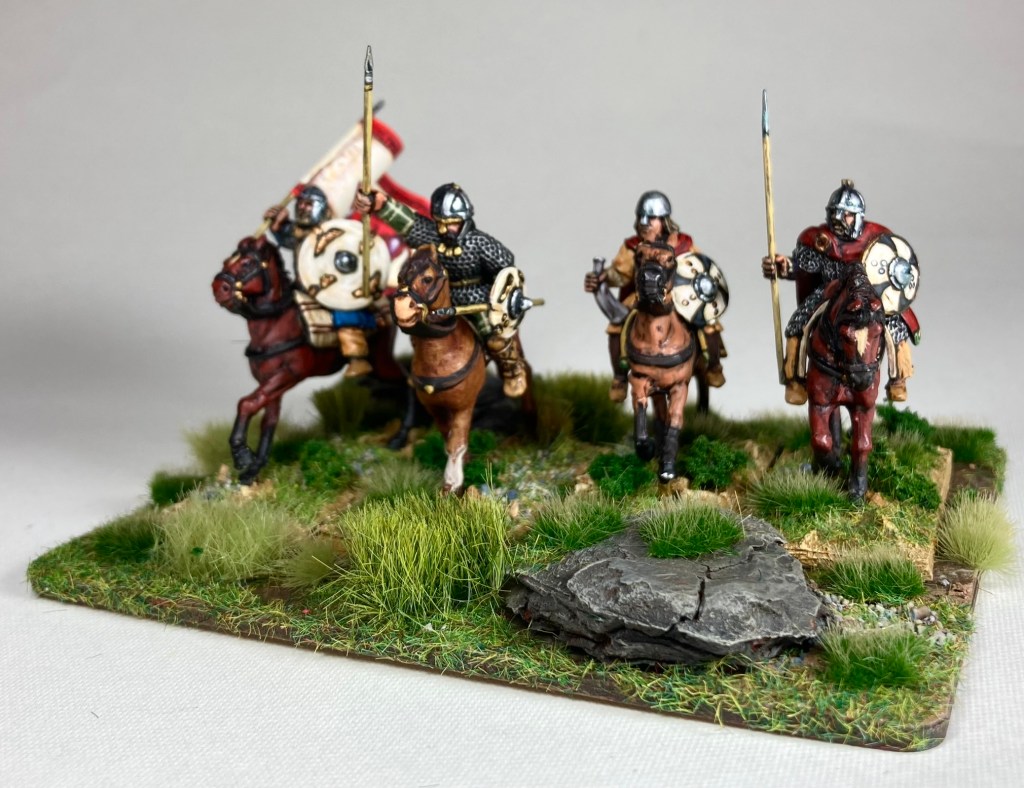
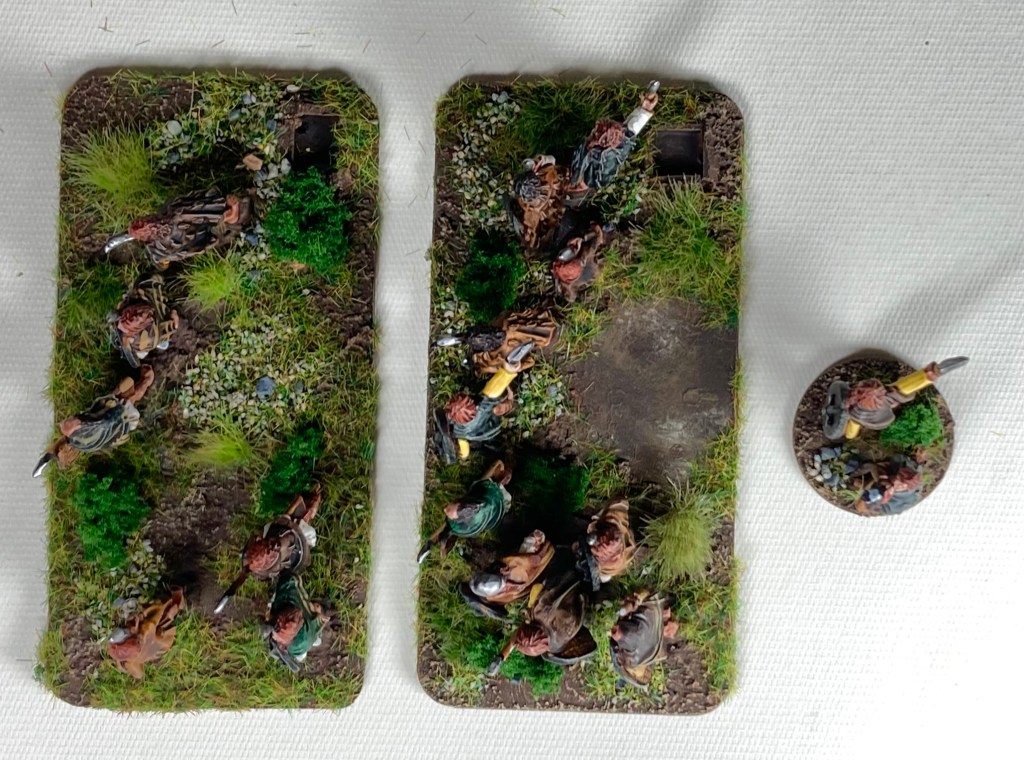
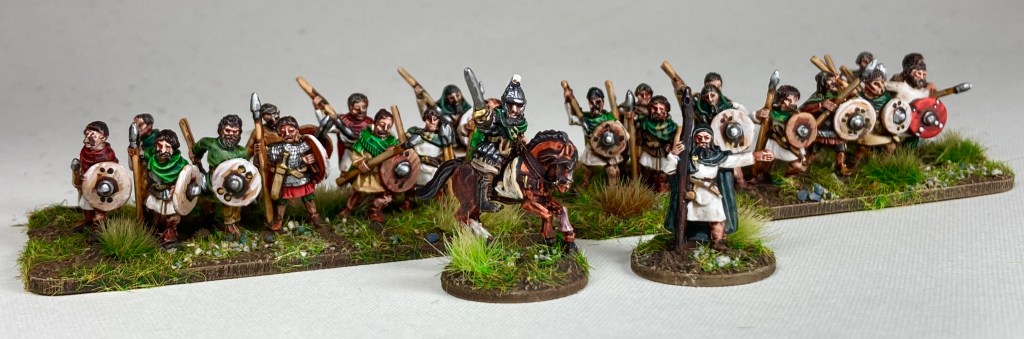
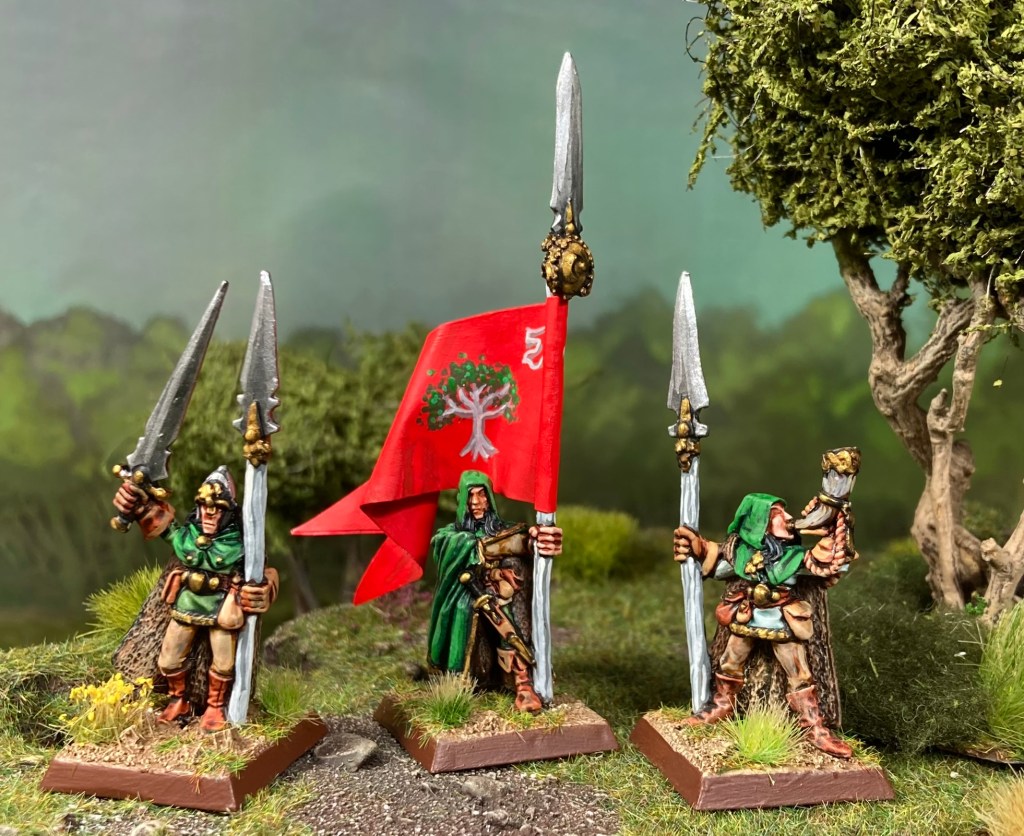
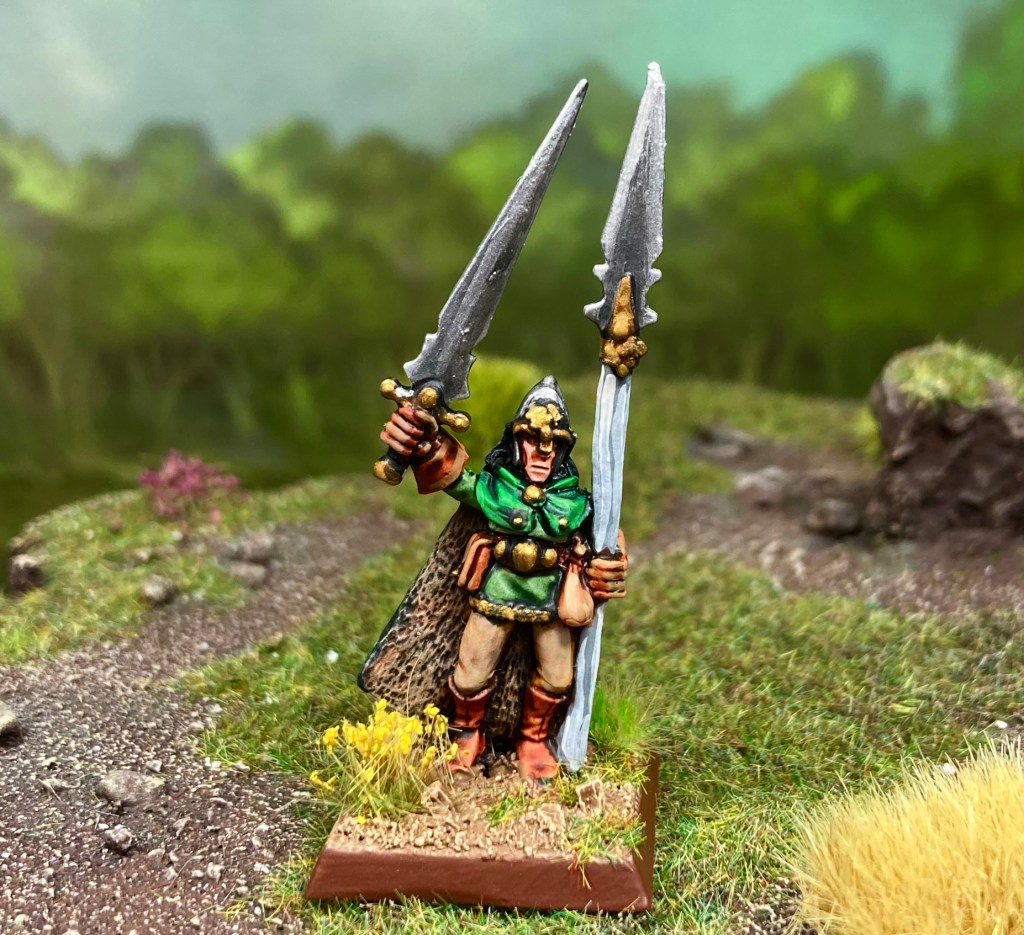
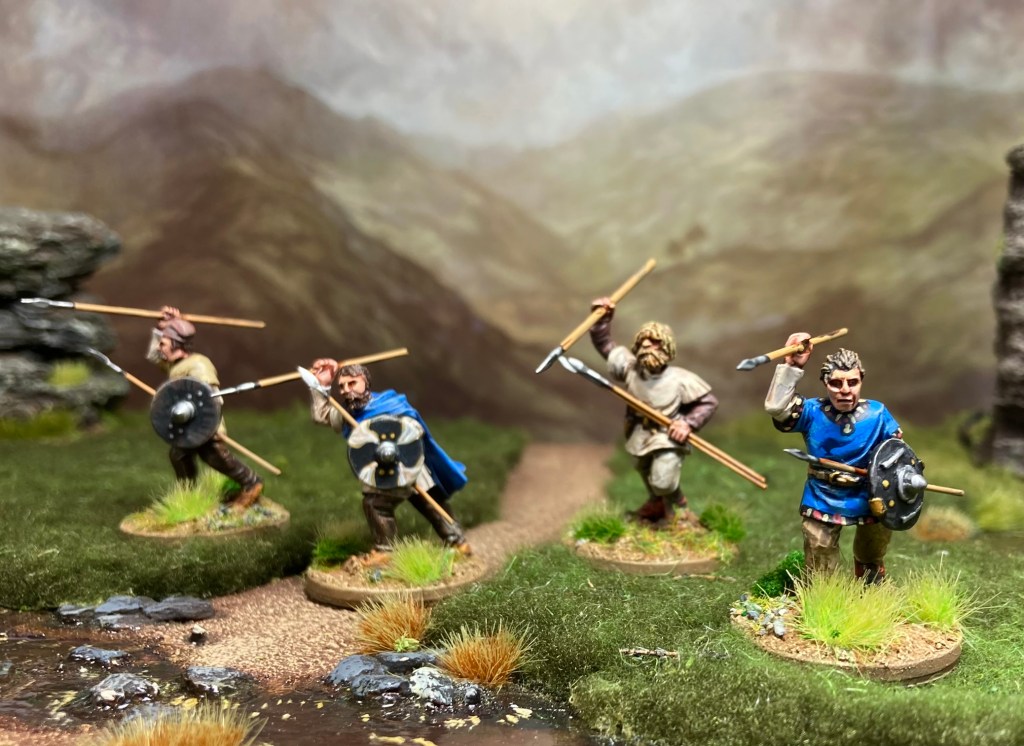
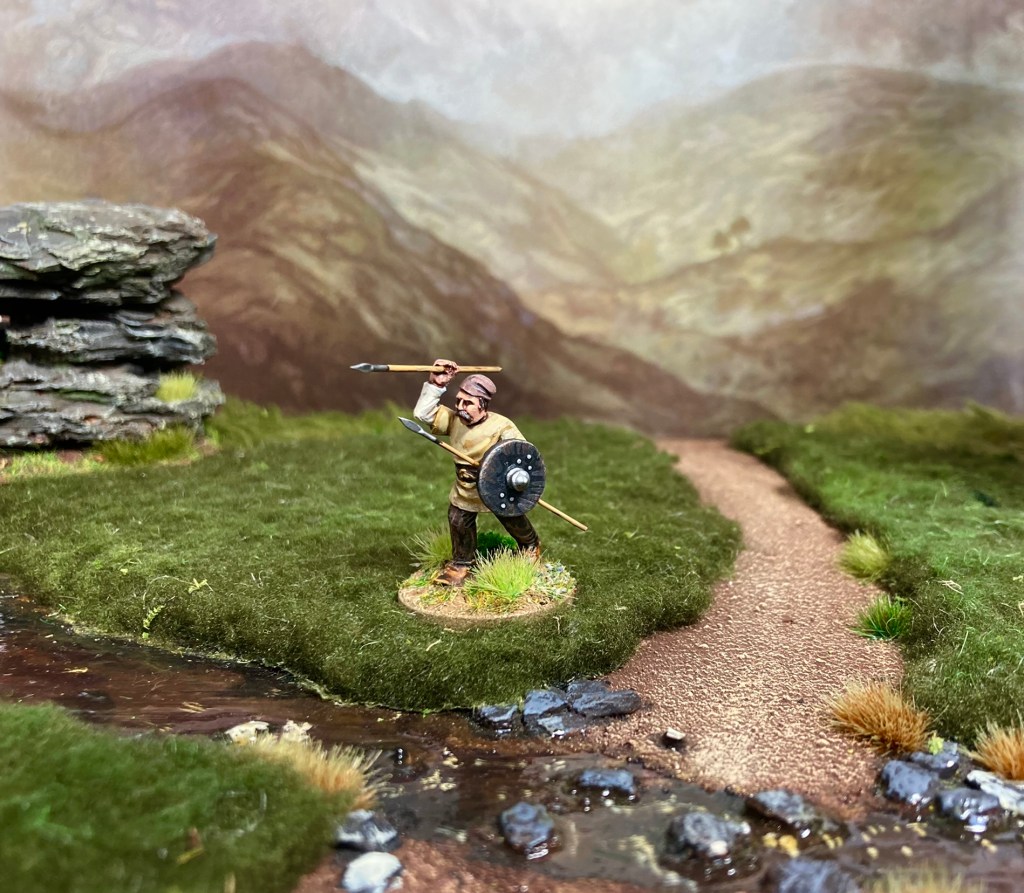
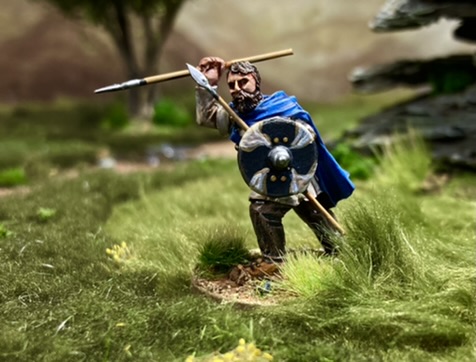
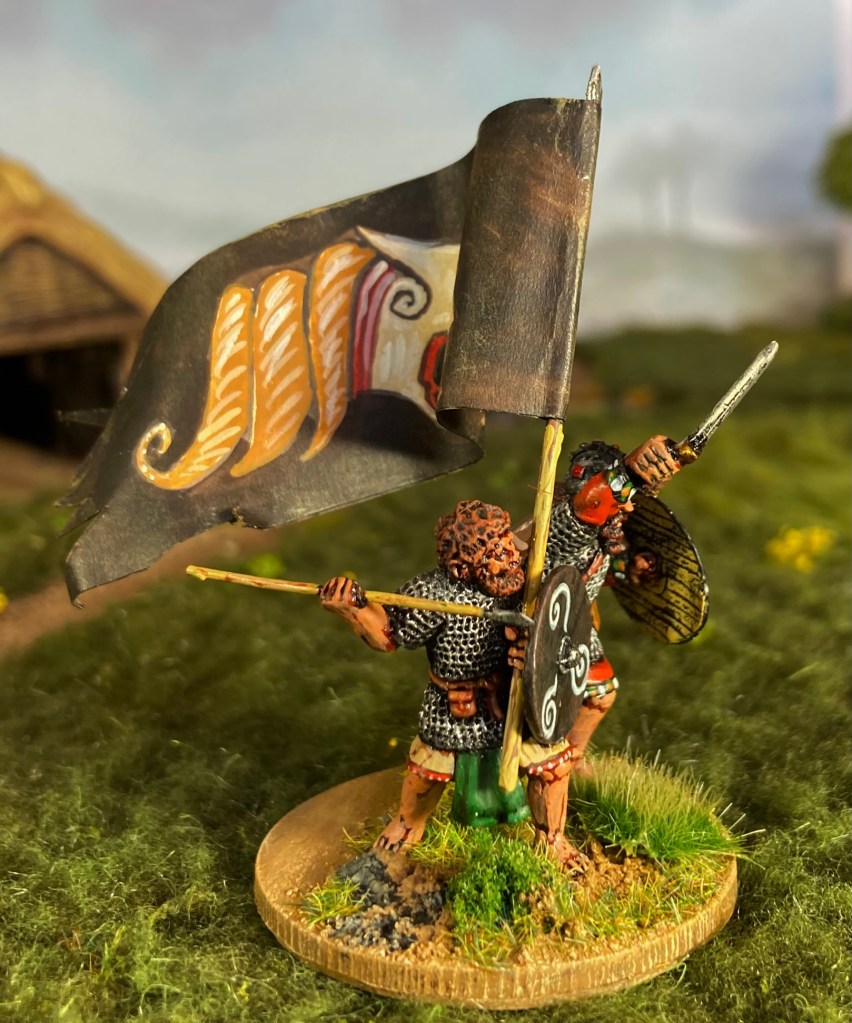
With the resurgence of the Dark Ages in my gaming activity, I revisited some old models from the bits box last week. The West Wind range of Arthurian/ Dark Age miniatures was released after I had collected most of my 28mm armies, so I don’t actually have that many in my collection. This is a shame, as they are terrific sculpts and I always fancied getting some more done.
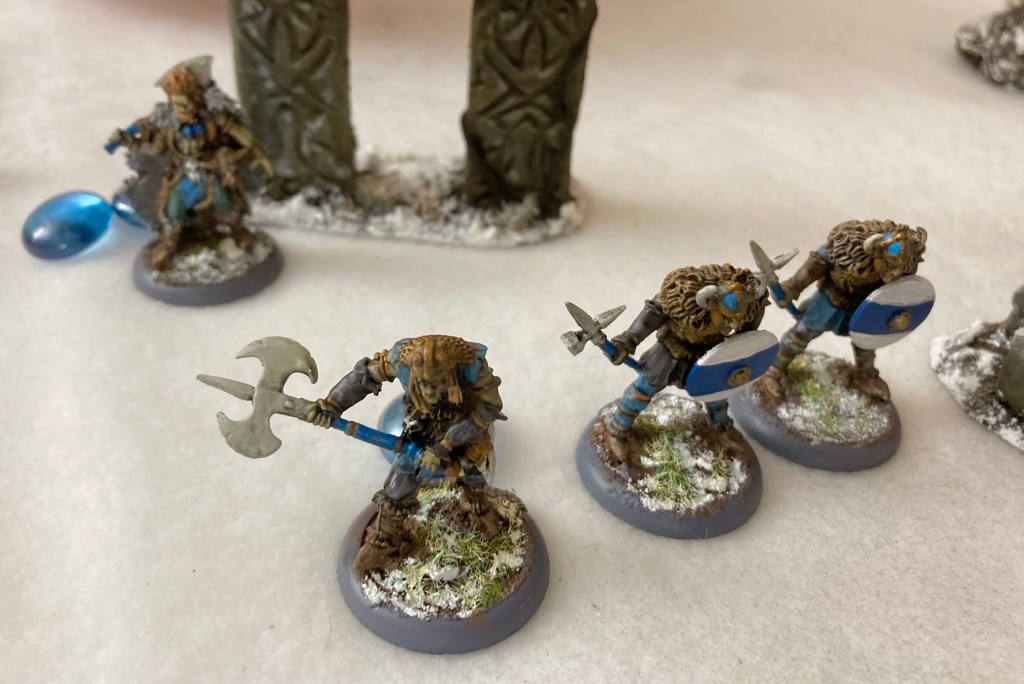
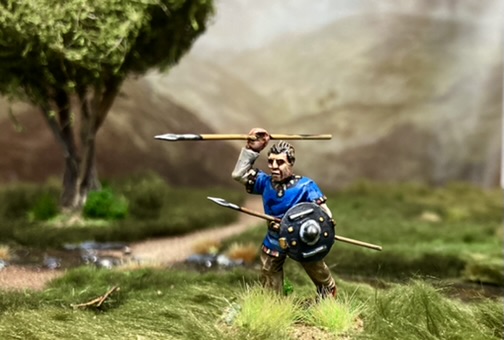
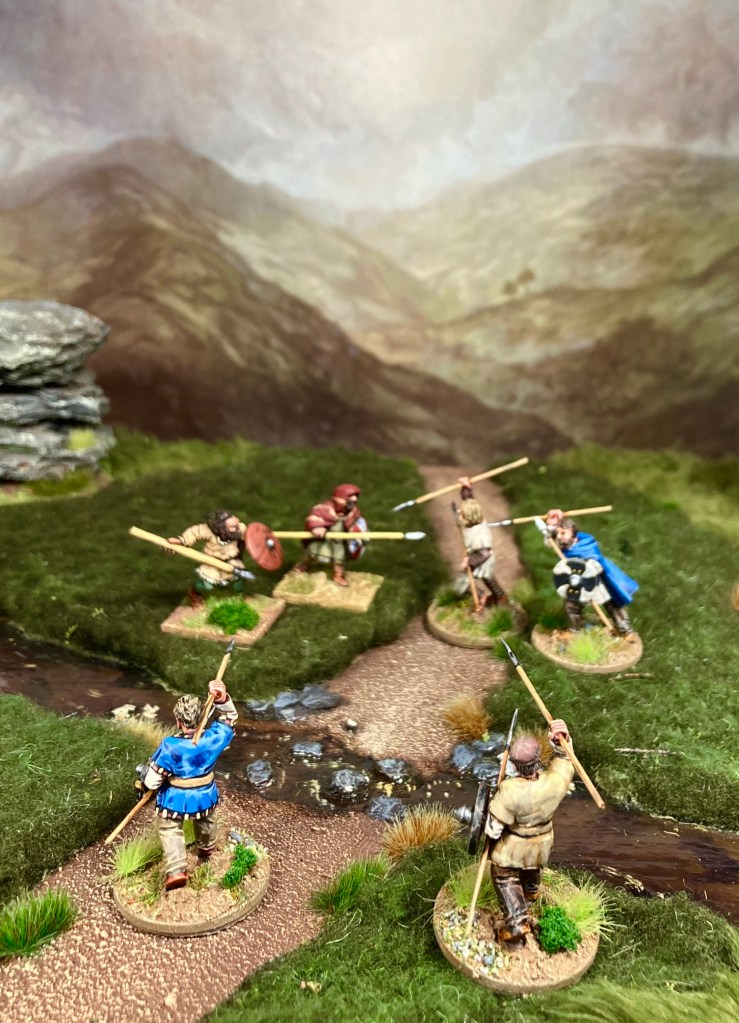
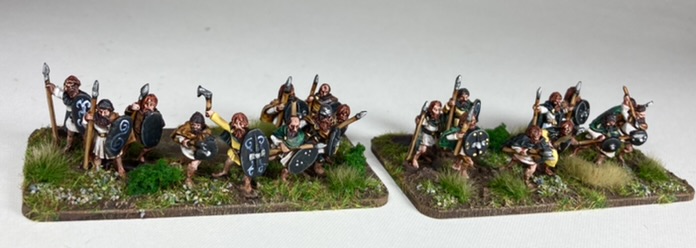
Siglac Smurf-Hat gets his file-hard spear ready for chucking.
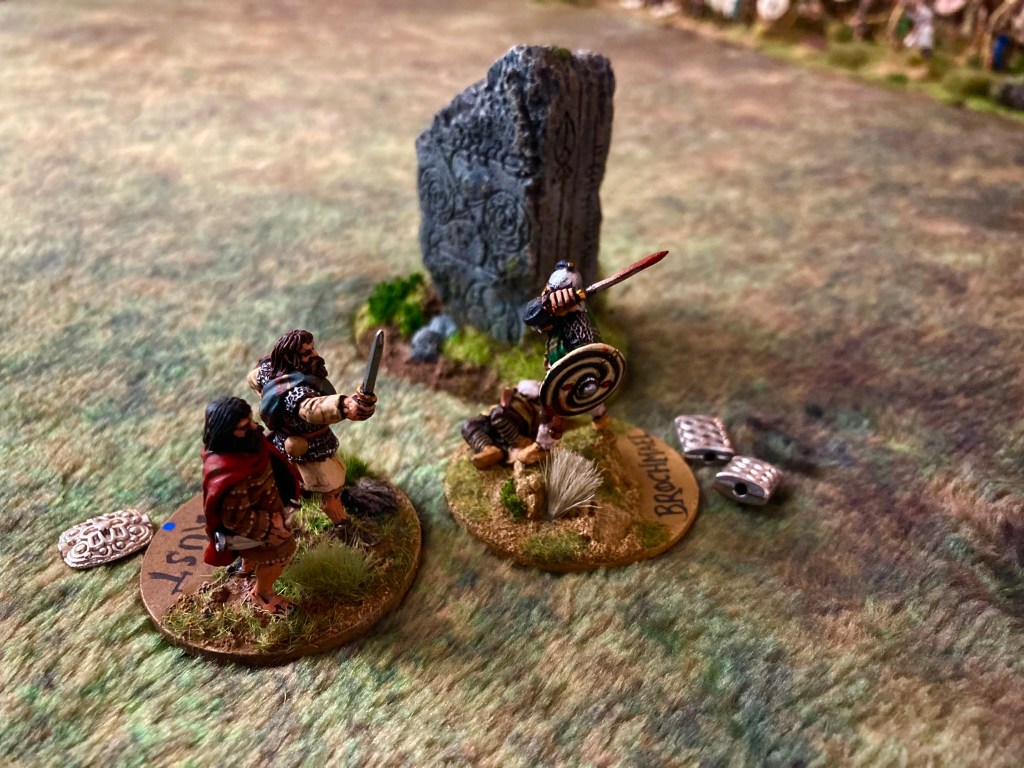
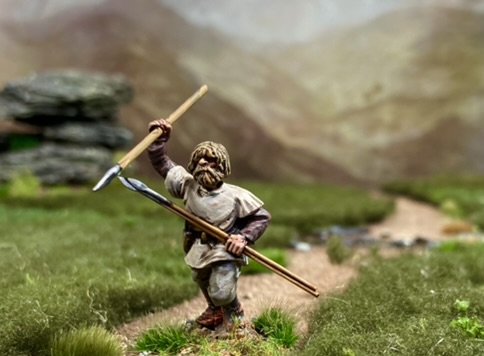
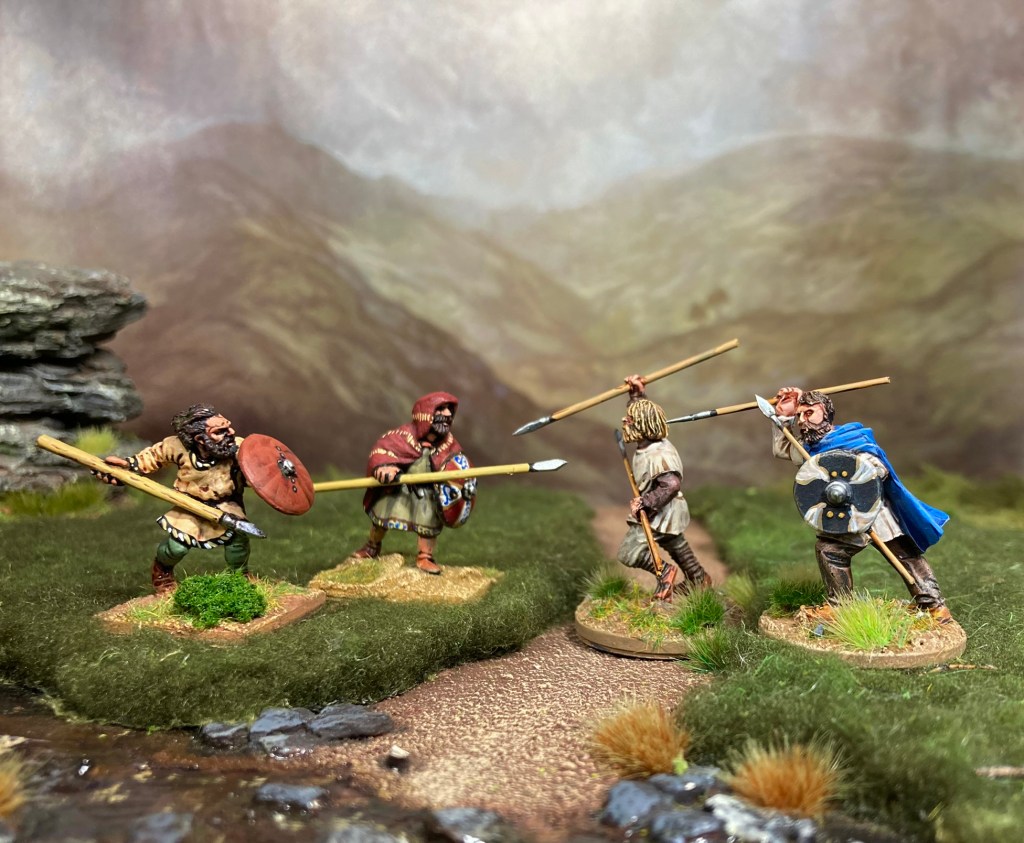
Hengist the Hairy wields his North Star spears with vicious intent
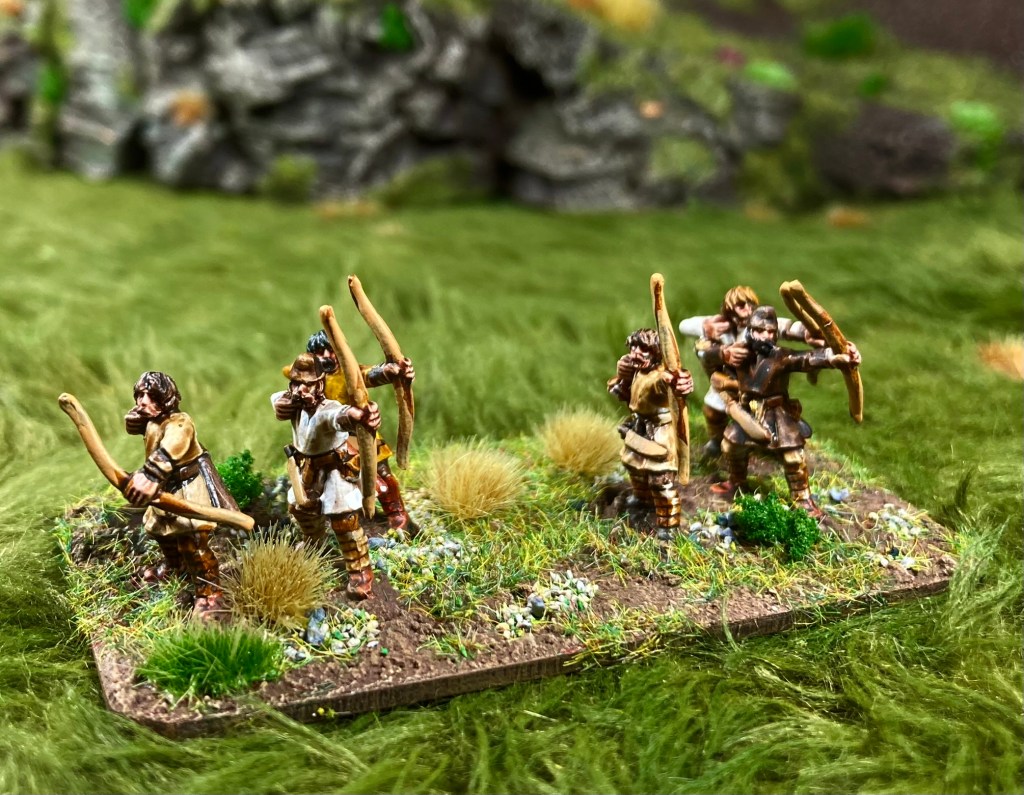
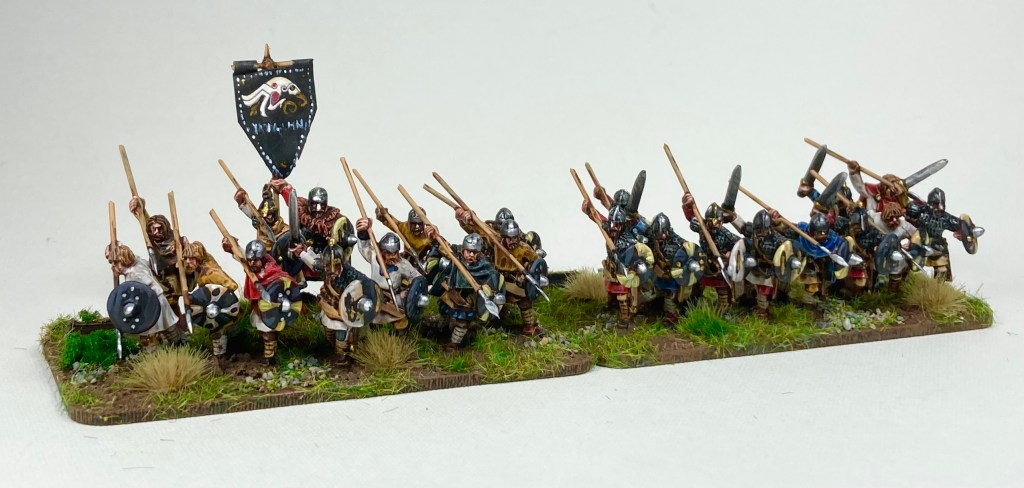
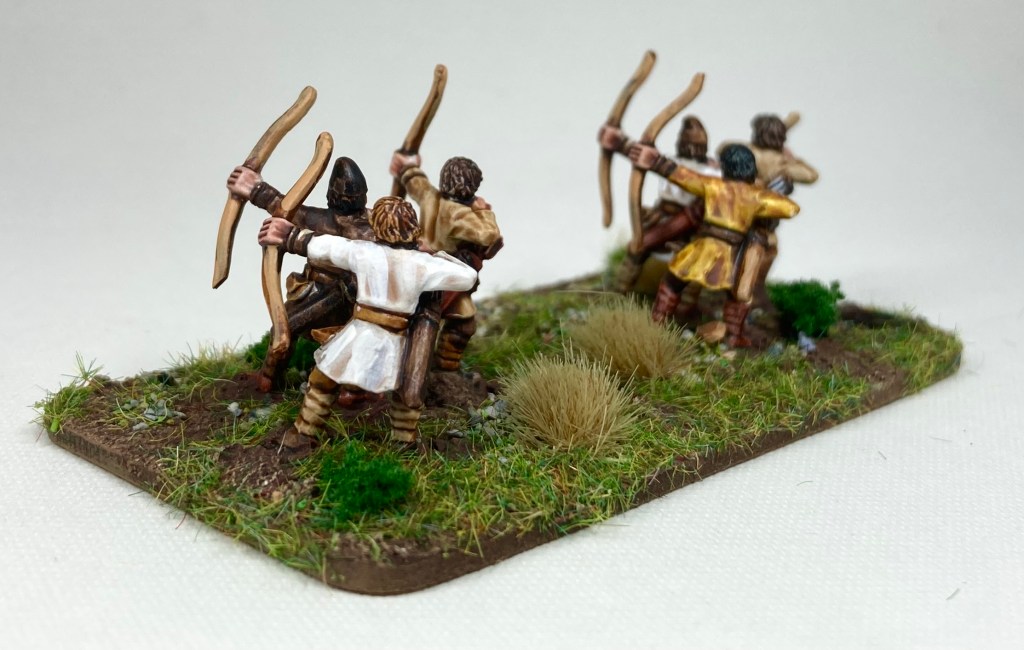
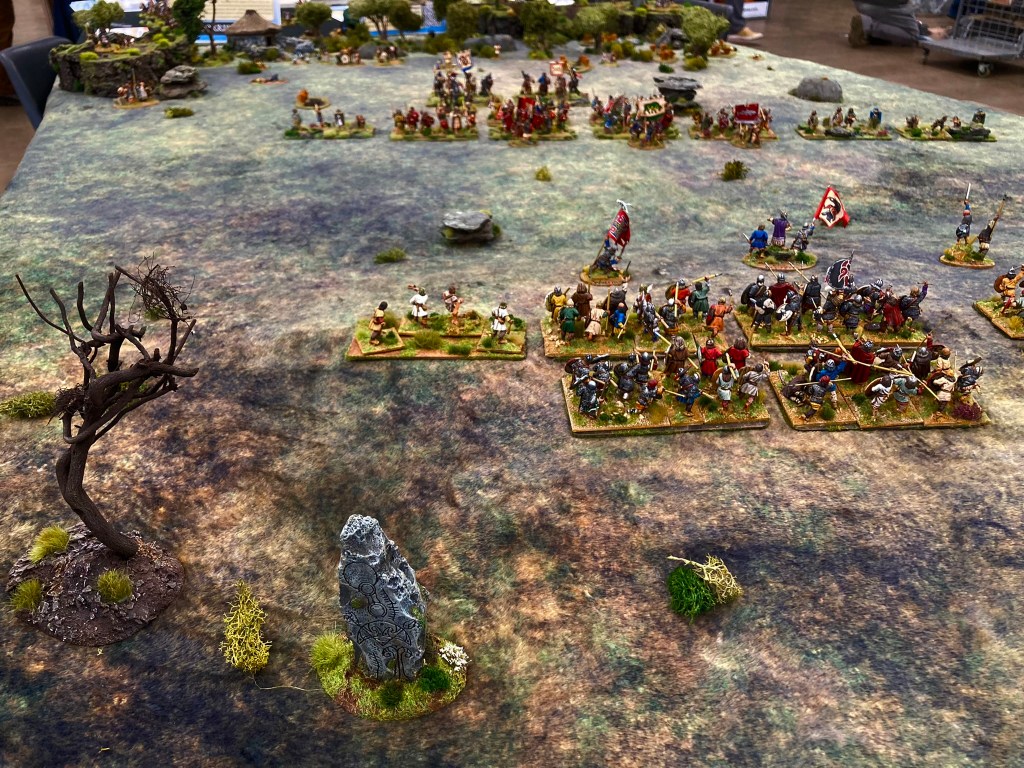
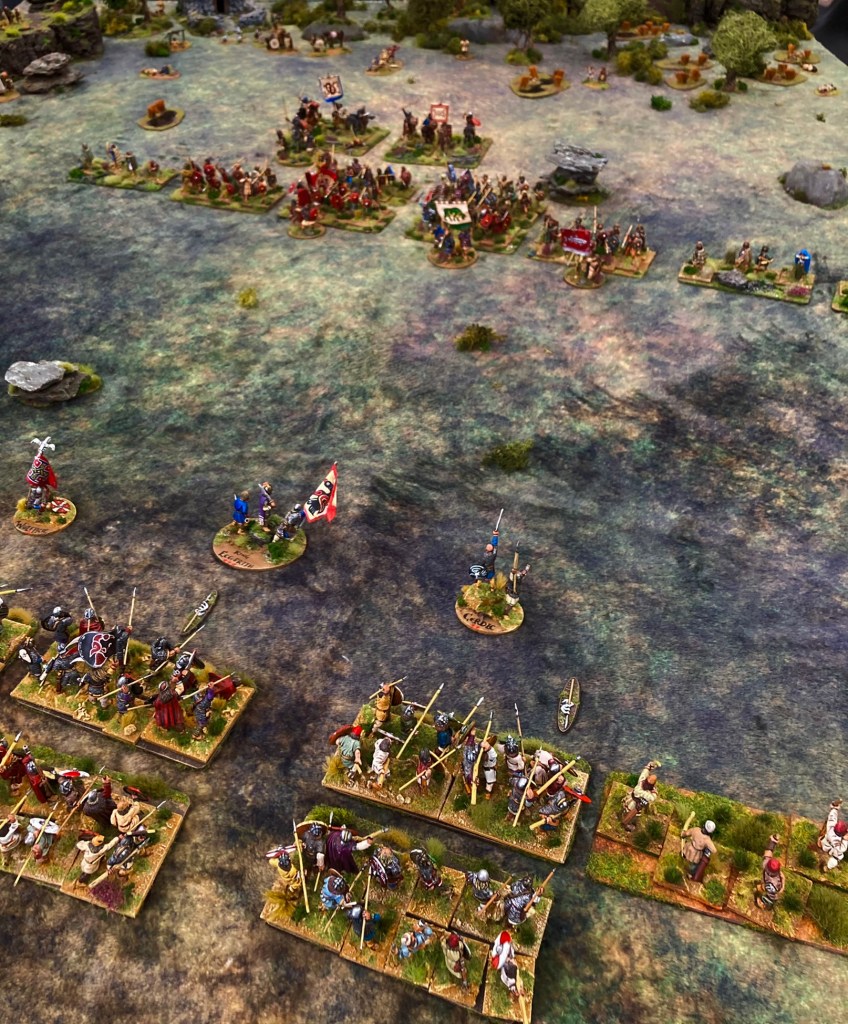
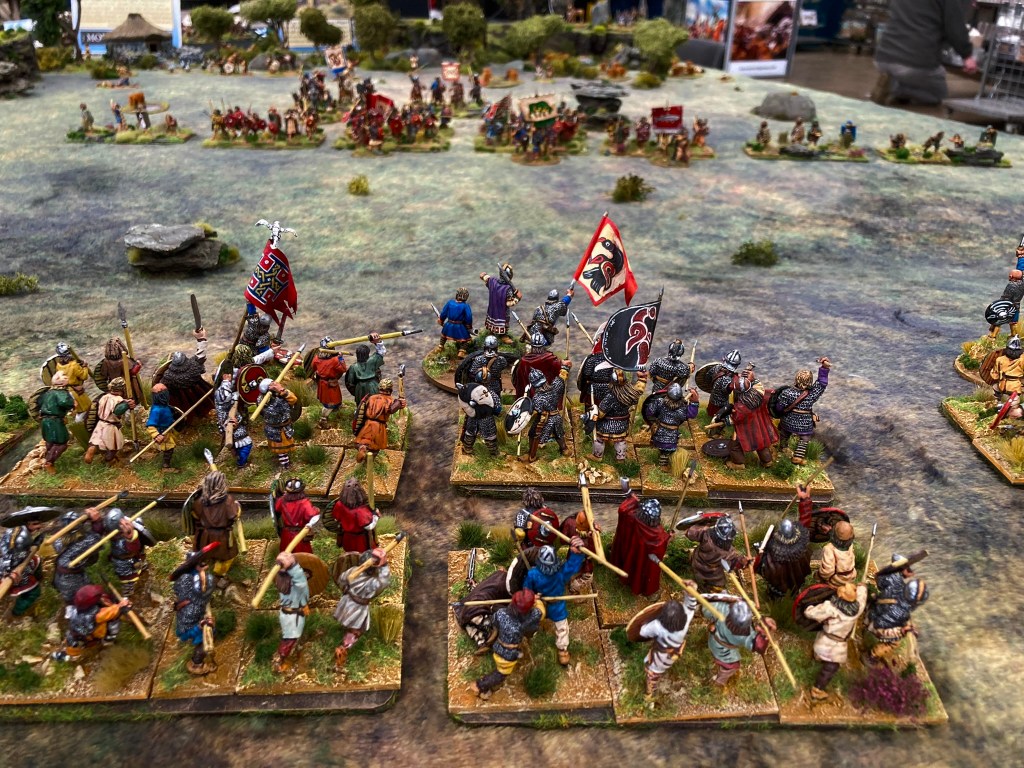
Fortuitously, I had a pack of Saxon javelin men handy, so I set to work getting these prepped and primed for painting. They have separate heads, which is great fun as you can really vary the models (my favourite is ‘Hengist the Hairy’ who is clearly in need of a barber.) These were a bit of an experiment as my original Dark Ages armies were painted with a black undercoat, base coat, wash and highlights. Recently I have converted to using a white undercoat with GW Contrast paint base coat followed by highlights, therefore cutting out one of the stages, but I wasn’t sure it would be quite right for these chaps.
I needn’t have worried as I managed to pull off something appreciably similar. Using Contrast Guilliman Flesh speeded up painting the skin areas and will certainly be something I do again. Other base colours used were Wyldwood, Gore-Grunta Fur, Snakebite Leather, Cygor Brown and Ultramarines Blue, all with various amounts of thinners. Once done, I just highlighted key areas with similar acrylic paints from my collection.
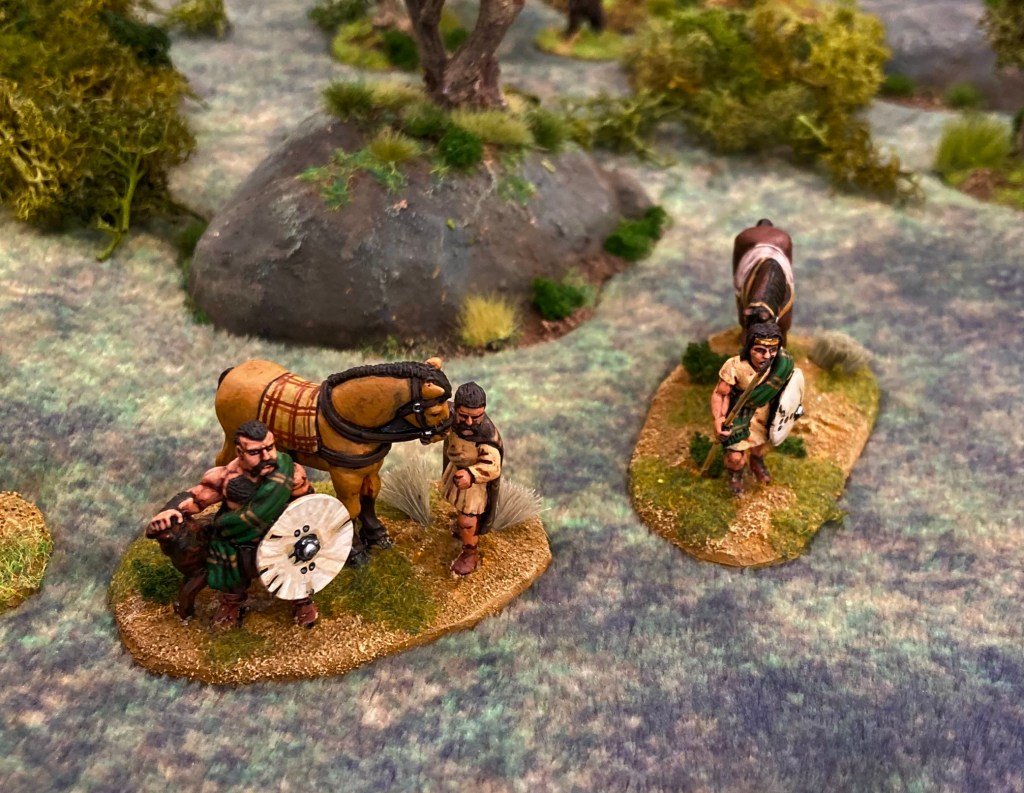
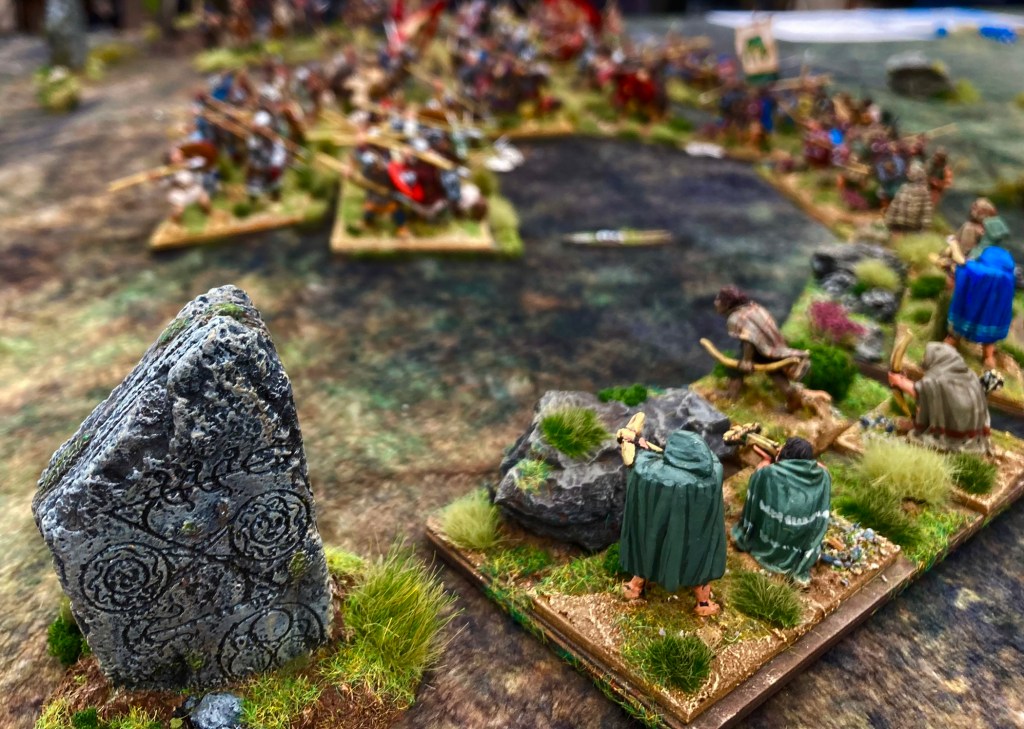
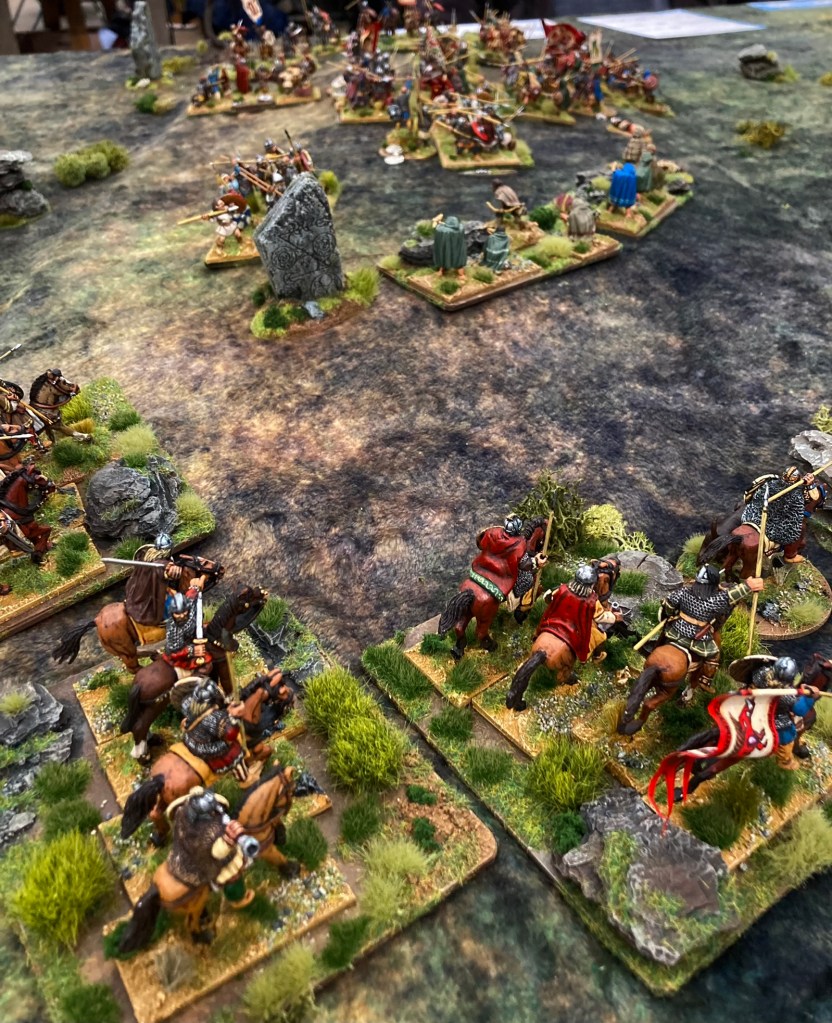
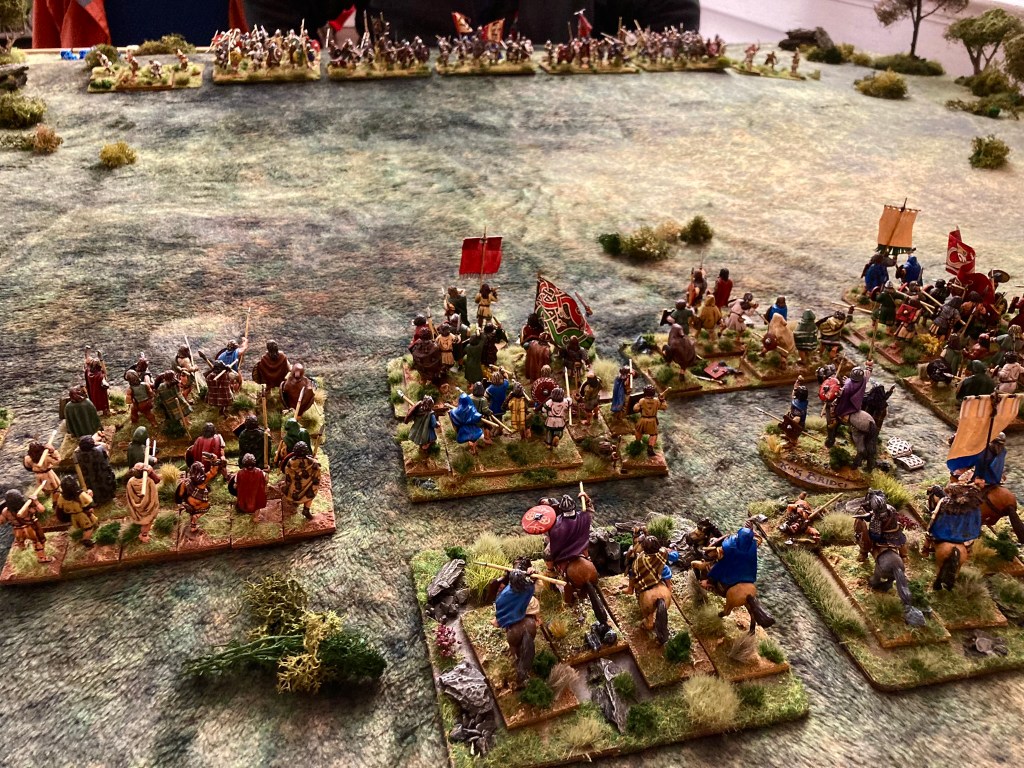
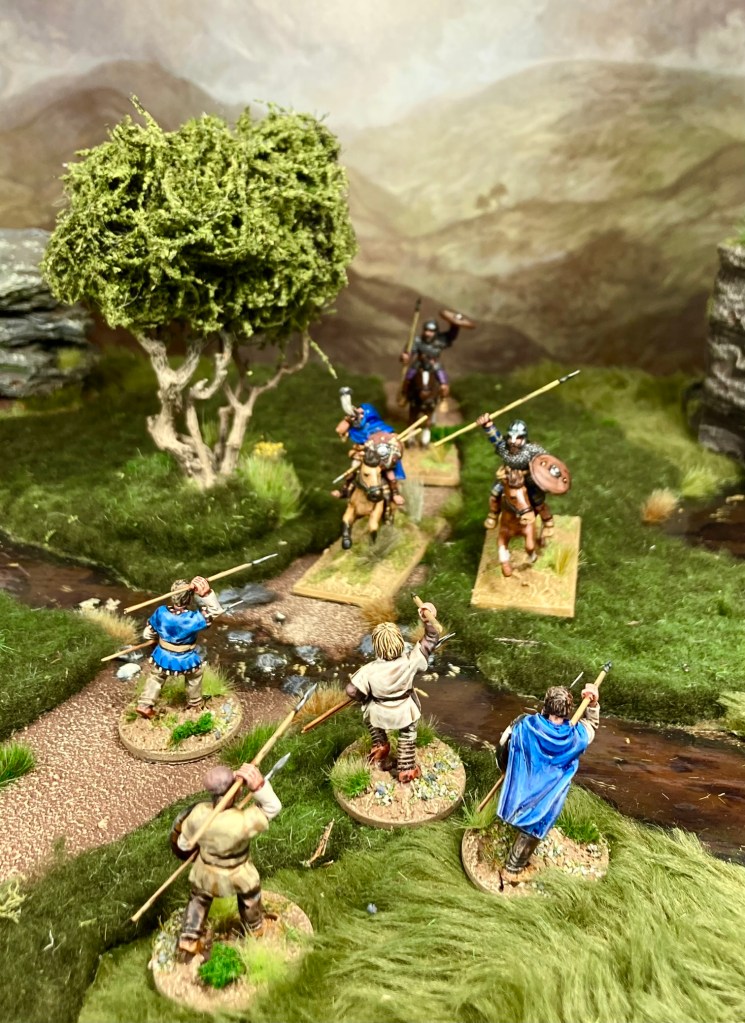
The pics here were taken against the new background from Jon Hodgson Maps, ‘Two Tree Valley’. This has distinct shades of the English Peak District but could equally be the Scottish or Welsh Borders.
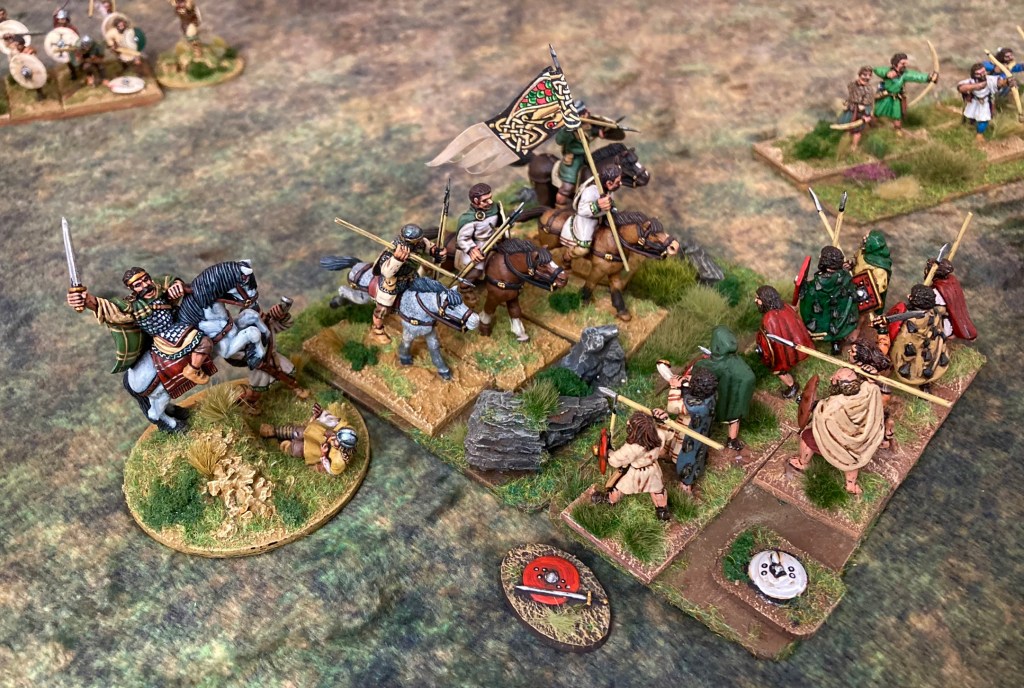
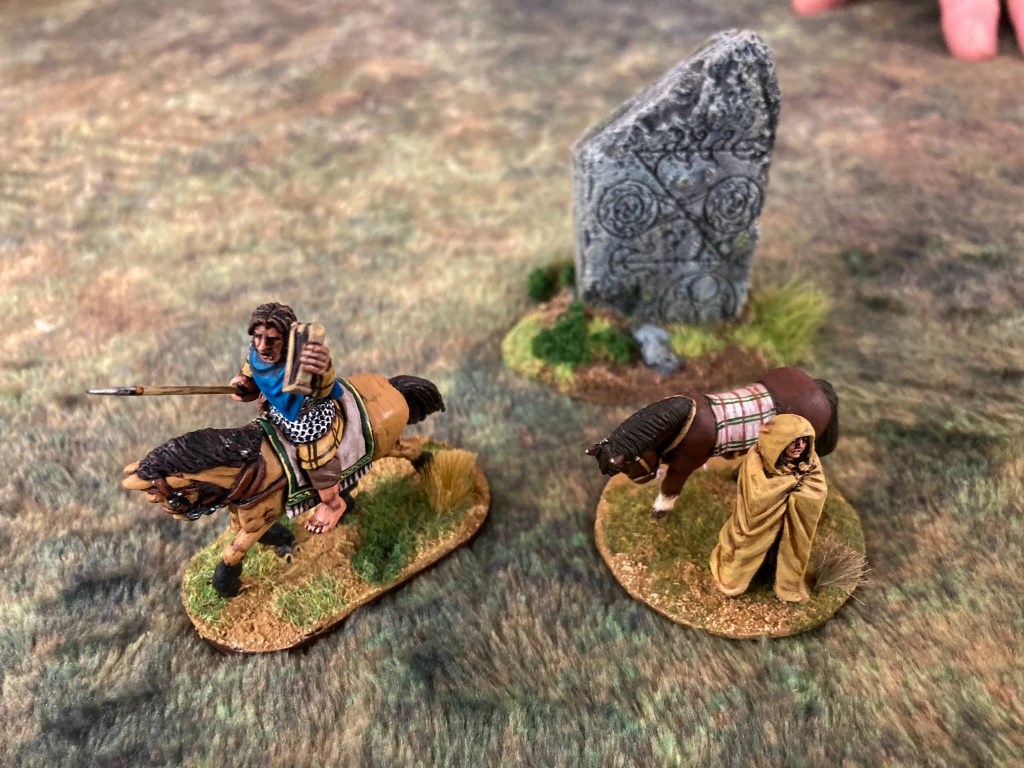
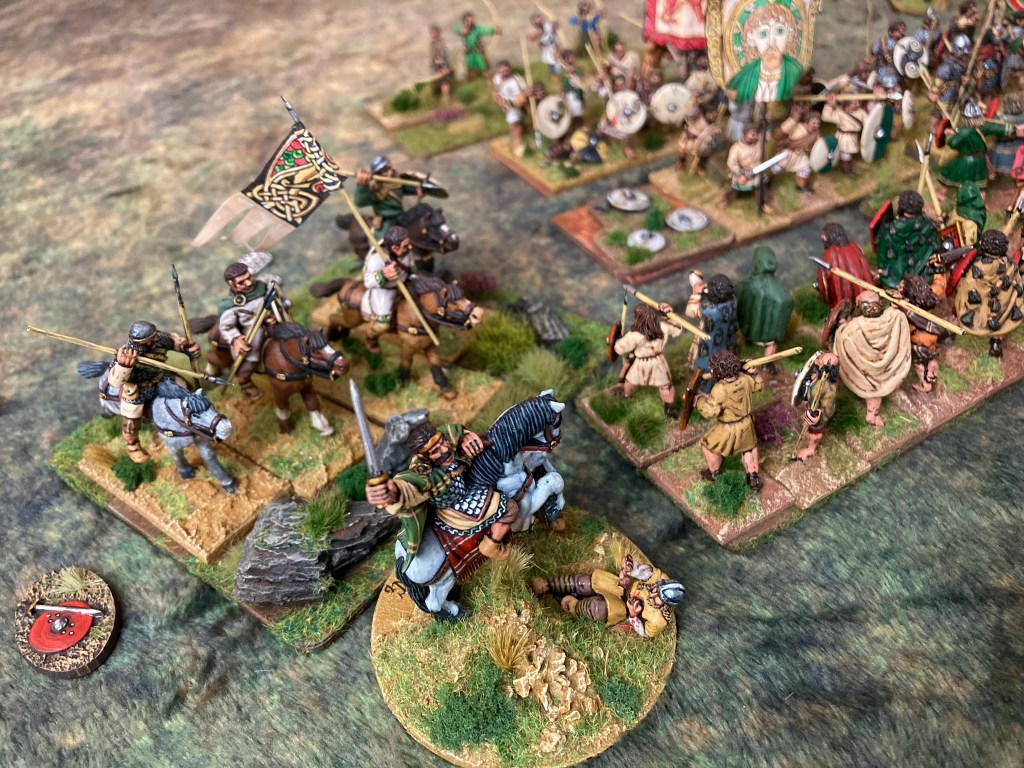
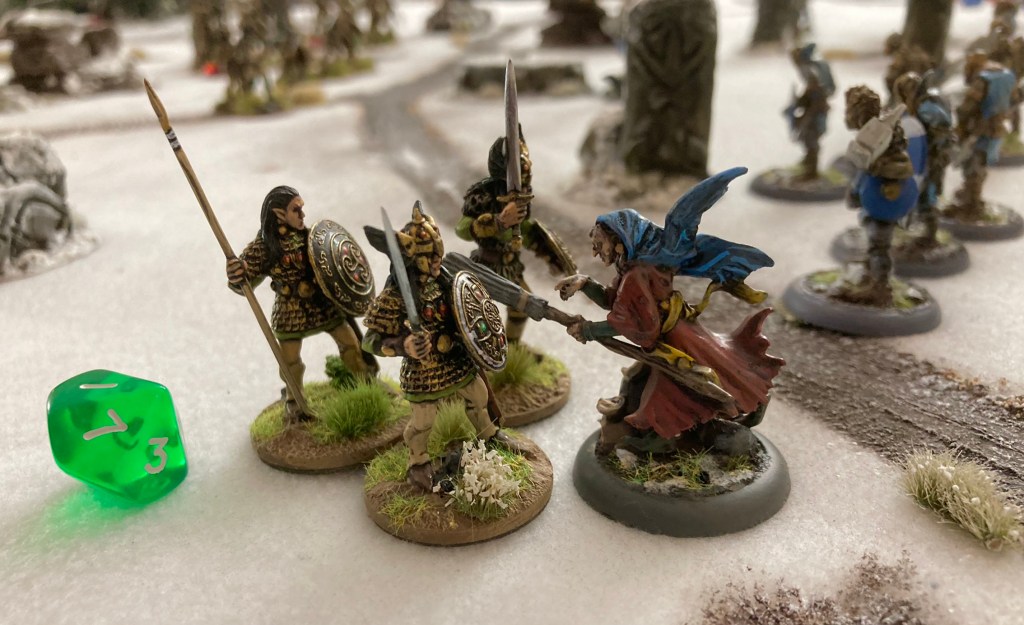
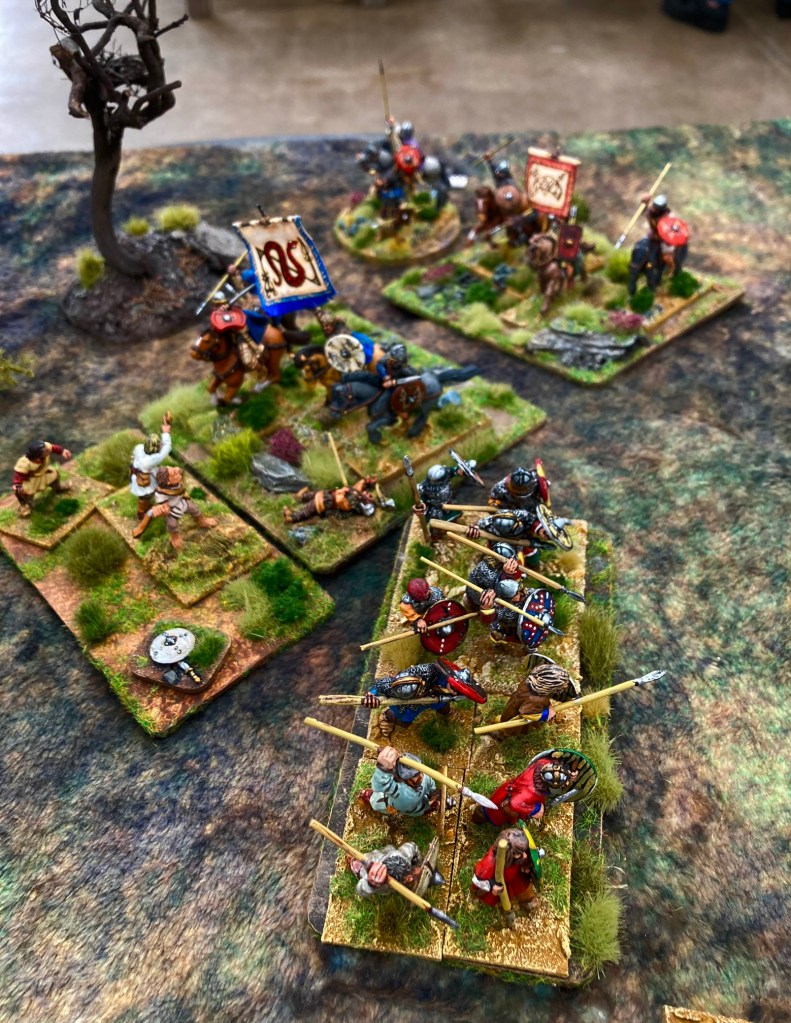
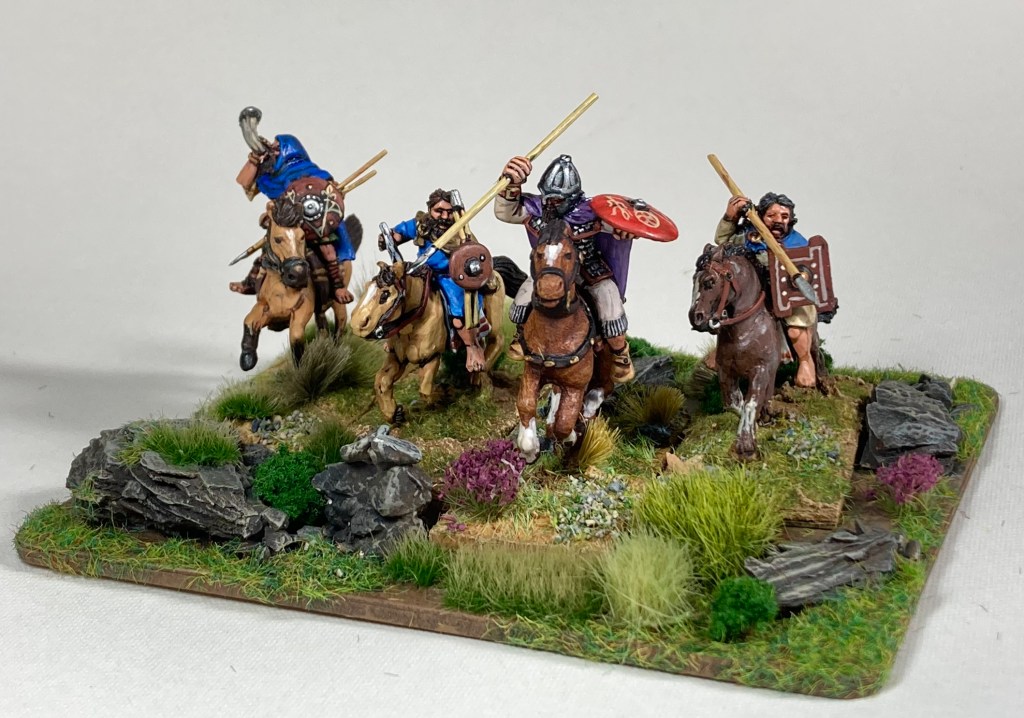
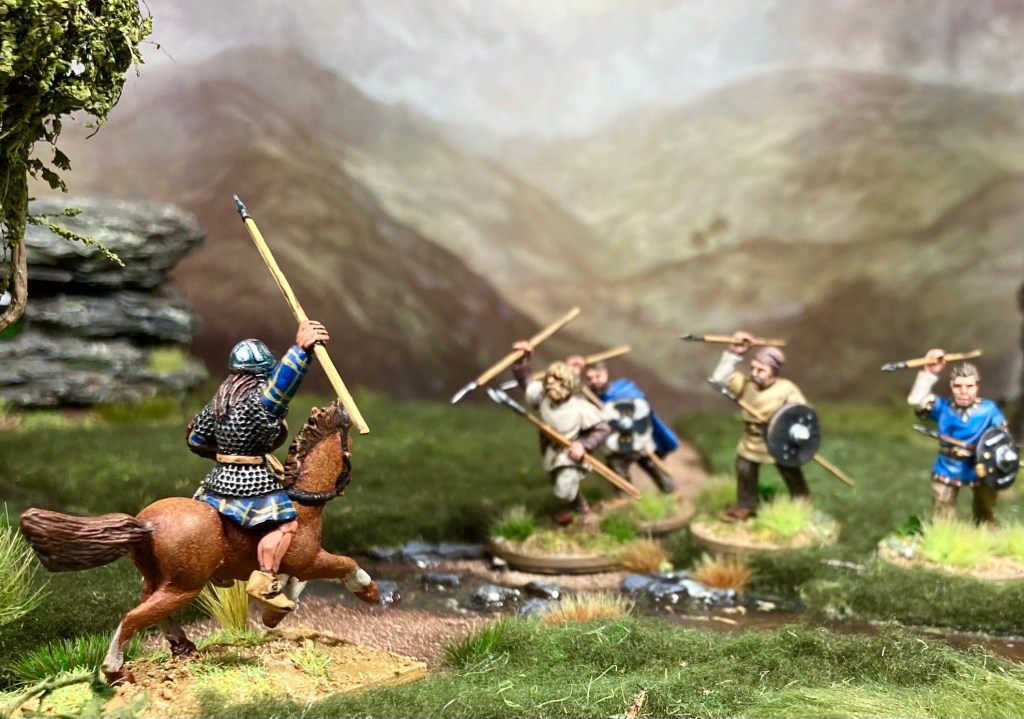
A Gripping Beast Pictish horseman challenges our brave javelinmen to single combat!
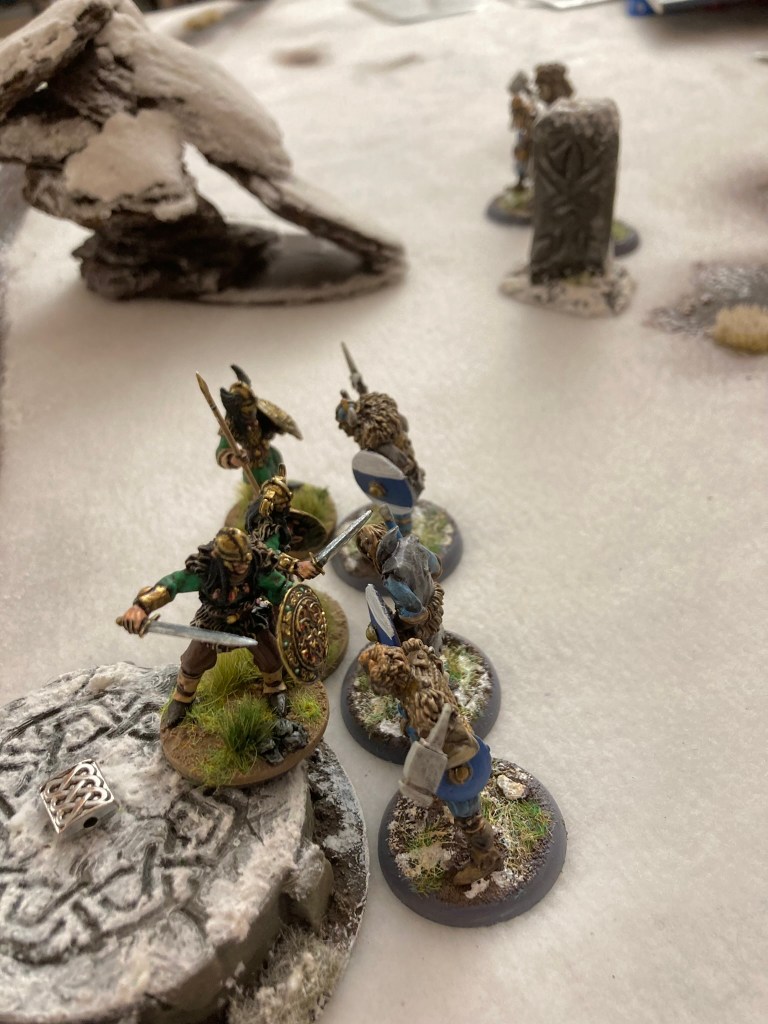
Call that a ford? Saxons clash with Pictish riders by Gripping Beast
The West Wind models (right) are very compatible with other manufacturers’ 28mm offerings – Black Tree and Gripping Beast (left)
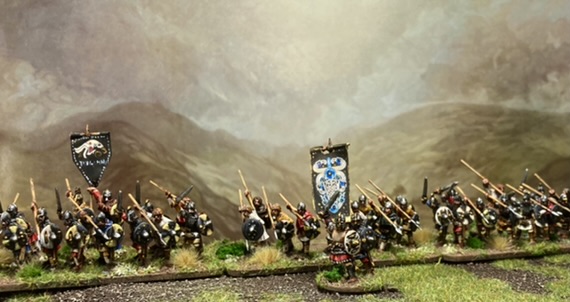
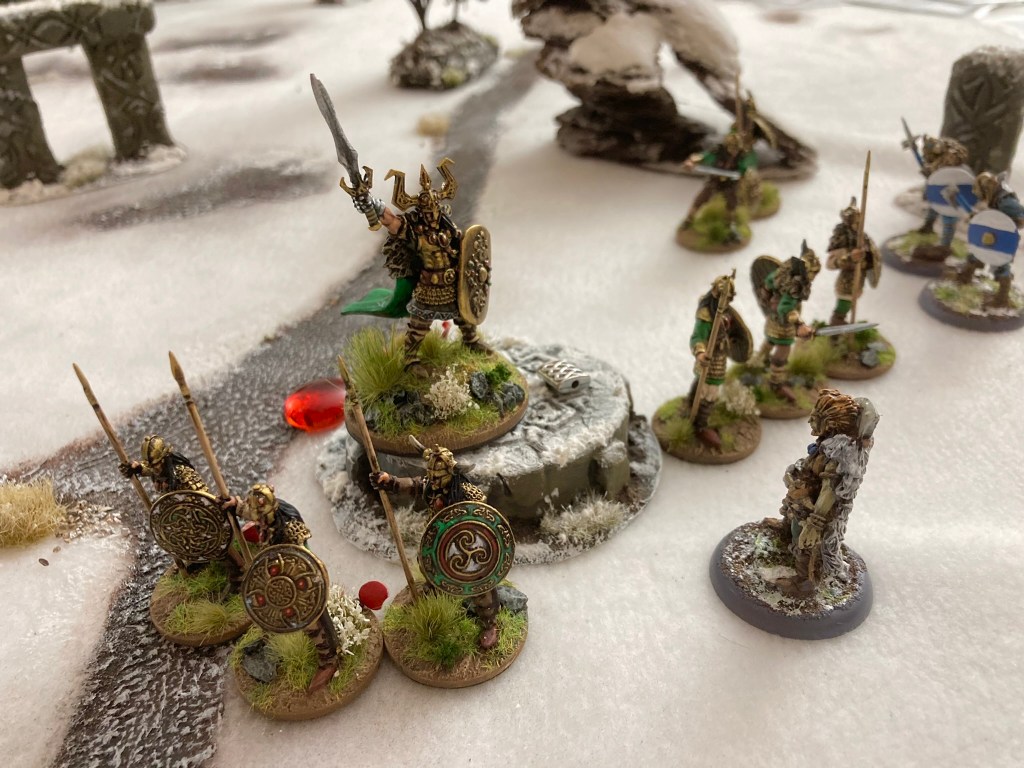
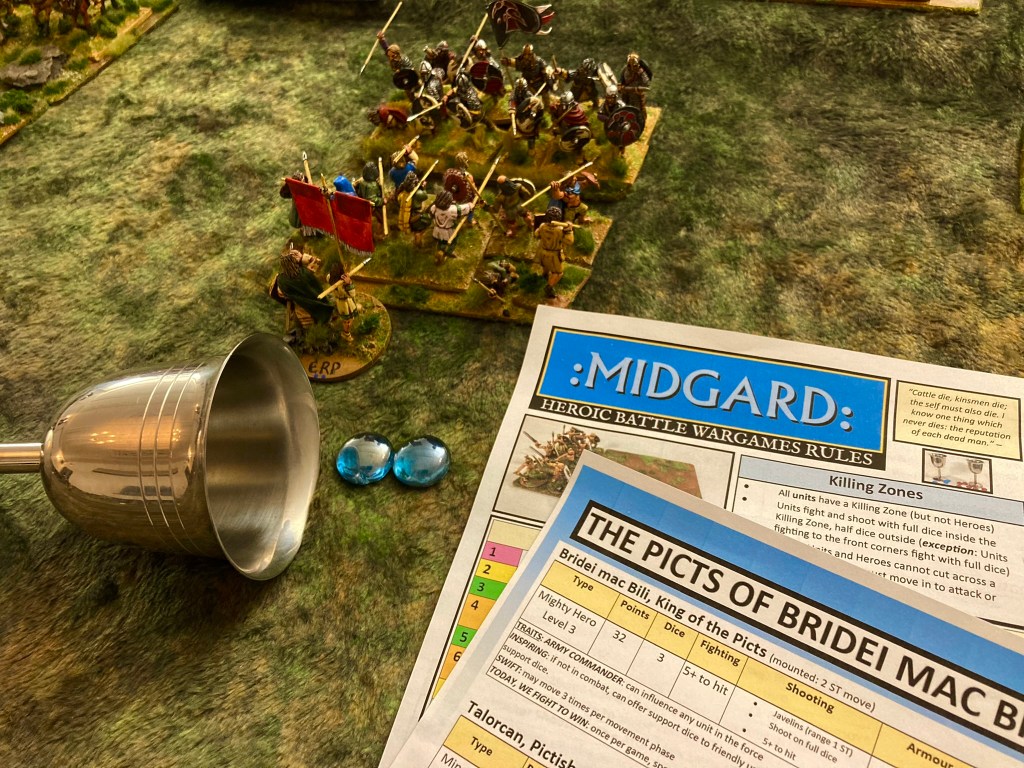
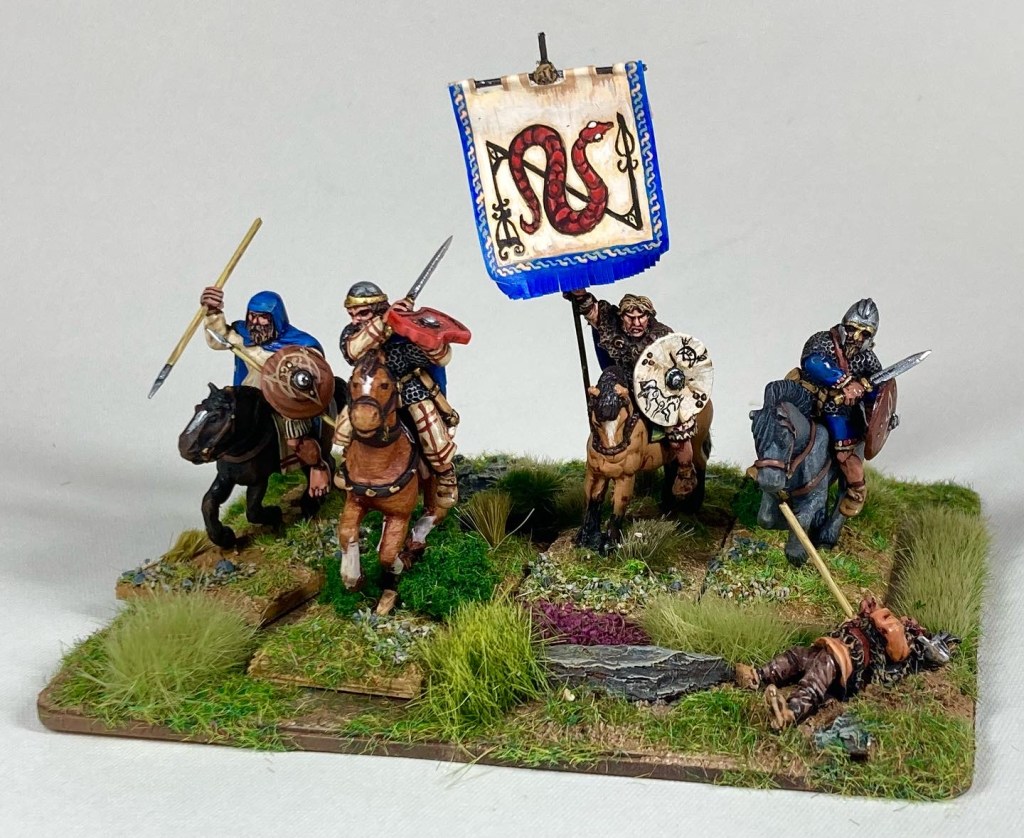
The warlords of the Picts, with my favourite misty trees background from Jon Hodgson Maps
My recent Battle of Degsastan game got me thinking that I should refurbish my beloved 28mm Dark Age armies. These were originally mostly based up for Warhammer Ancient Battles, with each model being on a small square base. I’ve always liked vignettes, so my later armies featured command bases on 40, 50 or 60mm round bases, but I’d never done this for my Irish and Picts.
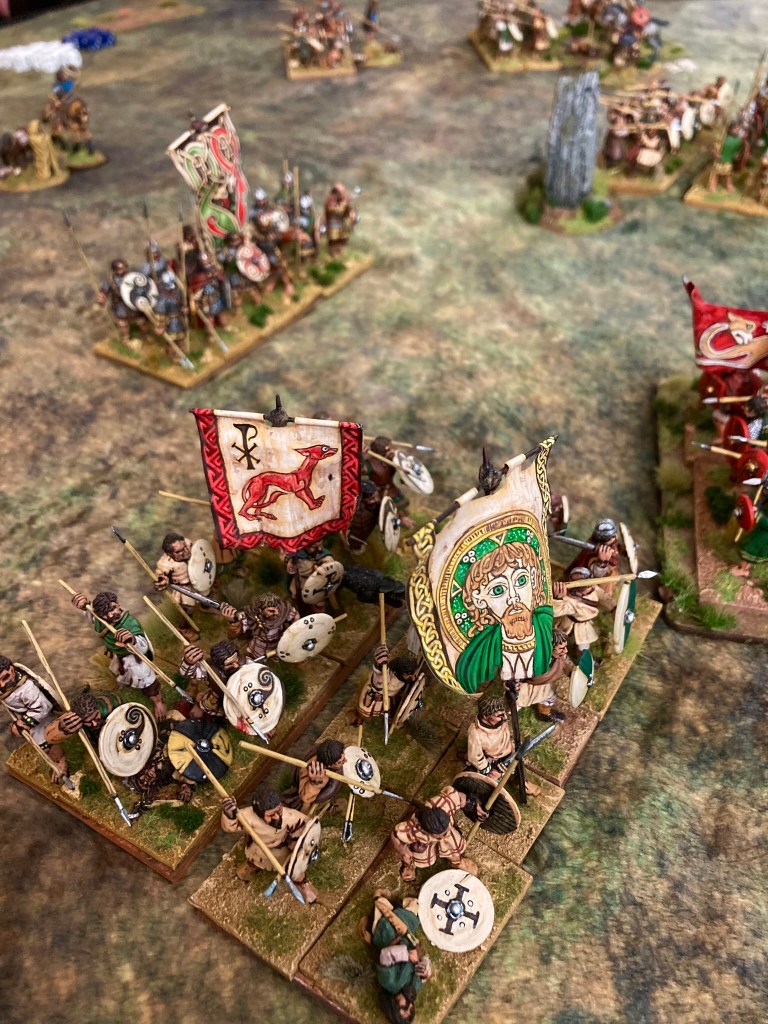
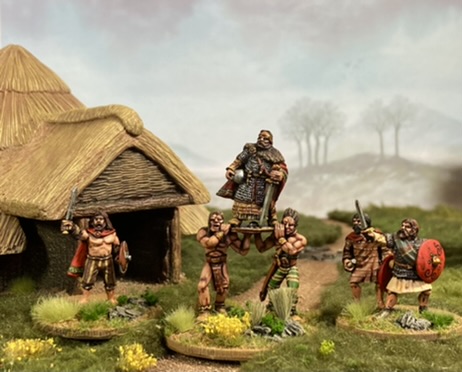
We muster at dawn! The Irish come out to fight. The King is a heavily converted Gripping Beast figures carried on his shield by two figures from the Alternative Armies Erin range.
Collecting the armies for this period was great fun, very much encouraged and enabled by two particular ranges: Gripping Beast’s Irish and Foundry’s Picts, which both trailblazed the better representation of ‘Celtic fringe’ types in 28mm wargaming. Now, of course, we have the miracle of two plastic boxed sets of Irish from GB and Wargames Atlantic, but back when these were collected, it was metal or nothing!
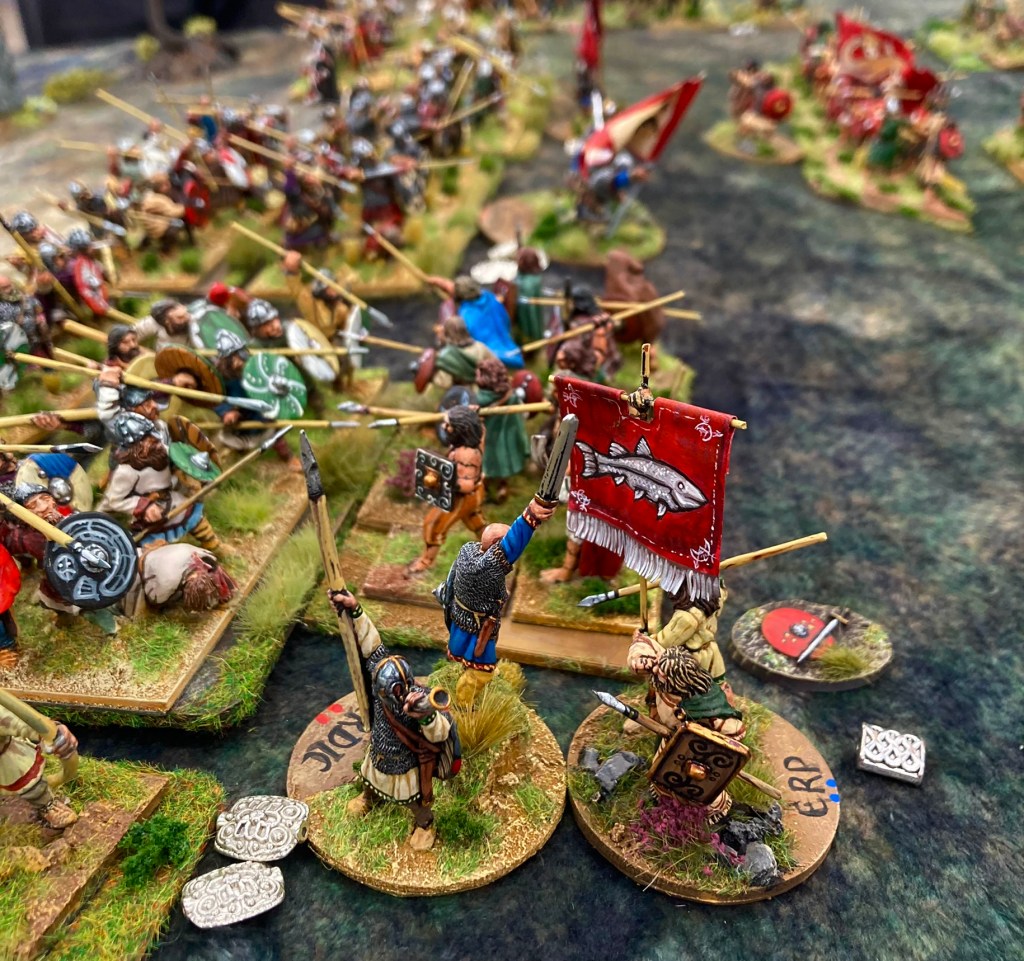
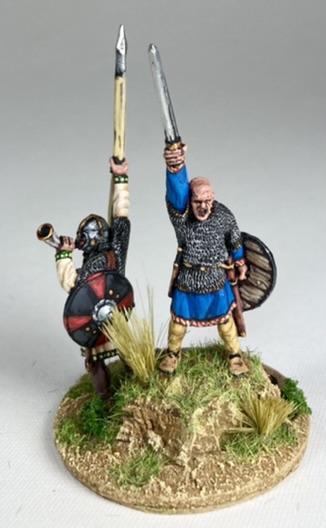
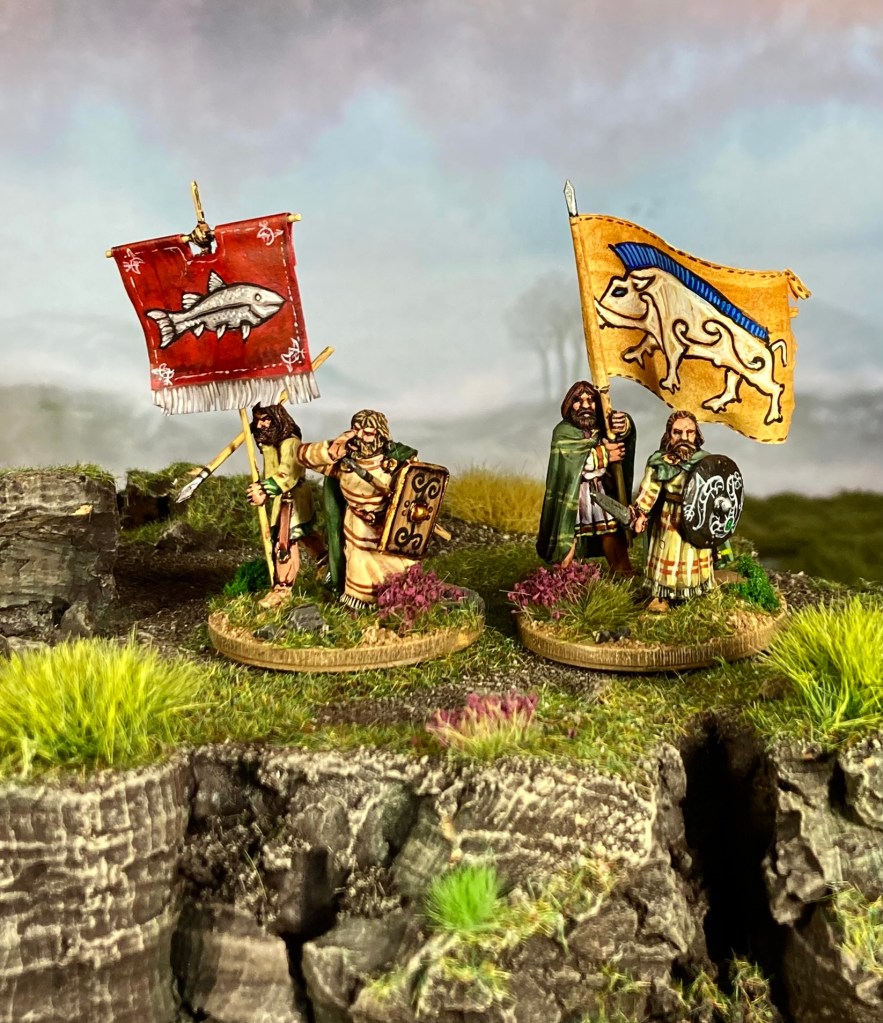
Pictish king – two Gripping Beast models with a hornblower from (I think) Old Glory. I always liked the idea that the ‘broken arrow’ Pictish motif might be a protective symbol so I painted it on the king’s shield.
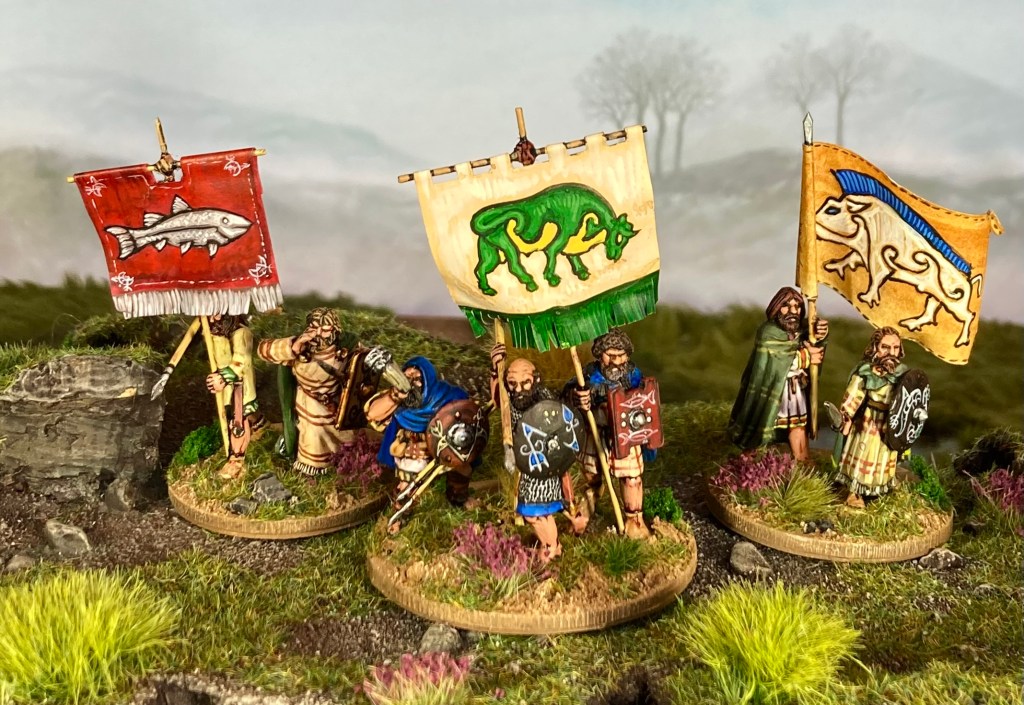
To create the vignettes, I went back through my units to pull out my favourite standard bearers, horn blowers and commanders and played around with arranging them on various bases. These were painted (and in some cases, repainted) over a number of years, dating back to my earliest dabblings in 28mm historicals, so you can probably see some variations in the brushwork!
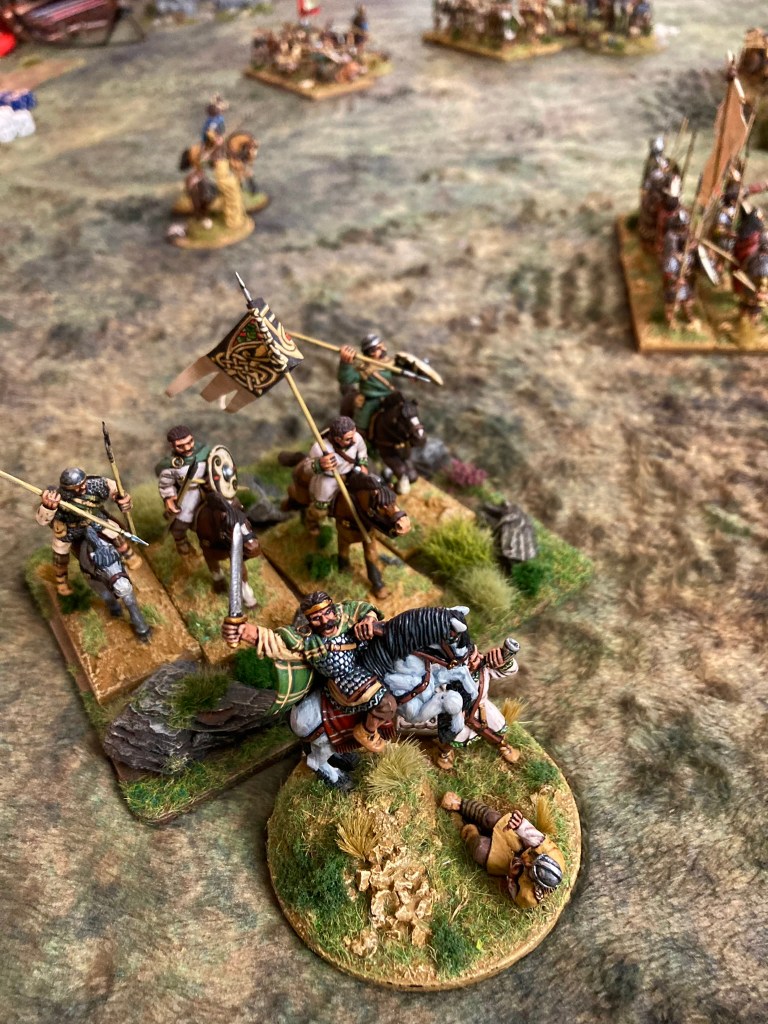
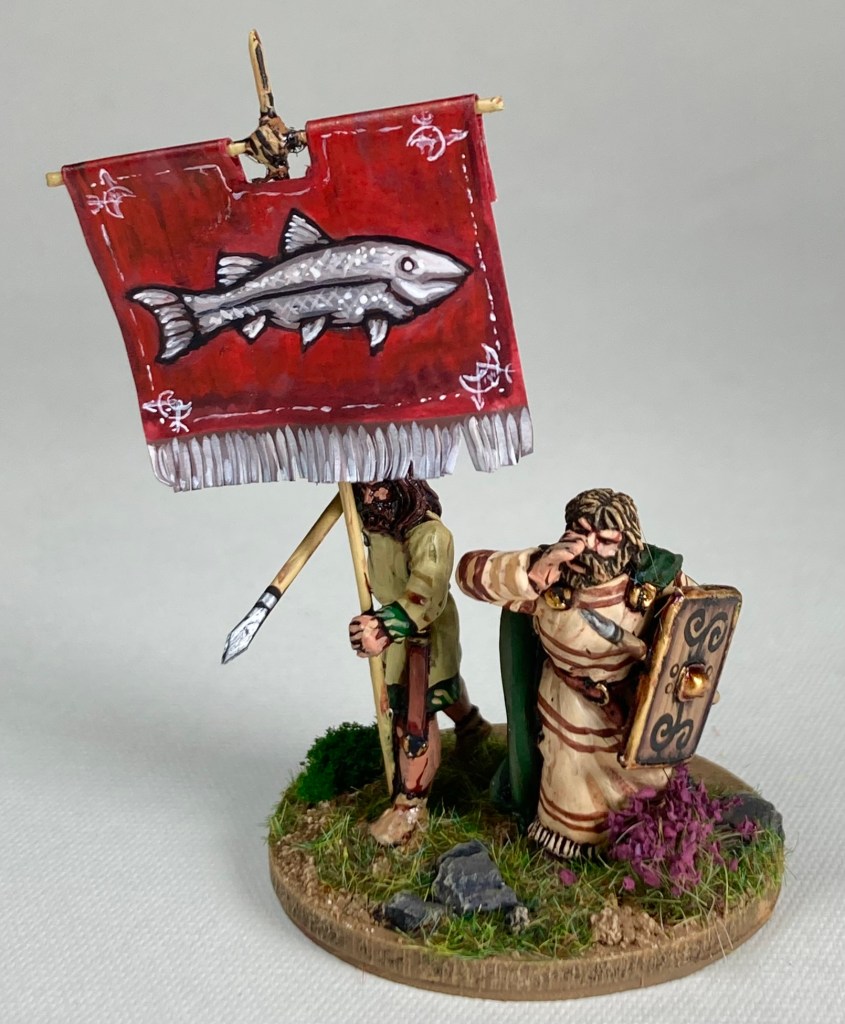
Irish King – a wonderful miniature sculpted by Duncan Patten for Gripping Beast, based on the Angus McBride painting. Flanking him are a banner bearer (a Colin Patten sculpt from GB) and a horn blower (a Pict from Black Tree Designs)
Angus McBride – Irish Sub-King from the Osprey book Arthur and the Anglo Saxon Wars
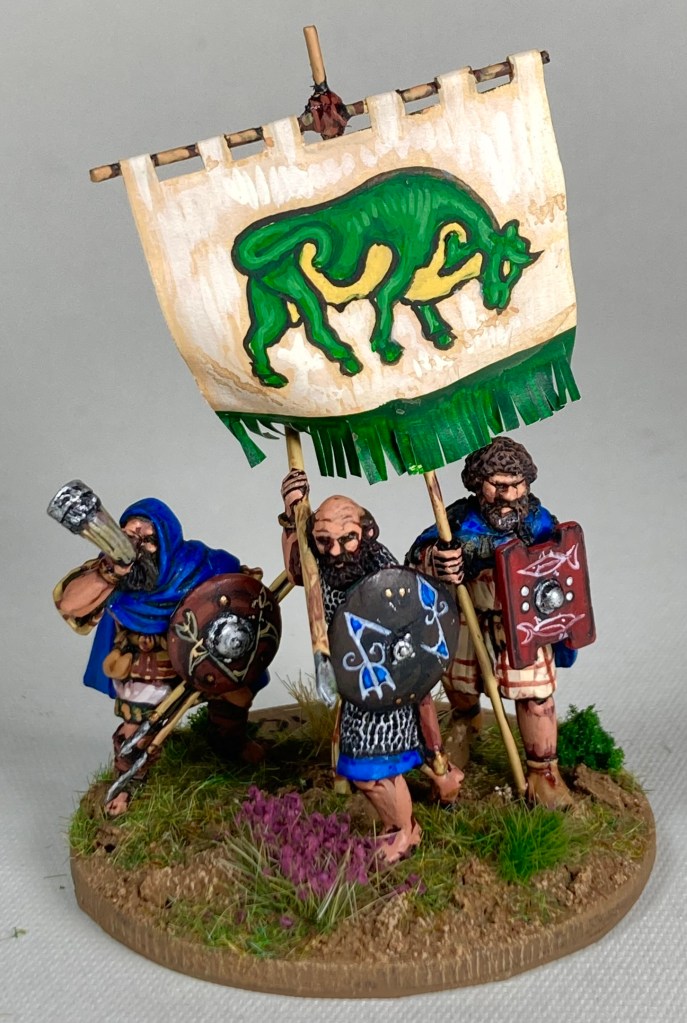
Flags and shields were all done by hand, using sculptural and pictorial references. It’s unlikely that any banners were as large as these in history, but for me , the visual appeal and ease of identification on the table is just as important.
It was lovely to revisit these old fellas, so much so that I impulse-ordered a few West Wind Picts to create a new command stand for these armies. More soon!
Irish champion from Crusader Miniatures
These chaps are both Black Tree Designs Picts masquerading as Irish
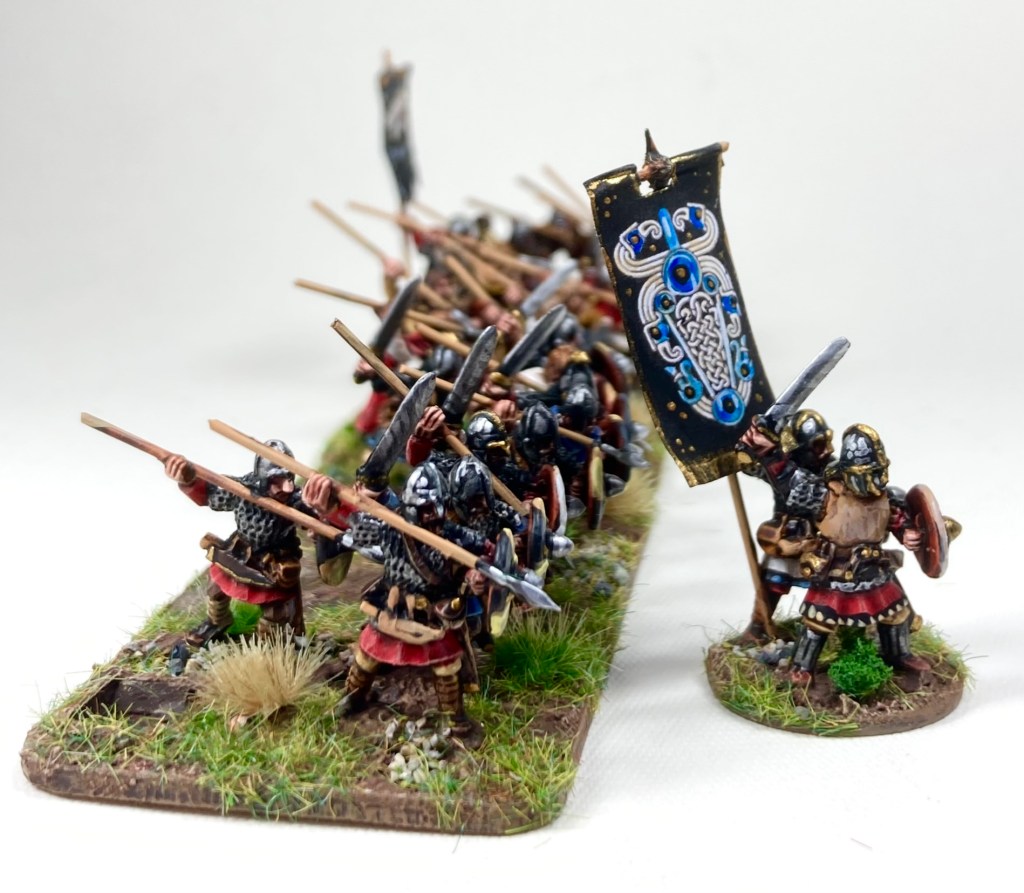
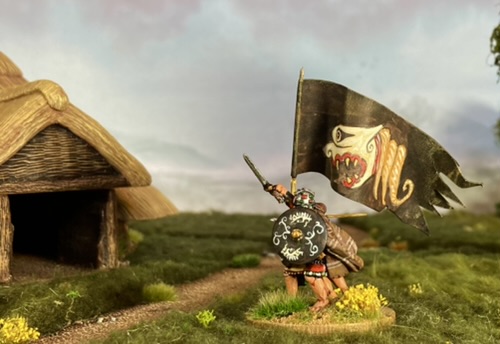
This banner is really hard to photograph! The black colour scheme was inspired by Owain’s Blackshield Irish in the Bernard Cornwell books
Irish warlord and standard using Gripping Beast figures
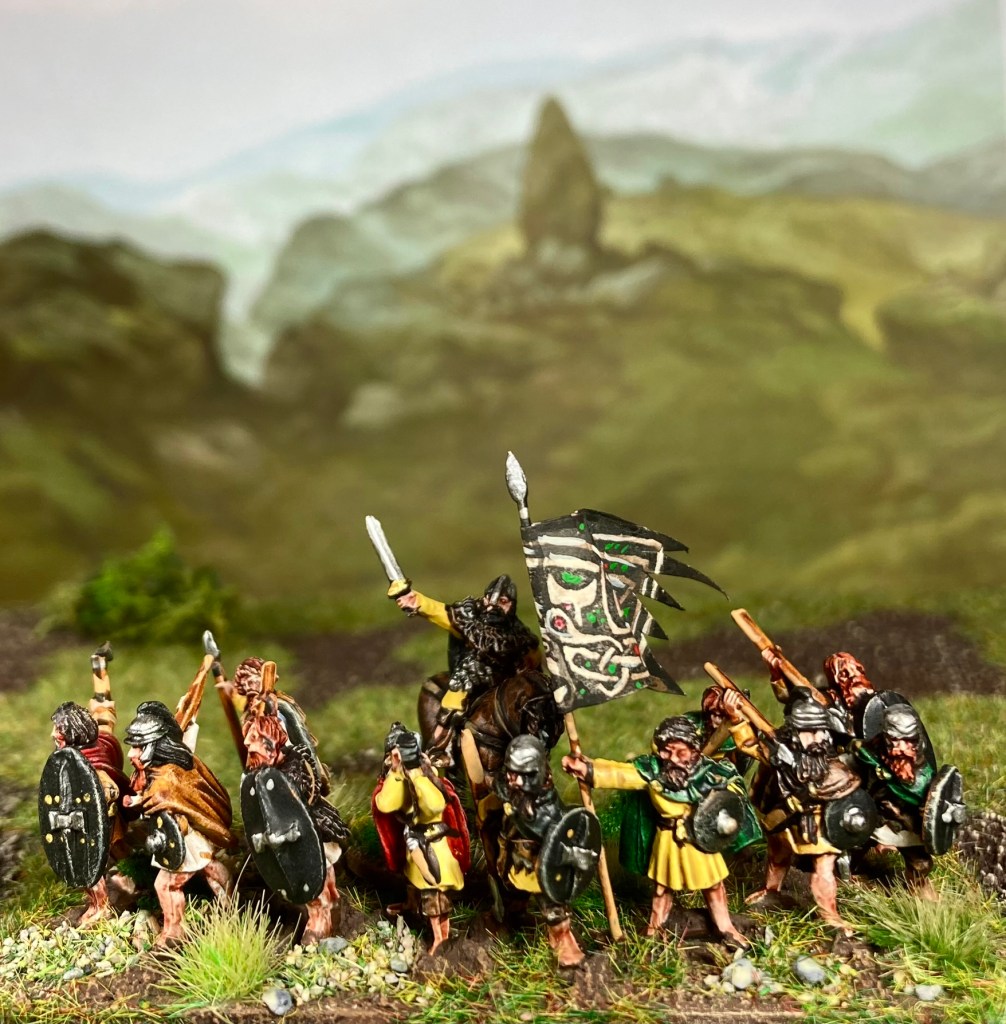
Pictish chieftains. Both standard bearers are Gripping Beast; the shouting commander is a Pict from Black Tree designs, the commander with sword is a Foundry Pict.
Penda and his finished unit. The background is a download from Jon Hodgson Maps
Although I’m mostly a dyed-in-the-wool 28mm gamer, I have odd lapses. When Dan Mersey announced that he was going to launch a small 15/18mm 7th century Dark Ages range, I thought ‘maybe I’ll get a few.’ Then it turned out that Mark Copplestone was sculpting…then I started getting back into the Dark Ages…then…yeah. Another odd lapse.
I’d already cracked and bought a few packs of Forged in Battle Welsh by way of experiment, which I blogged about a couple of weeks ago, and was waiting for some further news on the Wiglaf Miniatures range. One day last week, I managed to leave my sandwiches at home and had to pop back from work at lunchtime. This hungry cloud had a silver lining, as I found a small but weighty jiffy bag waiting for me with some familiar handwriting. I was absolutely delighted to find I had been sent a pre-production sample of some Wiglafs by none other than Mr Mersey himself!
As you’d expect from Mark Copplestone, they are superb little sculpts (comparable, I’m told, with his fantasy Barbarica range). Indeed, they could easily be 28mm, they have so much detail. The mail, pouches, faces, seaxes, clothing and hairstyles are terrific, but my favourite part has to be the helmets for the noble warriors: Benty Grange, Coppergate and Shorwell-type helms all feature.
“Err…Penda…they say your helmet’s a bit dodgy.” “Shut up, Wiglaf. Do you want to be food for the ravens?”
Named leaders are also included, wearing noted archaological finds – Raedwald of East Anglia (depicted wearing the Sutton Hoo helm) and Penda of Mercia (with the more contentious ‘Staffordshire Hoard’ reconstruction of fragments – see here for a discussion on this if you’re interested.) Whether or not his helmet is historically iffy, Penda is a splendid figure and was fun to paint (and the helmet crest could easily be removed if you didn’t want it.)
Something I’m not used to with 15/18mm figures is having to add spears; it added an extra layer of prep before painting, but really wasn’t too difficult. Swords and shields were already cast-on and the clean-up of the rest of the figures was quick and straightforward. Spears are not supplied with the figures but this was no problem as I have a large stash of North Star wire javelins. Cut down, they did the job nicely with a drop of super glue to hold them in place. Hands are cast open and took the spears without too much trouble. The standard bearer got a simple banner pole made from a spear and an offcut of wire.
I understand that cast-on spears were also considered, but that would undoubtedly have compromised on the dynamism of these models. When you see them lined up in a ‘shield wall’ – or whatever the 7th century equivalent really was – you can see how good they look.
Painting involved a white undercoat (Halfords White Primer in the UK) with similar stages to painting the Forged in Battle Welsh from a few weeks ago. Basecoats were applied with mostly GW Contrast paints and selected highlights and details. To be honest, I spent slightly longer on them than I was planning to due to the exceptional detail. I expect that future models will get done more quickly.
White undecoatedAll over wash of thinned down GW Contrast Wyldwood. Skin done with GW Contrast Guilliman Flesh when dry.Starting to block in coloursSpearshafts are GW Contrast Snakebite LeatherThe whole gang mid-painting in various stages of completionThis shot shows the wonderful level of detail on the cloaks and how easy it is to pick out with a wash or Contrast paints.
With the figures done, I was waiting for inspiration to strike on the banner. I was considering a raven in the style of early Saxon metalwork, but then realised that the Wiglaf Minis logo (itself a period design) would fit well on the banner pole! I quickly reduced it to an appropriate size on the printer, cut it out and added some colour before using PVA to fix it to the pole. Job done!
After painting and varnishing, Penda and his standard bearer were based up on a 2p coin with the rest of the unit on a 80x40mm 2mm MDF base from Warbases. Like the Welsh lord, I’ve arranged the unit so that Penda can join them or move separately as he likes (his base magnetises onto the unit base).
Wall of spears! Mini dice holder at top left for recording hits, space in the centre for Penda. You can see just how effective the separate spears are here!
In short, these little chaps are bloody amazing. At the time of writing, they are not yet available, but keep watching the Wiglaf Miniatures website for updates. I for one cannot wait to get a full army done.
They also base up singly very nicely – this chap is on a 20mm round base.One day, my lord, all this will be yours!
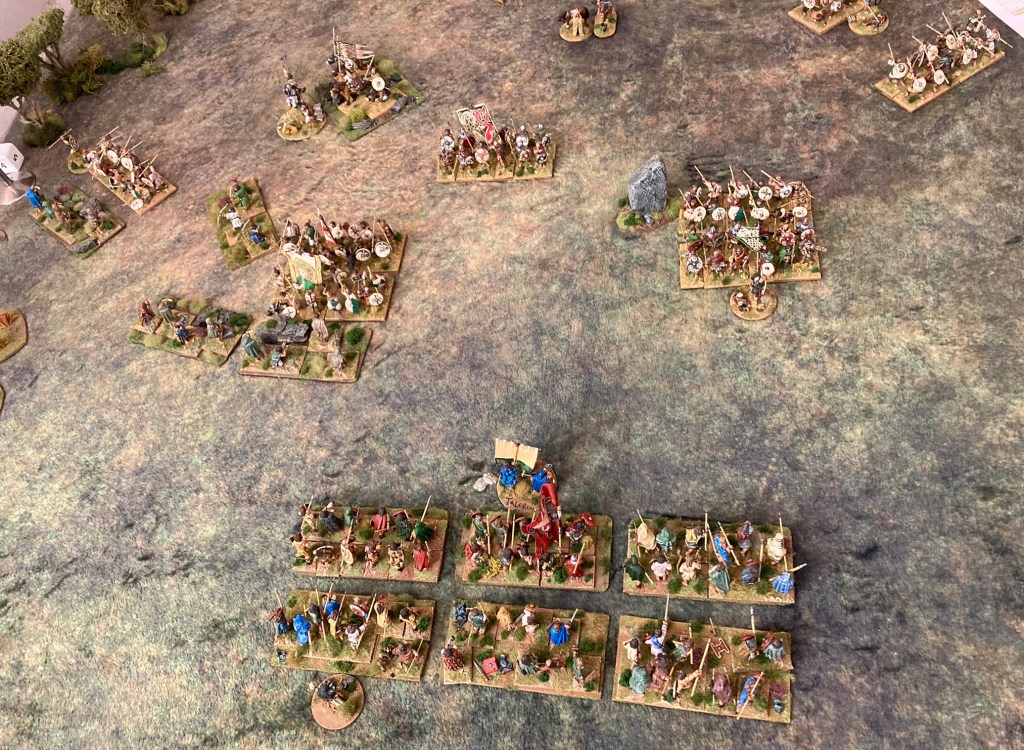
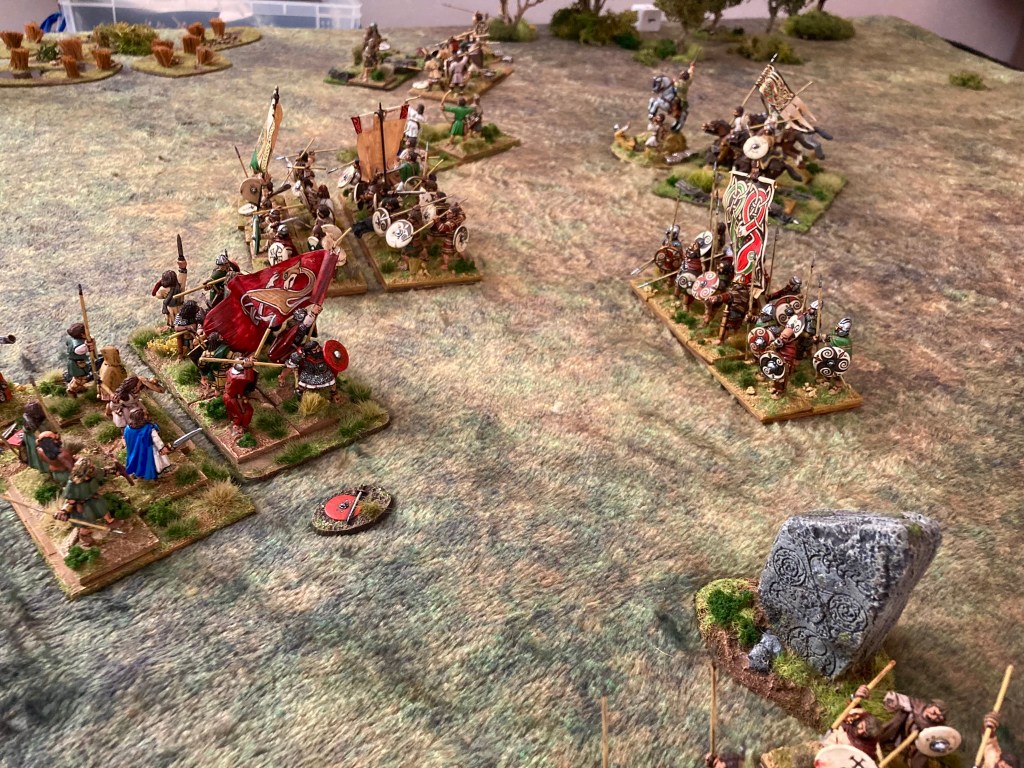
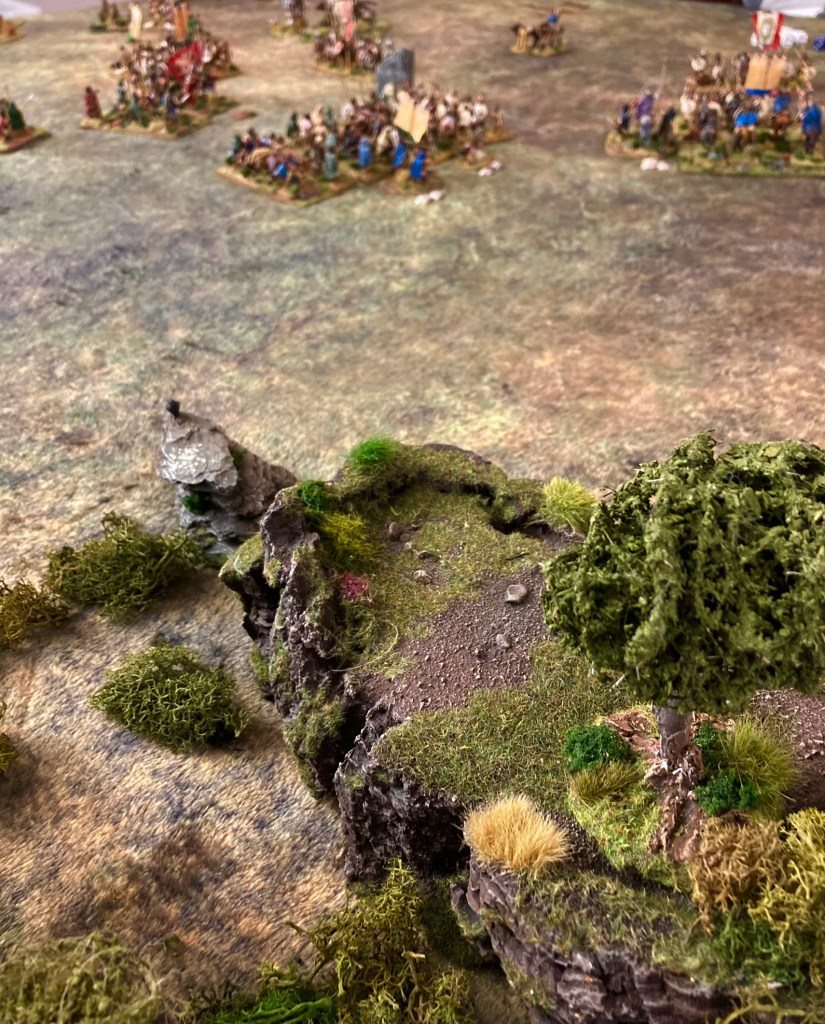
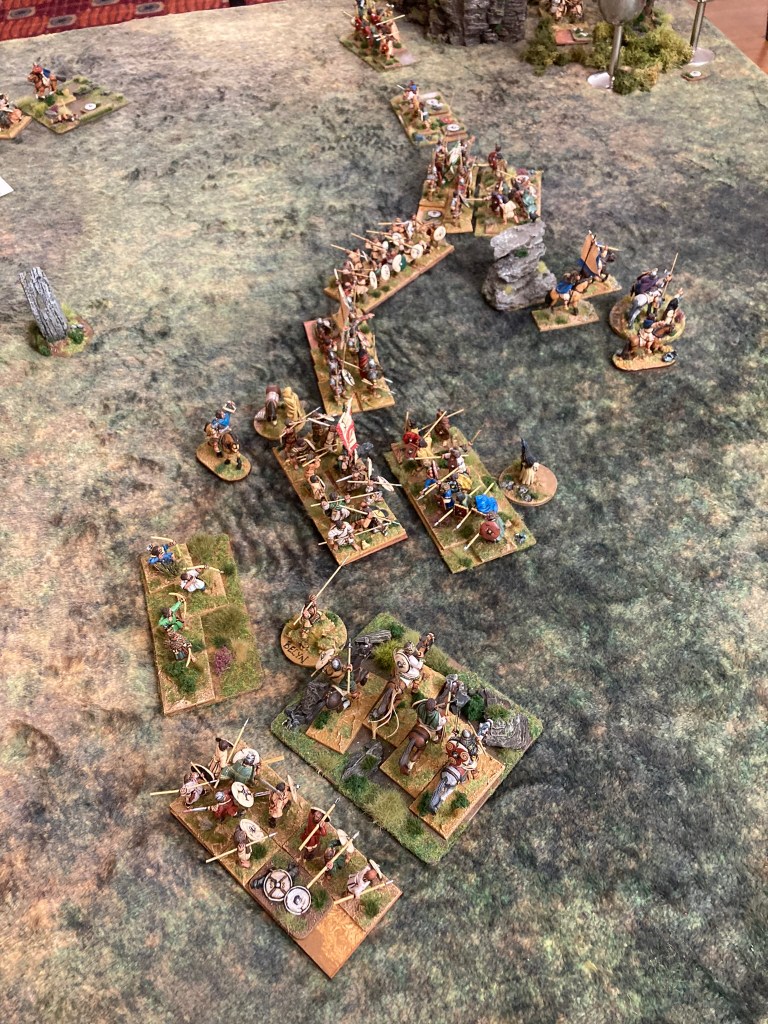
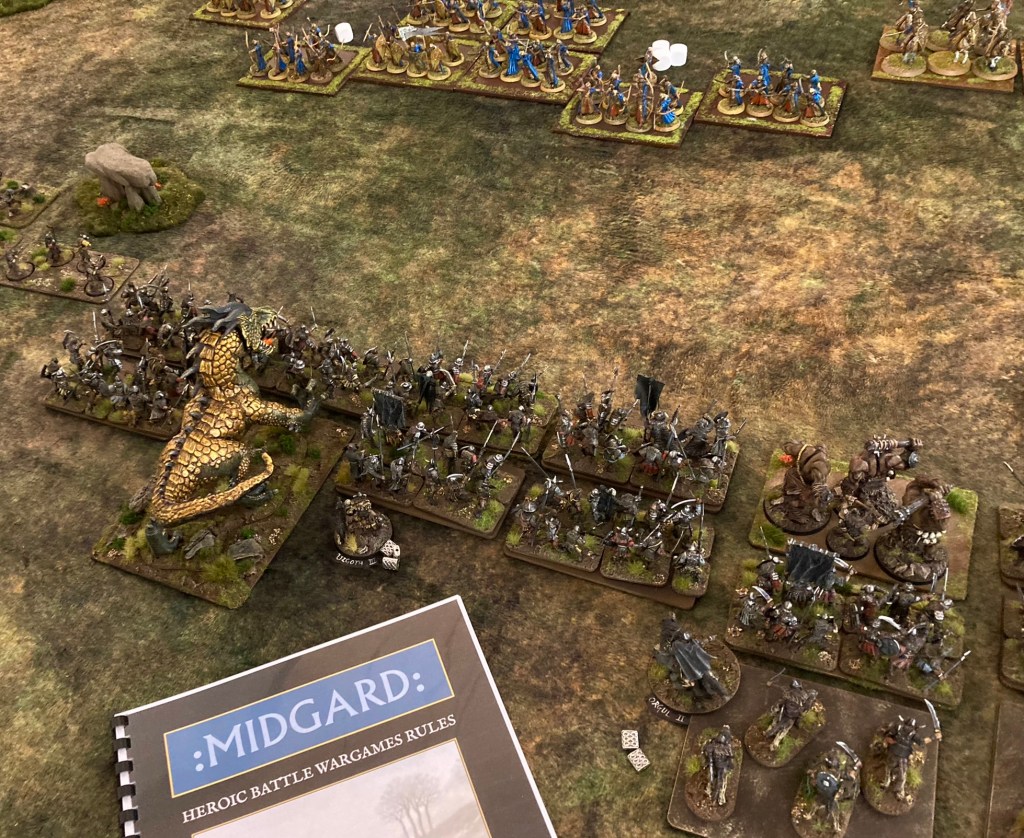
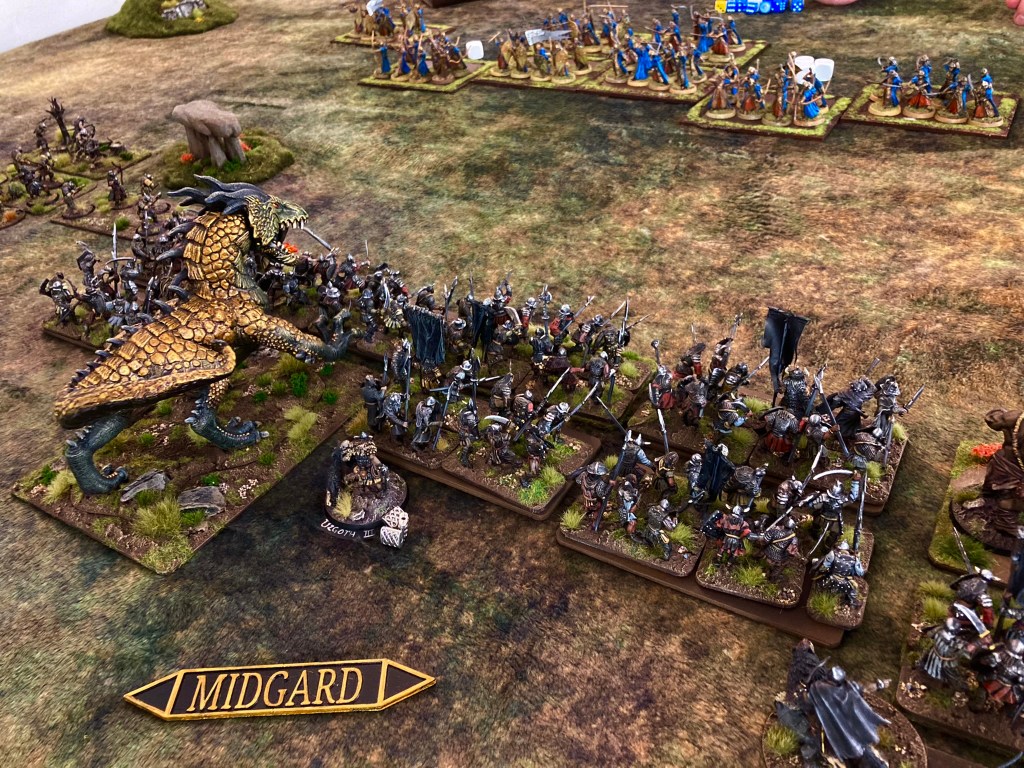
The forces array for battle across Dawston Burn, with Degsta’s Stone in the centre. Saxons at bottom, Dal Riada and allies at the top.
After several cancelled games over the holiday period, Matt and I were finally able to get together on Dec 31st for a final game of 2021. I’ve been getting back into the 7th Century recently and developing my Midgard heroic battle rules, so the Battle of Degsastan was an easy choice.
Degsta’s Stone overlooks the place of slaughter.
Degsastan was, by the standards of British battles of the time, a pretty large affair. Many of the battles of this period probably involved no more than a few hundred warriors, but Degsastan seems to have been into the thousands. The conflict came about because of the growing power of Aethelfrith, King of Northumbria in the north of Britain; nicknamed the ‘Twister’ by the Britons (presumably because of his cunning rather that his wrestling moves), Bede tells us that he ‘ravaged the Britons with more cruelty than all other English leaders.’ Aedan mac Gabhrain, King of Dal Riada, raised a coalition of Dal Riadans, Ulster Irish and Britons to put the tyrant back in check.
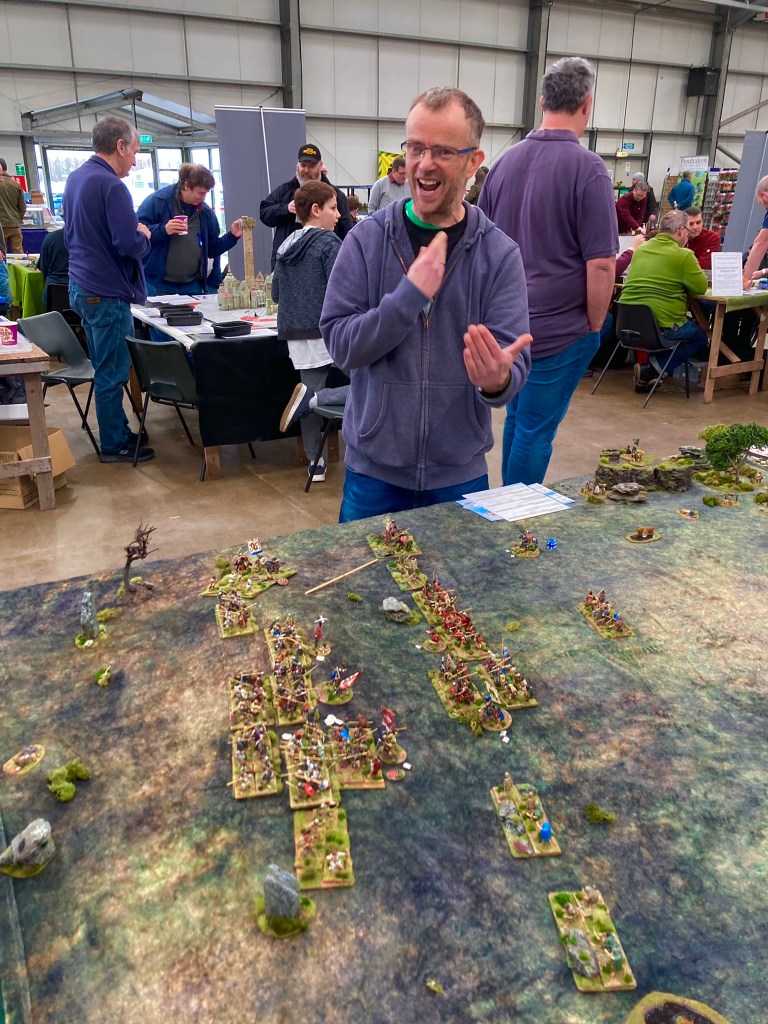
The table arrayed for battle. Forces are entirely metal from my collection built up between 1995 and 2012 or thereabouts, using Gripping Beast, Foundry, Black Tree and others. The terrain mat is a home-made piece using sherpa fleece as a base. Dice trays are from Handiwork Games.
The battle was fought at Degsastan, ‘Degsa’s Stone’, an unknown location in Northern Britain in 603 (or possibly 604). Peter Marren’s book Battles of the Dark Ages presents the evidence for the most likely site being Dawston Rigg at Liddersdale in the Scottish Borders (there are other options but for simplicity I just followed his lead.) Guy Halsall’s article for Miniature Wargames magazine in the 1980s included a suggested map of deployment (reproduced in Peter Marren’s book), with the two opposing forces facing off across Dawston Burn, so I took this as my blueprint for the game. Historically, the battle was a mighty victory for Aethelfrith of Bernicia and paved the way for the Saxon domination of the north of England.
Terrain was simple – some sloping hills on either side, a stream running down the middle, and Degsa’s Stone itself placed near the action.
Hills have been created with polystyrene sheets under the mat. Sherpa fleece is a very thick material with some flex so works perfectly for this.
The opposing forces were as follows:
DAL RIADA
Aedan mac Gabrain, King of Dal Riada
King Aedan Mac Gabhran of Dal Riada (the shield bearers are from the Alternative Armies Erin range; Aedan is a heavily-converted Gripping Beast Saxon)
Mael Umai, Ulster Warlord
Irish warlord Mael Umai and his warriors
Domingart, son of Aedan
Domingart, son of Aedan, commands a mixed force of British and Pictish allies.
2 units of household warriors (Aedan and Mael Umai’s bodyguards)
18 units of warriors (without armour – shields, javelins, spears and swords)
6 units of skirmishers
BERNICIA
Aethelfrith, King of Bernicia
Theobald, brother of Aethelfrith
Theobald takes up position with his Saxons
Hering. son of Hussa [from the sources, we know that Hering was present at the battle but it’s not clear which side he fought on. It is quite possible that he was leading an exiled group of Bernicians as part of the Dal Riadan army. I have placed him in Aethelfrith’s force.]
Hering, son of Hussa (with red raven banner, centre)
3 units of household warriors (bodyguards for the three leaders)
11 units of warriors (better armoured than their opponents, armed with spears, javelins and swords)
3 units of skirmishers
Having deployed the forces, I took command of the Bernicians; my friend Matt took the reigns of the Dal Riadans and their allies. I attempted a solid Saxon advance which rapidly fell apart as my command rolls were dreadful! Aethelfrith and Theobald’s men were obviously intimidated by the size of the Celtic host. As a result, I ended up with a piecemeal advance, which was to cost me dearly later.
Saxon forces – Theobald is visible at front left throwing some shapes next to Degsa’s Stone
The Dal Riadans played a waiting game, standing on their hill above the burn. The skirmishers were sent forwards along with Domingart, Aedan’s Son, who was desperate to show his prowess and strike the first blows of the battle (we were trying out a new rule which gives a Reputation bonus to the hero who leads the first charge, and Matt was determined to get it.)
After a couple of turns trying to whip the troops into order, Hering son of Hussa managed to get the Bernicia right wing to charge into combat against the Pictish and British skirmishers at the burn. Domingart got his wish and led the first charge although his unit was driven off and he rejoined his main force.
When you roll dice like this, those skirmishers are going to cause trouble! Dice tray from Handiwork Games
The more numerous Dal Riadan skirmishers caused problems to the Saxons up and down the line, in one case dropping arrows right in front of Aethelfrith’s own hearthguard.
Trouble with skirmishers! If it hadn’t been for you pesky kids…
Hering’s Saxons on the right wing were heavily engaged in combat with Domingart’s men across the burn. The British and Picts fought bravely, punching above their weight, but were steadily driven back by the better-equipped and armoured Bernicians. Hering, finding himself almost face-to-face with Domingart, issued a challenge to single combat and duly dispatched his opposite number.
Hering son of Hussa takes down the rash Domingart
However, in the centre, Aethelfrith’s men were making limited progress, suffering casualties from the hail of missiles coming from the Dal Riadans. Driving off the archers, the Bernician king surged forward and was met by Aedan’s forces coming off the hill, resulting in vicious fighting along the whole length of the burn as Theobald’s forces also arrived on the left flank.
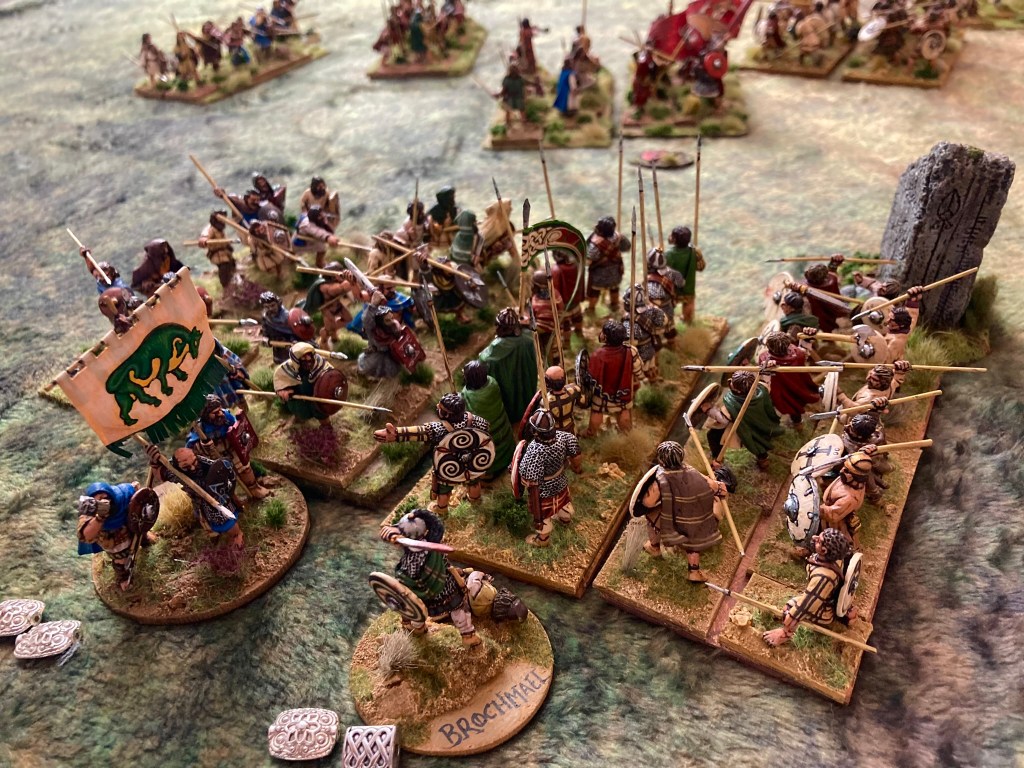
Wholesale fighting erupts along the burn
The Saxons were beginning to make their quality tell as Dal Riadan casualties mounted, but the early casualties and disorder started to play against them. Aethelfrith’s command was now outnumbered and taking casualties. In an effort to help them, the victorious Hering son of Hussa (on the right) began to swing his units around to assist his king – but was charged in the rear by an unbroken British unit. Hering, although wounded, managed to drive off the attackers with a hail of javelins, but the momentum was broken and casualties were mounting.
Hering son of Hussa’s men get charged in the rear by vengeful Britons
Fighting his way through the press of bodies in the centre, Aedan decided that he would have his slice of the glory and attacked the wounded King Aethelfrith. Calling upon Christ (and quite probably the Morrigan as well), Aedan cut down ‘the Twister’ and his gesiths perished around his body. This was the end for the Saxons – with the king and his brother dead, they started to flee the field. Hering son of Hussa was last seen, wounded, fighting a desperate last stand under his raven banner.
Turn 6: Aethelfrith and Aedan clash in single combat, but the wounded ‘Twister’ comes off worst and perishes.With his Reputation crumbling and nothing to lose, Theobald calls out the mighty Ulster warrior Mael Uma to single combat.
With the final turn of the game in sight and Bernician reputation teetering on defeat, Theobald, brother of Aethelfrith, charged in on the left wing and issued a challenge to Mael Umai of Ulster. Although they should have been evenly matched, the Ulsterman made short work of the Bernician in the style of Cuchulain himself!
and…Mael Uma barely breaks a sweat, dispatching Theobald to Woden in short order.
And so we had a complete reversal of the historical outcome! The game was great fun and Matt played with true Celtic spirit. The outcome most certainly could have been different but the piecemeal advance of the Saxons and some poor luck was most certainly a game-changer. I love this period and will be playing more very soon!
The end – with Aethelfrith and Theobald dead, the Saxon Reputation crumbles and the Bernicians flee the field. Casualties are heavy on both sides but Aedan clearly holds the victory.
‘Tonight, the ravens croak over the head of Aethelfrith the Twister.’
Finished! Forged in Battle 15mm Welsh; background is a printable download from Jon Hodgson Maps
In the last couple of weeks I’ve been tinkering with something that I can best describe as a ‘side project’. I have a long-standing love of the Early Medieval era, AKA ‘the Dark Ages’, and especially the 7th century in Britain. This period saw a host of colourful leaders emerge from the melting pot of Saxon, British, Irish and Pictish cultures to create the beginnings of medieval Britain. Thanks to the venerable Bede and other chroniclers, we have the skeleton of a timeline and a description of events, which have received attention from a host of talented historians to help to bring this period to life.
In deference to the great Father Ted, I’ve entitled this piece Small, Far Away. If you are reading outside the British Isles, or have yet to encounter this, I can only recommend that you watch this clip. )
Anyway, I hear you cry, let’s see some toy soldiers! Despite having collected armies for this period in 28mm, the impending release of Wiglaf Miniatures’ new Saxon range somehow got me started thinking about 15mm. I enjoyed reading Dan Mersey’s newly-released Age of Penda rules and was also thinking about creating a few units for my own Midgard rules in smaller scales. One thing led to another and, while waiting for the Wiglaf Miniatures to be released, I had a look at the Forged in Battle website and impulse-bought a couple of packs. I have a number of Andy Cooper’s characterful sculpts in 28mm in my Celtic myth, Arthurian and Wars of the Roses collections and was interested to see what he could do in this smaller scale.
Andy Cooper – handy in both scales! Left: Forged in Battle 15mm; right: West Wind 28mm hero from the Arthurian range (hornblower from Gripping Beast)Age of Penda rules – an interesting read although I’ve not played yet
A very quick turn-around saw a small jiffy bag of minis drop through my post box just a few days later. The figures (from packs 3 and 5, Welsh Teulu infantry & Welsh Skirmishers) are a pleasing 18mm tall and only required minimal clean up before undercoating. True to form with Andy’s previous work, they are highly detailed with a lot of character – the folded cloaks and moustaches are very nicely done. All the Welsh nobles are mailed, although I would have liked to have seen a few with helmets (but to be fair, we have no surviving ‘British’ helmets from this period – there’s nothing stopping me mixing in some helmeted Saxons in the future). The figures have a distinct Celtic feel to them and would probably serve perfectly well as the Scots-Irish of Dal Riada as well.
15mm Forged in Battle minis straight out of the bag
In the dim and distant past, I collected large armies of 15mm figures, and spent much too long trying to paint them with multiple washes and highlights. One of the drivers for buying these little fellas was that I was curious to see how GW’s Contrast paints would speed up the process.
After a simple spray undercoat of Halfords White Primer, I set to with the Contrasts. Following a couple of experimental models, I gave the whole batch a thinned-down coat of Wyldwood with a large brush, all over. This picked out the detail and provided the base coat for any white areas such as undyed woollen tunics. Contrasts do take a little bit of time to dry and it is important not to get impatient so that wet areas don’t bleed into each other, so I went off and tidied the loft for a bit.
Returning to the painting table, it was time for the skin tones. Guilliman Flesh is an absolute godsend for these chaps, quickly picking out the facial and hand detail in seconds as long as it is applied fairly liberally. Following this, I used a mixture of greens and browns for the clothing, leaving some white. GW Camo Green, Dark Angels Green and a drop of Warp Lightning all featured here, along with Wyldwood and Snakebite Leather.
Spears were done with a base coat of Snakebite Leather and shield backs with Gore Grunta Fur. The final basecoat stage was to touch in belts, pouches, shoes and hair with either Cygor Brown or Wyldwood. The Cygor Brown is so dark that it can serve as a base for metal work, so I also outlined the spear heads and shield bosses while I was about it.
This would have been quite adequate for a tabletop paint job, but, like many others, I have found that Contrasts are improved immeasurably by the addition of a quick highlight or dry brush. The clothing areas received a very light dry brush of Vallejo Iraqi Sand and I added a top layer of Foundry Buff Leather 7b to make the spear shafts stand out. I also used a thin line of yellow-brown to create a few suggestions of stripes on some of the cloaks for that Celtic vibe.
I’ve always felt that the bulk of Welsh shields for this period should be white (following the descriptions of ‘icy-hued’ shields in the British epic poem Y Gododdin) so I gave most of them a base coat of Foundry Canvas 6a followed by a streaky highlight of Vallejo Off-White. Some were simply brown (GW Contrast Gore-Grunta Fur with a drybrush of Vallejo Iraqi Sand), but I chose to identify the nobles with a few red shields (Miniature Paints Chestnut Brown followed by a highlight of Army Painter Pure Red). I didn’t bother with the rather fanciful spirals that I’d adorned my 28mm figures with, but I did add some rivets for interest, mostly just by neatly dotting spots of black paint in appropriate positions.
All the metal work (mail, weapons and shield bosses) was given a coat of Army Painter Gunmetal, then, when dry, the whole batch of minis was sprayed down with a can of matt varnish from my stash of Testors Dullcote. I’ve always hated the way that matt varnish kills the shine on metallics, so I tend to add a top coat of metal when the varnish is dry – in this case, a quick dab of AP Shining Silver on the edges of mail, shield bosses and spear blades.
The leader is on a magnetic base and fits inside his teulu or can step out if he’s feeling brave!
Basing was part of the fun for this mini-project: while 40mm elements are standard for 15mm models, I fancied creating a bit more of a ‘unit’ feel and decided to go for a larger unit on a 80 x 40mm 2mm thick MDF base. Warbases delivered me some of these in their usual record time along with some frames for micro-dice which I intended to use for damage purposes (the Age of Penda rules record a ‘battle rating’ of 6 or less, my own Midgard rules need to record up to four points of ‘stamina’).
2mm rare earth magnets drilled and glued in position, mini dice frame on bottom right of each baseMini dice frames to record damage on the finished bases
I had initially planned to use magnetic tape to magnetise the units for storage and transport, but with these small figures, I was reluctant to add the height to the base, so I drilled a 2mm hole in all four corners of the base and glued in a tiny 2 x 1.5mm rare earth magnet. I also had a plan to create a removable base for the leader model (just for flexibility) – therefore the warriors’ base also received two further magnets positioned at the top that would stick to a 20mm disc (in this case, a 1p coin). The dice tray was bevelled off with a scalpel before gluing to the base, then the whole thing had a coat of Halfords Camo Brown.
The figures had their bases painted a very dark brown to match the MDF before I fiddled around with possible arrangements of minis, creating a random scattering of skirmishers (6 models) and then a wall of Welsh teulu huddled around their leader (13 models). The Welsh hero went on a rock to look heroic, with his standard bearer squeezed on at his feet. I expect that lesser warrior units would look fine with 10-12 models per base, but I wanted to play with the visual impact of this one.
The unit base then had a thin layer of my regular basing mix – a decent dose of Burnt Umber and Black craft acrylics with a little filler and chinchilla sand added. When dry, I gave this a dry brush of AP Leather Brown and then Vallejo Iraqui Sand. The real fun was adding small amounts pf scatter, flock and tufts to build up an impression of moorland (I left off my favourite 12mm tufts this time to avoid the appearance of marching through elephant grass!)
Well, there you go. Two little units. Just a dabble or the first of many? Who knows.
Preview of the forthcoming Wiglaf Miniatures – looking like good opponents for the Forged in Battle minis.
Robbed by Covid of two games that I had fixed up this week with friends, I got my Saxon and Welsh armies out of the loft and set-to with a solo game. Once again, I’m still play testing my own Midgard rules. The game revolves around Reputation, represented by a pair of goblets full of tokens (one for each side). As heroic deeds are performed, Reputation is gained, but it can be lost by cowardly deeds and running from the battlefield. This time out, I was experimenting with a few extra ways to gain Reputation, with a special bonus for a hero leading the first charge of the battle. This would prove decisive in the game!
WelshSaxons
Having organised my venerable but beloved Saxon and Welsh armies onto suitable unit bases, I drew up a couple of forces for my favourite period, the 7th Century. (Midgard works on a standard 120mm frontage, although as long as both armies have roughly the same unit frontages, it doesn’t matter. Base depth is not relevant to the game.) The scenario was a raid into Mercia by Cadwaladr of Gwynedd with an attempted repulse by one of Penda’s thegns, Aethelwine, and his sidekicks, Osfrith and Ceonwulf.
The forces looked as follows:
GWYNEDD
3 x Heroes (Cadwaldr, Brochmael and Belyn of Lleyn)
2 x Teulu (Comitatus)
7 x Spearmen (lightly armoured but swift)
3 x Skirmishers with javelins and bows
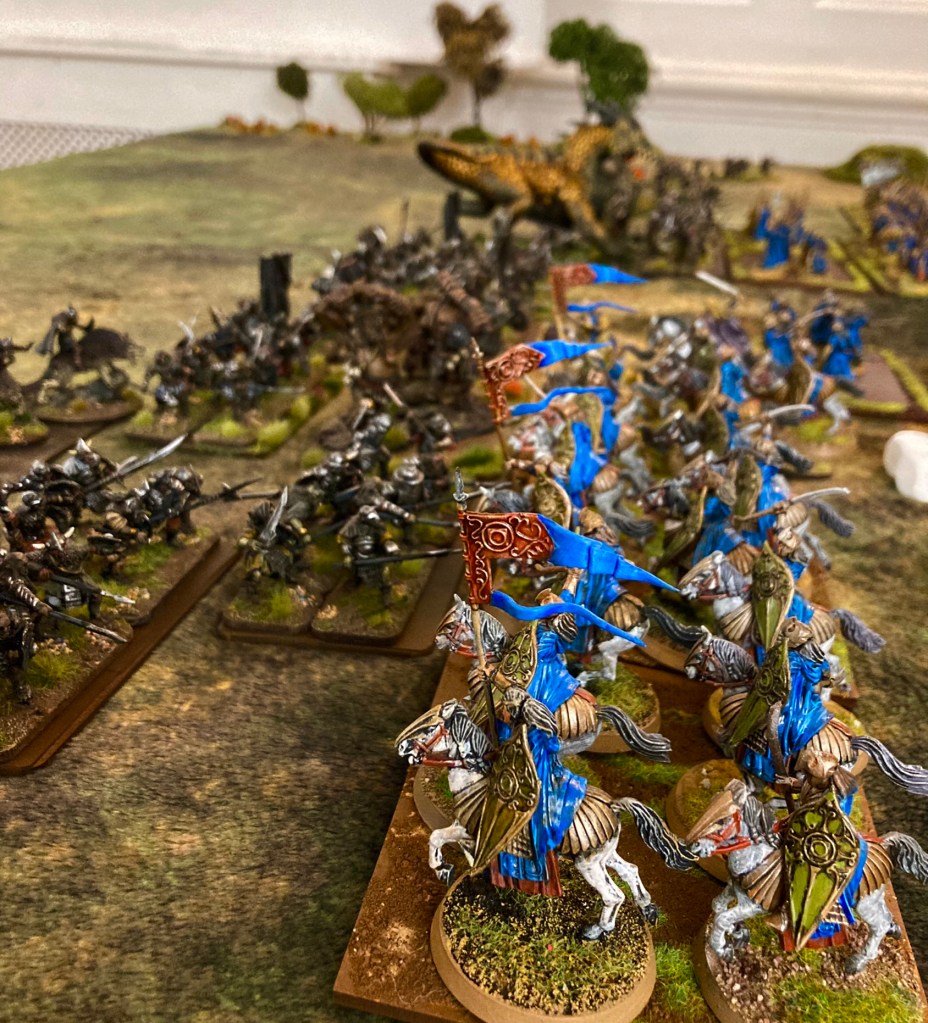
Welsh (top) and Saxons (bottom) prepare for battle
MERCIA
3 x Heroes (Aelfwine, Ceonwulf and Osfrith)
2 x Gedriht (Comitatus)
8 x Spearmen
2 x Skirmishers with slings and bows
Having lined up both sides in a plausible battle formation (two units deep where possible as supporting units are critical in Midgard), the scenario started with a challenge to single combat. (You can turn these down in Midgard, but you lose Reputation – something neither of our warlords were ready to do, I decided.) Osfrith of Mercia and Belyn of Lleyn took up their mightiest spears and went at it hammer and tongs, blades clashing and splinters flying (well, they threw everything at it but their dice rolling was appalling! That’ll teach me to play solo.) Both heroes gained Reputation for their struggle as the armies watched eagerly.
Belyn and Osfrith play ‘who’s got the biggest spear’5s to hit…5s to hit…never mind, there’s always next round….5s to hit…5s to hit….FFS…
The single combat ended with both heroes wounding each other on the third round. By this point, the commanders had had enough and Aethelwine ordered the impatient Saxons forward. Osfrith and Belyn were swept up in to their units and the battle was on!
Charge! Aethelwine orders the Saxons forward, although not everyone gets there!
The Saxons’ impetuousity was a disadvantage though, as poor Command tests held back the far left and right flanks. When Brochmael decided to push forward his Welsh warriors to force the issue, the Saxon left flank under Ceonwulf found itself stranded and unable to support Aethelwine in this centre. Although Brochmael himself would fall under Ceonwulf’s blade, the lack of support for the Saxon commander would later prove decisive.
Cadwaladr keeps the Welsh centre togetherThe Saxon advance is unintentionally wedge-shaped, as just one unit makes it through to attack the Welsh centre! This would lead to everything going pear-shaped later on…
In true heroic fashion, warlords Aethelwine and Cadwaldr clashed in the centre. This single combat turned out to be a lot more decisive than the one that opened the battle: Aethelwine just got the better of it, striking down the Welsh warlord on the third round. However, in a gripping turn of events, Cadwaldr got in a dying blow that mortally wounded the Saxon thegn. Both warlords dead on Turn Two!
Aelfwine and Cadwaladr clash in single combat in the press of shields5s to hit, guys, Oh, well done, SaxonsAethelwine’s Gedriht go it alone against the Welsh. Despite their inferior armour, the supporting units made the difference for the Cymric warriors in this fight.Skirmishers failing to get out of the way in time get caught up in the meleeGaps start to appear in the ranks as the blades bite
On the left flank, Ceonwulf’s luck had just run out. Despite putting up a good fight with his warriors, the wounded Saxon thegn took a stray blow in the scrum of shields as he rolled a 1. Fortunately he had saved a Might Point to reroll it, although he lost Reputation to do so (it’s bad for the warriors’ morale to show weakness) and promptly rolled another 1…exit Ceonwulf stage left. By this point, there were only two heroes (out of the original six) remaining – quite the bloodbath.
Saxon slingers get cheeky on the Welsh flank.
Osfrith and Belyn now found themselves facing each other once again on the Saxon right. Belyn’s men rolled some incredible dice and held off the Saxons, killing Osfrith in the process. By now, Saxon Reputation was teetering, with the loss of all three leaders.
The final countdown: Belyn of Lleyn finally fells Osfrith of Mercia with that massive spear!
Although Saxon units had broken through on both flanks, the advance was piecemeal. Finally, Ceonwulf’s Gedriht were destroyed – despite their resilience, they ended up fighting virtually alone against the Welsh centre. Strength in numbers, lads.
This was the end for the Saxons – despite taking a heavy toll on the Welsh leaders, their goblet of Reputation was empty and they fled back to Mercia. Clearly Penda will need to get involved!
Although the Welsh battle line is driven back on both flanks, the cohesion of the Saxons has been broken – victory is imminent.End of turn 3: the Welsh Reputation (left) looks healthy but the Saxons (right) are teetering.Sole surviving hero Belyn of Lleyn drives the Saxons back to the river bank!5s to hit guys…no wonder the Welsh won!Belyn fights on with the remains of his warriors.The end: the Saxons break and run. Victory to the Welsh!
Finished! 12 warriors and 8 archers using a variety of plastic kit parts. Backgrounds in the photos are, as ever, printed downloads from Jon Hodgson Maps Patreon.
Well, no, not until Wargames Atlantic released their recent Goblins boxed set. I’ve had a great time kitbashing my own vision of a Tolkien Orc force over the last few years, combining the GW LotR Orcs with plenty of Oathmark goblins, Warlord Games Orcs and as many different historical plastic sprues as I can get my hands on.
However, the WA Goblins are a wonderful addition to the genre. Slightly smaller than their Oathmark counterparts, they fit nicely into the ‘classic fantasy’ mould and offer some great options. First up, the sheer range of different heads is an absolute gift for modellers like me.
Bodies comparison shot – L-R: Warlord, Wargames Atlantic x 2, OathmarkBloody amazing selection of heads!
There’s some really sharp detail here – including (pun intended) some great sets of teeth. Quite a few of the helmets are based on the artwork of the late, great Angus McBride for the Middle Earth Roleplaying game (MERP), giving them even more old school kudos.
…and more heads!Some of Angus McBride’s wonderful artwork for MERP – a clear influence on both the WA and Warlord orc kits.
There are a number of weapons provided but, for me, the stand out equipment items are the characterful bows and quivers. All the arms are bare, meaning that you don’t have to worry about matching up pairs with different sleeves. This makes them highly versatile and gives even more options than usual.
Archers using the WA bow arms – lovely stuff! Bodies are Mantic Ghoul (left) and Gripping Beast Saxon (right).The sprue, rammed with Orcy goodness. The shield bottom right (centre) doesn’t seem to have a boss supplied but that’s a minor criticism, this kit is wonderful.
The arms have a curious pseudo ball-and-socket type joint which, for me, doesn’t quite work and can create some slightly unusual poses. Fortunately, it’s very easy to trim the ball joint on the arm to the position of your choice and I was far more happy with the poses once I had sorted this.
Weird arm joints – I trimmed these flat to get a better fit.90% pure WA goblins (the long sword has been pinched from the Warlord Orc sprue).
Although I’m not going to use them as cavalry, it’s worth mentioning that the WA kit has some of the legs posed so as to be able to sit astride a mount. A saddle is provided to fit WA’s own giant spiders. This was a rather neat touch. If using the bandy legs as infantry, you just need to make them a base from a scrap of plasticard. As the riding poses are split at the waist, this also gives you more variety if combining them with the Oathmark goblin wolf riders.
Archers. The chap on the left has Oathmark arms with all other components WA. The shooting archer has Gripping Beast Arab cavalry arms and uses the bandy-legged part that can be used to make spider riders.
Having put together a few Orcs using the basic WA components, I tried them out mixed with other kits. The Oathmark goblin bodies are marginally bigger but work really nicely with the head and arm variants.
WA arms and heads on Oathmark bodies – these are amongst my favourites. You can see how good the bow and quiver detail is!
One of my earliest exposures to Tolkien’s work was the 1978 animated Lord of the Rings film. The massed Orcs at Helm’s Deep were depicted by live actors wearing robe-like costumes and filmed using Rotoscope. I liked the tribal image and decided to have a go at making something similar. Fortunately, a sprue of Gripping Beast Arab infantry was sat on my painting table, having been rejected for an El Cid update.
Orcs as seen in Ralph Bakshi’s 1978 Lord of the Rings
Gripping Beast Arabs about to get Orc’ed.
I followed my usual principle of choose a pair of weapon arms, trim them to get the right pose and then fill any gaps with some scraggly clothing created from green stuff. I’m always amazed how well all this stuff blends together with a consistent paint job, although of course it’s always a bit easier doing creatures who may be slightly disproportionate. You have to be a bit more picky with Elves and Men!
Ready for painting with a few green stuff cloaks added.Perry Wars of the Roses provide appropriately nasty pole arms and spears.
I also pulled out a Gripping Beast Saxon thegn to add to the archer unit. I’ve found the GB models convert nicely to Orcs – perhaps because of their slightly stooped posing. Being garbed in standard Dark Age kit makes them ideal for this kind of thing.
Left: Mantic Ghoul with WA arms and head; Right: Gripping Beast Saxon with WA arms and head.
I had a few Mantic Ghoul bodies in my bits box which I discovered made a rather atmospheric hunched archer, reminding me very much of the old Asgard Miniatures range from days gone by.
L-R: Fireforge Sergeant, Mantic Ghoul, Gripping Beast Saxon, all plus WA arms and heads.This standard bearer is a Frostgrave barbarian with his face replaced with a WA goblin (insert own joke here).
Having got them stuck together (12 warriors and 8 archers for starters), I gave the models a spray undercoat using Halfords Black Primer. I long ago gave up on trying to win painting competitions and now focus on getting an army done quickly with an effective mix of painting techniques and decent basing. For the Orcs in particular, I wanted the mass effect of a horde. The late, great Chris Achilleos’s cover painting for MERP, John Howe’s painting and Ralph Bakshi’s film were all strong influences here, giving me a very monochromatic theme with teeth bared and weapons glinting.
I really liked the dark, monochrome nature of these Orcs, in Ralph Bakshi’s animated LOTR movie, where teeth and tusks were a salient feature, and tried to emulate it in my painting.A detail of Chris Achilleos’s superb MERP cover.John Howe’s outstanding Orcs – not much colour but bags of character.
To get this limited palette (and to get the little chaps painted quickly), I gave the black models an all-over dry brush of AP Leather Brown with a large, flat brush.
Stage 1: dry brush brown all over!
This was followed up with a more targeted dry brush of AP Gunmetal on helmets, armour and weapons, which then received a painted highlight of a streak of AP Shining Silver on any raised edges. I was initially worried that this would look too bright, but a thin line really emphasizes the weaponry and helmets of the Orcs.
Gunmetal dry brush and silver highlight really make this Orc’s helmet stand out, but without being too clean.
With this done, I then started on the skin tones. My basic principle on these is to use a base layer and a highlight in a variety of dull tones. There’s several Foundry triads that I use, although I generally just use two of the three colours (often A and C to get maximum contrast). Dark African Flesh (better on Orcs than Africans, I feel), British Denison Brown and Dusky Flesh all feature here, but I’ve used all kinds of khaki and dull browns in the past.
Very naff WIP shot as the skin tones start to go on!
Orcs showing a variety of skin tones.
As previously mentioned, I wanted teeth and tusks to be a salient feature. Although I hadn’t gone into any great detail on the faces, I re-undercoated the teeth in black and gave them a single dab of white. This really makes them stand out (and hides the speed of the bulk of the paintwork!)
Teeth and tusks really stand out painted in black then white.
Studs on the shields add interest to the flat surfaces.
Weapons and shields were also repainted in black before receiving a single highlight of Foundry Charcoal Black. This was a stylistic choice that I’d made when starting on the army. Although I could have left them in their original black with a brown dry brush, painting them this way creates a clear distinction for the woodwork. Shields are further detailed with some black dots which then have a dot of silver in the centre to represent studs (this is an old trick I picked up many years ago from Colin and Duncan Patten on the earliest Gripping Beast Saxons – it’s a great way to add interest to flat shields).
Weapons and shields are black with Foundry Charcoal Black.
The clothing is patched together using additional layers of whatever muted colours I can get my hands on – any old browns or greys can get used here, often dry brushed on. The Orcs finish off with a light dry brush of my favourite paint – Vallejo Iraqi Sand – to lift and define surfaces and edges of clothing and shields.
I reckon each Orc takes around 10-15 minutes when painted in this way. It’s been an interesting experiment to drop my standards to create a much better mass effect than I used to do and it means that I can knock out units at appreciable speed.
The finished archer unit.
It’s great to be spoiled for choice for plastic kits and even more fun to be able to mix and match. And there’s more on the horizon…Oathmark Orcs are coming up soon!
Fir Bolg warriors mass for battle at the dolmen. Background is, as ever, a fab download from Jon Hodgson Maps
The Fir Bolg – ‘People of the Bag’ – appear in Irish mythology as the indigenous people of Eriu, who are displaced by the Tuatha de Danaan. For the classic Alternative Armies Celtic Myth range from the 1990s, sculptor Andy Cooper gave them a look that mixes elements of Neanderthal, Celt and Aztec (plus a bit of Lemmy from Motorhead).
Fir Bolg warriors. Check out Lemmy in the centre!
Clubs, stone weapons and spears are the weapons of choice along with wicker shields, portraying a culture with little metal-working, which fits nicely with the concept of a Stone or Bronze Age society being supplanted by invaders wielding iron weapons. (I think an alternative portrayal could make use of the Foundry Bronze Age Europeans, but that’s a project for another day).
Our Fir Bolg hero in the centre stands over his fallen Milesian foe (a Gripping Beast Gallic casualty)
I wasn’t quite sure about them when they first came out but ended up acquiring a small warband second-hand over the years. They have a certain charm and I enjoyed painting up a small force for Of Gods and Mortals and Celtic gaming in general. The initial selection of models wasn’t huge – Andy only sculpted a few packs for AA – so I did some conversions for heroes and the druid, Cesar. For Cesar’s body I used another Andy Cooper sculpt (this time from his own company, Westwind). It’s a Arthurian wizard type with a head swap from another Fir Bolg.
Tailtiu, Queen of the Fir Bolg and Cesar the Druid. Cesar has been based up with an old Fantasy Warlord standing stone.
I also added Tailtiu – an ancient fertility goddess – inspired by the entry in the Celtic supplement for OGAM by Graeme Davis. . This involved repainting a very old fantasy figure and surrounding her with corn stooks (resin from the bits box, possibly by Hovels) and new-fangled flower tufts – unavailable in the 1990s but perfect for a goddess of crops and nature! I’m not entirely sure where the figure came from. I have a vague memory she might be an old Metal Magic mini from Germany but I really can’t be sure.
Alternative Armies have just added a figure for the Fir Bolg champion Sreng to the range – an entirely new sculpt – so I look forward to adding him to the war band in the very near future.
Pic from the AA website of the new Sreng model. Strong shades of Jim Fitzpatrick going on here – I like him!
The big push to get various frosty terrain and figures finished off was prompted by last week’s gaming fixture – a run-out of my Midgard rules at the club with old chum Kev M visiting from sunny Leeds. Tom WD had correctly pointed that, for a rules set entitled Midgard, we’d played hardly any games set in the world of Norse myth – so it was time to fix that.
Kev and Paul W take command of the Frost Giants’ army at the foot of Thor’s Hill. Fortunately for them, Thor has had one too many in the mead hall and isn’t on the battlefield yet.
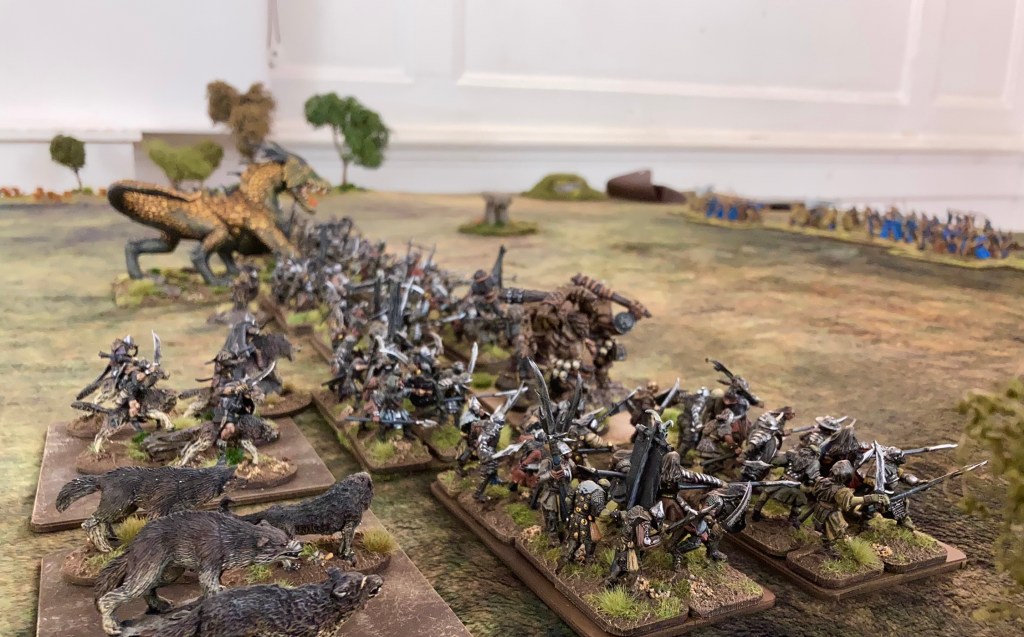
We used the ‘Take the High Ground’ scenario that we’d played many times before, where a depleted force (Vikings and Dwarves in this case) tries to hold a vital hill – Thor’s Hill – against the attack of Frost Giants, wolves, Draugr and Alfar (a mixed bag drawn from our various Norse myth collections) It was a good opportunity to test out the monstrosities rules for the Frost Giants as well as some new undead rules for the Draugr and a seeress.
The three standing stones at the top of this shot are the objectives in this game – units can gain Reputation by holding them from Turn 3 onwards.
Kev and Paul decided to hold back Hrungnir (the giant commander) and his towering chums behind a front line of wolves, Alfar and smaller giants.
Game on: the wolves (centre and right) are straight up the hill!
The wolves did better than expected, causing problems for the front line of Dwarves throughout the game and forcing back the front line around the critical standing stones.
Hard fighting around the crest of the hill as the wolves tear into the dwarvesOn the Viking right, norsemen and dwarves prepare to fend off the draugrDranghildr the Seeress (AKA Witch on a Moose, figure by Bad Squiddo) drives her draugr into combat. Kev’s gorgeous newly-painted Ragnarok figures lasted about two minutes!
We had some early excitement with our Dwarf commander, Grimnir, challenging Fenrir the Wolf to single combat. Grimnir should have been odds-on to chop up the oversized lupine, but instead fluffed his dice, took a wound and was then munched up! Not a good start for Thor’s forces.
Grimnir, Lord of the Dwarves challenges Fenrir to single combat. He went down in three gulps! Svenn Bloody-Blade and his norsemen drive back the onslaught of the draugr
On the Norse right, the Svenn Bloody-Blade and his Vikings were doing a sterling job of holding off the Alfar and Draugr, although Svenn ended up being cursed by the witch. Soon after, Thor himself arrived, finally getting back from the mead hall. He didn’t turn up in the best position (on the right flank, which was already secure), but hurled himself into combat, taking down Agnarr, Champion of the Alfar, in a very one-sided single combat.
However, the Frost Giants were making progress and the big boys were now grinding up the hill. Reputation see-sawed back and forth as Thor’s force nearly hit breaking point, but clawed it back through the single combat and the boost of holding the standing stones.
Thor gets back from the mead hall! Dokkalfar leader Agnarr is crushed in single combat (Thor is a SHQ mini by Kev, Agnarr is a Red Book of the Elf King mini)
After six turns – the scenario limit – we reached a breathless halt. Neither side had broken (losing all their Reputation), so we checked the Goblets; incredibly, Thor’s forces had 4 Reputation tokens remaining, but the Frost Giants had 5, therefore winning by the closest possible margin!
Good fun all round and a tense ending to what had seemed like a nailed-on Frost Giant victory earlier in the evening.
One of my collections that I’ve been developing alongside the Midgard project has been forces suitable for Norse mythology. Some of these are quite specific, such as Norse gods and frost giants, others do double duty with other game settings – like my Tolkien Dwarves or Red Book of the Elf King figures.
Red Book of the Elf King miniatures by Lucid Eye – great for Norse settingsFrost Giants take on the Alfar. The female giant is a Reaper Bones mini, the one with the rock is a figure from the board game Blood Rage
There’s no particular reason that Norse myth games have to take place in an icy landscape, but I’ve always liked the idea (Narnia was probably an early influence as well).
Reaper Bones Frost Giants vs Vendel Dwarves
Here’s some terrain and cloths for snowy settings that I made during last year’s lockdown. The mats were made using simple polar fleece fabric with some paint effects and distressing.
To match the cloths, I’ve knocked up a few movement trays to organise the figures into units. My Midgard rules require units to have similar base frontages – the standard is 120mm, so that’s what I’ve gone for here. The trays are 2mm MDF from Warbaseswith a top layer of steel paper (self adhesive flexometal) from Coritani/ Magnetic Displays.
Snowy bases under construction
As my figures all have magnetic bases, they stick to the tray and can be transported on them as well inside a Really Useful Box. The whole thing gets a light spray of dark brown paint (Halfords Khaki for UK readers), followed by a stippling of Army Painter Leather Brown. Finally, I used a ripped-up piece of sponge to apply white acrylic craft paint, most heavily around the edges. The idea is that my figures with neutral (non frosty) bases will match well enough with the base but blend in better with the snowy cloth – that’s the plan, anyway.
The bases were also decorated around the edges with some tufts from Gamers Grass, and also some clean cat litter painted to look like rocks. A word of warning here – if you’re having a go at these, be careful to keep the area where you want the figures to stick absolutely flat and free of texture – a single piece of grit or patch of flock can badly affect the figure’s magnetic base sticking to the tray.
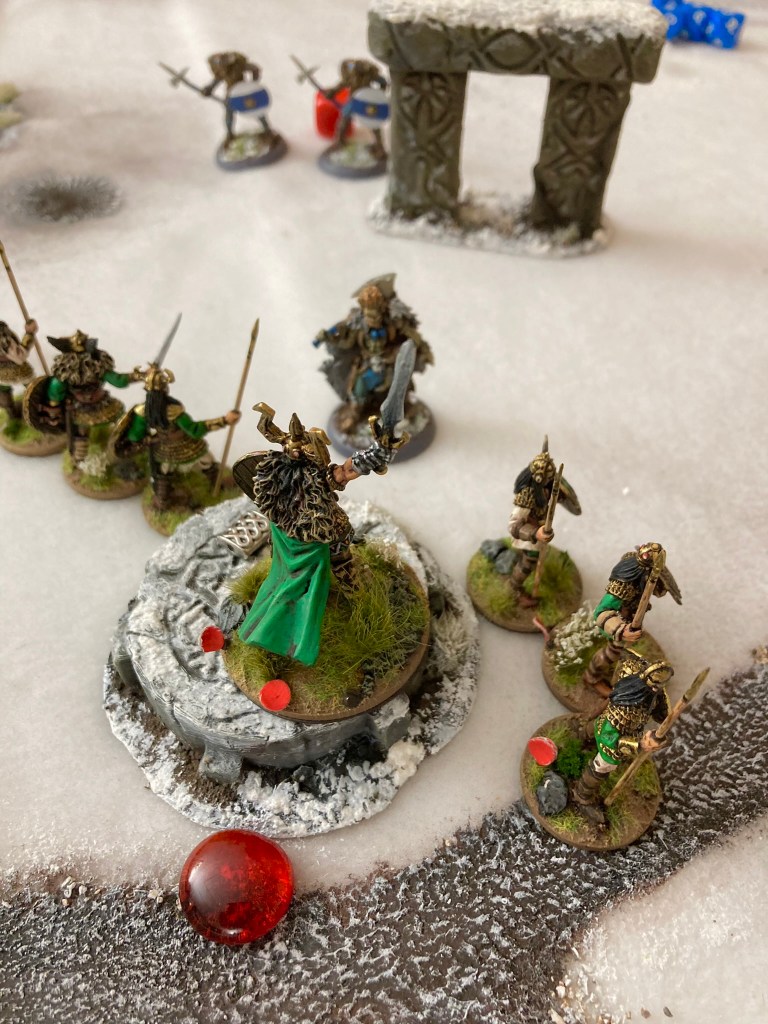
My friend Mike W had kindly 3d printed me a stone circle during lockdown, but I’d never got around to painting it. I already have a stone circle for my Celtic games so I thought it’d be fun to have one for the snowy setting as well.
Having painted the pieces an appropriate colour and based them in dark brown to match the earth areas of my cloth, I added a mix of white paint, pva glue and Woodland Scenics soft snow scatter. Following the advice in Pat Smith’s excellent ‘Setting the Scene’ book about modelling winter environments, I then dunked the base in more snow flock before it dried. Once dry, some extra white paint was dry brushed around the edges to even up some of the snow. I was quite pleased with how these looked when they hit the gaming table last week.
One of the elves tries out the stone circle for size. Background is a download from Jon Hodgson MapsTotally recommended reading if you’re doing any snowy wargames scenery!