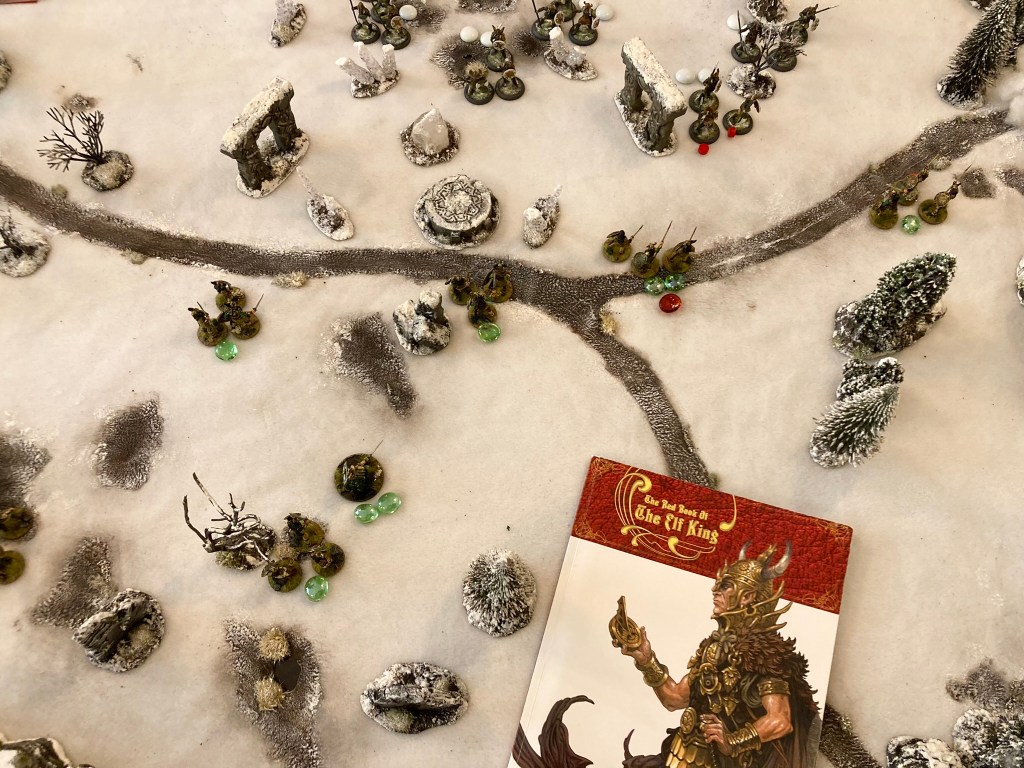
Looking for a break from Midgard and Xenos Rampant, Paul W and I decided to pull out Red Book of the Elf King for a fun Thursday night game, and it didn’t disappoint. This is a brilliant little set of rules by Rick Priestley, written back in 2017 to support Lucid Eye‘s figure range of the same name. Unfortunately, it has become one of those many games that has drifted off over the years – Lucid Eye are now selling an Elf King roleplaying game (which I haven’t looked at since it uses AI art, and I’m more of a wargamer than a roleplayer) but I don’t know what’s become of the miniatures game.

Anyway, Paul and I have all the minis, original rules and cards for the Red Book of the Elf King skirmish game, so it was no bother to pull them out to play a game. In my head it had only been about a year since we played, but upon checking my photo roll, it turned out to be two and a half years: tempus fugit!

Fortunately, it’s such a straightforward game that neither of us had forgotten how to play and there was only a tiny amount of rulebook-flipping.

The Star Fall scenario from the original rule book is always enjoyable so we plumped for that one. A chunk of star iron – which of course has great mystical properties – had fallen from the skies, so our two Elf circles (groups of 18 warrior companions plus a Thane, a magic-using leader) were squaring off to try and retrieve it.
Red Book of the Elf King uses a very cunning variant of the draw bag activation system where each side gets 1D6 counters, then a neutral 1D6 is rolled and added to both sides’ counters, meaning that you can expect 2-12 counters in the bag to activate 7 units over each turn of the game. If you have more than 7 counters, units can be activated more than once as long as every unit has had at least one token. Also, there are a number of glamours (spells) that can increase (and sometimes decrease) the number of counters in the bag, so what you get is an unpredictable and entertaining game.

You can choose various leaders and warbands for the game (one of the great features is that the Elf companions can serve as any one of the factions with simply a change of Thane); Paul choose Salian Trollblood (a Sting lookalike who terrifies all those around him) and I picked Alloysian of Vasterlant, who has the ability to redraw activation counters out of the bag thanks to some mystical sight. We’ve found that the ‘full fat’ Alloysian as written in the rules is a little over-powered, with unlimited counter redraws, so we agreed to reduce it to D3 per turn.

The game kicked off in earnest with the star iron deployed in the centre of the 4 x 4′ playing area, conveniently in the midst of a stone circle. Deployment was fairly even to start with, with both sides sending forth groups of companions (they always operate in units of three) to probe the area.
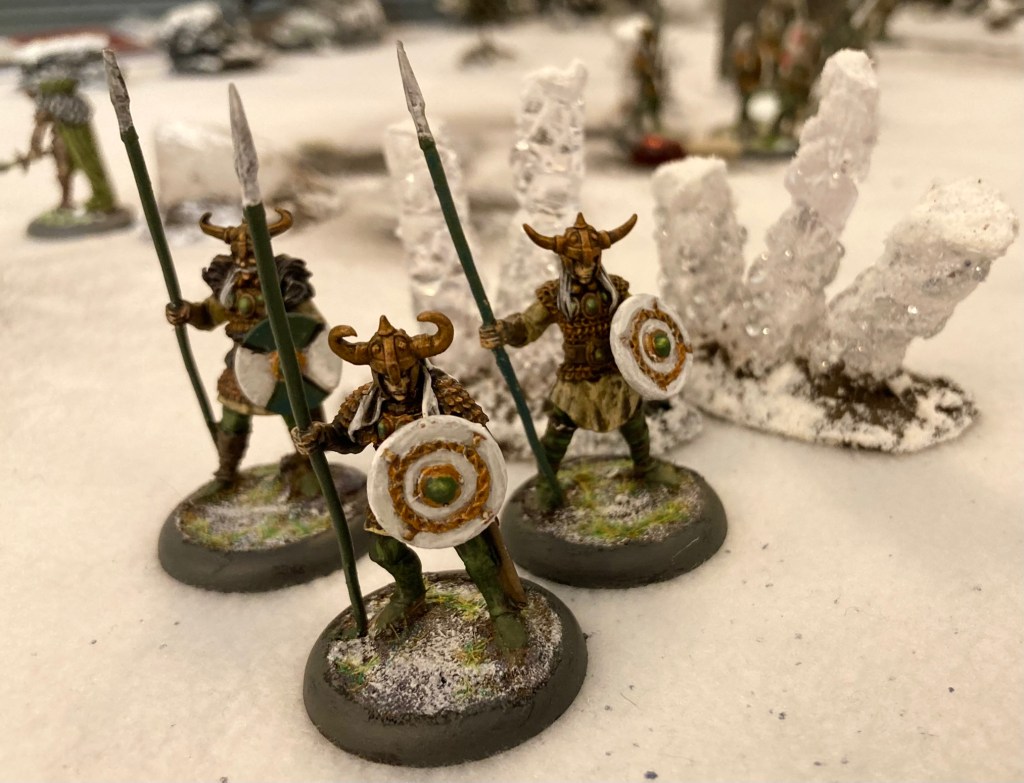
Spells are very important at this stage – each Thane starts with seven randomly-determined glamours. Clever use of these can give a serious tactical advantage, though a test has to be passed to cast them, which neither of us were doing very well at! I did manage to cast a glamour that allowed me to reroll any dice later on in the game which was a useful investment for the future.


Salian Trollblood’s companions made the best progress and got to the stone circle first, though I had some success in damaging them with rhud magick, a psychic ranged attack that can be made by all the Elves.

Each circle of companions has slightly different stats and skills – my special ability was Favour of the Hollow Fae, which allows them to add an extra dice to any ranged attack, so I was trying to get the most out of this. Being hit by rhud magick also forces a courage test which, if failed, results in a red penalty counter on a unit that inhibits its activations.

Having remembered that only the Thane has the power to carry the star iron, Paul sent Salian Trollblood up to the centre of the circle and started to drag it off towards his board edge.

However, he’d forgotten that carrying the star iron incurs an immediate penalty counter. Following a poor activation counter roll, this held him up just long enough for me to pull off a dastardly deed. In my deck of seven spells, I had found the ‘Dead Sun’ glamour.


The spells in Red Book can be pretty powerful – it’s a very sorcerous background, with a serious whiff of Moorcock and plane-warping, so it’s not a game to play if you don’t like anything more than the odd fireball in your fantasy games. The correct use of a glamour at the right time can be a game-winner, so I hoped this was going to be the case here.
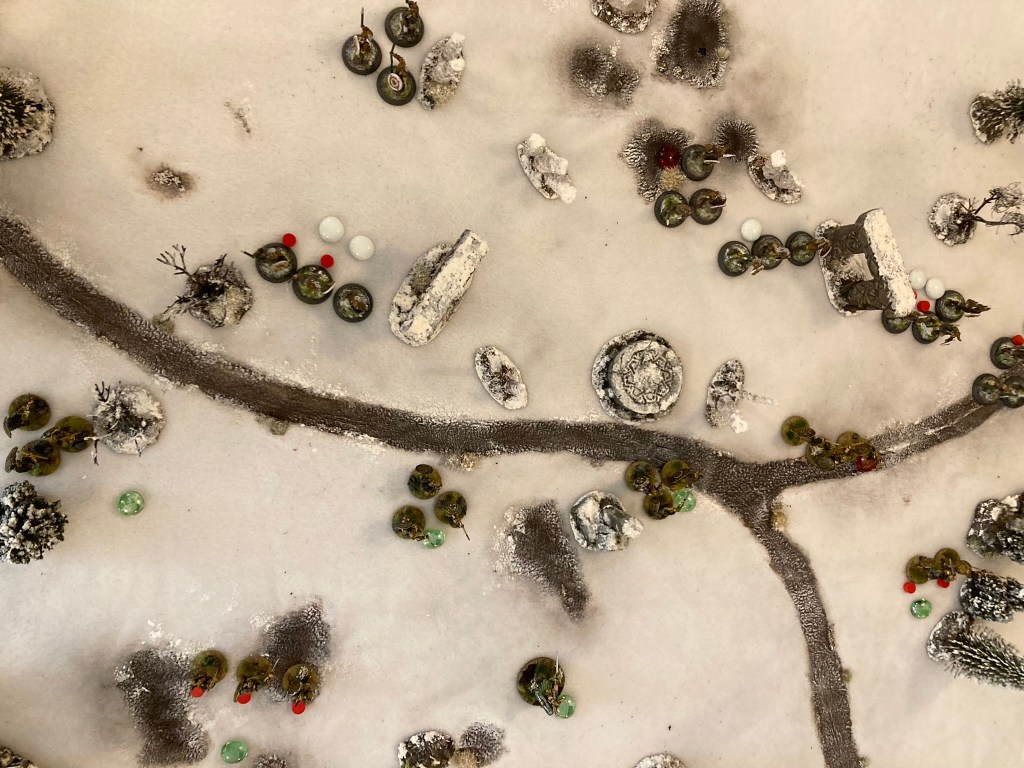

‘Dead Sun’ is a tricky one to cast (needing to roll a 3 or less on a D10, though I had a Glamour modifier of +2 which meant that a 5 or less would do it). However, if successful, it would prevent Salian Trollblood and his companions from making any moves or ranged attacks for the rest of the turn, which was exactly what I needed to catch up on the opposition.

I fluffed one casting roll but managed it the second time with the benefit of my reroll that I had tucked away at the start of the game and presto! Salian’s circle spent the rest of the turn frozen while I rushed forward my Elves to surround him.

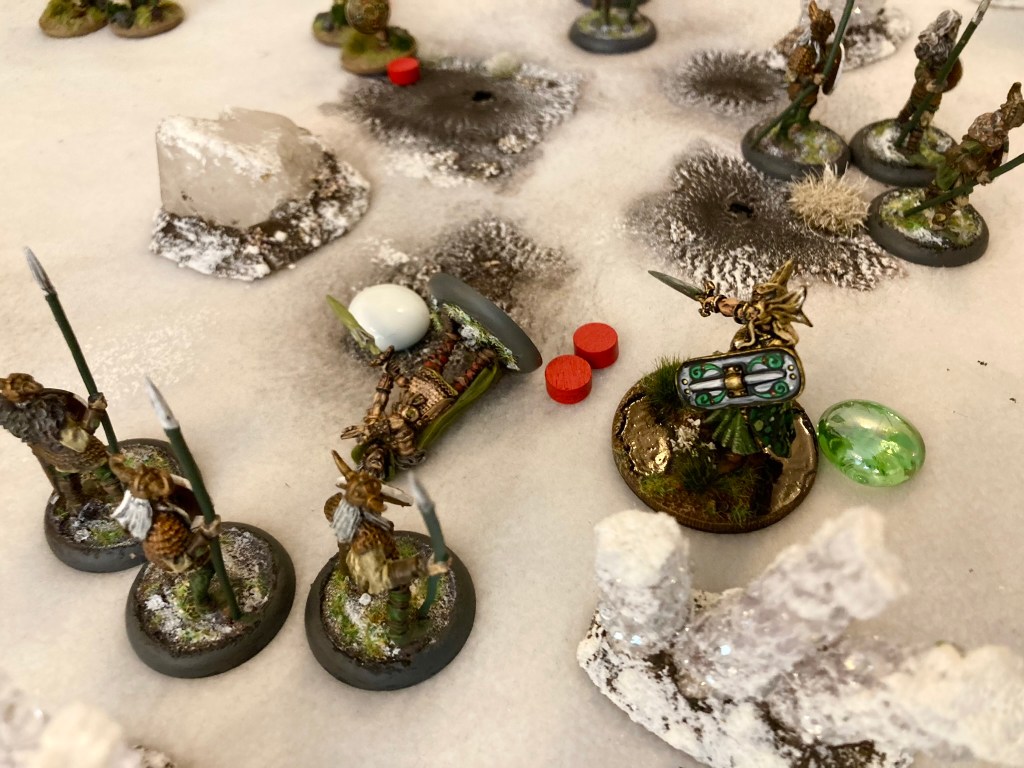
This swung the balance of the game; although Salian laid low a couple of my Elves, I had managed to wound him and keep his followers out of the fight. He dropped the star iron and had to concentrate on defending himself.

It was now the final turn of the game and Salian looked likely to win by virtue of more wounds and kills inflicted, but with a final rush Alloysian was able to overwhelm him and win the game.
Hoping not to wait two-and-a-half years before the next one! I have a yen to get my Trolls out and try out some of the different scenarios.


 mogsymakes
Well that does it, after having read the battle report and enjoyed your game through that.
Then having a little more look into the game I ended up trawling eBay and purchasing a used copy of the skirmish rules.
How many figures per side do you need for an average game?
I’m looking at some STLs to print before the book turns up.
LikeLiked by 1 person
You need exactly 19 minis per side: 18 companions (any type of Elf will do) and 1 Thane (there are specific character models for this but you can use whatever you like really).
LikeLiked by 1 person
I really like the figures and the idea of this game, but never had the spare time or money for it. Cool to see it in action though.
LikeLiked by 1 person
Thanks!
LikeLiked by 2 people