
Having tried out both Hairfoot and Wartnose Jousting, Mike B and I decided to get some all-goblin bouts in down at the club.
In case you’d missed it, Hairfoot Jousting is a fun little game from Joseph McCullough and Osprey Games. It’s a very low figure count game that plays in around an hour, so ideal for drop in/ drop out games at a show or a club night.

The first half of the book is about Hairfoot Jousting – a sport played for cheers and laughs by halflings riding twee oversized animals. However, turn into the second half and you find Wartnose Jousting – essentially the same set of rules, but re-skinned for goblins jousting each other for jeers and pain. Mike and I had both felt drawn towards the goblins so that’s what we were playing with.

Game 1 saw us taking on the challenge of the Spikefoot Run – a race/ combat event in which both sides take a three goblin team, designating two as the ‘runners’ (who have to complete laps of the arena) and one as the ‘blocker’ who has to, you know, whack the other team.
The main piece of scenery required for the scenarios is something to demarcate a 75 cm diameter arena. This doesn’t need to be anything special – Mike used a set of standard wargaming walls from Treefellas. Of course, being a goblin arena, there were also some unpleasant obstacles, including some spiked fences and pits that Mike had knocked up.
Hairfoot/Wartnose Jousting uses a very entertaining (if somewhat random) movement system. You begin your move by pointing your mount in the direction you want it to go, then roll a D6. There are six templates and you get one of these according to the number rolled! If you run into an opponent, you can whack them, hopefully causing Endurance loss, and if you run into an obstacle, you lose Endurance (though you gain a Jeering token as the crowd laugh at you. Get ten of these and you can trade them for a dice reroll).

Once you get into it, it’s not quite as mad as it sounds, as there are some special rules for each mount that can help you to plan your move. Frogs (being bouncy) can jump over obstacles in your path, avoiding damage in many situations. Cockroaches (being tough) ignore damage from running into obstacles. And several creatures have the ability to swap between different movement templates, giving you just a little bit more control. If you’re charging an enemy, because the templates are 60mm wide (the same width as the bases), you’re likely to hit them even if the direction wasn’t quite what you planned.

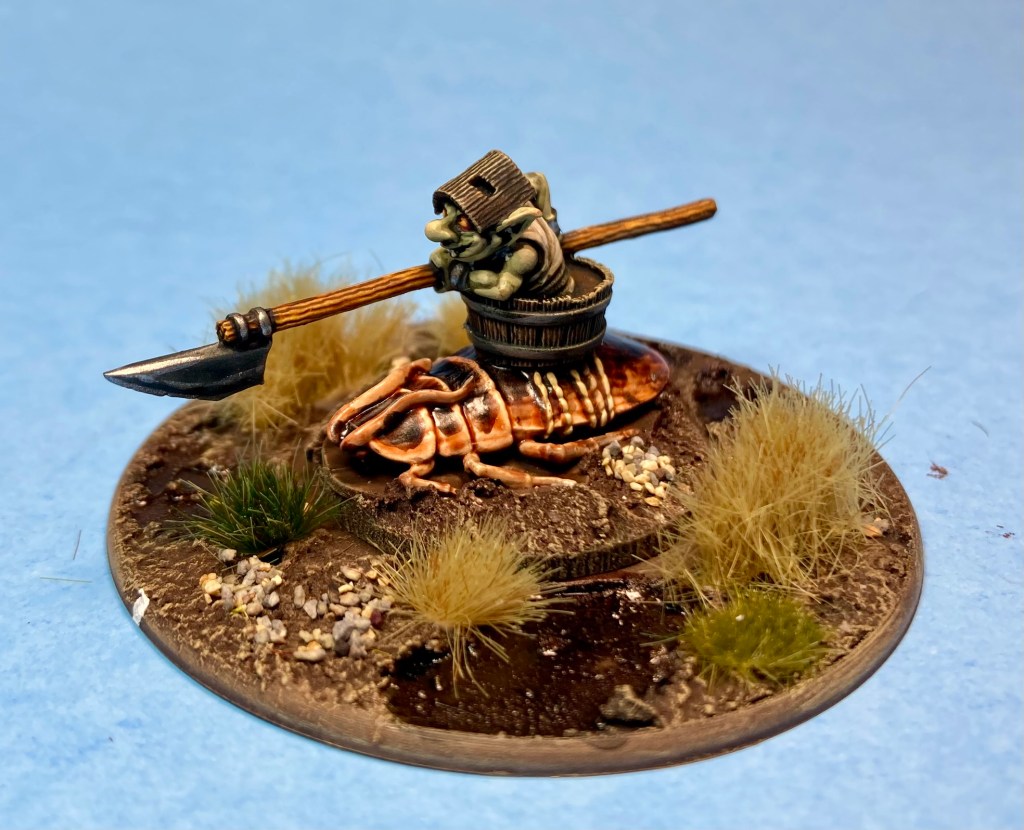
Anyway, back to the Spikefoot Run. My three challengers were Skulwig, riding a frog, Prince Charming (on a centipede) and Erbert on his trusty cockroach. Skulwig and Charming were sent to be the ‘runners’ (having some special rules giving me a bit more control over movement); Erbert was the ‘blocker’ as he could run into obstacles without damage.

Both pairs of runners set off, ricocheting off walls and obstacles as they progressed. Erbert had some success as a blocker, taking out one of Mike’s runners, and both sides progressed to rack up two laps apiece. Whoever could take the third lap would win it. Unfortunately, my runners had taken so much damage from their inept navigation of the course, Skulwig soon dropped out. Charming was limping towards the line when he was felled by a random event – a hail of pine cones from the spectators which did for his final point of Endurance! This left Mike with one runner in the race and he was ruled the winner.
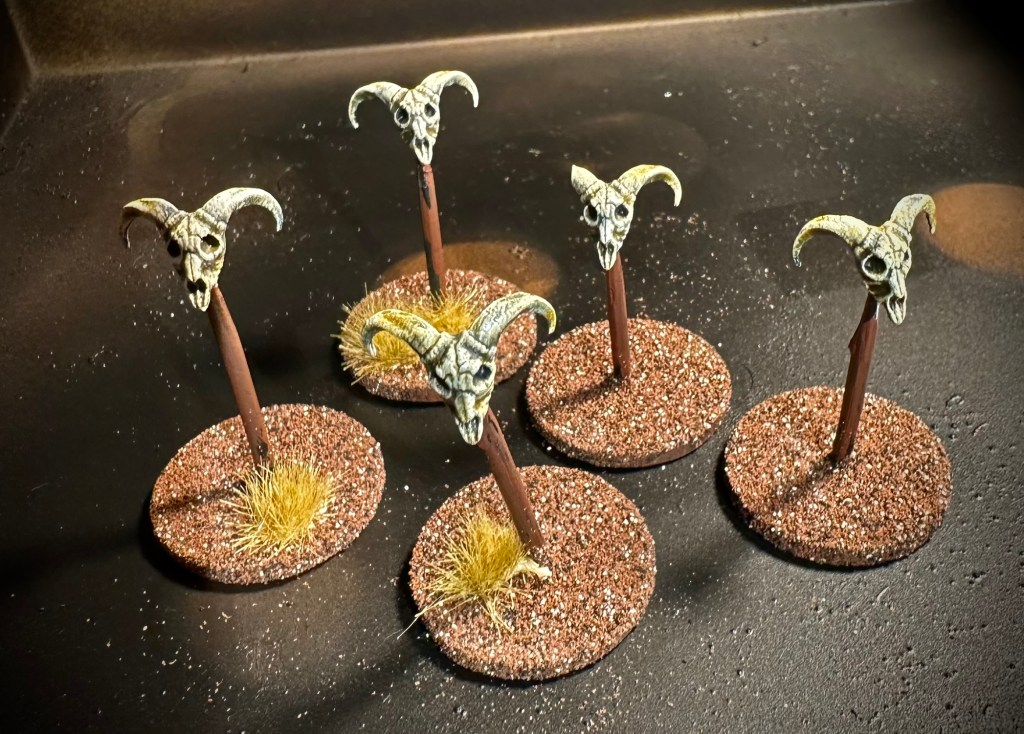
Game 2 involved a more formal joust with the Boneyard Arena scenario. This involved a bit of a tourney spiced up with five skulls on sticks; there were bonuses for hooking the skulls with your lance, and if a single jouster managed to hook three skulls, they were the winner and the game was over. This sounded like a big ask but I thought I’d give it a go.

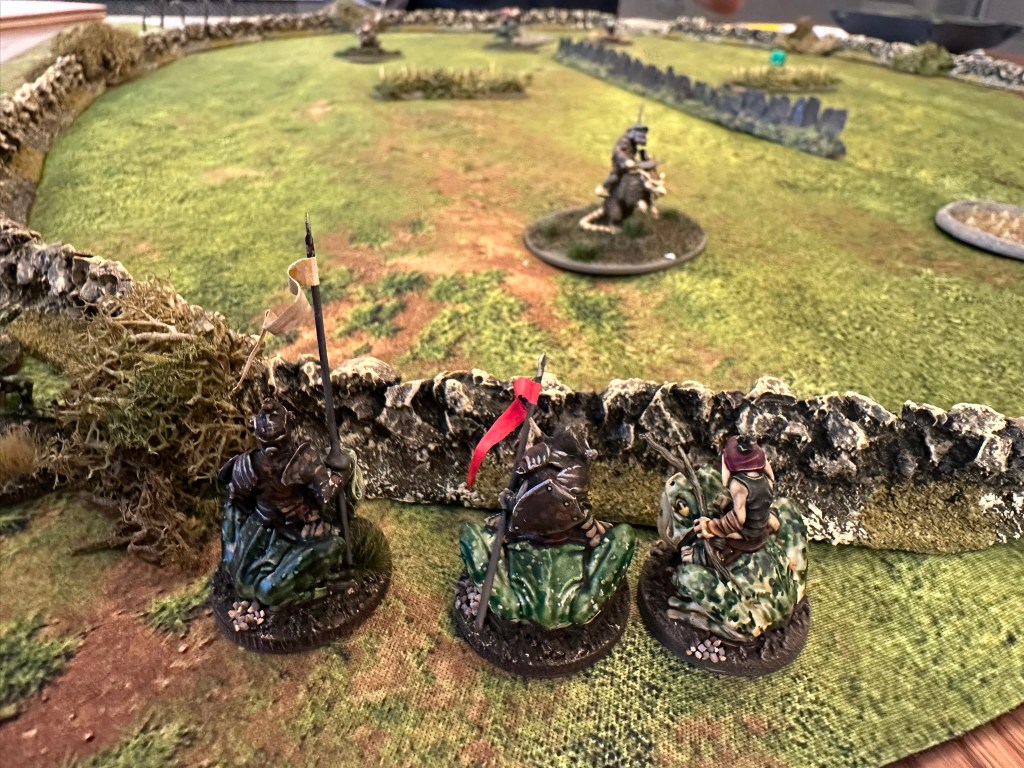
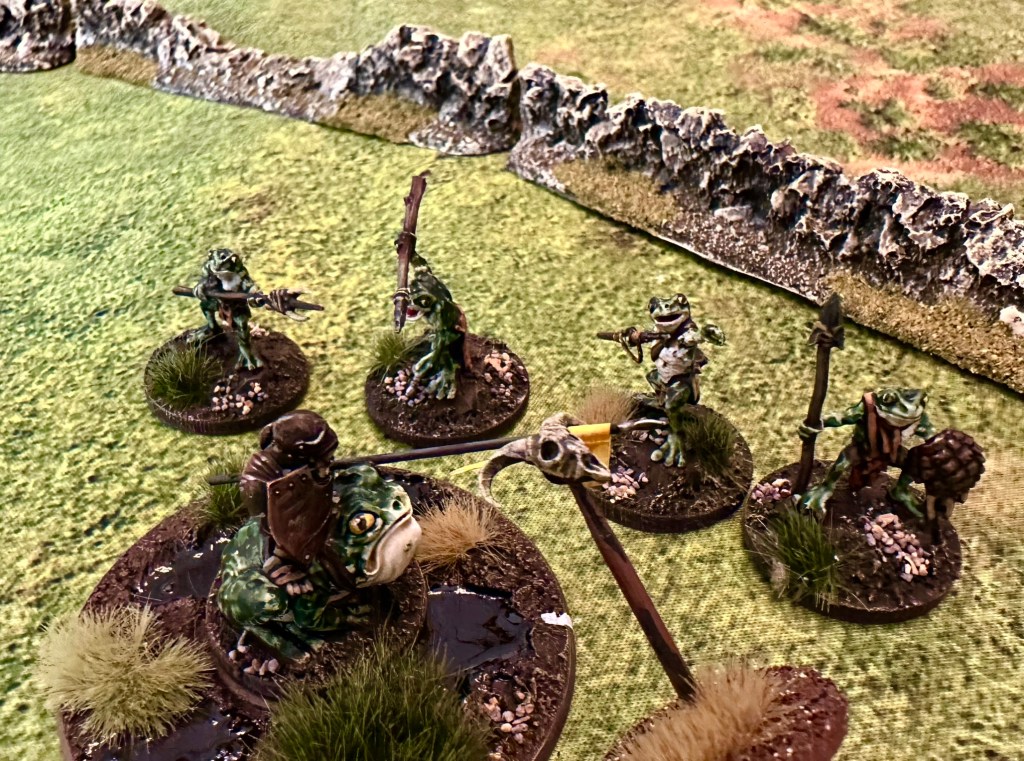
For this game, I fielded my complete team of frog-mounted riders (inspired by the art of Brian Froud – you can see a short video about making them here) converted from the official Northstar Miniatures for the game. These were Skulwig (yellow pennon), Kashan the Mighty (white pennon) and Sir Orrid (red pennon). Mike put out three unpleasant types wearing/ wielding different kitchen utensils – Pothead, Bellend and Axeman.

The game got off to an exciting start as both Skulwig and Axeman managed to hook skulls but started to settle down as we then kept missing (you need quite a high dice roll to pull it off – I think we’d both got lucky at the start). Attrition was lower in this game than usual as we were mostly focused on trying to hook skulls, though Mike’s goblins seemed to be hitting the wall an awful lot. I eventually figured out that this was down to Mike trying to gain ten Jeering tokens to be able to get a re-roll in order to hook more skulls! Typical goblin tactics :-).
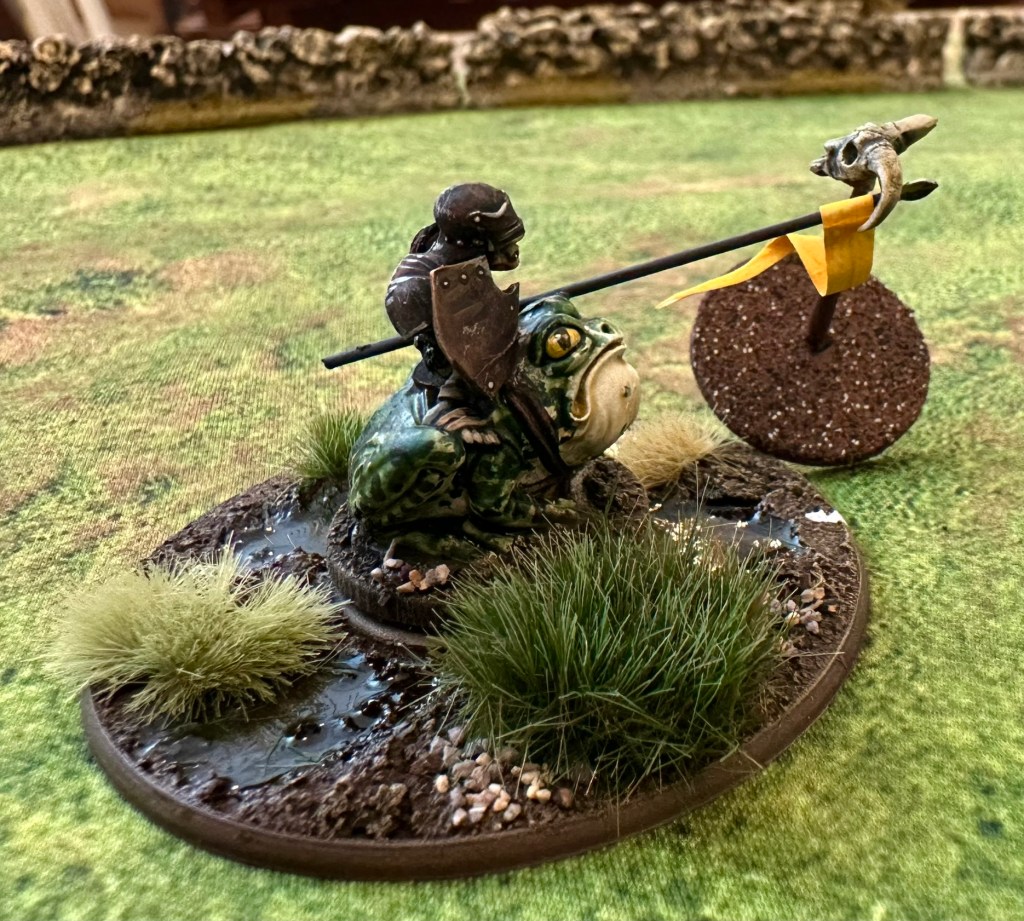
Once Skulwig had hooked the first skull, I’d decided that he’d go for all the others, while his team mates concentrated on blocking the opposition. This soon paid off as Skulwig got his second skull.

However, by now Mike had got his ten Jeering tokens for a re-roll and just beat Skulwig to the skull by virtue of his initiative roll. However, even with the re-roll, he just failed to do it and Skulwig pulled it off, winning the match. At which point the goblin and frog-men supporters invaded the pitch.

This was a lot of fun and a great diversion from the more serious projects that I’d been working on. It’s not a hard game to learn and, if you can cope with the lack of total control over your mounts, is a brilliant choice for a club night when everyone needs something lighter. We will definitely play again!
 mogsymakes
Hilarious!!!
All the best from the other ( Welsh) Mike B
LikeLike
Hee hee! Thanks very much.
LikeLike